This site is supported by our readers. We may earn a commission, at no cost to you, if you purchase through links. This content is for general informational and educational purposes only and is not a substitute for professional medical, dermatological, or nutritional advice.
That jade roller sitting on your bathroom counter collects more than glow-boosting minerals between sessions. Dead skin cells, leftover serum, and bacteria settle into its grooves and hinges within hours of contact, turning a soothing skincare tool into a breeding ground that you’re dragging across your face tomorrow morning.
Estheticians see the fallout in clinic chairs constantly: breakouts and irritation that trace straight back to a roller nobody bothered to sanitize properly.
Knowing how to clean a face roller isn’t an afterthought; it’s the difference between a tool that actually benefits your skin and one quietly working against it. From daily wipe-downs to weekly disinfecting, here’s how to keep yours genuinely safe.
Table Of Contents
- Key Takeaways
- How to Clean a Face Roller
- Deep Clean Weekly for Hygiene
- Choose Safe Cleaning Solutions
- Clean by Roller Material
- Store and Replace Properly
- Frequently Asked Questions (FAQs)
- What happens if you don’t clean your derma roller?
- How to clean face rollers?
- How do you care for a facial roller?
- How do you clean a derma roller?
- Do facial rollers need to be cleaned?
- How do you use a face roller?
- How to clean a roller?
- What should I clean my face roller with?
- How to clean a skin roller?
- How to clean a power roller?
- Conclusion
Key Takeaways
- Wipe your face roller down with a damp microfiber cloth after every single use to stop oil, bacteria, and dead skin from building up before your next session.
- Set aside time once a week for a deeper clean—disassemble the head, soak it in mild soapy water, scrub the hinges with a soft toothbrush, then disinfect with 70% isopropyl alcohol for 5–10 minutes.
- Match your cleaning method to your roller’s material, since jade and rose quartz need gentle, mostly alcohol‑free care while stainless steel and glass can handle alcohol wipes or even UV sanitizing.
- Always dry your roller completely before storing it in a protective case away from bathroom humidity, and replace it right away if you spot cracks or chips, since damaged stone or metal becomes a breeding ground for bacteria.
How to Clean a Face Roller
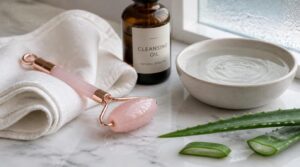
Your face roller touches your skin with every pass, so it picks up oil, bacteria, and product residue just as quickly as the skin does. A clean roller isn’t optional if you want real results, and the good news is the process is simple once you know the order of operations.
Pairing a clean roller with natural acne treatments that actually work gives your skin a real shot at staying clear and calm.
Here’s exactly how to keep yours sanitary after every single use.
Wipe After Each Use
Always wipe down your face roller immediately after use—this daily quick clean is the backbone of postuse sanitization and skincare hygiene.
A damp microfiber cloth, waffle weave for absorption, lifts residue and prevents product oxidation without causing micro-abrasions.
For thorough sanitization, consider use 70% isopropyl alcohol after wiping.
- Wipe immediately, every session
- Follow lymphatic drainage direction
- Use light, gentle pressure
- Skip aggressive rubbing motions
- Never store while still damp
Use Mild Facial Cleanser
A daily wipe removes surface debris, but visible buildup calls for mild soap. Apply a small amount of gentle facial cleanser for 15–30 seconds—its emulsifiers lift residue without scratching stone.
| Benefit | What It Does | Why It Matters |
|---|---|---|
| pH balance | Matches skin acidity | Prevents stone etching |
| Hydrating agents | Adds moisture | Preserves luster |
| Hypoallergenic formula | No fragrance/parabens | Protects sensitive skin |
Rinse With Warm Water
Once the cleanser has done its job, rinse thoroughly under warm running water—this is where actual residue removal happens. Aim for 98°F to 105°F, never exceeding 176°F, which can strip jade’s protective coating.
- Dissolves oil-based serums
- Prevents permanent stone stains
- Loosens hardened sunscreen residue
Skipping this step lets pigment embed in stone pores, undermining your face roller’s cleaning routine.
Pat Completely Dry
Once rinsed, reach for a clean microfiber towel—never paper towel, which leaves lint in crevices.
Pat gently along the stone’s grain instead of rubbing; rubbing invites micro-scratches.
Direct pressure away from the gemstone setting.
Then air dry completely in a well-ventilated spot for 3-5 minutes; humid bathrooms above 60% need extra time.
Never store a roller that isn’t dry thoroughly.
Wiping the roller with alcohol and letting it air-dry fully follows the same logic as cleaning razor blades with soap, where trapped moisture invites bacteria long after the tool looks clean.
Avoid Abrasive Scrubbing
Because gritty pads strip away jade’s protective coating, reach only for gentle tools:
- Soft microfiber cloth for everyday wipes
- Soft sponge with mild soap
- Soft-bristled toothbrush for hinges
- Gentle soap, never harsh abrasive cleaners
- Light pressure, preventing stone scratches
This gentle brushing technique avoids surface damage and protects your tool—true beauty tool maintenance keeps rollers smooth and effective for months.
Deep Clean Weekly for Hygiene
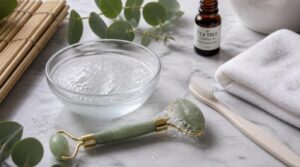
Your daily wipe-down removes surface grime, but it won’t touch what’s hiding in the hinges and crevices. Once a week, your roller needs a more thorough reset to stay genuinely sanitary. Here’s exactly how to break it down, step by step.
If you’re curious why this weekly deep-clean matters so much, understanding why the post-shave routine matters just as much as the shave makes the extra effort feel worthwhile.
Remove Detachable Roller Heads
A weekly deep clean starts at the handle, not the head, so before you reach for soap, disassemble what you can.
Press the lever to swivel it free, slide the head right, twist counterclockwise, or pull magnetic heads straight off.
Pop the jade stone out, check the metal mechanism for grime, and confirm hardware compatibility before reattaching anything.
Soak in Soapy Water
Soaking is where the real cleaning happens, so grab a clean glass container, fill it with warm water, and add a few drops of mild soap. Submerge the roller head fully for 2 to 5 minutes—heavily soiled rollers can go up to 10, but don’t exceed that limit, especially with jade or rose quartz.
Brush Hinges and Crevices
That hinge crevice is where most of the trouble hides—skincare oils travel there through capillary action, collecting with dead skin into a buildup that turns bacterial within 24 to 48 hours. Work a soft‑bristled toothbrush or interdental brush along the joint, gently scrubbing until residue lifts.
Hinge crevices trap oils and dead skin into bacterial buildup within just 24 to 48 hours
A squeaking sound during rotation signals it needs oil lubrication afterward, preventing corrosion.
Rinse Away All Residue
Rinse with warm water right after cleaning—cold water won’t dissolve oil buildup or product residue left from the soap water wash. Hold the roller under running water for 15 to 30 seconds, flushing every crevice. This dissolves skincare residue and disrupts bacterial biofilm before it hardens.
Porous stones need a gentler, shorter rinse, since prolonged soaking saturates the surface unnecessarily.
Disinfect With Alcohol Safely
Alcohol is where real sanitizing happens. Submerge the roller head in 70% isopropyl alcohol for 5–10 minutes, rotating gently so every surface gets contact.
- Bacteria you can’t see, gone
- Breakouts you’ve been fighting, prevented
- Skin you can finally trust again
Wear gloves, work in ventilated space, and air-dry completely before storing—never reuse that alcohol batch.
Choose Safe Cleaning Solutions

Not every cleaning product belongs near your skincare tools, and picking the wrong one can do more harm than good. Your roller’s material determines what’s safe to use on it, so a one-size-fits-all approach won’t cut it here. Here’s what actually works, and what you should keep far away from your roller.
Gentle Soap Options
Because your skin barrier deserves gentle care, choose fragrance-free, low pH soap when cleaning your face roller. Mild options—baby shampoo, dish soap, or plant-based cleansers with coco glucoside—lift residue without stripping protective oils.
| Soap Type | pH Level | Best For |
|---|---|---|
| Baby shampoo | Low | Jade, quartz |
| Dish soap | Neutral | Metal rollers |
| Plant-based | Low | Sensitive skin |
Always rinse with warm water afterward.
70% Isopropyl Alcohol
After cleaning your face roller with soap, soak it in isopropyl alcohol 70% or higher for 5–10 minutes—this concentration penetrates microbial cell walls, causing cell death bacteria can’t survive.
It’s flammable, so disinfecting it with alcohol means keeping flames and sparks away. Slower evaporation extends contact time for thorough sanitizing, so air-dry fully, then store sealed and away from heat.
Alcohol Wipes for Metal
Soaking works well at home, but alcohol wipes offer a faster option for stainless steel and gold-plated rollers between full soaks.
Choose wipes with 70–90% alcohol concentration, press firmly, and maintain 30 seconds of contact time per section to wipe away metal surface residue.
Higher concentrations risk corrosion, so don’t substitute wipes for proper soaking during your weekly deep clean.
UV Sanitizer for Glass
Glass rollers respond well to UV light disinfection as an alternative to wiping. Clear glass transmits UVC wavelengths fully, letting light reach microbes directly on the surface.
A proper UV sanitizer needs at least a 40 mJ/cm² dosage, with a 9‑minute exposure for full sterilization. Always wipe away visible debris first, since UVC can’t penetrate organic matter, and use devices with safety interlocks.
Avoid Bleach and Harsh Chemicals
Reaching for bleach feels like a quick fix, but it’s one of the worst choices for safe cleaning practices. It strips the mineral layer protection on jade and quartz, causes surface etching damage, and triggers metal corrosion risks and adhesive bond failure.
Stick with gentle soap and 70% alcohol, matched to your tool’s material, to avoid chemical residue dangers altogether.
Clean by Roller Material
Not every roller plays by the same rules, and that comes down to what it’s made of. Jade behaves differently than steel, and glass needs its own kind of caution. Here’s how to treat each material so you protect both your skin and your investment.
Jade Roller Care

Jade carries a delicate, semi-porous structure, meaning microbial skin risks rise fast without daily attention. Wipe it down after every session, using gentle soap rather than alcohol for routine care.
Reserve isopropyl alcohol for occasional sanitizing only; since frequent exposure degrades the stone.
Always dry jade and rose quartz rollers fully before storage; this porous stone maintenance habit directly reinforces material durability and keeps your skincare routine truly hygienic.
Rose Quartz Roller Care

Because rose quartz is natural quartz, its cool surface and smooth density support lymphatic drainage benefits while staying gentle on sensitive skin. After cleaning your face roller, dry it fully to protect stone integrity and prevent irritation.
Treat sanitizing the same as jade: mild soap daily, alcohol sparingly, and proper moisture control before storage. This gemstone care habit keeps breakouts away.
Stainless Steel Roller Care
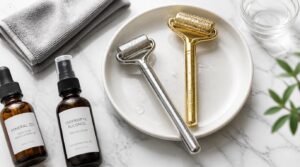
Surgical-grade stainless steel and gold-plated rollers resist oxidation, yet vinegar or abrasive powders etch the finish. Microfiber wipes and warm rinses fight corrosion; dry fully before storage. One mineral oil drop quiets squeaky hinges—simple rust prevention.
- Avoid vinegar and abrasive powders
- Wipe with microfiber only
- Disinfect with isopropyl alcohol
- Lubricate hinges sparingly with mineral oil
- Dry fully to stop oxidation
Glass Roller Cleaning
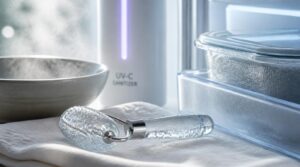
Glass demands precision, since thermal stress is its biggest enemy. Stick to water between 90–100°F when wiping, never above 176°F when soaking.
For deeper sanitizing, a UV-C sanitizer at 260nm for 3–5 minutes kills surface bacteria effectively. Dry fully before storing or chilling—refrigerator storage is safe only when sealed and completely moisture-free, preventing cracks from sudden temperature shifts.
Porous Stone Drying Tips

Porous stones hold onto water like a sponge holds onto juice, which means moisture retention risks are real if you rush this step.
Always lay it flat first, then finish vertically, stone-end up, to cut drying time by up to 40%.
Budget 45–90 minutes depending on humidity, and never store it damp—that’s how mold sets in.
Store and Replace Properly

Cleaning your roller is only half the job, how you store it afterward matters just as much. A damp roller left in a closed bag is basically an invitation for bacteria to move back in. Here’s what proper storage and timely replacement actually look like.
Dry Before Storing
Before that roller goes anywhere near storage, it needs to be completely dry—no exceptions.
Set it in a well‑ventilated area where air reaches both sides, check hidden crevices and end caps for hidden moisture, and confirm there’s no tacky residue.
This drying technique prevents mold growth, eliminates musty odors, and avoids condensation risks that sneak up once you’ve sealed it away.
Use a Protective Case
Once dry, a protective case becomes your roller’s home base—store safely between sessions.
- Impact protection from drops
- Blocks dust accumulation
- Durable case material (rigid plastic/silicone)
- Organizes cleaning accessories
- Simplifies travel storage
This clean storage container offers hygienic storage solutions, keeping your beauty accessory tucked safely away, ready whenever your skin needs it.
Keep Away From Humidity
That protective case only works if the space around it stays dry. Bathroom humidity is the real enemy—steam re-wets a clean roller fast. Run the fan, or better yet, store it in your bedroom.
| Risk | Solution | Result |
|---|---|---|
| Steamy shower | Dehumidifiers | Mold prevention |
| Porous stone | Extra dry time | No musty odor |
| Damp counter | Dry place | Hygienic storage |
Refrigerate in Sealed Bag
Once your roller is bone-dry, the fridge becomes your best tool for maximizing cooling benefits. Always use a sealed bag for odor and contamination control.
- Confirm roller is fully dry
- Slide into a sealed bag
- Refrigerate, never freeze (cracks!)
- Chill several minutes to overnight
- Wipe condensation before use
Replace Cracked Rollers Fast
Once cracks, chips, or a wobbly hinge show up, don’t wait, replace your facial roller before bacteria settle into the damage.
Small fractures often qualify for professional repair services (€4.90–€9, 48‑hour turnaround) or quick DIY fix methods like jewelry epoxy.
Keep an emergency repair kit on hand, and consider durable, cost‑effective alternatives like stainless steel for better tool longevity.
Frequently Asked Questions (FAQs)
What happens if you don’t clean your derma roller?
Skipping cleanup invites bacterial skin infections, skin irritation, and micro-wound contamination, since trapped debris fuels microbial contamination.
Acne breakout spread, needle sharpness loss, and metal component corrosion follow—turning a trusted tool into a crosscontamination risk.
How to clean face rollers?
Wipe your face roller after every use, then deep clean weekly with mild soap, a soft brush for crevices, and isopropyl alcohol—matching solvents to material prevents microbial buildup, moisture damage, and signals when replacement’s overdue.
How do you care for a facial roller?
Think of your roller as a second skin tool: clean it gently, dry it completely, store away from humidity, use mild cleansers, disinfect metal with alcohol, and replace at first sign of cracks or wear.
How do you clean a derma roller?
Rinse your derma roller under 98–104°F water, then soak the head in 70% isopropyl alcohol for 5–10 minutes for disinfection. Air-dry on paper towels, never cloth, checking needle integrity before storing for proper microneedling hygiene.
Do facial rollers need to be cleaned?
Funny enough, the very tool meant to calm your skin can quietly harbor bacteria and leftover product residue. Yes, facial rollers absolutely need regular sanitizing—neglect invites breakouts, cross-contamination, and skin infections, undermining your whole skincare routine.
How do you use a face roller?
Apply serum first, then roll upward from neck to jaw, promoting lymphatic drainage and reducing puffiness.
Use gentle pressure, three passes per area, five minutes daily. This facial massage tool delivers real results when used with proper technique.
How to clean a roller?
Wipe your facial roller after every use, rinse with warm water, and deep clean weekly using isopropyl alcohol 70%+ to eliminate microbial buildup, prevent cross-contamination, and extend your tool’s lifespan through consistent sanitization.
What should I clean my face roller with?
Use a pH-balanced, fragrance-free facial cleanser or mild liquid soap — never bar soap, bleach, or harsh chemicals. For metal parts, 70% isopropyl alcohol disinfects safely.
How to clean a skin roller?
A clean tool does clean work." After each use, wipe your facial roller with a damp microfiber cloth, then sanitize weekly using 70% isopropyl alcohol to eliminate microbial buildup and maintain safe, effective skin contact.
How to clean a power roller?
Before cleaning a power roller, unplug the cord and turn off the power switch. Scrape excess paint residue, disassemble components, then soak parts in mild detergent solution to prevent mineral buildup.
Conclusion
roller as a scalpel—precision only holds when it’s clean. Every swipe across unclean stone undoes the care you’ve layered into your routine, deposits bacteria where serums should absorb.
Knowing how to clean a face roller properly isn’t maintenance; it’s the foundation your entire skincare investment rests on.
wipe it down, disinfect weekly, store it dry, and replace it without hesitation when damage appears. Your skin notices every choice you make.