This site is supported by our readers. We may earn a commission, at no cost to you, if you purchase through links. This content is for general informational and educational purposes only and is not a substitute for professional medical, dermatological, or nutritional advice.

Most men will never experience a truly close shave. A cartridge razor skims the surface; a straight razor cuts at the follicle, leaving skin smooth for two full days, not twelve hours. That difference is not about the tool alone.
Blade angle, grip pressure, lather consistency – these variables separate a clean result from a cut face. Barbershops built their reputations on mastering every one of them, without exception.
Straight razor shaving techniques aren’t reserved for professionals. You control every pass, every angle, every outcome. Master the fundamentals, and the razor does exactly what you tell it.
Table Of Contents
- Key Takeaways
- Prepare Your Straight Razor, Skin, and Shaving Lather
- Hold a Straight Razor Correctly: Grip, Angle, and Skin Tension
- Shave Facial Contours With Short, Controlled Strokes
- Follow The Three-Pass Straight Razor Shaving Method
- Prevent Cuts, Soothe Irritation, and Maintain Your Straight Razor
- Frequently Asked Questions (FAQs)
- Why do people not use straight razors anymore?
- Why won’t my straight razor shave?
- Can I shave my pubic hair with a straight razor?
- Do you shave up or down with a straight razor?
- How do you shave with a straight razor?
- Why should you choose a straight razored shave?
- How to use a straight razor?
- Should you learn to shave with a straight razor?
- How much does it cost to shave a straight razor?
- How long does it take to shave a straight razor?
- Conclusion
Key Takeaways
- A straight razor cuts at the follicle level, delivering up to two days of smooth skin versus the twelve hours a cartridge razor provides, but only when blade angle, grip pressure, and lather quality are all dialed in.
- Proper preparation — heat-softening facial hair for 60–90 seconds, stropping the blade before every shave, and building a whipped-cream-consistency lather — determines the result before the first stroke lands.
- The three-pass method (with grain, across grain, against grain) is what separates a close shave from a rough one, with short half-inch strokes, constant skin tension, and a shallow blade angle of 20–30 degrees applied throughout.
- The upfront cost of roughly $300–$330 for a quality razor, strop, and brush drops to around $10–$25 per year over time, making straight razor shaving far cheaper than lifelong cartridge use.
Prepare Your Straight Razor, Skin, and Shaving Lather

Before the blade ever touches your face, preparation decides the outcome. Every step in this section builds the foundation for a clean, irritation-free shave. Work through each one without shortcuts.
Skipping even one step — whether cleansing, exfoliating, or hydrating — can undo everything, so following a complete cartridge razor shaving guide for your face ensures your routine actually holds up start to finish.
Check Blade Sharpness
Before you touch lather to skin, your edge needs a proper blade sharpness test. Hold a single hair taut and pass the blade lightly across it. A sharp edge parts the hair cleanly and without catching. A dull one drags or bends it.
Check the bevel under direct light for dull patches or damage. Poor sharpness means honing, not stropping.
Strop Before Shaving
You’ve passed your edge test. Now strop your blade and make it shave-ready.
Start with canvas strop use to align and warm the bevel, then move to leather. Leather strop use removes micro-burrs and refines the edge. Twenty to thirty passes, light pressure, spine leading.
Applied a leather strop compound? Use that side last. Strop before every shave. No exceptions.
Soften Facial Hair
Your blade’s stropped and ready. Your face needs the same care.
A proper pre-shave routine makes all the difference — discover the full technique for shaving with a straight blade so your skin stays as sharp as your edge.
Whisker softening starts with heat. Soak a towel in hot water, hold it directly against your stubble for 60 to 90 seconds. Follicle softening with heat drops blade resistance a lot. Rub in preshave oil for a full minute. Skin hydration and proper skin preparation determine how cleanly you shave.
Build Protective Lather
Your skin’s prepped, your follicles are open. Now your shaving lather preparation starts. Load your brush onto the soap with tight circles for 30 seconds. Drop in water slowly, working until you hit whipped cream lather consistency. That’s the load/hydrate lather method. Quality shaving lather traps water between every bubble, cushioning each pass. Lather stability and grip protect your skin.
A quality shaving soap puck for wet shaving gives you that dense, glycerin-rich base that holds moisture and makes the load/hydrate method work its best.
Hold a Straight Razor Correctly: Grip, Angle, and Skin Tension
Grip the scales firmly but not rigidly. Your wrist drives the edge’s path, not your knuckles. A tight clenched grip blocks the fine corrections your jaw and cheek contours demand.
Your blade angle should sit between 20 and 30 degrees. Flatter is safer. That edge glides; it doesn’t bite. A good straight razor shaving angle guide can help you find that sweet spot before the blade ever touches your face.
Tension is non-negotiable. Apply skin tension and stretching before every stroke so hair shafts stand uniform against the edge. Loose skin moves under the razor and breaks your angle every time.
Master these four straight razor grip fundamentals:
- Index finger on the spine controls blade angle
- Thumb anchors below the shank for stability
- Free hand stretches the skin ahead of each stroke
- Razor weight provides contact; you add zero extra pressure
Shave Facial Contours With Short, Controlled Strokes

Map your face into zones before you touch the razor to your cheek. Your jaw, upper lip, and chin all curve differently, and a single long stroke can’t follow those transitions cleanly.
Use short controlled strokes, roughly half an inch to an inch long, to keep your blade alignment and pressure consistent as the contour shifts beneath the edge. Apply skin tension and stretching with your free hand in each zone. Tight skin reduces the chance of the edge catching on loose folds.
| Zone | Stroke Priority |
|---|---|
| Jawline corner | Extra short strokes |
| Upper lip | Micro-passes only |
| Cheek plane | Moderate length |
| Neck shift | Direction change |
Short strokes let you reset your blade angle on every pass, keeping contact uniform across curved planes.
Follow The Three-Pass Straight Razor Shaving Method
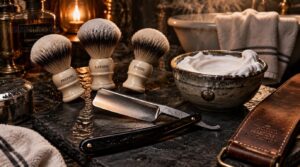
The three-pass method is the standard that separates amateurs from masters. Each pass builds on the last, taking your face from stubbled to smooth with precision and control. Here’s how you execute all three.
The three-pass method separates amateurs from masters, building precision with every stroke
First Pass With Grain
The first pass sets everything. Move with the grain, following each area’s natural growth direction because your cheeks and neck don’t match.
Keep skin taut with your free hand, use short controlled strokes, and let the sharp edge cut. Light pressure. Don’t compensate with force. Your properly hydrated lather is working. Trust it. This pass removes the bulk, nothing more.
Second Pass Across Grain
The second pass works like a crosshatch: what the first pass missed, across the grain XTG catches it from a completely different cutting angle. For a closer look at how this angle shift reduces missed patches—and what it means for ingrown hair risk on coarse or curly hair—the mechanics behind each pass make the technique worth understanding.
Keep your blade angle shallow and consistent. Pull the skin taut, move strictly left to right, and use short stroke precision control through each section. No diagonal drifting allowed. Re-lather if glide drops before you finish.
Third Pass Against Grain
This is the finishing pass. The third pass against grain cuts opposite to your hair’s growth, so every control variable tightens. Keep skin taut, use short stroke precision control, and drop your pressure.
Your blade honing and stropping investment pays off right here. A dull edge drags; a sharp one glides clean. Target only your missed patches, not full zones.
Prevent Cuts, Soothe Irritation, and Maintain Your Straight Razor

Cuts follow pressure. The moment you force the blade, you’ve already lost control. Keep your strokes light, your skin taut, and your angle locked. Razor burn prevention starts before the razor ever touches your face.
Your razor maintenance schedule is non-negotiable:
- Rinse and dry the blade completely after every shave to stop oxidation from degrading the edge
- Strop before each session for blade edge realignment, restoring your cutting surface in under a minute
- Schedule razor honing and stropping together monthly to keep your edge sharp and performing at its peak
For your skin, skin exfoliation and cleansing two to three times weekly clears away dead cells that trap heat and cause irritation. Cold water closes pores fast. Protect your investment.
Frequently Asked Questions (FAQs)
Why do people not use straight razors anymore?
Cartridges killed the tradition fast. Convenience and perceived safety made disposables your default. Nobody taught you to strop or hone blades. Barbershops faded. The culture shifted, and traditional shaving became a niche, not your norm.
Why won’t my straight razor shave?
A dull blade is a butter knife wearing a costume.
Blade honing frequency rules everything here. Reset your shaving angle to around 30 degrees, strop carefully before every single pass, and watch it cut clean.
Can I shave my pubic hair with a straight razor?
Barbershops see razor injuries spike on sensitive zones. Don’t do it. Genital skin is too delicate, too contoured, and too moist. The blade angle that works on your face will nick you here every time.
Do you shave up or down with a straight razor?
Up or down? It’s neither. Shaving stroke direction follows local grain, not a fixed axis.
Shave with the grain first, then work against the grain ATG to clear anything left. Always map each zone first.
How do you shave with a straight razor?
Ready to own your shave? Hold the straight razor at 30 degrees, thumb underneath for stability. Stretch skin taut with your free hand, then make short, controlled strokes with the grain. Rinse after each stroke.
Why should you choose a straight razored shave?
A straight razor delivers the closest shave possible, cutting every hair right at skin level. You’ll prevent skin irritation and ingrown hairs for good.
One quality blade lasts decades. No more cartridge cycles. That’s mastery.
How to use a straight razor?
A sword demands respect. Grip your straight razor pen-style, thumb beneath, fingers above. 30-degree angle, blade weight working.
Strop 50 strokes, prepare your skin, pull it taut. Short strokes, with the grain. Pressure kills precision.
Should you learn to shave with a straight razor?
You could keep tossing disposable razors every month. Or you could master straight razor shaving, cut lifetime costs a lot, improve your skin, and own a real skill that actually means something. The choice is obvious.
How much does it cost to shave a straight razor?
Your upfront spend lands around $300–$330: quality razor, strop, and brush all included. Annual consumables run just $20–$ Spread that over 20 years of daily shaves, and you’re paying roughly $10–$25 yearly. Cartridges can’t compete.
How long does it take to shave a straight razor?
Learning this takes an eternity at first. Beginners need 20 to 30 minutes. With shave pass optimization, experienced shavers finish in 5 to 15 minutes. Expect 50 to 100 shaves before control becomes your instinct.
Conclusion
Old-school barbers shaved fifteen clients before noon, every single day, without a single nick. That precision wasn’t luck. It came from years of repetition and deep respect for the craft.
This straight razor shaving techniques tutorial gives you the foundation. What you build on it is entirely yours. Control the angle, own the pressure, trust the blade. Every pass gets cleaner. Every morning gets sharper. The razor doesn’t forgive carelessness, but it rewards discipline completely.