This site is supported by our readers. We may earn a commission, at no cost to you, if you purchase through links.

Your scalp sits at a precise 4.5 to 5.5 on the pH scale when everything’s working right. Shift too far in either direction and you’re looking at irritation, flaking, or hair that won’t cooperate no matter what products you throw at it. Most people never think about this number until persistent issues force them to dig deeper.
pH testing strips for scalp offer a straightforward way to measure what’s happening on your skin, removing the guesswork that comes with trying to diagnose problems by symptoms alone. Digital meters provide precision, but paper strips deliver quick answers without calibration hassles.
Understanding which method fits your needs and how to interpret those results transforms vague concerns into actionable data you can use to restore balance.
Table Of Contents
Key Takeaways
- Your scalp’s healthy pH sits between 4.5 and 5.5, and when it shifts outside this range, you’ll see irritation, flaking, and hair damage that won’t resolve until you restore the balance.
- Digital pH meters give you precision down to 0.01 units but need calibration and maintenance, while paper strips deliver quick readings in 0.5-1.0 unit jumps without the hassle—choose based on whether you need exact numbers or fast answers.
- Testing catches problems early, but keeping your scalp balanced long-term means rotating products strategically, managing stress and diet, and monitoring monthly rather than hoping one-time fixes will last.
- When your readings stay abnormal beyond a few weeks despite pH-balanced products, or if you develop hair loss, persistent itching, or painful bumps, stop troubleshooting at home and get a dermatologist’s evaluation before permanent damage sets in.
Digital PH Meters Vs. Paper Strips
When you’re choosing between digital pH meters and pH test strips for scalp pH measurement, you’re comparing two fundamentally different tools. Digital meters display precise numerical readings on an LCD screen, giving you pH values down to 0.01 units with ±0.1 to ±0.2 accuracy. They require calibration methods using buffer solutions and routine probe maintenance to stay reliable.
For most people monitoring scalp health at home, learning how to balance scalp pH naturally with either method provides sufficient accuracy without needing professional equipment.
pH test strips offer convenience but come with strip limitations—they only distinguish pH changes in 0.5 to 1.0 unit jumps and depend on your color perception under various lighting conditions. Digital readings remove guesswork entirely.
If you need consistent pH testing for scalp conditions or product formulation, meters win for precision. Strips work fine for quick checks when exact numbers aren’t critical. Understanding the pH measurement process is essential for selecting the right tool.
Accuracy and Reliability of Different Methods
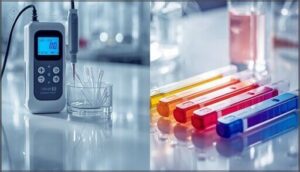
Precision matters when you’re tracking scalp health, so let’s look at what separates accurate pH testing from guesswork. Digital sensors paired with proper calibration techniques deliver consistent results you can trust—but only when you follow the protocol. Measurement errors creep in through expired buffers, dirty electrodes, or skipped temperature checks.
If you notice persistent dryness or irritation, understanding scalp pH imbalance symptoms helps you decide whether professional testing makes sense for your situation.
Five factors that introduce pH variability in your readings:
- Ionic interference from oils and styling products coating the electrode surface
- Temperature swings between room conditions and scalp warmth affecting chemical reactions
- Sample collection inconsistency when comparing dry patches to oily zones
- Calibration drift as your pH meter ages without fresh buffer validation
- Color interpretation bias with pH test strips under poor lighting conditions
Sampling methods matter too—swabbing versus direct contact changes what you measure. A pH meter gives you numbers, while pH test strips give you approximations. Choose accuracy when tracking treatment progress.
For lasting results, pair accurate testing with habits that support your skin’s natural balance, including restorative sleep and mindful stress reduction.
Why Scalp PH Matters for Hair Health
Your scalp’s pH isn’t just a number—it’s the foundation of healthy hair growth and protection against damage. When this delicate balance shifts too far in either direction, you’ll notice changes in how your hair looks, feels, and behaves.
Understanding what happens at different pH levels helps you make informed decisions about the products you use and the treatments you consider.
For a gentler, more personalized approach, try these DIY avocado oil hair recipes that work with your hair’s natural pH balance.
Normal Scalp PH Range
Your scalp pH levels naturally sit between 4.5 and 5.5—slightly more acidic than neutral. This acidic balance forms a protective barrier that keeps your scalp healthy and your hair strong. Women in their 50s often show lower scalp pH than those in their 20s, and regional pH variations exist across different scalp areas. Maintaining the natural skin pH balance is vital for overall scalp health.
| Measurement Zone | Typical pH Range |
|---|---|
| Healthy Scalp Surface | 4.5 – 5.5 |
| Hair Shaft (Fiber) | ~3.7 |
| General Skin pH | 4.2 – 6.5 |
| Internal Body pH | ~7.4 |
| Ideal Product Target | ~5.0 – 5.5 |
Understanding these hair pH scale benchmarks helps you choose products that support your skin pH without disrupting your scalp’s natural defenses. A scalp pH tester confirms whether your hair pH stays within this protective window, ensuring pH balance for ideal scalp health.
Effects of Acidic Scalp Conditions
When your scalp dips too far below that healthy 4.5 baseline, the skin barrier weakens and inflammation response kicks in. Acidic solutions disrupt your protective layer, triggering scalp irritation and ramping up transepidermal water loss by 10–20%. A scalp pH tester helps you catch pH imbalance early, preventing hair damage and safeguarding your skin and scalp health before chronic issues take hold.
- Barrier breakdown increases dryness and itch
- Microbial shifts favor dandruff-linked fungi
- Sebum quality declines, reducing hair shaft protection
- Inflammation markers rise, worsening dermatitis symptoms
Effects of Alkaline Scalp Conditions
Alkaline damage starts when your scalp pH climbs above 7.0, triggering a cascade of barrier disruption. pH imbalance at this level strips protective lipids, increases transepidermal water loss, and invites scalp irritation that undermines follicle health and hair weakening through enzymatic breakdown.
Many people unknowingly raise their scalp pH by using body wash as shampoo, which compounds alkaline stress and accelerates the barrier damage described above.
| Alkaline Effect | Impact on Hair Health |
|---|---|
| Barrier disruption | Moisture loss, dryness |
| Enzyme activation | Fiber weakening, breakage |
| Lipid depletion | Reduced sebum protection |
| Inflammatory response | Erythema, discomfort |
pH testing catches skin pH balance shifts before chronic damage sets in.
How to Adjust Scalp PH Levels

Once you’ve identified a pH imbalance, you don’t have to live with dry, itchy skin or brittle hair.
Your scalp reacts to targeted adjustments, whether you prefer gentle home remedies or need professional intervention.
Here’s how to restore balance based on what your testing reveals.
Natural Remedies for PH Balance
Your scalp responds well to gentle, evidence-based approaches. Apple cider vinegar diluted with water can lower pH toward mildly acidic levels, while aloe vera gel soothes irritation and maintains natural pH balance. Coconut oil maintains protective moisture, and green tea extracts offer anti-inflammatory benefits. Probiotic-containing products may influence your scalp’s microbiome.
These DIY hair care recipes and natural hair care products promote hair and scalp health without harsh chemicals.
When to Seek Professional Help
When should you stop troubleshooting at home? If your scalp pH stays abnormal beyond a few weeks despite pH-balanced hair care, or if you notice hair loss, persistent itching, painful bumps, or red patches, it’s time for medical evaluation.
A dermatology professional can identify follicle damage, scalp disease, or skin infection before these conditions cause permanent harm to your hair health.
Maintaining Optimal Scalp PH Long-Term
Getting your scalp pH balanced is one thing—keeping it that way is another. Think of it like tending a garden: you can’t just water once and walk away.
Balancing your scalp pH once isn’t enough—maintaining it requires ongoing care, just like tending a garden
Your daily habits and the products you choose play a bigger role than you might expect in maintaining that healthy 4.5 to 5.5 range over time.
Product Rotation Strategies
Think of your pH testing devices as tools that need regular check-ins to stay accurate. Strategic product alternation keeps your measurements reliable:
- Switch between test formats seasonally to capture ingredient variability in hair care products
- Rotate daily testers to minimize batch-specific measurement biases
- Align rotation schedules with your shampoo, conditioner, and serum usage patterns
- Log monthly which tester was used with which cosmetic product testing
- Compare repeated measurements after tester calibration using a standard control sample
Lifestyle Factors Affecting Scalp PH
Your daily habits shape your scalp’s pH balance more than most realize. Dietary influences, especially refined sugar intake, and hydration levels directly affect sebum composition, altering what your Scalp pH Tester measures.
Stress management helps preserve skin barrier integrity, while sleep patterns regulate cortisol levels that influence pH level measurement.
Environmental factors like hard water and heat styling compound these effects, making consistent hair care and pH balance monitoring essential for long-term scalp health.
Frequently Asked Questions (FAQs)
Can pH strips test oily or flaky scalps?
Yes, pH test strips can measure scalp surface acidity when you swab oily or flaky areas. They detect pH shifts from sebum and keratin buildup, helping you understand your scalp health and choose appropriate hair care products.
How often should I test my scalp pH?
Most people need scalp pH monitoring only when irritation persists. For those establishing new routines, monthly routine checks suffice.
Managing active conditions? Your dermatologist may recommend pH test strips every four to six weeks to track treatment progress.
Do hair dyes affect scalp pH levels?
Hair dyes containing alkaline agents like ammonia temporarily raise scalp pH during application, causing pH fluctuations. Though your scalp usually rebalances within hours, repeated color treatments may contribute to scalp irritation and affect hair porosity over time.
Are pH strips reusable or single-use only?
Like a thermometer after checking for fever, pH strips are designed for single use only. Cross-contamination from reused strips compromises accuracy, while fresh strip reuse risks remain minimal with proper single-use benefits.
What time of day gives accurate readings?
For the most reliable pH values, take morning readings before applying products or sweating. Consistent timing minimizes diurnal variation and environmental factors that affect your pH tester, improving accuracy when tracking scalp pH measurement and testing routines.
Conclusion
Getting to the root of scalp problems starts with knowing where you stand. pH testing strips for scalp conditions give you concrete numbers that guide smarter decisions about products and treatments.
When your measurement lands outside the 4.5 to 5.5 range, you’ve got a clear signal that something needs adjustment. Regular monitoring keeps minor imbalances from turning into persistent issues. Test monthly, track patterns, and your scalp will reward you with stability that shows in every strand.