This site is supported by our readers. We may earn a commission, at no cost to you, if you purchase through links. This content is for general informational and educational purposes only and is not a substitute for professional medical, dermatological, or nutritional advice.
Most people hold their hair dryer too close, crank the heat too high, and wonder why their hair feels like straw by Wednesday. The truth is, your dryer isn’t the problem—it’s how you’re using it. Professional hairstylists follow specific techniques that transform blow drying from a damaging chore into a styling superpower.
The difference between frizzy, heat-damaged hair and salon-smooth results often comes down to three things: distance, direction, and timing. Master these fundamentals, and you’ll cut your styling time in half while actually improving your hair’s health.
Understanding proper dryer technique means knowing when to use high heat versus low, how sectioning changes everything, and why that cool shot button exists for more than decoration.
Table Of Contents
Key Takeaways
- Master distance, direction, and timing by holding your dryer 6-12 inches away, directing airflow downward along the hair shaft, and keeping constant motion to prevent heat damage while achieving salon-worthy smoothness.
- Choose a dryer with 1200-1800 watts, ionic or ceramic technology for even heat distribution, and essential attachments like concentrator nozzles for sleek styles or diffusers for curls—then match heat settings to your hair type (300-350°F for fine hair, up to 410°F for thick hair).
- Prep correctly by applying heat protectant to damp hair, sectioning into manageable pieces (0.5-1.5 inches depending on texture), and starting at the roots for volume before working through each section systematically.
- Limit blow-drying to 2-3 times weekly, never exceed 150°C, and finish every session with the cool shot button to seal the cuticle and lock in your style without compromising long-term hair health.
Choosing The Right Hair Dryer
Your hair dryer isn’t just a tool—it’s the foundation of every great blowout. The right features can mean the difference between salon-worthy results and a frizzy mess that leaves you frustrated.
Pairing it with the right technique transforms your routine—check out this professional hair styling guide to master the methods stylists swear by.
Here’s what you need to look for when choosing a dryer that works with your hair, not against it.
Power and Wattage Considerations
When shopping for a hair dryer, look for models between 1200 and 1800 watts—they balance power efficiency with effective drying speed. Higher wattage doesn’t automatically mean better results; motor types and energy consumption matter too.
Professional dryers often hit 1800 to 2000 watts, cutting styling time by up to 30 percent while maintaining wattage control that protects against heat damage when paired with proper heat settings and heat protectant.
Essential Heat and Speed Settings
Now that you’ve got the right wattage, heat control and speed settings become your best tools for thermal protection. Most dryers offer three heat levels—high heat around 140°C dries fast but risks heat damage, medium balances speed with safety, and low protects delicate strands.
Pair high speed with lower heat to move air without overheating. Always finish with a cool shot to lock in your style and seal the cuticle.
Key Attachments: Concentrators and Diffusers
Concentrator nozzles direct airflow into a focused stream, cutting drying time while you smooth sections with a round brush—keep it one to two centimeters from hair for precision without scorching.
Diffuser attachments spread air gently across curls, using finger-like projections to lift and define without disrupting your natural pattern.
Both come in heat-resistant plastic or metal, so check your dryer’s nozzle fit before buying. To learn more about the benefits and best use of hair dryer attachments for styling, check which option suits your hair type and goals.
Technology Features (Ionic, Ceramic, Tourmaline)
Beyond attachments, the internal tech in your hair dryer determines how quickly and safely you dry. Ionic emission—rated in millions of ions per second—neutralizes static for smoother results, while ceramic coatings provide even heat distribution to avoid hot spots. Tourmaline surfaces emit infrared warmth that penetrates each strand gently, reducing frizz and cutting drying time without cranking up the heat. For an in-depth look at the, see the latest research on how these innovations improve hair health.
- Ionic benefits: Millions of negative ions seal the cuticle and banish flyaways.
- Ceramic technology: Even heat flow prevents scorching and patchy drying.
- Tourmaline effects: Infrared warmth dries from the inside out for uniform finish.
- Combined performance: Triple-tech dryers balance speed, shine, and gentle styling.
- Heat protectant pairing: High-grade materials work best with thermal spray for maximum safeguarding.
Durability and Quality Factors
Material selection separates a dryer that lasts from one that fizzles out. High-grade stainless steel and heat-resistant polymers endure thousands of hours without warping, while reinforced joints prevent cracks under stress.
Build quality shows in tight tolerances and corrosion-resistant coatings that survive humid bathrooms.
Durability testing—drop tests, thermal aging, vibration cycles—confirms longevity factors that protect your investment and your hair from inconsistent heat damage over time.
Preparing Your Hair for Blow Drying

The real work of blow drying doesn’t start when you turn on the dryer—it starts in the shower. How you prep your hair determines whether you’ll end up with salon-worthy shine or heat-damaged frizz.
Let’s walk through the five essential steps that protect your hair and set you up for a perfect blowout.
Washing and Conditioning for Best Results
Think of washing and conditioning as laying the foundation for every salon-worthy blowout. Your hair care routine directly impacts how your hair reacts to heat, so gentle cleansing with sulfate-free shampoo preserves your scalp’s moisture balance while reducing irritation.
Pairing this prep with the right hair dryer for men ensures your styling tools work with your routine instead of against it.
Here’s how to prep for damage-free drying:
- Massage your scalp while shampooing to boost blood flow and support hair health
- Choose products matching your hair porosity for ideal moisture absorption
- Condition mid-lengths to ends only, avoiding the scalp to prevent oiliness
- Leave conditioner for 2-5 minutes to boost softening benefits
- Rinse with cool water to seal the cuticle and lock in shine
These hair care tips minimize hair damage before heat styling even begins.
Proper Towel Drying Techniques
After rinsing, your towel drying technique sets the stage for efficient, damage-free styling. Skip vigorous rubbing—it roughens cuticles and triggers frizz. Instead, use gentle patting or blotting motions with a microfiber towel, which removes up to 60 percent of surface moisture without friction.
Wrap sections for two to five minutes to boost drying efficiency, then unwrap and lightly squeeze from roots to ends for best heat damage prevention.
Detangling Without Damage
Wet strands snap easily under tension, so detangling tools matter. Start with a wide-tooth comb at your ends, working upward in small sections to prevent hair breakage. Gentle combing through damp—not soaked—hair reduces knot removal trauma by 40 percent.
For stubborn tangles, apply a slip-rich conditioner before tackling each section. This damage prevention step protects your texture before heat styling begins.
Applying Heat Protectant Products
Heat protectant products act as a thermal shield between your strands and the dryer’s airflow. Apply them to damp hair before heat styling to lock in moisture and minimize heat damage.
- Spray evenly from roots to ends, holding the bottle 6–8 inches away.
- Comb through to distribute the heat barrier without buildup.
- Choose your protectant types—lightweight sprays for fine hair, hair serum for thicker textures.
- Let it absorb 30 seconds before drying for maximum damage repair.
Selecting Suitable Styling Products
Your choice of styling products depends on hair texture and your styling goals. Match product ingredients to your needs—lightweight mousses lift fine strands, while creams hydrate thick curls. Consider hold levels: light for movement, strong for sleek looks. Pair these hair products with your styling tools for finishing touches that elevate your hair care routine.
| Product Type | Best For | Hold Level |
|---|---|---|
| Mousse | Fine hair volume | Light to medium |
| Cream | Thick, wavy texture | Medium |
| Gel | Sleek, structured styles | Strong |
| Serum | Frizz control, shine | Light |
| Spray | Quick set, humidity protection | Light to medium |
Sectioning Hair for Efficient Drying
Sectioning your hair before you start drying isn’t just a stylist trick—it’s the difference between a smooth, salon-worthy blowout and a frizzy, uneven finish. When you work with smaller, manageable sections, you control heat distribution and guarantee every strand gets the attention it needs.
Here’s what you need to know to section like a pro and transform your blow-drying routine.
Why Sectioning Matters
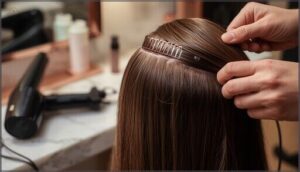
Proper hair partitioning transforms your blow drying techniques from guesswork into precise thermal control. When you divide hair into manageable sections, you cut drying time by up to 30 percent while reducing damage risk.
This method ensures even heat distribution with your hair dryer, prevents overdrying, and gives you the styling precision needed for salon-worthy results every time.
Tools for Sectioning (Clips, Combs)
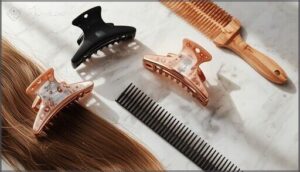
Alligator clips and butterfly clips give you the secure grip you need—alligator clips work beautifully for standard sections, while butterfly clips handle thick or heavy hair.
Pair them with a wide-tooth comb for detangling and a rat-tail comb for precision parting.
Metal clips resist heat better than plastic during extended sessions, and silicone-coated grips prevent slipping on damp strands.
Section Size by Hair Type
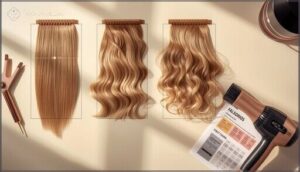
Once you’ve picked your tools, consider how hair texture and hair density shape your section width—the key to salon-worthy dry time and curl preservation. Fine to medium hair thrives with these hair styling techniques:
- Fine straight: 0.5 to 1 inch sections prevent clumping and boost root lift
- Wavy: 1 to 1.5 inch sections balance efficiency with wave pattern
- Curly: 0.75 to 1.25 inch sections maintain curl formation
- Coily: 0.5 to 1 inch sections support even heat distribution
Adjust your heat settings accordingly to prevent hair damage.
Customizing Sections for Styling Goals
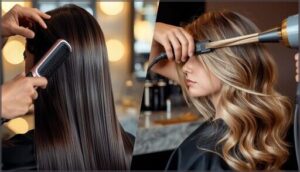
Your styling goal determines how you map those panels. For sleek, straight results, create six to eight narrow vertical sections and pull each taut with a round brush—your hair dryer at medium heat settings will seal the cuticle smoothly.
Chasing beachy waves? Switch to four large horizontal styling panels and twist each before drying.
Always apply heat protectant first to shield every custom section.
Step-by-Step Hair Dryer Techniques
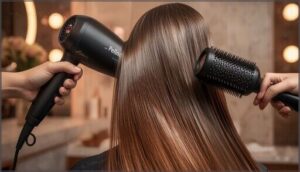
Now that your hair is properly prepped and sectioned, it’s time to master the actual drying techniques that make the difference between a good blowout and a salon-worthy one.
The way you use your dryer—from where you start to how you direct the airflow—determines your final results.
Let’s walk through the essential techniques that’ll help you achieve professional-looking hair every time.
Starting at The Roots for Volume
Want root lift that lasts all day? Start blow drying at the crown with your dryer nozzle aimed vertically down at the scalp. This pushes root hairs forward for maximum hair elevation.
Apply a lightweight root booster spray first, then flip your head upside down for 20 to 30 seconds. Use medium heat settings and finish with a cool shot to lock in that volume boost while protecting scalp care.
Using a Round Brush for Smoothness
A round brush transforms your blow drying into a salon-worthy smoothing session. Choose a barrel between 25 mm and 50 mm—ceramic or tourmaline coating distributes heat evenly while natural boar bristles add shine.
Section hair into 1 to 2 inch chunks, then wrap each piece around the barrel at a 45 degree angle. Glide slowly from roots to ends, keeping your hair dryer moving to prevent heat damage.
Drying With a Diffuser for Curly Hair
A diffuser transforms your hair dryer into a curl-enhancing powerhouse. Start with damp hair treated with heat protectant and curl cream, then:
- Cup sections of curls in the diffuser bowl and pulse medium heat at low airflow for 10 to 15 seconds.
- Tilt your head upside down to add volume at the roots.
- Press the diffuser gently against your scalp for defined curl clusters.
Finish with a cool shot for frizz reduction.
Directing Airflow for Best Results
Airflow direction makes the difference between frizz and salon-worthy smoothness. Aim your concentrator nozzle downward along each section, following the hair shaft from roots to ends. This technique seals the cuticle for frizz control and a smooth finish.
For volume creation, lift hair perpendicular to your scalp and direct heat underneath for root lift. Never blast one spot—keep your hair dryer moving constantly.
Utilizing Heat and Speed Settings Properly
Heat control and speed settings aren’t just dials—they’re your thermal protection toolkit. Match these dryer settings to your hair’s needs for airflow management that prevents heat damage:
- Fine or color-treated hair: Low heat, medium speed with heat protectant to minimize cuticle stress
- Medium-textured hair: Medium heat and speed for balanced temperature regulation
- Thick or coarse hair: High heat, high speed for efficient drying
- Heat styling finish: Cool shot to set your style
Achieving Different Styles With a Hair Dryer
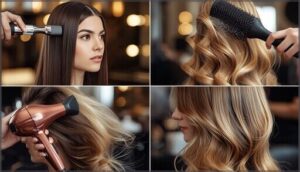
Your hair dryer isn’t just for quick drying—it’s a multi-purpose styling tool that can create everything from sleek, polished looks to bouncy, voluminous styles. The key is understanding which techniques and attachments work best for your desired outcome.
Let’s break down how to achieve four popular styles that look salon-worthy every time.
Creating Sleek, Straight Hair
Want salon-worthy straight hair without frying your strands? Master heat settings first. Fine hair thrives at 300–350°F, while thick, coarse textures tolerate 370–410°F. Attach your concentrator nozzle and work in 1-inch sections from roots to ends. Use medium heat with low speed to minimize frizz, then finish each pass with a cool shot to lock that sleek style.
If you’re ready to switch things up, mastering the wrist-turning technique in this guide to curling hair with a flat iron can help your style hold longer once you’re done straightening.
| Hair Type | Ideal Temperature Range |
|---|---|
| Fine/Thin | 300–350°F |
| Medium | 350–370°F |
| Thick/Coarse | 370–410°F |
| Color-Treated | 300–350°F |
Adding Volume and Lift
Flat hair can’t compete with the lift a round brush delivers at your roots. Focus heat styling on your crown first—that’s where volume naturally settles—and work in sections with a vented brush for maximum airflow.
Apply lightweight mousse at damp roots, then lift each section upward while blow drying with medium heat. Finish with a cool shot to lock your height.
For a deeper breakdown of every step, this fluffy hair technique guide walks through the root-lifting method in detail so you can troubleshoot as you go.
Enhancing Natural Waves or Curls
Your diffuser is the secret to turning wavy or curly hair into defined, frizz-free spirals. Attach it before drying, then scrunch damp sections upward with low to medium heat—this preserves your natural curl pattern without disrupting it.
- Apply a heat protectant and curl-enhancing serum to damp hair
- Use a diffuser attachment with gentle, wide airflow
- Scrunch sections upward toward your scalp while drying
- Keep the dryer 6 to 8 inches away to prevent frizz
- Finish on cool to seal the cuticle and lock curl definition
Finishing Touches: Cool Shot and Styling Products
Once your curls are shaped, lock them in with the cool shot button—it closes each strand’s cuticle for lasting definition and shine.
Follow with a lightweight serum or flexible hold spray to boost frizz control and heat protection. These styling products work together to preserve your look without weighing hair down, giving you salon-worthy results that move naturally.
Preventing Damage When Using a Hair Dryer
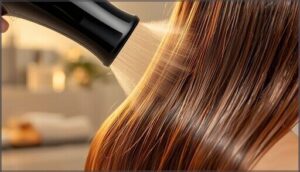
Heat damage is one of the biggest threats to your hair’s health, but it’s completely preventable with the right approach. The key lies in understanding how to control temperature, distance, and drying time without sacrificing your styling results.
Let’s walk through the essential strategies that’ll keep your hair healthy while you achieve that salon-worthy finish.
Safe Distance and Motion Techniques
Protecting your hair during heat styling techniques starts with mastering safe distancing and motion—the foundation of damage prevention in hair dryer usage. Think of heat control like grilling: too close and you’ll scorch, too far and results suffer.
Master safe heat styling by keeping your dryer six to twelve inches away and moving constantly—too close scorches, too far weakens results
- Hold your hair dryer 6 to 12 inches from your scalp to prevent heat damage while maintaining effective airflow management
- Keep the nozzle moving constantly using circular or back-and-forth motion techniques to distribute heat evenly
- Angle airflow downward along the hair shaft to seal cuticles and minimize frizz
Never linger on one spot for more than 2 seconds during proper hair drying techniques.
Avoiding Overdrying and High Heat
Mastering heat control forms the cornerstone of damage prevention in safe styling. Never exceed 150°C (302°F) on any setting—fine hair thrives at 120°C maximum.
Your hair dryer should contact each section for only 2 to 3 seconds before moving on. Switch to cool or warm air after initial drying to lock in your style without overdrying, and always layer on heat protectant before you begin.
Common Mistakes to Avoid
Three errors sabotage even salon-quality tools: skipping heat protectant invites cuticle damage and hair breakage, while holding your hair dryer closer than six inches risks burn prevention failures. Overdrying with constant high heat strips moisture and triggers frizz control challenges.
Master proper hair drying techniques by keeping the nozzle moving—stationary heat creates scorched spots that accelerate hair damage prevention needs.
Frequency of Use and Hair Health Tips
Limit your blow dryer to two or three times weekly—daily heat styling and damage accelerate hair health concerns even with proper hair drying techniques.
Between sessions, refresh your hair care routines with dry shampoo and embrace air-drying for daily hair maintenance.
This spacing lets strands recover, strengthening healthy hair habits while your heat damage prevention strategy and styling product tips deliver salon-worthy results without compromise.
Long-Term Damage Prevention Strategies
Heat damage builds up over months, so your heat shielding and hair hydration routines need consistency.
Schedule deep conditioning every one to two weeks, keep heat between 120 and 140 degrees Celsius, and maintain six centimeters of dryer distance.
Track your heat styling and damage patterns in a log, replace tools every two to three years, and embrace protective styling between heat sessions for lasting hair health and maintenance.
Frequently Asked Questions (FAQs)
What to apply on hair before using a hair dryer?
Ironically, the tool that dries your hair needs wet-hair prep. Apply heat protectant spray six to eight inches from damp strands, then layer leave-ins or lightweight serums mid-length to ends for thermal shields and moisture retention.
Can I blow dry hair extensions safely?
Yes, you can blow dry hair extensions safely with proper heat protection and technique. Use low to medium heat, keep the dryer six to eight inches away, and focus airflow downward to preserve bond integrity.
How do I clean my hair dryer?
Your dryer won’t last forever without help. Unplug it, brush the filter clean, blow out dust with compressed air, and wipe the exterior—simple dryer maintenance keeps airflow optimization strong.
What causes my hair dryer to smell burning?
A burning smell from your hair dryer signals overheating causes like vent blockage from lint buildup, faulty elements, or electrical issues. Stop use immediately—continuing risks heat damage and fire hazards.
Is it safe to blow dry colored hair?
You can safely blow dry colored hair using low heat settings and heat protectant. Color-treated strands are more porous, so minimize heat exposure to prevent color fade and maintain hair health and maintenance.
Can I use a hair dryer on children?
You can absolutely blow-dry kids’ hair with the right precautions. Choose a kid-friendly dryer with gentle drying settings and low heat limits. Keep constant motion six inches from their scalp to protect delicate strands and guarantee child safety.
Conclusion
Your blow dryer is only as good as the hands holding it. Learning how to use a hair dryer properly transforms your routine from damaging necessity to confidence-building skill.
Distance, direction, and heat control aren’t just suggestions—they’re the foundation of healthy hair and professional results.
Start with one technique today, master it, then add another. Your mirror will reflect the difference, and your hair will thank you for years to come.