This site is supported by our readers. We may earn a commission, at no cost to you, if you purchase through links. This content is for general informational and educational purposes only and is not a substitute for professional medical, dermatological, or nutritional advice.
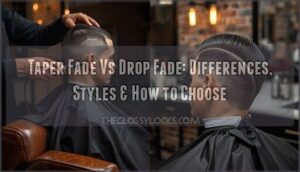
Your barber asks if you want a taper or a drop fade, and suddenly you’re standing at a crossroads with clippers humming in the background. Most guys nod and hope for the best, but that single choice reshapes your entire look—from how your jawline reads to whether you’re walking out with a boardroom cut or something that turns heads on the street.
The taper fade vs drop fade debate isn’t about splitting hairs; it’s about two fundamentally different approaches to where and how your fade curves around your head. One follows a straight, vertical path that whispers sophistication, while the other arcs behind your ear with an unmistakable edge.
Understanding the mechanics behind each fade, how they interact with your face shape and hair texture, and what you’re actually committing to in the barber’s chair puts you in control of your style instead of leaving it to chance.
Table Of Contents
Key Takeaways
- Taper fades follow a straight vertical line down your head for a clean, subtle look, while drop fades curve behind your ear with a bold arc that creates sharper contrast and demands more frequent touch-ups.
- Your face shape and hair texture determine which fade works best—taper fades suit wider faces needing vertical definition, while drop fades add width to narrow or elongated head structures.
- Drop fades require barber visits every 2-3 weeks to maintain that curved line, but taper fades stretch to 4 weeks between cuts because the gradual blend disguises regrowth better.
- Bringing reference photos and specifying fade height, arc placement, and your hair’s texture gives your barber the exact information needed to nail your cut on the first try.
Taper Fade and Drop Fade: Key Differences
Taper fades and drop fades might look similar at first glance, but the differences matter when you’re sitting in the barber’s chair. Understanding how each fade is cut, where it sits on your head, and what shape it creates will help you choose the right style for your look.
A closer look at the skin fade vs. taper fade breakdown shows how these techniques differ in blending, placement, and overall vibe.
Here’s what sets these two popular fades apart.
Definition and Visual Overview
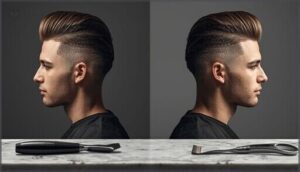
Your fade haircut starts with understanding two core fade options: the taper fade and drop fade.
A taper fade gradually shortens hair from top to sides with a straight vertical drop, creating a soft silhouette. A drop fade curves downward near the temple, forming a distinct arc below the temple line.
Visual contrast differs—taper fades offer subtlety, drop fades deliver bold curvature.
How Each Fade is Created
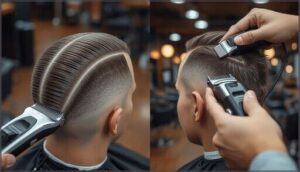
Creating these fade options requires precision clipper techniques and deliberate blending. Your barber removes length gradually with guards in half-inch increments, then uses clipper over comb methods and thinning shears to perfect transitions.
Taper fades follow straight vertical lines, while drop fades demand curved lines shaped with careful diagonal passes.
Razor edging defines your hairline after fade blending, giving you control over your final look. For additional inspiration, you can discover more about the and see how these transitions enhance style across different mediums.
Placement and Shape on The Head
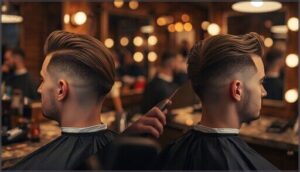
Placement determines whether your hairline, temporal fades, and ear alignment create a taper fade or drop fade. Taper fades follow straight crown placement down your side transitions, matching your head shape’s natural curve.
Drop fades curve behind your ear, creating back contours that complement your face shape differently. Both styles respect your skull’s anatomy, but their paths around your head make all the difference.
Taper Fade Explained
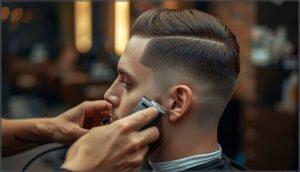
The taper fade is all about control, giving you a clean, gradual shift that doesn’t scream for attention but still makes a statement. It’s a flexible cut that works with your natural hair growth, not against it, making it easier to maintain between barber visits.
The taper fade offers a clean, controlled transition that works with your hair’s natural growth for easy maintenance
Here’s what you need to know about how it’s done, the different styles you can choose from, and whether it’s the right move for your look.
Gradual Transition Technique
A taper fade lives and dies by the clipper’s precision—your barber uses guard progression and controlled pressure to create smooth hair blending from crown to nape.
This shift style relies on micro adjustments at temples and curves, delivering fade haircut options that look sharp without harsh lines.
Proper clipper control and scalp management guarantee the gradient stays smooth, giving you a clean, natural fade that frames your face perfectly.
Classic Vs. Modern Taper Fades
Your choice between a classic and modern taper fade reveals your style evolution and respect for taper history. Classic versions offer gentle, rounded transitions that honor traditional barber techniques, while modern takes deliver sharper angles and higher placement—perfect for exploring fade trends. Each approach caters to different hair texture needs and fade haircut options, letting you control your taper vs fade haircut narrative. To fully understand how styling and maintenance factor into these choices, explore this guide to.
- Classic tapers provide timeless, soft blending that flatters round or oval faces naturally
- Modern variations create sculpted, angular profiles with crisp edges for contemporary looks
- Both styles work across hair textures, though technique adjustments preserve smooth transitions
- Your fade choice reflects personal rebellion—classic sophistication or bold, current trends
Who Suits a Taper Fade?
Balance defines the taper fade’s universal appeal. Your face shape—round, oval, or square—finds harmony through subtle transitions that avoid harsh contrast. Hair texture, from wavy to thick, responds well, while your personal style stays polished, whether for business casual or streetwear. Lifestyle needs minimal fuss; maintenance tips point to trims every 2–4 weeks. Among men’s haircuts, this tapered cut suits you.
| Feature | Best Match |
|---|---|
| Face Shape | Oval, round, square jawlines |
| Hair Texture | Wavy, straight, thick, or fine |
| Personal Style | Classic, understated, timeless |
| Lifestyle Needs | Active, low daily grooming |
Drop Fade Explained
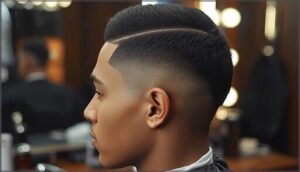
A drop fade breaks the mold with its signature curved fade line that dips down behind the ear, creating a bold arc instead of a straight horizontal cut. You can customize how high or low that curve starts on your head, and the placement changes the entire vibe of the cut.
Whether you’re drawn to sharp contrasts or want a fade that complements your features, understanding these variations helps you own the look.
Distinct Curved Fade Line
The signature of a drop fade is the arc that curves around your ear, breaking away from the straight-line monotony of standard fade haircuts. This curved fade techniques approach separates drop fade designs from taper fade styles, giving you that unmistakable contour that hugs your head’s natural shape.
Barbers use contoured guard usage and freehand arc shaping methods to trace this defining line, which demands fade line precision and curved edge maintenance.
High, Mid, and Low Drop Fades
Drop fade styles break into three main fade techniques based on where the arc hits your head: high, mid, and low fade options. Each level controls contrast, suits different face shapes, and changes how often you’ll need maintenance tips.
- High fade: Starts above the temples, drops sharply behind your ear, and exposes the most scalp for bold, edgy drop fade haircuts
- Mid fade: Begins around mid-temple, curves through the back, and balances coverage with modern contrast
- Low fade: Kicks off just above your ear, dips toward the neckline, and keeps more hair for a softer finish
- Regrowth speed: High fades show new growth fastest, low fades stretch longer between barber visits
Your hair texture and head structure determine which drop fade height works best for your look.
Who Suits a Drop Fade?
You’ll rock a drop fade if you want men’s haircuts that match bold personal style with sharp structure. This curved fade flatters round or oval face shapes, works across any hair texture, and pairs perfectly with streetwear or polished looks. Lifestyle needs matter—expect barber visits every two to four weeks.
Here’s how different profiles fit the drop fade versus taper fade:
| Factor | Drop Fade Match | Taper Fade Match |
|---|---|---|
| Face Shape | Round, oval, heart-shaped | All face shapes |
| Hair Texture | Straight, wavy, curly, thick | Fine to medium density |
| Style Goals | Edgy, fashion-forward, modern | Classic, adaptable, understated |
| Maintenance Tips | Touch-ups every 2–4 weeks | Visits every 4 weeks |
Style, Maintenance, and Upkeep
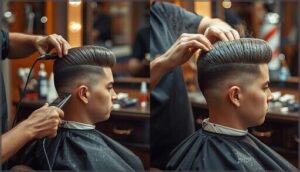
Your cut doesn’t end when you leave the barber’s chair. Both taper fades and drop fades come with their own upkeep demands, from how often you’ll need touch-ups to what you can handle at home.
Let’s break down what each style requires to stay sharp.
Frequency of Barber Visits
Your fade demands commitment—drop fades need touch-ups every 2 to 3 weeks to keep that curved line sharp, while taper fades stretch to 4 weeks between barber schedules. Hair growth dictates your visit frequency, and faster-growing hair means tighter intervals.
- Drop fades fade fast: That dramatic curve loses definition quickly, demanding more frequent trips
- Taper fades buy you time: The gradual shift disguises growth better than aggressive fades
- Budget accordingly: Touch-up cuts cost less than full services, but they add up
- Lifestyle matters: Your styling needs determine whether you’re a every-other-week regular or monthly client
At-Home Maintenance Tips
Between barber visits, you can extend your fade’s life with simple home trimming and fade maintenance. Keep a trimmer handy to clean up stray hairs along your neckline and edges, following the barber advice you got during your last cut.
For taper fade haircut maintenance and care, focus on those gradual lines. These hair care tips and style guidance steps preserve your haircut maintenance until your next appointment.
Styling Products and Methods
Once your fade is fresh, the right styling products keep it sharp. Hair gels offer high hold with crisp edges, while styling creams provide softer texture.
Pomade types range from matte to high shine, so match hold levels and finish techniques to your hair type and personal style.
Comb through damp hair for even coverage, and experiment with hair styling techniques until you nail your styling options.
Choosing The Right Fade for You

Picking between a taper fade and a drop fade isn’t just about what looks good in a picture, it’s about what works with your natural features, your hair, and how you actually live.
Your face shape, hair texture, and daily routine all play a role in which cut will look sharp and stay sharp.
Here’s what to think about before you sit down in the chair.
Face Shape and Head Structure
Your bone structure plays a major role in choosing between these cuts. Face proportions, especially cheekbone width and jawline angle, determine which fade balances your features best.
A drop fade adds width through its curved line, which works when you have a narrow head shape or elongated silhouette. Taper fades offer straighter transitions, ideal for wider facial structures that need vertical definition.
Hair Type and Texture Considerations
Your strands tell the story before scissors even touch them. Fine hair holds taper fades longer because growth lines stay subtle, while coily textures reveal drop fade curves faster due to shrinkage.
Curl patterns demand moisture levels that affect how edges crisp up—porosity dictates whether your fade stays sharp or softens within days. Texture analysis guides which fade styles resist frizz and maintain that rebellious edge you’re chasing.
Personal Style and Lifestyle
Your daily rhythm dictates which fade survives your grind. Taper fades suit nine-to-five boardrooms and conservative dress codes, while drop fades enhance streetwear and creative workspaces where cultural expression runs wild.
- Corporate environments demand subtle taper fades that respect social influence without sacrificing edge
- Active lifestyles require low-maintenance cuts—swimmers and athletes favor drop fades for quick styling
- Personal identity drives fade choice—your mens haircut styles should mirror how you move through the world
Communicating With Your Barber
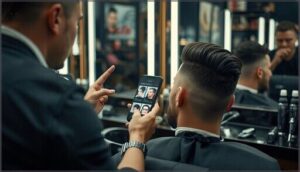
Getting the fade you want starts with knowing how to ask for it. The words you use matter, and bringing the right visuals helps your barber nail the look on the first try.
Here’s how to communicate clearly, whether you’re after a taper fade, a drop fade, or something in between.
What to Ask for a Taper Fade
When you sit in the chair, clarity is everything—tell your barber you want a taper fade and specify the height: low, mid, or high. Mention your preferred taper length on the sides, whether you want a soft or sharp fade style, and how it should blend with your hair texture. Bringing reference photos eliminates guesswork and ensures you walk out owning your look.
| Element | What to Say | Why It Matters |
|---|---|---|
| Taper Height | “I want a low taper that starts near my ear” | Controls where the fade begins and how dramatic it looks |
| Fade Style | “Keep it gradual, not too tight at the bottom” | Defines the shift sharpness and overall vibe |
| Top Length | “Leave about two inches on top for styling” | Ensures balance between the tapered cut and crown |
| Hair Texture | “My hair is thick and wavy, so blend carefully” | Helps the barber adjust technique for your unique texture |
| Maintenance | “I can come back every three weeks” | Sets expectations for upkeep and maintenance costs |
What to Request for a Drop Fade
When you’re ready for a drop fade, nail down your fade line placement first—tell your barber whether you want a high, mid, or low drop, then specify if you prefer a skin fade or shadow fade. Describe how steep the curved arc should be behind your ear, mention your hair texture, and confirm your haircut maintenance schedule so the barber can adjust fade techniques accordingly.
- “I want a mid drop fade that curves behind my ear”
- “Take it to the skin for maximum contrast”
- “My hair grows fast, so I’ll be back in two weeks
Key Terms and Photos to Bring
Photos speak louder than words when you walk into the shop. Bring high-resolution reference shots showing your desired fade heights, hairline guidance around temples and sideburns, and the exact curved drop or gradual taper you want.
Include profile views, back-of-head angles, and top-length comparisons so your barber nails the style consultation—clear photo reference transforms vague mens haircuts requests into precise haircut style execution.
Frequently Asked Questions (FAQs)
What is a drop taper fade?
A drop taper fade merges gradual fade techniques with curved lines that dip behind your ears, following your skull’s natural contour. This creates a bold, striking silhouette that highlights hair texture and head shape.
What is the 3 2 1 buzzcut rule?
The 3 2 1 buzzcut rule uses clipper guard sizes—three on top, two on sides, one at edges—to create a stepped gradient.
This barbering technique delivers a clean, textured fade with minimal maintenance required.
Can women get taper or drop fades?
Absolutely—women can rock both taper and drop fade styles, creating clean contrast between longer tops and gradual or curved transitions.
These feminine haircuts suit various hair textures, offering flexible womens fade options and fresh tapered looks.
How much does each fade style cost?
Old-school barber shops charged a flat rate, but today’s fade haircut differences mean taper costs around $20–$60, while drop fade runs $40–$
Budget planning for maintenance costs and salon fees every 2–4 weeks matters.
What clipper guards create the best fade?
Guards 0 through 4 create the smoothest fade when you progress gradually. A zero guard establishes your base, while 1, 2, 3, and 4 build fluid transitions that eliminate harsh lines and maintain clean blends.
Do fades work with longer hair on top?
Yes, fades pair beautifully with longer hair on top. The contrast between short sides and extended length creates dimension, allows flexible styling with pomade or clay, and suits most hair textures when blended properly.
Can you switch between fade styles easily?
You can switch between fade styles, but expect extra detailing time and more frequent barber visits.
Hair texture and growth rate affect how cleanly the blend holds, so communicate your vision clearly.
Conclusion
They say the devil’s in the details, and that’s true when choosing between a taper fade vs drop fade. Your haircut’s shape can frame your face, sharpen your style, or set you apart in a crowd.
Whether you want a clean, classic look or a bold, modern edge, knowing the difference puts the power in your hands. Walk into your next appointment with clarity, and let your fade speak for you—no guesswork, just confidence.