This site is supported by our readers. We may earn a commission, at no cost to you, if you purchase through links.
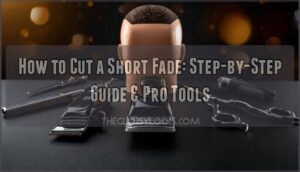
Most barbers won’t tell you this, but the short fade is one of the hardest haircuts to master at home—and one of the easiest to mess up. The difference between a crisp, professional-looking fade and a choppy disaster often comes down to three things: the right guards, proper blending technique, and knowing where to start your fade line.
Here’s the truth: you don’t need years of barber school to cut a clean short fade on yourself or someone else. You need the right tools, a steady hand, and a step-by-step process that breaks down each stage of the cut. Once you understand how to layer your guards and blend those boundary zones, you’ll have the control to create sharp fades that rival what you’d pay $40 for at a shop.
Table Of Contents
Key Takeaways
- You don’t need barber school to cut a clean fade—just the right guards (starting with 0 or 1 at the bottom, stepping up in single increments), proper blending technique, and knowledge of where to start your fade line.
- Preparation determines success: wash and dry hair properly, set up a clean 36×24 inch workspace with good lighting, and choose fade length based on your face shape (oval faces handle 3-9mm, round faces need 10-12mm for lift).
- Master the technique by sectioning hair with a tail comb for precision, using short vertical clipper passes while lifting quickly to avoid hard lines, overlapping guard sizes to blend, and detailing edges with a zero-gap guard.
- Maintain your fade every 2-4 weeks for standard fades or 2-3 weeks for tight skin fades, using daily brushing along the fade line and cold water rinses to keep it sharp between cuts.
Preparing for a Short Fade Haircut
Before you pick up the clippers, you need to set yourself up for success.
If you’re new to this, learning how to cut your own hair with clippers can save you from common beginner mistakes.
The right prep work separates a clean fade from a choppy mess.
Here’s what you need to handle before you start cutting.
Choosing The Right Clipper Guard Sizes
Guard size selection is your first move toward fade mastery. Start with a 0 or 1 guard at the bottom for that near-skin look, then step up in single increments—1, 2, 3—to blend smoothly into longer hair on top.
Check your brand’s chart because guard numbers don’t always match across clippers. Test a small patch first to confirm your gradation works. To better understand the differences among brands and guard types, consult this guide on clipper guard size variations.
Washing and Drying Hair Properly
Once you nail your guard lineup, take command of your canvas. Rinse your hair with warm water, then massage shampoo into your scalp for 30 to 60 seconds—this scalp massage lifts dirt and preps for a clean cut.
Rinse fully, apply conditioner to the ends, and blot gently with a microfiber towel. Damp hair obeys the clippers and shows true texture.
Setting Up Your Workspace and Tools
Your hair is prepped—now command your station. Clear a 36 by 24 inch workspace and position your mirror at eye level for precision.
Lay out your Wahl clipper, guard sizes, and scissors on a non-slip mat. Wipe clippers with disinfectant spray, oil the blades, and check your cord. A clean setup transforms your fade haircut from guesswork into controlled mastery.
A clean, organized clipper station turns guesswork into controlled mastery
Determining The Ideal Fade Length for Your Style
With your station set, it’s time to lock down your fade length. Face Shape Analysis matters—oval faces handle 3 to 9 millimeter fades, while round faces need 10 to 12 millimeters for vertical lift.
Hair Type Considerations shift the game too:
- Fine hair demands a higher Fade Height Options around 6 to 10 millimeters to avoid harsh lines
- Thick coarse strands hold sharp contrast longer, letting you push a tight Short Fade from 0 to 6 millimeters
- Wavy textures blend smoother with mid-range Fade Length between 4 and 8 millimeters
- Personal Style Preferences and Scalp Visibility Factors dictate whether you start skin-tight or leave breathing room
Mark your upper fade line with a longer guard first—your Fade Technique begins there.
Step-by-Step Guide to Cutting a Short Fade
Cutting a fade takes control and precision, but once you know the moves, you own the outcome.
A fade haircut length guide breaks down which guard numbers create clean transitions at every stage.
This guide breaks down each step so you can execute clean lines and flawless blends with confidence. Follow these techniques to master the fade from start to finish.
Sectioning Hair for Precision

Before your clippers touch one strand, you need to map out your battlefield. Sectioning hair creates clean reference points that turn guesswork into precision. Use a tail comb to carve horizontal lines across the head—these guides keep your fade techniques consistent. Don’t skip this step; it’s the difference between a sharp fade haircut and a choppy mess.
| Sectioning Tool | Best For |
|---|---|
| Fine tooth comb | Dense, thick hair |
| Tail comb | Straight parting lines |
| Sectioning clips | Holding sections firm |
| Magnetic clips | Quick release access |
| Paper foils | Temporary separation |
Crown and temple markers align your fade height with facial features, while zigzag patterns reduce visible lines on curved areas. For precision cutting, smaller sections work best on fine hair, wider ones on dense textures. Label each section before you start—this speeds up your work and catches mistakes early. Rechecking before final passes ensures your clipper guides stay aligned, so your fade stays immaculate from every angle.
Using Clippers for Initial Fade Lines
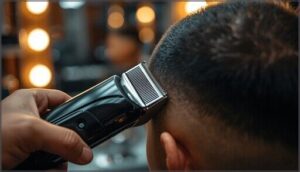
Start with a zero guard to define the perimeter just above your natural hairline—this crisp boundary gives you full control over the fade’s starting point.
Switch to guard size one and make short vertical passes, lifting the clippers quickly to avoid hard lines. Keep your blade angle consistent and check both sides in the mirror for symmetry.
Clean your Wahl clipper head between passes to maintain sharp cutting angles across every hair texture.
Blending and Tapering Techniques
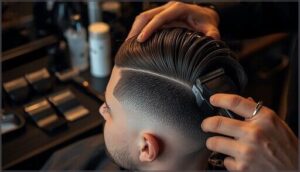
Precision trimming demands you overlap guard sizes to erase hard lines—drop to a smaller guard and feather upward where the fade junction meets longer hair.
Adjust your clipper angles to follow the skull’s natural curve for flawless blending. Keep your hand steady, use light pressure, and switch between guards until the tapered fade flows smoothly from skin to length without visible steps.
Trimming The Top for a Balanced Look
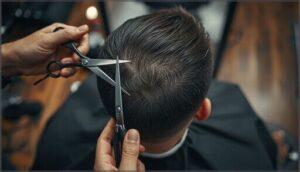
Your crown texture sets the rhythm for the entire cut—point-cut the top to remove bulk while respecting natural growth patterns. Keep top length guidance between 0.5 and 1.5 inches to echo your fade height, creating visual balance that draws the eye.
For fringe trimming, aim slightly longer than the sides to soften the shift. Master these barbering tips and your haircutting techniques deliver control, not compromise.
Detailing The Edges and Neckline
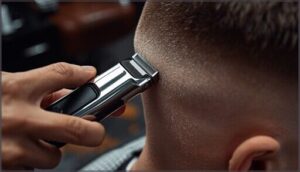
Clean edges don’t happen by accident—they demand edge detailing with a zero-gap guard and steady palm pressure.
For neckline shaping, follow your natural curve about 1 to 2 cm above the hairline, never square. Use dual-blade trimmers for hairline precision around temples and ears.
This edge cleanup transforms a decent tapered fade into a sharp, commanding finish.
Top Tools for Short Fade Haircuts
The right tools make all the difference when you’re cutting a fade at home. You need clippers that hold a sharp edge, guards that blend seamlessly, and scissors that give you control over the top.
Here are five professional-grade options that’ll help you nail the cut every time.
1. Wahl Fade Hair Cutting Kit
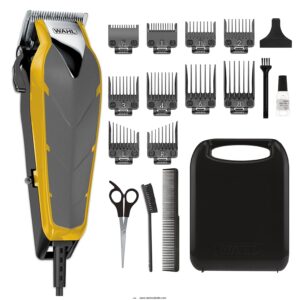
This 20-piece kit delivers everything you need to master fade cuts at home. The Powerdrive motor processes thick hair without snagging, while self-sharpening blades stay precise cut after cut.
You’ll get 12 attachment guards covering every fade length, plus an adjustable taper lever that lets you blend seamlessly without switching guards. The kit includes scissors, a styling comb, blade oil, and a storage case.
It’s built for consistent performance during weekly cuts, giving you professional-grade results from your own bathroom.
| Best For | Home users who want to achieve professional-looking fades and military-style cuts without paying for regular barbershop visits. |
|---|---|
| Weight | 2.25 Pounds |
| Material | Metal/Plastic |
| Brand | Wahl |
| Use Case | Professional/Home |
| Power Type | Corded |
| Blade Type | Xtreme Precision |
| Additional Features |
|
- Powerdrive motor handles thick hair smoothly without pulling or snagging
- Adjustable taper lever lets you blend different lengths seamlessly without constantly changing guards
- Complete 20-piece kit includes everything you need—guards, scissors, comb, oil, and storage case
- The motor runs louder than expected, which can be distracting during longer cuts
- Corded design limits movement and the cord can get tangled while working
- Not durable enough for daily professional use—best suited for weekly home haircuts
2. Equinox Professional Hair Cutting Scissors

Once you’ve shaped your fade with clippers, you need scissors to perfect the top. The Equinox Professional Hair Cutting Scissors bring Japanese stainless steel blades sharpened to a razor edge, perfect for texturizing and point cutting.
At 6.5 inches with 2.5-inch blades, they give you control without strain. The curved finger rest reduces hand fatigue, while the tension screw lets you adjust blade resistance for different hair densities. At 3.5 ounces, they’re light enough for detailed work but sturdy enough for daily cuts.
| Best For | Barbers and home stylists who want salon-quality scissors without the high-end price tag. |
|---|---|
| Weight | 3.5 ounces |
| Material | Stainless Steel |
| Brand | Equinox International |
| Use Case | Professional/Home |
| Power Type | Manual |
| Blade Type | Hand-Sharpened |
| Additional Features |
|
- Japanese stainless steel blades with razor-sharp edges handle precise cuts and texturizing
- Adjustable tension screw lets you customize blade resistance for different hair types
- Ergonomic design with curved finger rest keeps your hand comfortable during long cutting sessions
- Won’t match the sharpness of premium Japanese shears
- Needs regular maintenance and cleaning to stay in good shape
- Very sharp edges require careful handling to avoid accidents
3. Fadeking Professional Hair Clippers Set
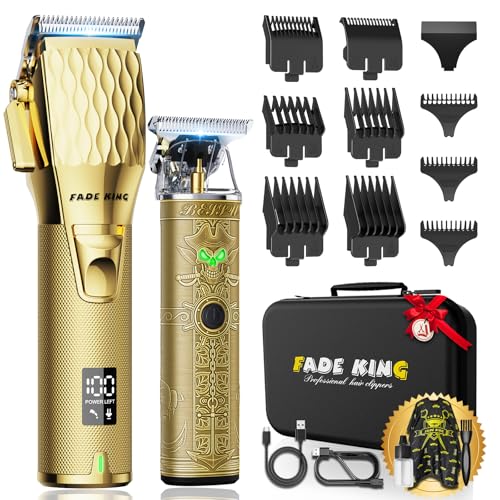
The Fadeking Q1S-Y5 delivers 300 minutes of cordless power with adjustable blades that lock in smooth blends. Its zinc alloy body feels professional in your hand, not flimsy like cheaper models.
The LCD display tracks battery life so you won’t lose power mid-fade. At 2.2 pounds, it’s balanced for control without wrist strain. You get multiple guide combs, a cleaning brush, and a storage case.
The rotary motor runs quiet and cool, perfect for those extended sessions when you’re dialing in that perfect taper.
| Best For | Barbers and home users who want pro-level control for fades and tapers without dealing with cords. |
|---|---|
| Weight | 2.2 Pounds |
| Material | Metal/Plastic |
| Brand | FADEKING |
| Use Case | Professional/Home |
| Power Type | Cordless |
| Blade Type | Adjustable |
| Additional Features |
|
- 300-minute battery life means you can knock out multiple cuts before recharging
- Adjustable blades dial in tight fades and sharp lineups with precision
- LCD display keeps you from getting caught with a dead clipper mid-session
- Instructions for the guards could be clearer if you’re new to adjustable systems
- Feels bulky in smaller hands during long sessions
- Higher price point compared to basic clippers, though most users say it’s worth it
4. Wahl Lithium Ion Pro Cordless Hair Clippers
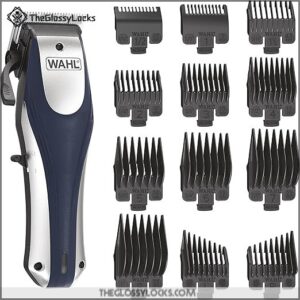
The Wahl Lithium Ion Pro runs for two hours on a single charge, giving you the freedom to work without hunting for outlets. Its self-sharpening stainless steel blades stay sharp through dozens of cuts while the taper lever lets you adjust blend lengths on the fly.
You get twelve snap-lock guards from 1/16 to one inch. The high-torque motor powers through thick hair without bogging down.
At just under 2.2 pounds with balanced weight distribution, your hand stays steady through those critical fade transitions.
| Best For | Home barbers who need a reliable cordless clipper that can handle multiple haircuts without constant recharging. |
|---|---|
| Weight | 980 Grams |
| Material | Metal/Plastic |
| Brand | Wahl |
| Use Case | Home |
| Power Type | Cordless |
| Blade Type | Self-Sharpening |
| Additional Features |
|
- Two-hour battery life means you can cut hair for several people before plugging back in
- Self-sharpening blades stay effective over time without manual maintenance
- Powerful motor handles thick hair smoothly without pulling or stalling
- Clipper guards feel flimsy and may not hold up to frequent use
- Basic storage case doesn’t keep accessories organized
- USB charging is slower than a standard AC adapter
Novah Professional Cordless Hair Clipper and Trimmer Set
The Novah set packs both a clipper and trimmer into one cordless package. You’ll work with six clipper guards and four trimmer accessories for complete fade control.
Its turbo two-speed motor tackles thick hair texture without pulling, while the LED display tracks your battery life. The self-sharpening blades need minimal blade sharpening maintenance—just oil them between cuts to keep your fade haircut tools running smooth.
For added durability and professional performance, consider the benefits of a premium build quality design.
Maintaining and Styling a Short Fade
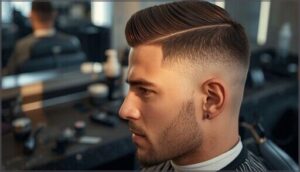
Your fade won’t stay sharp on its own. You need to know when to re-trim, how to keep it clean between cuts, and which styles work best with your new look.
Here’s what you need to maintain that crisp fade and make it your own.
How Often to Re-Trim Your Fade
Your fade loses its edge fast because hair pushes that crisp line forward every day. Plan your trimming schedules around these intervals to keep control of your look.
- Standard fades need a trim every 2 to 4 weeks to maintain sharp contrast between clipper guards
- Tight skin fades demand attention every 2 to 3 weeks as regrowth blurs the fade line
- Hair growth rate varies by genetics, but expect roughly half an inch per month
- High-traffic areas like temples show fade breakdown within 10 to 14 days
Tips for Keeping Your Fade Sharp Between Cuts
Daily routine beats emergency fixes when you’re guarding that sharp edge. Brush along the fade line each morning to lift trapped oils that dull your look.
Use a soft bristle tool after showering to reset the line, then finish with a cold water rinse to tighten everything up.
Scalp care matters too—exfoliate weekly and skip heavy products near the skin to prevent buildup that blurs your fade.
Recommended Hairstyles to Pair With a Short Fade
Your short fade becomes a foundation, not a finish. Pair it with a pompadour for maximum lift, or keep things raw with a messy top that brings controlled chaos.
Curl and wave patterns contrast beautifully against the clean sides, while slick backs deliver polish. Add a beard to frame your face and own the edge. These mens haircut styles adapt to any texture or vibe you want.
Frequently Asked Questions (FAQs)
How short should a fade be?
Your clipper guard determines everything. A 0 to 1 fade sits closest to the scalp, creating maximum contrast.
Guard sizes 1 to 2 or 3 to 4 preserve more length while still delivering that sharp, tapered fade effect.
What face shapes suit short fade haircuts?
Oval faces handle tight skin fades naturally, while round faces need height on top and high fades for length.
Square jawlines rock sharp lines, but rectangular faces require low tapers to avoid looking stretched.
Can you fade curly or textured hair?
Yes, you can fade curly hair using staggered clipper elevations and guard sizes 1 to
Moisturize curls before cutting, blend freehand along natural curves, and preserve curl patterns through careful texture management and fade techniques.
How do you fix uneven fade lines?
When one side sits higher than the other, lower it with a longer guard, then reblend carefully.
Check symmetry by stepping back—good lighting reveals what your eye might miss up close.
Whats the difference between taper and fade?
A fade transitions sharply from skin to longer hair, creating dramatic contrast.
A tapered cut gradually decreases hair length over a larger area, offering a smoother, subtler blend that grows out more forgivingly.
Should you fade wet or dry hair?
Most barbers start with damp hair—not soaking wet—to control flyaways and see clean fade lines.
Then switch to dry blending with clipper guards and taper lever for precise, textured finishing touches.
Conclusion
Sure, your barber will happily charge you $50 every two weeks to maintain that fade—after all, they’ve got rent to pay. Or you can take back control with clippers in your own hands.
You’ve learned how to cut a short fade from start to finish. The technique is yours now. The guard sizes, the blend zones, the detailing—it’s all here.
Walk into your next cut knowing exactly what you’re doing. Independence never looked this sharp.
- https://wahlusa.com/how-to/haircutting/haircuts-101/taper-lever
- https://www.sebastianprofessional.com/en-GB/barbering/hair-cutting-techniques
- https://kingsmangroomingstudio.com/mens-grooming/how-to-choose-the-best-haircut-for-men-based-on-face-shape/
- https://www.rustybladebarber.com/post/perfect-haircuts-for-oval-face-men
- https://www.chapsandco.com/us/blog/the-art-of-the-fade-choosing-the-right-fade-style-for-your-face-shape/