This site is supported by our readers. We may earn a commission, at no cost to you, if you purchase through links. This content is for general informational and educational purposes only and is not a substitute for professional medical, dermatological, or nutritional advice.
White flakes dusting your shoulders aren’t always dandruff—sometimes your products are the culprit. A mismatch between ingredients, an overloaded application, or one drying alcohol hiding in your formula can turn a good hair day into a flaky mess.
Most people blame their scalp, switch shampoos, and repeat the cycle. The real fix starts with understanding what’s actually happening at the ingredient level. Once you know what causes hair products to flake, you can choose smarter formulas, layer them correctly, and stop treating a chemistry problem like a hygiene one.
Table Of Contents
- Key Takeaways
- Common Causes of Hair Product Flaking
- The Role of Hair Product Ingredients
- Application Mistakes That Lead to Flaking
- Differentiating Product Flakes From Dandruff
- How to Prevent Hair Product Flaking
- Solutions for Removing Product Flakes
- Top 5 Flake-Free Hair Care Products
- Frequently Asked Questions (FAQs)
- How to stop hair products from flaking?
- What are the white flakes from product buildup?
- Can weather affect how hair products perform?
- Are flakes more common with certain hair types?
- Does water quality impact product flaking?
- Can diet or health influence scalp flaking?
- How does hair porosity affect product absorption?
- Conclusion
Key Takeaways
- Drying alcohols and rigid synthetic polymers like PVP are the most common ingredient-level culprits behind flaking, as they form brittle films that crack when your hair moves.
- Layering incompatible products — like a cationic leave-in under an anionic gel — causes a charge clash that shows up as white “product snow” on your strands.
- Applying products to anything less than soaking-wet hair is a setup for flaking, since dry hair can’t absorb the formula and it just crusts on the surface instead.
- Not all flakes come from products — yellowish, greasy flakes that don’t clear with clarifying shampoo often signal a scalp condition like seborrheic dermatitis that needs a different fix entirely.
Common Causes of Hair Product Flaking
Flaking usually has a clear source once you know what to look for.
Whether it’s dry skin or product buildup, identifying beard flakes by their texture and appearance points you straight to the right fix.
Most of the time, it comes down to a handful of key factors — some product-related, some process-related.
Here’s what’s actually behind it.
Product Buildup on Scalp and Hair
Product accumulation is sneaky — it doesn’t happen all at once. Every layer of styler, conditioner, or dry shampoo leaves a thin film behind.
Over time, that film traps sebum and dead skin, creating waxy scalp residue that sheds as hair flakes.
Regular hair clarifying breaks that cycle, keeping your scalp conditions balanced and your roots feeling genuinely clean. For more on understanding the balance of the scalp microbiome, see how product build-up impacts scalp health.
Incompatible Product Layering
Sometimes, buildup isn’t the only culprit — layering order matters just as much. When you combine products with opposing charges, like a cationic leave-in over an anionic gel, charge mismatch causes them to separate and clump. Base conflict works the same way.
Checking product compatibility before styling — even a quick palm test — helps you avoid that frustrating “product snow” effect on your curls. Learning about the compatibility of charged ingredients can help you make smarter choices when combining products.
Drying Alcohols and Synthetic Polymers
Beyond layering conflicts, the ingredients inside your products matter too. Drying alcohols like isopropyl alcohol speed up alcohol evaporation, leaving a brittle polymer film behind.
Synthetic polymers such as PVP create hard, glassy coatings that crack with movement, causing hair flakes. For better flake prevention, look for flexible co-polymers and alcohol-free hair gel formulas, especially in low-humidity conditions where humidity control becomes even harder.
Insufficient Moisture During Application
Ingredients aren’t the only problem. Hair hydration plays a bigger role than most people realize.
When moisture levels are too low during styling, products can’t penetrate the strand — they just sit on top and dry into a brittle crust. Think of it like painting a dry, rough wall.
Dry hair repels styling products like a rough wall repels paint, leaving a brittle crust instead of hold
For flake prevention, your hair should feel soaking wet, not just damp, before any product touches it.
The Role of Hair Product Ingredients
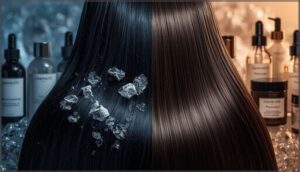
What’s actually in your hair products matters more than most people realize. Certain ingredients are built to hold without flaking, while others practically guarantee a white-residue situation by the end of the day.
Here’s what to look for — and what to avoid.
Synthetic Vs. Natural Holding Agents
The holding agent in your hair gel is the difference between a style that stays crisp and one that crumbles into white dust. Film Formation depends on polymer chemistry — and the two camps behave very differently.
- Synthetic polymers like PVP form hard, brittle films that crack and flake
- Natural alternatives like flaxseed gel create softer, more elastic coatings
- Biodegradable options break down faster in water with less product buildup
- Eco friendly products using plant-based natural ingredients reduce environmental impact
- Copolymer-based styling products balance flexibility and hold to resist flaking
Alcohol Content and Its Effects
Alcohol is one of the sneakiest flake causes hiding in plain sight on your ingredient list.
Drying alcohols like isopropyl and SD alcohol 40 are fast-evaporating drying agents that pull moisture out as they dry. That hair dehydration leaves the scalp irritated and brittle polymer films more likely to crack.
The result? hair flakes you didn’t see coming.
Plant-based Polymers and Flake Prevention
Plant-based polymers are quietly changing the game for flake-prone hair. Ingredients like corn starch-derived polymers, tara fruit gum, and red algae galactan form flexible films that bend instead of crack — so you won’t see that chalky residue.
These biodegradable options and sustainable ingredients work as effective hair gel flaking solutions, reducing product buildup without stiffness. Natural hair care products using plant-based polymers simply move with your hair.
Humidity-resistant Ingredients
Humidity is the silent enemy of a good hair day. Certain hair product ingredients are designed to fight back.
Film formers like VP/VA copolymer create moisture barriers that keep polymer molecules sealed against water in the air. Silicone benefits go further — dimethicone and amodimethicone coat each strand, delivering real humidity control and anti frizz protection.
Unlike water soluble options, oil-based products with silicone hold their ground when the air turns thick.
Application Mistakes That Lead to Flaking
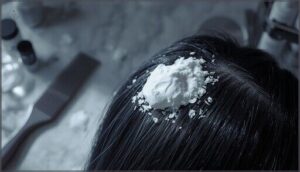
Even the best products can flake if you’re not applying them the right way. How you use a product matters just as much as what’s in it.
Here are the most common application mistakes that lead to unwanted flaking.
Using Excessive Amounts
More product doesn’t mean better results — it’s one of the most common hair care mistakes. Product overload creates a thick film that dries into visible flakes and triggers scalp irritation.
It also causes moisture imbalance by blocking your hair shaft from absorbing water properly. For flake prevention, start with a dime-sized amount and only add more where hair still looks dry.
Skipping Sectioning for Even Distribution
Skipping sectioning is like painting a wall with one broad stroke — you’ll miss spots and overload others. Without proper hair sectioning, product distribution becomes uneven: some strands get saturated while inner layers stay dry.
That imbalance triggers product buildup and hair flaking. Using sectioning techniques ensures even coverage on every strand, making flake prevention a natural result of smarter hair product application techniques.
Failing to Test Product Compatibility
Even sectioning gets you far, but it won’t save you if your products are fighting each other. A quick palm test can reveal a lot — rub your leave-in and gel together and watch what happens. If they ball up or turn chalky, that’s a product clash waiting to happen on your hair.
Here’s how to avoid it:
- Rub two products together on your palm before applying them — clumping means incompatibility.
- Avoid layering silicone-based creams under water-based gels; they repel each other and flake.
- Check product ingredients for conflicting pH levels or polymers.
- Introduce one new product at a time to identify the source of buildup.
- Use a hair care product guide to match compatible formulas.
This simple compatibility test is your best flake prevention tool.
Differentiating Product Flakes From Dandruff
Not all flakes are created equal, and telling them apart matters more than most people realize.
Product residue and dandruff can look surprisingly similar, but they’ve different causes and need different fixes.
Here’s what to look for when you’re trying to figure out which one you’re dealing with.
Visual and Texture Differences
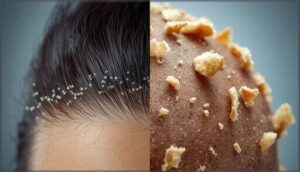
Color, size, and feel tell you more than you’d think. A quick texture analysis can save you from treating the wrong problem.
| Feature | Product Buildup | Dandruff/Flaky Skin |
|---|---|---|
| Flake Color | Bright white or off-white | Yellowish, greasy-looking |
| Flake Size | Tiny specks along hair shaft | Larger, irregular plates |
| Texture | Waxy, smears when rubbed | Dry, crumbles easily |
| How it sits | Clings to hair texture | Rests on scalp, falls off |
| Water reaction | Turns tacky when misted | Stays crumbly, lifts away |
How Scalp Conditions Mimic Product Flaking
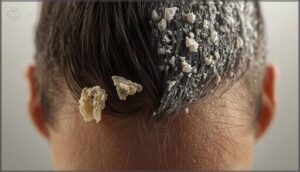
Some scalp flake causes have nothing to do with your products at all. Seborrheic dermatitis produces soft, yellowish clumps that sit on top of styling products and look like formula breakdown.
Psoriasis speeds up skin cell turnover, dropping thick white scales that resemble dried gel. Even a dry skin issue or itchy scalp can shed flakes that mirror product residue almost exactly.
Signs of Underlying Skin Issues
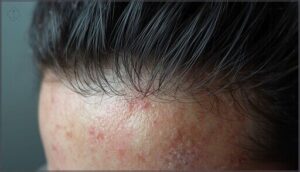
Some flake symptoms point to more than styling habits. Redness signs like persistent discoloration, warmth, or tenderness often signal scalp inflammation — not product irritation.
Watch for:
- Greasy yellow flakes paired with redness (seborrheic dermatitis)
- Thick silvery scales that bleed when scratched (psoriasis)
- Itching causes that return after rinsing
- Flaking that spreads past your hairline
Skin conditions don’t clear with clarifying shampoo.
How to Prevent Hair Product Flaking
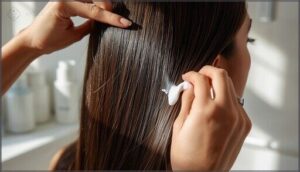
Preventing product flakes isn’t complicated — it mostly comes down to a few habits you can build into your routine.
The good news is that small adjustments make a big difference.
Here’s where to start.
Starting With a Clean, Hydrated Scalp
Think of your scalp as a canvas — what’s already on it determines how well your products perform. Gentle cleansing removes old residue, while scalp exfoliation lifts dead skin that causes hair flakes treatment to feel futile. Consistent hydration methods keep the barrier intact, supporting scalp balance and flake prevention before you even open your styling products.
| Step | Purpose |
|---|---|
| Clarifying shampoo (weekly) | Removes buildup and residue |
| Scalp exfoliation | Lifts dead skin and unclogs follicles |
| Hydrating serum | Restores scalp health and barrier |
| Itchy scalp remedies | Calms irritation before styling |
Sectioning for Even Coverage
Section size matters more than most people realize. Dividing your hair into four to eight sections lets you control product distribution from root to tip — no overloaded patches, no dry inner strands shedding product later.
Use a rat tail comb and clips as your sectioning tools, then rake gel through each section evenly. That’s how hair care routines stay flake-free.
Performing Compatibility Tests
Before committing to a full wash day, run a quick palm mixing test. Rub a pea-sized amount of your leave-in and gel together on the back of your hand. If it turns grainy or separates, that combo will flake on your strands.
For strand testing, apply the blend to one small section first. Compatibility checks like these make smart hair product application techniques second nature.
Solutions for Removing Product Flakes
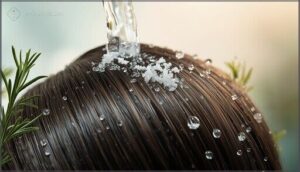
Getting rid of product flakes doesn’t have to mean stripping your hair every time. The right approach depends on how much buildup you’re dealing with and how sensitive your scalp is.
Here are four ways to clear the flakes and get back on track.
Clarifying Shampoos for Residue Removal
A clarifying shampoo is your scalp’s reset button. When product buildup turns into visible hair flaking or scalp irritation, deep cleansing breaks down those dried gel films and residue layers that regular shampoos simply miss.
Ingredients like sodium lauryl sulfate bind directly to oils and styling product films, lifting them away completely. Use one weekly for effective residue removal, hair purification, and a true scalp detox without over-stripping.
Co-washing for Gentle Cleansing
Sometimes your scalp just needs a break from heavy cleansing. Co-washing uses mild conditioning surfactants to lift light product buildup and sweat without stripping your scalp’s natural oils — making it a smart tool for moisture balance and curl health.
Here’s how co washing aids gentle cleansing:
- Removes light residue without disrupting scalp comfort
- Preserves natural oils that reduce hair flaking
- Delivers co wash benefits like added slip and hydration
- Aids natural hair care routines between deeper cleanses
Scalp Treatments for Persistent Flakes
When co-washing isn’t enough, targeted scalp treatment remedies can tackle stubborn hair flaking at the source. Medicated shampoos with antifungal treatments — like ketoconazole or selenium sulfide — work directly against the yeast driving persistent flakes.
Keratolytic therapies using salicylic acid dissolve thick scale buildup, while scalp exfoliation tools help active ingredients penetrate more evenly. Together, these approaches support microbiome balance and long-term scalp health.
Refreshing Sprays Between Wash Days
Between wash days, a good refresher spray does double duty. It performs light scalp cleansing while delivering hydration benefits that keep curls from going brittle and stiff.
Water-based mists are your best bet for curl reactivation without adding to product buildup — just mist, scrunch, and let it dry fully. That last step matters most for preventing hair flaking from disturbed product cast.
Top 5 Flake-Free Hair Care Products
Finding the right products can feel like guesswork, but it doesn’t have to be.
These five options are formulated to hold your style without the dreaded white flakes.
Here’s what made the cut.
1. Pattern Curl Cocktail Kit
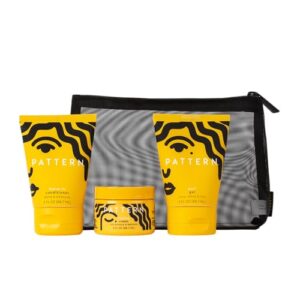
The Pattern Curl Cocktail Kit gives you three mini products — a Leave-In Conditioner, Styling Cream, and Curl Gel — designed to layer without the clumping or white residue that plagues so many styling combos. Each formula uses plant-based polymers and moisture-locking ingredients like aloe vera, glycerin, and honey to keep hold soft rather than stiff.
That matters when you’re trying to avoid flaking. At $32, it’s travel-friendly, refillable, and built to work as a system from the start.
| Best For | Curl-focused folks with thick, thin, or wiry hair who want a ready-to-go styling system they can toss in a bag and actually use on the go. |
|---|---|
| Hair Type | Curly, thick, thin |
| Form | Cream and gel |
| Frizz Control | Yes |
| Chemical-Free | Paraben-free |
| Curl Definition | Yes |
| Detangling | Yes |
| Additional Features |
|
- Layers clean — no clumping or white residue, just soft hold that keeps curls defined without going stiff
- Refillable tubes make it easy on your conscience (and eventually your wallet)
- Works across a range of styles, from wash-and-gos to protective-style touch-ups
- The rose scent can be a lot, especially from the gel — sensitive noses may notice it fast
- If your hair is long and thick, these minis won’t last you long at all
- $32 for travel sizes feels steep, especially if you need to use a generous hand each time
2. Cantu Coconut Hair Care Bundle
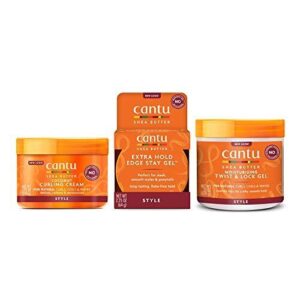
If you want a fuller system without the premium price tag, the Cantu Coconut Hair Care Bundle does a solid job. It pairs a sulfate-free shampoo, moisturizing conditioner, and the Coconut Curling Cream — all in one set.
The cream skips mineral oil, silicones, and parabens, leaning instead on shea butter, glycerin, and plant oils to soften curls without heavy buildup. Apply it to soaking wet hair in small sections, and you’ll get definition with soft hold and far less residue.
| Best For | People with curly, kinky, or wavy hair who want a full wash-and-style routine without spending a lot. |
|---|---|
| Hair Type | Curly, kinky, wavy |
| Form | Cream and gel |
| Frizz Control | Yes |
| Chemical-Free | Dairy-free |
| Curl Definition | Yes |
| Detangling | No |
| Additional Features |
|
- Defines curls without weighing them down, leaving hair soft and bouncy
- Free from sulfates, mineral oil, silicones, and parabens — gentler on hair over time
- Comes as a complete bundle, so you’re not hunting for individual products
- Can feel greasy or sticky after the curling cream settles, and may leave a white cast
- Needs a hair dryer to really lock in the style — air drying might not cut it
- Doesn’t play as well with looser curl patterns like 2C hair
3. Jorganic Kids Curl Care Kit
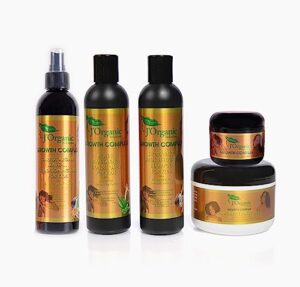
For younger curls, the J’Organic Kids Curl Care Kit takes a smarter approach. The full five-piece system — shampoo, conditioner, leave-in milk, scalp stimulator, and MoistureFuse butter cream — skips drying alcohols, mineral oils, and sulfates entirely.
That matters because those ingredients are usually behind the flaking. Instead, you get marshmallow root, argan oil, and avocado oil doing the heavy lifting. The formulas stay lightweight and moisture-rich, so curls dry soft, not stiff — and flakes don’t get a chance to form.
| Best For | Kids with curly, coily, or wavy hair who need a gentle, chemical-free routine that keeps flakes and dryness in check. |
|---|---|
| Hair Type | Curly, coily, wavy |
| Form | Cream |
| Frizz Control | Yes |
| Chemical-Free | Alcohol-free |
| Curl Definition | Yes |
| Detangling | Yes |
| Additional Features |
|
- Full five-piece system covers everything — shampoo, conditioner, leave-in, scalp care, and moisture — so there’s no guessing what else you need.
- Made with natural ingredients like marshmallow root, argan oil, and avocado oil that hydrate without weighing curls down.
- Free from drying alcohols, sulfates, and mineral oils, which means less breakage and more shine over time.
- The scent of some products might not be for everyone.
- The shampoo can strip natural oils if used too frequently.
- The conditioner may not deliver enough moisture for very thick or coily hair types.
4. Kinky Curly Leave In Conditioner Gel
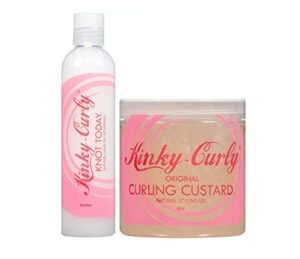
Kinky Curly Knot Today paired with their Curling Custard is a classic combo for good reason. The leave-in conditioner relies on organic mango extract, marshmallow root, and slippery elm — ingredients that coat and smooth the cuticle without leaving residue behind.
That clean base is exactly what makes the gel layer sit right. Keep application to soaking-wet hair, skip heavy butters underneath, and you’ll get defined curls without the white flakes that usually follow.
| Best For | People with kinky or curly hair who want defined, frizz-free curls without a lot of harsh chemicals weighing their hair down. |
|---|---|
| Hair Type | Kinky, curly |
| Form | Gel and leave-in |
| Frizz Control | Yes |
| Chemical-Free | No harsh chemicals |
| Curl Definition | Yes |
| Detangling | Yes |
| Additional Features |
|
- The leave-in and custard combo work really well together — you get soft, defined curls that actually look healthy and shiny
- Made with natural ingredients like mango extract and marshmallow root, so it’s gentle enough for kids too
- Great for low-porosity hair that tends to reject heavier products
- The gel can dry a little crusty if you don’t apply it to soaking-wet hair or layer it wrong
- Thicker hair may need extra time and patience during the detangling step
- At $33 for 8 oz, it’s a bit of an investment — and a few buyers got damaged packaging on delivery
5. Camille Rose Curl Defining Gel
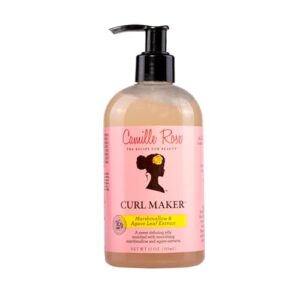
Camille Rose Curl Maker is a jelly-gel that actually earns its flake-free reputation. The formula skips drying alcohols and relies on natural film-formers like pectin, xanthan gum, and chondrus crispus to hold your curls without cracking into white bits.
Aloe juice and golden agave keep the moisture balance in check while the gel sets. Your one rule: apply it to soaking-wet hair. Too dry, too much product, or a heavy cream underneath, and you’ll see residue fast.
| Best For | Curl girls with 4b, 4c, or wavy hair who want defined, frizz-free curls without the crunch. |
|---|---|
| Hair Type | All hair types |
| Form | Gel |
| Frizz Control | Yes |
| Chemical-Free | Silicone-free |
| Curl Definition | Yes |
| Detangling | Yes |
| Additional Features |
|
- Defines curls and fights frizz without leaving that stiff, crunchy finish
- Made with natural ingredients like aloe juice and nettle root that actually nourish your hair
- Silicone-free and works across a wide range of curl types and textures
- Can flake if you use too much or apply it to hair that isn’t soaking wet
- Some users noticed dryness and hair loss, and a few feel the formula has changed over time
- Not the best pick if you’re after volume — it’s more about definition than lift
Frequently Asked Questions (FAQs)
How to stop hair products from flaking?
Think of flaking as your hair’s way of waving a red flag. Start with a clean scalp, use less product, and choose alcohol-free formulas to keep flakes from forming.
What are the white flakes from product buildup?
Those white flakes are dried styling product residue — film-forming polymers like PVP and acrylates that coat your hair shaft, then crack and shed into tiny white specks when your hair moves.
Can weather affect how hair products perform?
Yes, weather plays a real role. Cold, dry air makes gels crack and flake more easily.
High humidity can break down product films and cause frizz. Temperature swings affect how evenly products apply and hold.
Are flakes more common with certain hair types?
Flaking does tend to show up more with curly and coily hair types.
Tighter curl patterns are washed less often, which lets product residue build up and break apart into visible flakes over time.
Does water quality impact product flaking?
Absolutely. Hard water is loaded with calcium and magnesium minerals that coat your strands, preventing styling products from forming a smooth, even film — so they dry unevenly and shed as visible flakes.
Can diet or health influence scalp flaking?
Your diet and overall health can absolutely affect your scalp.
Low zinc, poor hydration, and excess sugar can all increase oiliness or dryness, making flaking more likely — even when your products aren’t the problem.
How does hair porosity affect product absorption?
Low porosity hair blocks products out; high porosity drinks them in too fast.
Either way, poor absorption raises your flaking risk — so knowing your porosity helps you choose the right formula.
Conclusion
Take someone who switched gels three times in a month, convinced her scalp was the problem. It wasn’t—two incompatible polymers were clashing on every wash day.
Once she understood what causes hair products to flake, one formula change fixed everything. Your products should work with your hair, not against it.
Read your ingredient labels, layer smarter, and stop guessing. Flaking is a chemistry problem—and chemistry always has a solution.
- https://www.wondercurl.com/blogs/news/gel-flaking-reasons-fix
- https://beautycluboutlet.com/blogs/curly-hair-help/a-guide-to-combining-curly-hair-products-without-flaking-say-goodbye-to-product-buildup
- https://www.balancebeautyspa.com/single-post/why-you-might-have-product-build-up-on-your-scalp-and-how-to-fix-it