This site is supported by our readers. We may earn a commission, at no cost to you, if you purchase through links. This content is for general informational and educational purposes only and is not a substitute for professional medical, dermatological, or nutritional advice.
Most people applying five products in a row are unknowingly canceling some of them out. Layering skincare isn’t just about stacking products—it’s chemistry. The sequence you follow determines whether your vitamin C is absorbed at its active pH, whether your retinoid actually reaches the dermis, or whether everything just pills off your face by 8 AM.
Order matters because your skin operates on rules: viscosity, molecular weight, and pH compatibility all dictate what gets absorbed and what sits uselessly on the surface. Knowing how to layer skincare products correctly is the difference between a routine that produces outcomes and an expensive guessing game.
Table Of Contents
- Key Takeaways
- Why Skincare Layering Order Actually Matters
- How to Layer Your Morning Skincare Routine
- How to Layer Your Evening Skincare Routine
- Active Ingredient Compatibility and Common Layering Mistakes
- How to Customize Layering for Your Skin Goals
- Top 5 Products for Layering Skincare Correctly
- Frequently Asked Questions (FAQs)
- What is the golden rule of skincare layering?
- What is the 1% rule in skincare?
- Can you layer skincare over a fresh sunburn?
- Does the order change when skin is oily versus dry?
- How many products are too many to layer daily?
- Should layering routines change with the seasons?
- Can you apply skincare immediately after exercising?
- Conclusion
Key Takeaways
- Layering order isn’t a preference—it’s chemistry: pH, molecular weight, and viscosity determine whether your actives actually absorb or just sit uselessly on the surface.
- Your morning routine should always run from thinnest to thickest, ending with SPF, while your evening routine is where repair actives like retinoids do their deepest work.
- Stacking incompatible actives—like retinoids with AHAs or benzoyl peroxide—overloads your barrier quickly, so alternating them on separate nights protects your results without sacrificing efficacy.
- More products rarely mean better skin; a focused 3–6 step routine built around your specific skin goal—acne, dullness, sensitivity, or aging—consistently outperforms an overcrowded shelf.
Why Skincare Layering Order Actually Matters
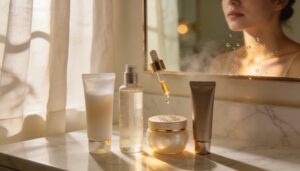
The order you apply your skincare isn’t just a preference — it determines whether your products actually work. Layering correctly means your skin absorbs what it needs, when it needs it, without interference.
Your morning and evening routines actually call for different layering strategies, and understanding how morning and night skincare routines differ can make a real difference in how well your products perform.
Here’s what’s really driving that logic.
The Thinnest-to-Thickest Rule Explained
Think of your routine as a viscosity gradient — water-thin toners first, richer creams last. This thin-to-thick order works because lighter products can’t penetrate through heavier ones.
Skipping the absorption pause between layers causes pilling and uneven texture. Texture sequencing isn’t fussy; it’s physics.
Follow the lightest consistency first, and every subsequent layer actually reaches your skin.
Molecule Size and Skin Absorption
Texture hierarchy isn’t just about feel — it’s about molecular weight impact. Smaller molecules diffuse through the stratum corneum’s lipid partitioning pathways more efficiently, so size-dependent penetration actually drives your layering order principles.
Hyaluronic acid sits on the surface; vitamin C reaches deeper.
Encapsulation strategies in specialized serums control that release further.
Apply lighter, smaller-molecule products first — your skin absorbs what gets there first.
PH Levels and Active Ingredient Compatibility
Molecule size shapes your layering order — but pH quietly runs the whole operation.
L-ascorbic acid works best around pH 2–3, while most moisturizers sit near neutral. That pH gap matters.
Acidic buffering keeps actives stable; skip it, and you risk irritation or reduced efficacy.
Applying a buffering moisturizer between a low-pH serum and the next step is simple pH shift mitigation that actually protects your results.
How Layering Protects The Skin Barrier
Layering order isn’t just about absorption — it’s how you actively repair and reinforce your skin barrier.
- Humectant layering benefits like glycerin pull water into the stratum corneum before your moisturizer seals it in
- Emollient barrier sealing fills gaps between skin cells, reducing friction and irritation
- Ceramide lipid reinforcement restores the barrier’s structural foundation
- Occlusive film formation from petrolatum or dimethicone locks everything in place
How to Layer Your Morning Skincare Routine
Your morning routine is your skin’s first line of defense, and the order you apply products can make or break how well they actually work. Getting it right doesn’t require a shelf full of products — just the right steps in the right sequence.
Here’s exactly how to build a morning routine that layers cleanly and effectively.
Step 1 – Cleanse With a PH-Balanced Cleanser

Your cleanser sets the tone for everything that follows. A pH-balanced formula — ideally between 4 and 6 — keeps your skin barrier intact so actives actually absorb.
Surfactant selection matters: skip anything that foams aggressively or leaves tightness. Use lukewarm water, prioritize rinsing thoroughness to clear residue, then pat dry gently.
Fragrance-free formulas reduce irritation, especially before layering treatment products.
Step 2 – Apply Toner or Hydrating Essence

Once your skin is freshly cleansed, toner and essence do the real prep work — and timing is everything here.
Press an alcohol-free toner or hydrating essence into slightly damp skin using your palms, not a pad. This patting application method drives humectants like glycerin and hyaluronic acid more quickly.
- Lock in hydration before it evaporates
- Follow essence layering order: toner first, essence second
- Move to serums within 1–2 minutes for ideal absorption timing
Step 3 – Layer Antioxidant and Treatment Serums

Once toner has set, you’re ready for the most active part of your morning routine. Start with your vitamin C serum — press two to three drops across cheeks, forehead, and chin using a patting vs rubbing approach, then wait two to three minutes for full product absorption timing.
Active layer sequencing matters here: thinnest antioxidant protection first, treatment serums second. Spot treatment integration happens after, targeting only problem areas.
Step 4 – Apply Eye Cream Around The Orbital Bone

Eye cream works best when you treat the orbital bone like a map. Use a pea-sized amount total — that’s it for both eyes.
- Warm the product between fingertips before applying
- Follow the orbital bone from inner corner outward
- Pat, don’t rub — light pressure only
This warm fingertip application and orbital bone mapping approach prevents creasing and protects delicate tissue throughout your morning routine steps.
Step 5 – Seal With a Lightweight Moisturizer
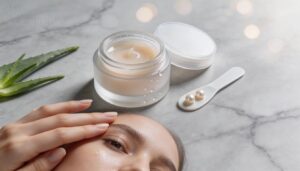
Think of moisturizer as the settling layer — it locks everything underneath in place. Apply about two pea-sized amounts to slightly damp skin using a patting application technique, pressing outward across cheeks and jawline.
Texture compatibility matters here: a gel-cream gives you humectant balance without heaviness. That silicone buffer role also reduces friction over actives, supporting your skin barrier protection without disrupting what’s already absorbing.
Step 6 – Finish With Broad-Spectrum SPF 30 or Higher

Sunscreen isn’t optional — it’s your morning routine’s final protective layer, and skipping it undoes everything beneath. Choose a broad-spectrum SPF 30 minimum for full UVA UVB coverage, and apply about half a teaspoon across face and neck.
Let it set two to three minutes before makeup. Water-resistant formulas hold up through commuting or light sweating, and reapplication timing matters: every two hours outdoors keeps your UV protection working.
How to Layer Your Evening Skincare Routine
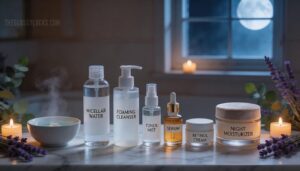
Your evening routine is where the real repair work happens — this is when your skin shifts into recovery mode and actives can do their deepest work. Getting the layering order right at night is just as important as it’s in the morning, and a few missteps can undo a lot of good.
Here’s exactly how to build your PM routine, step by step.
Step 1 – Double Cleanse to Remove Buildup
Start your evening by double cleansing — it’s the foundation, everything else builds on. An oil cleanser or cleansing balm melts through sunscreen films and makeup residue using gentle massage duration of 30–60 seconds.
Then your water-based cleanser emulsifies whatever’s left. Three things to nail it:
- Apply oil cleanser to dry skin to emulsify makeup residue properly
- Use lukewarm water for temperature control — hot water strips your barrier
- Rinse thoroughly, then pat dry for ideal post-cleanse hydration
Step 2 – Apply Toner or Exfoliating Mist
Once your skin is patted dry, toner is next. Hydrating mists work best on slightly damp skin — that surface moisture helps humectants like glycerin pull water into the outer layers more effectively.
Spray from about six inches away for even mist spray consistency, then press gently using your palms.
Pat vs rub isn’t just preference; patting prevents friction and reduces irritation. Allow 30–60 seconds absorption waiting time before moving forward.
Step 3 – Use Treatment Actives Like Retinoids or AHAs
Now comes the part where Retinoid Strength Selection and AHA Exfoliation Frequency actually matter. Beginners do best by starting retinol at 0.025–0.1%, working up slowly.
AHAs fit alternate nights, not daily.
Buffering and Sandwiching — moisturizer before and after your retinoid — eases irritation without killing efficacy.
Never combine both actives the same night; rotating them is your best Irritation Management Strategy.
Step 4 – Apply Night Eye Cream
Once your actives have settled, reach for your eye cream. Use a pea-sized amount and apply it with your gentle ring finger — it applies the least pressure on that delicate orbital bone area. Pat, don’t rub.
Nighttime eye hydration works best when you avoid product migration toward the lash line. Let it set before pillow contact to minimize irritation risk and support overnight repair.
Step 5 – Lock in Hydration With a Night Moisturizer or Facial Oil
Your final layer is what keeps all that hard work sealed in overnight. Think of it as the closing argument — your night cream or facial oil locks down the hydration boost you’ve built underneath.
- Occlusive agents like petrolatum or dimethicone create a silicone seal that slows water loss.
- Humectant synergy happens when glycerin pulls moisture inward before the oil texture settles over it.
- Application timing matters — apply to slightly damp skin for maximum absorption.
- Barrier repair moisturizers with ceramides support nighttime skin repair while you sleep.
Active Ingredient Compatibility and Common Layering Mistakes
Mixing the wrong actives together is one of the fastest ways to wreck your skin barrier — and it happens more often than you’d think. The good news is that most compatibility issues follow predictable patterns, so once you know the rules, you won’t have to guess.
Here’s what to watch for when building your routine.
Retinoids and AHAs/BHAs — Why Not to Combine Them
Think of retinoids and AHAs/BHAs as two strong-willed coworkers — productive separately, chaotic together. The acid retinoid conflict is real: both trigger exfoliation, stacking irritation mechanisms that can overwhelm your barrier damage risk threshold fast.
Retinoids and AHAs are productive separately but chaotic together — stacking them overwhelms your barrier fast
BHAs clear pores; AHAs resurface; retinoids accelerate cell turnover — all at once is too much.
Alternate nights instead, and always prioritize SPF to manage sun sensitivity increase during the adaptation period.
Vitamin C Pairings That Work and What to Avoid
Vitamin C plays well with the right partners. Pair it with ferulic acid for a measurable antioxidant boost and slower oxidation, then layer niacinamide on top for synergy that calms redness while brightening.
Add hyaluronic acid hydration to offset any tightness from vitamin C’s acidity.
Always finish with sunscreen as your final protective layer — and avoid acidic exfoliants same-application to prevent barrier irritation.
Be aware that caffeine interaction with vitamin C can increase gastrointestinal irritation.
Benzoyl Peroxide and Retinoids — Keep Them Separate
Benzoyl peroxide and retinol are both proven acne-fighters — but layering them together is like doubling down on irritation. Each stresses the barrier independently, so stacking them invites redness and peeling fast.
Instead, use an Alternating Night Schedule: retinol one night, benzoyl peroxide the next.
Apply benzoyl peroxide with Spot-Specific Application to affected zones only, and use the Moisturizer Sandwich Technique around retinol nights to buffer sensitivity.
How to Prevent Product Pilling Between Layers
Pilling usually comes down to one thing: rushing. When you don’t allow proper layering intervals — about 30 to 60 seconds between steps — each new layer drags through the previous one instead of bonding to it.
thin layer application, pat rather than rub, and avoid heavy occlusives beneath lighter formulas. silicone buffer moisturizer between serums and SPF also helps everything sit smoothly.
Simplifying Routines to Avoid Irritation and Overload
More products don’t mean better results — they often mean more irritation. A Minimalist Product Count approach, rooted in Barrier First thinking, is your smartest move when skin starts reacting.
- Patch Testing Basics: introduce one new active at a time
- Step Consolidation Strategy: combine hydration steps where possible
- Frequency Rotation Plan: alternate actives across nights
- Simplify layering order principles: to four core steps
How to Customize Layering for Your Skin Goals
one-size-fits-all routine doesn’t exist — your skin has specific needs, and your layering strategy should reflect that. Whether you’re fighting breakouts, fading dark spots, calming sensitivity, or getting ahead of fine lines, the right combination of actives makes all the difference.
Here’s how to tailor your routine to what your skin is actually asking for.
Acne-Prone Skin — BHA, Niacinamide, and Oil-Free Layers
If your skin breaks out easily, your layering order can either calm things down or quietly make them worse. Start with a BHA concentration between 0.5% and 2% salicylic acid, then follow with a niacinamide dosage around 4–5% to regulate oil. Finish with a noncomedogenic, oil-free moisturizer to protect your barrier without clogging pores.
| Pore-Clearing Sequence | Why It Works |
|---|---|
| BHA (salicylic acid) | Dissolves buildup inside pores |
| Niacinamide serum | Helps sebum control and calms irritation |
| Oil-free moisturizer | Seals hydration without comedogenic risk |
This layering order keeps your acne-prone skin regimen effective while managing irritation through thoughtful, noncomedogenic formulas.
Dull or Uneven Skin Tone — Vitamin C AM, Exfoliant PM
Where acne layering focuses on clearing, dull, or even tone calls for a brightness-first strategy. Use your morning skincare routine for Vitamin C — specifically L-ascorbic acid for proven results — and reserve your evening skincare routine for an exfoliating serum like lactic or mandelic acid.
Apply layering order principles: thinnest first, always. Before adjusting Vitamin C Concentration or Frequency Optimization, run a quick Patch Test Protocol.
Sensitive or Reactive Skin — Limiting Actives and Prioritizing Barrier Support
Reactive skin doesn’t need a complex routine — it needs a smarter one. Start with Gentle Patch Testing before introducing anything new, then keep your active ingredient compatibility and irritation prevention strategy simple:
- Use Low Frequency Actives — once or twice weekly max
- Apply a Silicone Buffer before retinoids
- Reach for Barrier Boosters like ceramides and panthenol
- Choose Soothing Pairings — niacinamide with barrier repair moisturizers
skin barrier will thank you.
Early Aging and Prevention — Antioxidants in The Morning, Retinol at Night
If sensitive skin called for restraint, early aging calls for strategy.
Your Morning Brightening Serum — ideally a Vitamin C serum — fights Oxidative Stress Reduction by neutralizing free radicals before they accumulate.
At night, Retinol rebuilds what daytime exposure breaks down.
| Routine Phase | Hero Ingredient | Goal |
|---|---|---|
| Morning skincare routine | Vitamin C serum | Antioxidant defense |
| Evening skincare routine | Retinol | Cell turnover |
| Both | Moisturizer | Barrier Reinforcement |
Follow Layering order principles — thinnest to thickest — for true Anti Aging Synergy.
Top 5 Products for Layering Skincare Correctly
Knowing the right layering order is only half the equation — the products you choose matter just as much. Some formulas are built to work well within a routine, with textures and ingredients that don’t fight each other or throw off your skin.
Here are five that earn a regular spot in a well-layered routine.
1. CeraVe Renewing Salicylic Acid Cleanser
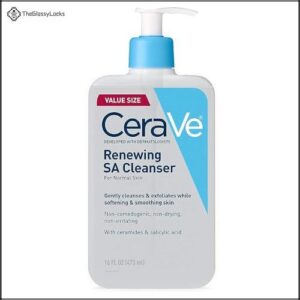
If your routine starts with the wrong cleanser, everything that follows pays the price. The CeraVe Renewing SA Cleanser earns its place as a first step because it does double duty — salicylic acid dissolves pore-clogging debris while ceramides NP, AP, and EOP actively protect your barrier during cleansing.
Niacinamide helps keep irritation in check, which matters when you’re layering actives afterward. It’s fragrance-free, non-comedogenic, and won’t strip your skin dry before your serums even have a chance to absorb.
| Best For | Anyone dealing with mild acne, clogged pores, or rough texture who wants an everyday cleanser that exfoliates without wrecking their skin barrier. |
|---|---|
| Fragrance Free | Yes |
| Skin Type | Acne-prone, dry, sensitive |
| Dermatologist Tested | Yes |
| Non-Comedogenic | Yes |
| Product Type | Foaming cleanser |
| Price (USD) | Not listed |
| Additional Features |
|
- Salicylic acid clears out dead skin and excess oil while ceramides and hyaluronic acid keep your barrier intact — so your skin doesn’t feel stripped after washing.
- Fragrance-free and non-comedogenic, making it a solid pick for sensitive or acne-prone skin types.
- Works on both face and body, so it pulls double duty if you deal with body acne or rough patches.
- It’s not going to cut it for moderate-to-severe acne — think of it more as a maintenance cleanser than a treatment.
- The foam is pretty light, so if you love a rich, sudsy lather, this one might feel underwhelming.
- Very sensitive or rosacea-prone skin can get dry or irritated with daily use — you’d want to ease in slowly.
2. BYOMA Barrier Repair Gel Cream
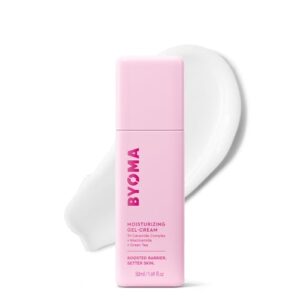
Sealing your routine with the right moisturizer makes or breaks how well your actives actually work. BYOMA Barrier Repair Gel Cream does exactly what a layering-friendly moisturizer should — it absorbs fast, sits weightlessly on skin, and doesn’t interfere with what came before it.
The tri-ceramide complex reinforces your stratum corneum while niacinamide calms redness and green tea antioxidants add backup protection.
At $14.99 for a fragrance-free, non-comedogenic formula, it’s a smart, barrier-focused step before your SPF.
| Best For | Anyone with sensitive, oily-combo, or redness-prone skin who wants a lightweight moisturizer that plays nicely under makeup and supports a solid skincare routine. |
|---|---|
| Fragrance Free | Yes |
| Skin Type | Dry, oily, combination, sensitive |
| Dermatologist Tested | Yes |
| Non-Comedogenic | Yes |
| Product Type | Gel-cream moisturizer |
| Price (USD) | $14.99 |
| Additional Features |
|
- The tri-ceramide complex plus niacinamide is a genuinely strong combo for calming irritation and keeping your barrier intact
- Oil-free and fragrance-free makes it a safe bet for sensitive or acne-prone skin without any guesswork
- At $14.99, a little goes a long way — twice-daily use stretches the bottle further than you’d expect for the size
- The 1.69 fl oz bottle feels small, and if you have very dry skin, this gel-cream probably won’t feel rich enough on its own
- It leaves a slight dewy finish, so if you want a truly matte look, you’ll need to set it with powder
- A handful of buyers have reported packaging issues like broken seals or missing outer boxes, which is worth keeping in mind when ordering
3. Neutrogena Hydro Boost Gel Cream Cleanser
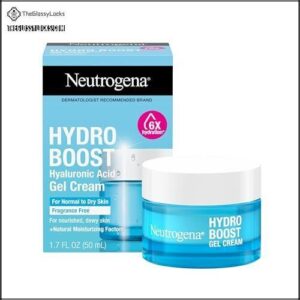
Cleansing is the foundation everything else builds on — and Neutrogena Hydro Boost Gel Cream Cleanser earns its spot here because it doesn’t strip your barrier before you’ve even started.
The gel-to-foam formula lifts dirt, oil, and makeup through water activation, not harsh surfactants. Hyaluronic acid works in the background to maintain surface moisture as you rinse.
It’s fragrance-free, non-comedogenic, and at $22.35 for the set, you’re getting a dermatologist-tested starting point that sets your layers up to actually absorb.
| Best For | Anyone with sensitive, acne-prone, or combo skin who wants a gentle, no-fuss cleanser that won’t wreck their skin barrier. |
|---|---|
| Fragrance Free | Yes |
| Skin Type | Normal, dry, oily, combination, sensitive |
| Dermatologist Tested | Yes |
| Non-Comedogenic | Yes |
| Product Type | Gel-cream moisturizer + cleanser set |
| Price (USD) | $22.35 |
| Additional Features |
|
- Fragrance-free and non-comedogenic — plays nice with even the most reactive skin
- Hyaluronic acid keeps moisture levels steady while you cleanse, so you’re not left feeling tight or stripped
- Works for basically every skin type, making it a solid pick for beginners building out a routine
- The trial-size cleanser (0.5 oz) runs out fast — you’ll be repurchasing before long
- Light, watery feel might not cut it for people with very dry or dehydrated skin
- Glass jar on the moisturizer looks great but isn’t the most travel-friendly option
4. Naturium Mandelic Acid Niacinamide Serum
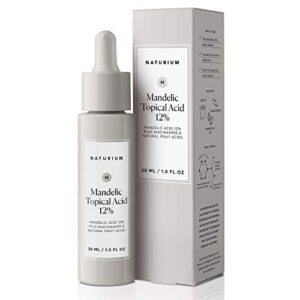
$20 for a serum for a serum that pairs 12% mandelic acid with niacinamide, Naturium’s formula punches well above its price point.
slower-penetrating AHA, which means it exfoliates without overwhelming sensitive or reactive skin.
support your barrier and keep irritation in check while the acid works.
lightweight gel texture absorbs quickly, layers cleanly under your moisturizer, and won’t pill under makeup — making it a practical AM or PM treatment option.
| Best For | Anyone dealing with hyperpigmentation, uneven texture, or breakouts who wants a gentle acid serum that won’t wreck sensitive skin — especially at a budget-friendly price. |
|---|---|
| Fragrance Free | Yes |
| Skin Type | Sensitive, dry, oily, combination, acne-prone |
| Dermatologist Tested | Yes |
| Non-Comedogenic | Yes |
| Product Type | Leave-on AHA serum |
| Price (USD) | $20.00 |
| Additional Features |
|
- Mandelic acid is slower-penetrating than most AHAs, so it exfoliates without the harshness — great for reactive or sensitive skin types.
- Niacinamide helps calm inflammation and support your skin barrier while the acid does its thing.
- At $20 for a leave-on serum that tackles aging, blemishes, and dark spots, the value is hard to beat.
- Daily use can lead to irritation, peeling, or tingling — you’ll want to stick to 2–3 times a week.
- Some users notice a cinnamon-like smell that takes some getting used to.
- You’ll need to wear SPF after using it, since AHAs increase sun sensitivity.
5. Versed Gentle Retinol Serum
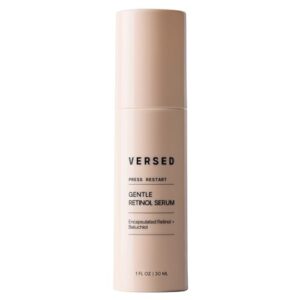
At $19.99, the Versed Gentle Retinol Serum is one of the most beginner-friendly retinol options you’ll find. Its microencapsulated retinol releases slowly, reducing peak skin exposure — which is exactly why it works for sensitive types who’ve struggled with retinol burn before.
Pair it with bakuchiol and aloe vera, and you get renewal without the redness.
Apply two pumps on almost-dry skin after cleansing at night, then follow with your moisturizer to lock everything in.
| Best For | Sensitive skin beginners who want anti-aging results without the redness and irritation that usually comes with retinol. |
|---|---|
| Fragrance Free | Yes |
| Skin Type | Sensitive, first-time retinol users |
| Dermatologist Tested | Yes |
| Non-Comedogenic | Not stated |
| Product Type | Night serum |
| Price (USD) | $19.99 |
| Additional Features |
|
- Microencapsulated retinol releases slowly, so your skin gets the benefits without the harsh hit
- Pairs retinol with bakuchiol and arophira — natural alternatives that soften the experience even more
- Fast-absorbing and unscented, so it fits easily into any skincare routine
- Results take time — don’t expect overnight changes; consistency over weeks is the real game
- A small number of users still experienced irritation or breakouts, so it’s not totally risk-free
- Effectiveness varies from person to person, and some users didn’t see the improvements they were hoping for
Frequently Asked Questions (FAQs)
What is the golden rule of skincare layering?
The golden rule is simple: go from thinnest to thickest. Start with lightweight, water-based layers and work up to heavier creams.
This order lets each product absorb properly without blocking what comes next.
What is the 1% rule in skincare?
The 1% rule means starting actives at low concentrations — around 5% to 1% — and introducing them slowly. It protects your skin barrier while your skin builds tolerance without irritation or setbacks.
Can you layer skincare over a fresh sunburn?
Layering skincare over a fresh sunburn is like pressing on a bruise — it only makes things worse. Skip actives entirely.
Stick to a gentle cleanser, a soothing fragrance-free moisturizer, and SPF if you’re heading outside.
Does the order change when skin is oily versus dry?
The core order stays the same for both.
Oily skin does better with lighter, water-based layers, while dry skin needs richer creams and a stronger final seal to lock moisture in.
How many products are too many to layer daily?
More products don’t mean better skin — they often mean more irritation. Most dermatologists agree that 3 to 6 products daily hits the sweet spot, keeping your barrier intact without overwhelming it.
Should layering routines change with the seasons?
Yes, your routine should shift with the seasons. Cold, dry air calls for richer occlusives and gentler actives. Heat and humidity mean lighter textures. Same principles, adjusted execution.
Can you apply skincare immediately after exercising?
Skip the serum right after your spin class. Let your skin cool down first — then cleanse, moisturize, and apply SPF if you’re heading outside.
Conclusion
Like a master builder, you’ve learned to construct a harmonious skincare routine, one layer at a time. By understanding the intricacies of pH, viscosity, and molecular weight, you’ve gained the power to realize your products’ full potential.
Now, as you begin your morning and nighttime rituals, remember that how to layer skincare products correctly is a journey, not a destination. With patience and practice, your skin will thank you for the TLC.
- https://www.thesun.co.uk/fabulous/28098429/skincare-dermatology-neutrogena-retinol-wrinkles-anti-aging/?utm_source=chatgpt.com
- https://cna.st/affiliate-link/28iSGvNLVT39oQegDVpm1G5rcQbZzEKpDXzbFoyeZicj956EgxoUkKSM4XVmjwPGQYdJy1WQg6mdNxQNB8tyoBoV2hHXeF3w3YuZuwc86GyXpGpABRzZ5YFD5cng43Xsv1We7tgasYMZWiUxgTznNwKcWuHmAp7VxsjKPhFZw83HBqVVR48Ldo2v2oC3wvmvD3dp86gU3ZRHrZ5LNttNKYf9s3LHGQiBLr59L75otxdnNAHNAoUKP2pzcYjCiu1vA3TLJagjfVMMQyVeAqe16QftZTcTGieqsfVRYhoVmMJuqvZkJzHRZkYFH6BV9TzaLPRjazwL4xHKvSdPdXEDMXkuwb6xRc27nU9N9