This site is supported by our readers. We may earn a commission, at no cost to you, if you purchase through links. This content is for general informational and educational purposes only and is not a substitute for professional medical, dermatological, or nutritional advice.

A bald patch doesn’t always mean the follicle underneath has died. In many cases it’s alive, just held in a resting state by signaling pathways like JAK-STAT and by the immune cells that surround it.
That changes the question. Reviving a follicle depends less on repairing structural damage than on shifting the inflammatory signals that keep it quiet, and the window matters, since prolonged dormancy can lead to fibrosis that sharply lowers the odds of recovery.
The treatments to stimulate dormant hair follicles range from FDA-approved drugs to light therapy and plant-based options, and each carries different evidence and different risks. Here’s how to match them to your situation.
Table Of Contents
- Key Takeaways
- Can Dormant Hair Follicles Be Revived?
- Medical Treatments to Stimulate Dormant Hair Follicles
- Microneedling and Light Therapy: Benefits and Risks
- Natural Follicle Treatments: Evidence and Safety
- Regrowth Timelines and When to Seek Help
- Frequently Asked Questions (FAQs)
- How to make dormant hair follicles active?
- Can dormant hair follicles be brought back?
- How can I stimulate hair follicle regrowth?
- How to stimulate follicles to grow?
- How can you tell if follicles are dormant?
- Do dormant follicles stay alive after years of baldness?
- Does caffeine shampoo help wake up sleeping follicles?
- Can stress or poor sleep keep follicles dormant?
- Conclusion
Key Takeaways
- Your bald patch likely holds living follicles that are held in a resting state by inflammatory signals, not destroyed, so reviving them depends on calming those signals, and you’ll want to act early because years of dormancy can lead to scarring that closes off recovery.
- Minoxidil is your most dependable starting point, with a prescription DHT blocker like finasteride as the next step if hormones are driving your loss, and the right choice depends on whether your thinning is androgenetic or triggered by something like low iron.
- Microneedling, red light therapy, and natural options like rosemary oil, saw palmetto, and scalp massage can support treatment, but each has limits, and microneedling in particular can scar and silence follicles if you use needles longer than 0.5mm or treat inflamed skin.
- You should expect extra shedding early, visible change around months four to six, and peak density near month twelve, and you should see a dermatologist if you’ve had no change after six months or your loss is sudden, patchy, or worsening.
Can Dormant Hair Follicles Be Revived?
Why do some bare patches stay bare while others fill back in? In most cases, your dormant hair follicles are still alive, just held in a resting state, and that’s what makes follicle reactivation realistic.
If your goal is fuller coverage on hair you already have rather than regrowth in empty spots, these thickening beard products for men are a better fit.
Research shows that signaling pathways such as JAK-STAT keep hair follicle stem cells quiet, and that blocking them can restart growth in both mouse and human studies. Surrounding immune cells also help maintain this pause, so the picture is more inflammatory than structural.
Timing matters, though, so act early. Follicles dormant for years may develop fibrosis, which sharply reduces your odds of revival. Most current approaches aim for hair growth phase extension or better topical treatment absorption, and results vary widely by hair loss type. Because surface-level checks can mistake resting follicles for permanently lost ones, a trichoscopic evaluation is needed to tell dormant from dead follicles before assuming the loss is permanent.
Medical Treatments to Stimulate Dormant Hair Follicles
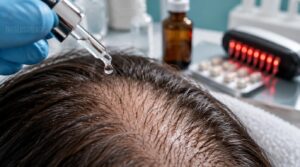
If you want dormant follicles to start producing hair again, medical treatments give you the most reliable and best-studied place to begin.
Below, you’ll find the options that carry real clinical evidence, along with what each one asks of you in time and caution.
Knowing how they differ will help you choose a realistic treatment plan with your dermatologist.
Minoxidil for Hair Growth
Minoxidil remains the most dependable option for hair follicle reactivation, though it works by nudging dormant hair follicles rather than rebuilding them.
Once converted to its active sulfate form, it shortens the resting phase of the hair growth cycle and extends growth.
Apply it to a dry scalp twice daily, expect shedding early on, and give it four months before judging results.
Prescription DHT Blockers and Safety
If minoxidil isn’t enough, a prescription DHT blocker may be next. Finasteride 1 mg daily is FDA-approved for hormonal hair loss, with sexual side effects in under 2% of men, usually reversible.
Since results vary from person to person, it helps to compare options side by side, and this guide to the best hair growth products for men can help you choose.
Dutasteride suppresses DHT more strongly but lingers for weeks and is off-label. Both are dangerous in pregnancy, so watch your mood and talk to a doctor.
Matching Treatment to Hair Loss Type
Which treatment helps depends on why your follicles went quiet. In androgenetic alopecia, where hair follicle miniaturization drives thinning, minoxidil and DHT blockers fit best, mostly at the vertex.
Telogen effluvium is different: fix the trigger, such as low ferritin under 30 ng/mL. After chemotherapy, minoxidil or platelet-rich plasma therapy may help, but results vary.
Microneedling and Light Therapy: Benefits and Risks

If medications alone haven’t given you the results you want, microneedling and light therapy are the two device-based options most often considered next. Both have real evidence behind them, and both carry limits you’ll want to understand before you buy or book anything.
Below, you’ll find the benefits and risks of each, so you can judge which approach fits your scalp.
Microneedling Benefits
Can a few hundred tiny punctures wake up a sleeping follicle? Microneedling, also called collagen induction therapy, suggests it might. The controlled micro-injuries trigger repair signals, including VEGF and PDGF, which may support hair follicle activation in dormant follicles.
Scalp stimulation also improves blood flow, and the micro-channels can help minoxidil absorb more deeply. Results appear strongest in combination.
Microneedling Risks
The same wound healing response that drives dermal papilla cell activity and follicle stem cell activation can turn against you. Microneedling carries three risks worth fearing:
- Infection from unclean needles.
- Permanent scarring that silences follicles.
- Chronic inflammation, undermining scalp inflammation reduction.
Avoid home needles beyond 0.5mm, skip treatment over active infections or dermatitis, and protect your scalp from sun afterward.
Light Therapy Benefits
Picture your follicles as tiny solar-powered batteries, sitting half-charged beneath the scalp. That’s roughly what photobiomodulation aims to fix.
Red light at 650 nm may boost mitochondrial ATP, helping follicles shift from telogen toward anagen, possibly via WNT signaling. Low-level light therapy also calms perifollicular inflammation and improves microcirculation, though results vary, and viable follicles respond best.
Light Therapy Risks
Worried that light is "too gentle" to cause harm? Lowlevel light therapy rarely does, but side effects exist.
Photobiomodulation and light wavelength therapy can cause:
- Scalp tingling or warmth
- Temporary shedding and itchiness
- Rare cold sore reactivation
- Rare melasma flare-ups
- Eye strain without protection
Wear eye protection during each laser therapy LLLT session, since red and near-infrared light can strain eyes.
Natural Follicle Treatments: Evidence and Safety

Natural options can support your follicles, but the evidence behind them ranges from reasonably solid to quite thin. Below, you’ll find four approaches, each with what research suggests and where the safety limits sit. Read them with realistic expectations, since none replaces medical treatment when hair loss is severe.
Rosemary Oil and Topical Alternatives
Itchy, red scalps ruin routines. Rosemary oil matched 2% minoxidil in a six-month trial, with less irritation.
| Option | Evidence | Irritation |
|---|---|---|
| Rosemary oil | Matched minoxidil | Low |
| Minoxidil | Established | Higher |
Topical hair growth serums use it. Dilute five drops in a teaspoon of carrier oil, add scalp massage, and wait months. It’s a natural DHT inhibitor, but it won’t revive scarred follicles.
Saw Palmetto and Pumpkin Seed Oil
Can a supplement really act as a natural DHT inhibitor? Partly. Saw palmetto blocks 5-alpha-reductase, and in one study 38% of men saw growth after 24 months on 320 mg daily.
Pumpkin seed oil raised hair counts 40% in 24 weeks at 400 mg. Neither rivals finasteride, so treat them as early-stage support for hair follicle regeneration, and check with your doctor first.
Scalp Massage and Inflammation Control
Unlike supplements, scalp massage costs nothing and carries almost no risk. Aim for four minutes daily with moderate pressure, enough to move the skin over the skull without irritating it.
It helps with inflammation control by improving lymphatic drainage and easing tension in the galea. Expect 24 weeks before any thickening shows, and use it alongside minoxidil, since massage may improve absorption.
Correcting Deficiencies Without Excess Supplements
Massage helps the scalp, but it can’t fix what’s missing from your blood. Test before you buy anything, since too much zinc or selenium can cause shedding of its own.
Ask your doctor to check:
- Ferritin, to confirm iron deficiency
- Vitamin D
- Zinc and B12
- Omega3 intake, through diet review
Correct gaps with food first, then retest in three to six months.
Regrowth Timelines and When to Seek Help

Whatever route you take, hair regrowth runs on a slow biological schedule, so patience matters as much as the product. Hair follicle cycling means the telogen to anagen shift takes weeks to begin, and you may see extra shedding in the first 2 to 8 weeks. Visible improvement usually appears between months 4 and 6, with peak density around month 12. Follicular autophagy, the cellular recycling that helps follicles adapt to stress, is still being studied, so don’t expect a supplement to speed things up.
Hair regrowth runs on a slow biological schedule, with visible improvement around months four to six and peak density near month twelve, so patience matters as much as the product
Stop treatment and gains usually fade within 3 to 6 months.
See a dermatologist if loss is sudden, patchy, or worsening, or if six months of use brings no change. Discuss clinical hair restoration methods.
Frequently Asked Questions (FAQs)
How to make dormant hair follicles active?
Picture a thinning crown that’s stalled for two years.
You can wake it gently by encouraging hair follicle cycling: microneedling every four weeks stimulates the dermal papilla, raises VEGF expression, and helps lasting follicle regeneration.
Can dormant hair follicles be brought back?
Yes, often, if your follicles are dormant rather than dead. Dormant follicles keep their dermal papilla intact, so treatment can trigger the telogen to anagen shift. Scarred follicles can’t regenerate, and that’s where you’ll hit a limit.
How can I stimulate hair follicle regrowth?
Start with 5% topical minoxidil, which helps push resting follicles from telogen to anagen and may support follicle miniaturization reversal. Add daily scalp massage to apply mechanical stretching to the dermal papilla, and give it six months.
How to stimulate follicles to grow?
To stimulate follicles, combine minoxidil with microneedling, which activates WNT signaling and drives the telogen to anagen shift. Add a DHT blocker if androgens are the cause, and expect visible follicle miniaturization reversal after months.
How can you tell if follicles are dormant?
Look closely at thinning areas for fine, colorless peach fuzz or visible pores, since these suggest an intact dermal papilla and a follicle stuck in the telogen phase. A smooth, shiny scalp points toward scarring instead.
Do dormant follicles stay alive after years of baldness?
Picture a dormant bulb in winter soil: nothing shows above ground, yet the root holds. Likewise, your follicles often survive years of baldness, stalled in telogen, unless scarring has replaced them, and trichoscopy can confirm viability.
Does caffeine shampoo help wake up sleeping follicles?
Picture a man who’s used caffeine shampoo for three months and sees less shedding. Caffeine may support hair follicle metabolism and prolong the anagen phase, yet it’s supportive only. Don’t expect it to rival minoxidil’s mechanism of action.
Can stress or poor sleep keep follicles dormant?
Yes, they can. Chronic stress and sleep deprivation keep cortisol elevated, which likely stalls follicle stem cells in the resting phase. Your follicles stay intact, so sleep and stress recovery may restore growth.
Conclusion
You might wonder whether a long-bald area is a lost cause. Not necessarily, though time narrows your odds, so act early. The best treatments to stimulate dormant hair follicles work by calming the signals that keep them quiet, and each option carries its own evidence and risks.
Start with a proper diagnosis, choose the approach that fits your hair loss type, and give it six months before judging. Your follicles may be waiting, not gone.