This site is supported by our readers. We may earn a commission, at no cost to you, if you purchase through links. This content is for general informational and educational purposes only and is not a substitute for professional medical, dermatological, or nutritional advice.
In 2002, a shampoo with 5% tea tree oil cut dandruff severity by 41% in four weeks. The placebo managed 11%. That gap is hard to ignore.
Yet the research on natural oils for dandruff control isn’t uniform. Some oils show clear antifungal effects against Malassezia, the yeast linked to flaking. Others may feed it, especially on an oily scalp. Strength, dilution and timing all change the outcome.
You don’t need to guess. Here’s what the studies say about five popular oils, and how you can use them without irritating your skin.
Table Of Contents
- Key Takeaways
- When Natural Oils Help Dandruff
- 5 Natural Oils for Dandruff Control
- Choosing and Diluting Dandruff Oils Safely
- Applying Natural Oils Without Worsening Dandruff
- When Dandruff Needs Shampoo or Medical Care
- Frequently Asked Questions (FAQs)
- What is the best natural oil to use for dandruff?
- Which oil is best to stop dandruff?
- What kills dandruff fast naturally?
- How do Koreans get rid of dandruff?
- How long until natural oils reduce dandruff?
- Can castor oil help stubborn dandruff?
- Does olive oil worsen or improve flaky scalp?
- Is peppermint oil safe for sensitive scalps?
- Can children use essential oils for dandruff?
- Conclusion
Key Takeaways
- Tea tree oil has the strongest evidence, since a 2002 trial found a 5% shampoo cut dandruff severity by 41% in four weeks, compared with 11% for placebo.
- Lemongrass, coconut, MCT and neem oils show promise in small or lab studies, but you shouldn’t expect guaranteed results because human evidence is still limited.
- You’ll want to dilute essential oils in a carrier oil at 0.5 to 1 percent (never above 2 to 3 percent), patch test first, and skip oils on broken or inflamed skin.
- Oils work best as a calm-scalp add-on rather than a cure, so if flaking lasts four to six weeks despite medicated shampoo, or you notice redness, swelling or oozing, see a doctor.
When Natural Oils Help Dandruff
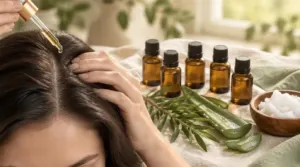
Most people with mild to moderate dandruff may see benefit from natural oils, but only in the right situation. Dandruff often involves Malassezia, a yeast that feeds on scalp sebum. Some oils, such as tea tree oil, may disrupt that yeast. Evidence remains limited, so don’t expect miracles.
If you’re still weighing which oil suits your scalp, this comparison of argan oil versus jojoba oil for hair explains how their textures differ, which matters when flaking is oil-driven.
Current scalp oiling evidence doesn’t establish oils as a universal treatment, since a 16-week study of 140 women found microbiome shifts but no clinical proof of reduced dandruff.
Oils tend to work best on oily or fungal dandruff when your scalp is calm. They can help as a preventive step or an addition to shampooing. They don’t replace medicated shampoo during a flare-up.
Skip oils if your skin is inflamed, broken, or weepy. Heavy oils like coconut oil may add fuel for yeast on an oily scalp. Lighter jojoba oil or soothing aloe vera may suit scalp health better.
5 Natural Oils for Dandruff Control
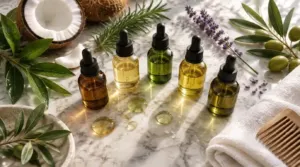
Not every natural oil has the same level of research behind it. Below, you’ll find five oils, ranked from strongest evidence to the most preliminary findings. Each one may help your scalp, but you’ll want to keep the limits of the research in mind as you read.
Tea Tree Oil: Strongest Clinical Evidence
A 2002 trial offers the strongest clinical evidence for tea tree oil. A 5% shampoo improved dandruff severity by 41% after four weeks, versus 11% for placebo. Itching and greasiness dropped too.
Because tea tree oil is potent, always dilute it in a carrier oil, and if your scalp runs greasy, this dandruff treatment guide for oily scalps offers helpful routines.
Its antifungal properties come mainly from terpinen-4-ol, which may damage Malassezia cells. You could notice less itching within two weeks. Flaking often eases by week four. No trials compare it with ketoconazole.
Lemongrass Oil: Promising Tonic Research
Among natural remedies, lemongrass is less potent than tea tree oil, but it has its own research. A 2015 trial of 30 adults found a 10% lemongrass tonic cut dandruff by 81% in 14 days. The antifungal properties come from citral.
Don’t apply neat essential oil. Tonic results may not match a 1% mixture, and scalp health evidence remains limited.
Coconut Oil: Scalp Microbiome Research
Coconut oil works differently from the oils above. Its appeal lies in the scalp microbiome rather than strong antifungal properties.
Research suggests coconut oil may raise Malassezia globosa, a fungus linked to healthy scalps, while lowering Malassezia restricta in dandruff. In a 16-week study, the ratio moved toward healthy baseline levels.
Evidence remains limited, so don’t expect guaranteed dandruff results.
MCT Oil: Limited Clinical Evidence
A small 2018 lab study found that MCT oil slowed Malassezia growth at 5% concentration. That’s the main finding so far. No clinical trials have tested it on human scalps, so the evidence remains limited.
MCT oil’s antifungal properties may be weaker than coconut oil’s. It could help with scalp moisturization, though. Among natural dandruff remedies, treat it as a gentle extra, not a proven fix.
Neem Oil: Preliminary Antifungal Findings
Neem oil shows antifungal properties against Malassezia in lab studies, though human trials remain limited. It may be one of several natural antifungal agents worth considering. Protect your scalp microbiome and your peace of mind:
- Patch test before every use.
- Keep it at 5-10% strength.
- Store it away from light.
- Stop if your scalp stings.
- Stay hopeful, but stay realistic.
Choosing and Diluting Dandruff Oils Safely
Think of an essential oil as a spice, not a sauce. A little changes everything, and too much ruins the dish.
Treat essential oils like spice, not sauce: a little transforms everything, while too much ruins the dish
Essential oil safety starts with carrier oil dilution. Tea tree oil, with its antifungal properties, may irritate your scalp if you apply it straight. Mix it into a cold-pressed carrier like jojoba or coconut oil. Start at 0.5 to 1 percent, which is about 3 to 6 drops per tablespoon, and don’t go past 2 to 3 percent.
- Patch test behind your ear for 48 hours.
- Store mixtures in dark glass bottles and label the date.
- Avoid clear plastic containers, which may degrade oils faster.
- Discard any mixture that smells off or separates.
- Reduce it if burning occurs.
Applying Natural Oils Without Worsening Dandruff
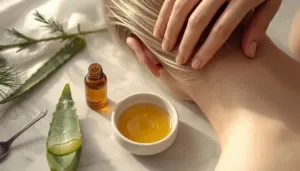
You might think more oil means more relief. It may backfire. Extra oil can feed Malassezia and upset your microbial skin balance.
Apply oil only to your scalp, not the hair shafts. Warm it slightly, then massage with fingertips in gentle circles for 5 to 10 minutes. Leave it on for 30 minutes at most, and use it no more than twice weekly.
Jojoba or grapeseed suits an oily scalp, while heavy coconut oil may worsen it. Dilute tea tree oil at 2 to 3 drops per tablespoon, and patch test first.
Skip broken or inflamed skin, which may weaken skin barrier function. Aloe vera could soothe afterward. Wash with sulfate-free shampoo, and stop if redness or itching increases.
When Dandruff Needs Shampoo or Medical Care

Oils can’t fix everything. Sometimes the flaking points to a problem that needs more than a bottle from your shelf.
If flakes last four to six weeks despite regular use of an OTC dandruff shampoo, see a doctor. You may have psoriasis or a fungal infection.
Redness, swelling, pain, crusting, or oozing could signal infection. Get care promptly. Flaking or irritation that spreads to your face, ears, chest, or eyelids often points to seborrheic dermatitis, and a dermatologist can confirm it.
Seek help if you notice hair loss in affected areas, or if symptoms disrupt your sleep or daily life. If you have a weakened immune system, call a provider as soon as new or severe scalp symptoms appear.
Frequently Asked Questions (FAQs)
What is the best natural oil to use for dandruff?
You’ll find a thousand oils promising to wipe out dandruff overnight, but tea tree oil is the one with real proof. A 5% tea tree shampoo cut dandruff by 41% in one trial. Patch test first.
Which oil is best to stop dandruff?
Tea tree oil has the strongest evidence. A 2002 trial found a 5% shampoo improved dandruff by 41%, versus 11% for placebo. This antifungal treatment may help your scalp health, though coconut oil and other essential oils have less proof.
What kills dandruff fast naturally?
In one study, 5% tea tree oil cut dandruff severity by 41% in four weeks. You could try it diluted in a carrier oil, but it may not work fast. Skip baking soda and apple cider vinegar.
How do Koreans get rid of dandruff?
You might think a quick shampoo fixes everything, but Korean clinics first identify your dandruff type. They then use tea tree oil products, light oils like jojoba, and medicated shampoos. Skip coconut oil on oily zones.
How long until natural oils reduce dandruff?
Patience pays off here. You may notice less itching within 1–2 weeks, but visible flaking usually eases around 3–4 weeks. Full control of dandruff often takes 6–8 weeks of consistent use.
Can castor oil help stubborn dandruff?
Castor oil may ease flaking, but it won’t treat the cause. Its antifungal properties look weak, and one study found no effect on Malassezia. Moisturizing your scalp may help with flake reduction, so use it cautiously.
Does olive oil worsen or improve flaky scalp?
Many people try olive oil on a flaky scalp, hoping for scalp hydration. It may loosen scale, but it won’t treat the cause. Malassezia yeast can feed on it, so your flaking could also worsen.
Is peppermint oil safe for sensitive scalps?
Think of peppermint oil as a strong cooling signal, not proof of safety. On sensitive scalps, it may irritate or trigger allergy. Evidence for dandruff is limited, so don’t skip proven shampoos for natural oils.
Can children use essential oils for dandruff?
A child’s scalp is a young garden, and it needs gentle hands. Essential oils like tea tree oil may help children over 3, but only diluted, at 5%. Coconut oil is milder. Skip peppermint.
Conclusion
That 41% drop in dandruff severity, against 11% for placebo, shows what a well-tested oil can do. Most oils don’t have that backing, though. Tea tree has the strongest evidence, while lemongrass, coconut, MCT and neem remain less certain.
Treat natural oils for dandruff control as a patch-tested, diluted option, not a cure. If flaking persists or your scalp burns, switch to a medicated shampoo or see a doctor. Your scalp rewards caution, not guesswork.