
This site is supported by our readers. We may earn a commission, at no cost to you, if you purchase through links. This content is for general informational and educational purposes only and is not a substitute for professional medical, dermatological, or nutritional advice.

Your ears have been quietly growing a fringe, and your razor was never invited to the party. One stray tuft poking out at a wedding photo can undo a very sharp suit, and a nick from a wrong tool stings far longer than the mistake lasts.
The good news: ear hair trimmers for men now come with rounded tips, foil guards, and blades that glide instead of yank. Some run on one AA battery, others charge over USB-C, and a few shrug off water entirely.
We tested the field so you can match a tool to your habits, then trim with total control.
Table Of Contents
Key Takeaways
- Pick a trimmer with a rounded, guarded tip (like a foil guard or rotary head) so you get control without nicks or tugging.
- Choose your power source to match your habits: AA-battery models are cheap and travel-friendly, while rechargeable ones cost more upfront but deliver steady power and save money over years.
- Keep your trimmer working well by brushing out the blades, wiping them with 70% isopropyl alcohol, letting them air-dry, and adding a drop of trimmer-specific oil every few weeks.
- Trim only the visible hair at the ear entrance every two to three weeks, never inside the canal, and skip plucking, waxing, or scissors.
Best Ear Hair Trimmers for Men Reviewed
Ear hair has a way of showing up uninvited (and overstaying its welcome), so we rounded up five trimmers that keep you in control without the nicks. Each one earned its spot by being safe, easy to handle, and worth the money if that’s your bag. Here’s the lineup, so you can pick the one that fits your routine.
If you’d like a closer look at how each model handles safety and comfort, our best electric trimmers for ear hair guide breaks down the details.
1. MicroTouch MAX Lighted Personal Trimmer
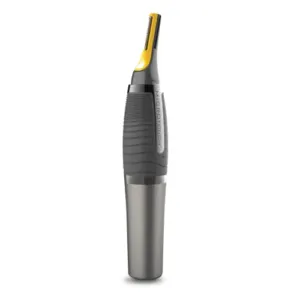
Grab this trimmer if you want something that earns its spot in the bathroom drawer without much fuss. The built-in LED light is the headline act, helping you spot stray hairs in your ears and nostrils (those dim corners where mistakes love to hide). Weighing just 3.17 ounces, it runs on one included AA battery, so you can toss it in a travel bag.
Be warned, though: some users report the light failing, and a few units quit within a month.
- Built-in light makes it easier to see stray hairs in hard-to-reach spots like nostrils and ears
- Lightweight at 3.17 ounces and powered by one included AA battery, so it packs easily for travel
- Rubber non-slip grip and included cleaning brush add comfort and easy upkeep
- Some users report the light failing to turn on
- A few units have broken within a month of use
- Feedback on reliability, quality, and value for money is mixed
Philips Norelco Nose Trimmer 3000
If dim lighting and flaky units worry you, the Philips Norelco Nose Trimmer 3000 trades the gadgetry for a sturdier idea. Its ProtecTube technology puts an ultra-thin foil guard with rounded tips between skin and blades, so you get control without nicks (or tugging, since hairs can’t snag between the moving cutters).
Since battery-powered, water-resistant models like this one are easy to rinse clean, it helps to know what to look for in a nose and ear trimmer before you buy.
The soft-touch grip helps, and a battery’s included. Cleanup is simple too, since you only need to rinse the trimming head under water and dry it before storage.
Panasonic ER-GN30-H
Prefer a trimmer you can rinse like a dinner plate? Panasonic’s wet/dry ear and nose hair trimmer, the ER-GN30-H, is fully waterproof, so shower trimming is fair game.
Its rotary attachment and curved skin protection design keep control in your hands, while the vacuum cleaning system flushes hair out in seconds.
One AA battery (not included) gives you 90 minutes.
Wahl Micro Groomsman
If rinsing isn’t your thing, the Wahl Micro Groomsman keeps it simple with one AAA battery, included, and roughly 60 minutes of runtime. At 1.6 ounces, it’s a slim, pen-like trimmer you can use wet or dry.
For a closer look at what makes pen-style trimmers like this one cut so gently, how nose and ear trimmers work breaks down the blade design behind it.
The rotary head controls nose and ear hair without pulling, and the detail head adds 2mm and 4mm combs. It’s built for light touch-ups, not full beards.
Manscaped Weed Whacker 2.0
A 7000 RPM motor drives this Manscaped electric nose and ear trimmer, and the dual blades barely tug. Here’s what we like:
- Wet/dry capabilities, so shower trimming works.
- Rinse it to self-clean.
- Forty-five minutes per charge.
- Rubberized grip keeps control.
- Lightweight at 0.28 kg.
Don’t expect an LED display, and the built-in battery means battery-operated grooming ends when it dies.
Comparing Ear Trimmer Blades and Comfort

Steel blades are the workhorse of the ear trimmer world (rust-proof, tough, and kind to your wallet), but they dull sooner and run warm, so long sessions can leave your ear feeling like it’s been sunbathing.
Ceramic costs more and chips if you drop it, yet it stays cooler, hums more quietly, and keeps its edge far longer, which is real blade longevity if you ask us.
Titanium-coated blades sit in the middle: harder, lighter, and rust-resistant, though the coating can wear thin eventually.
Rotary heads shield your skin, so they’re the safer pick for painless trimming inside the ear. Add a linear blade for stubborn hairs, and a dual blade setup covers nose and ear without a second gadget.
Battery-Powered Versus Rechargeable Ear Trimmers

Disposable power gives you convenience today, while a rechargeable gives you savings tomorrow (and that trade-off is the whole story here). A trimmer running on an AA battery costs little up front, runs about 30 to 60 minutes per set on alkaline cells, and needs zero charging, so it’s your travel buddy when an outlet is nowhere in sight. The catch? Power fades gradually as the cells drain, and there’s no gauge to warn you.
Rechargeable models cost more at the start, but they hold steady power the whole way through, often 45 to 120 minutes per charge. Most top up over USB-C in roughly 1.5 to 3 hours, and an LED indicator tells you when to recharge. Expect around 300 to 500 cycles before capacity dips to 80 percent. If you trim weekly, that’s years of use.
Cleaning and Maintaining Your Ear Trimmer

Think a tiny trimmer doesn’t need much care? Fair, but a head clogged with hair and wax pulls instead of cuts, and that’s the last thing you want near your ear canal.
Power it off and pop out the battery first (a motor that wakes up mid-clean is a story nobody wants to tell). Then brush the blades gently, and use a lint-free cotton swab for the tight corners. After that, wipe the blades with 70% isopropyl alcohol, which takes care of hygiene maintenance in about 30 seconds. Skip soaking the whole thing, and let every part air-dry before reassembly. If you want exact drying times and a few oil recommendations, this step-by-step guide to cleaning a nose and ear trimmer properly covers them.
Every two to four weeks, add a drop of trimmer-specific oil. Coconut or olive oil turns sticky. Leave those in the kitchen.
How to Trim Ear Hair Safely
Think of your ear canal as a no-fly zone (and your trimmer as a very nervous pilot). We stick to the visible fringe, and you should too.
Treat the ear canal as off-limits airspace, and keep your trimmer flying cautiously along the outer edge where you can see
- Shower first, since warm water softens hair.
- Wash and dry your outer ears.
- Grab a mirror and good lighting.
- Trim only hair at the ear entrance, never inside the canal.
- Wipe away clippings with a damp cloth.
Scissors and tweezers don’t belong anywhere near the canal, and waxing is a bad idea (burns and blockages aren’t a fun trade for tidiness). Pick a trimmer with a guarded tip, a comfy ergonomic grip, and wet/dry capabilities if you like shower sessions.
Finish by cleaning the blade, and stop if redness or pain shows up.
Frequently Asked Questions (FAQs)
How often should men trim their ear hair?
Ear hair is a bit like a lawn in spring: ignore it for a month and suddenly it’s staging a coup. Trim every two to three weeks, and swing back sooner if you spot stray hairs poking out.
Why does ear hair grow thicker with age?
Picture your dad at 60, squinting in the bathroom mirror at tufts that weren’t there when you were a kid. Blame testosterone: your ear follicles grow more sensitive to it over time, turning fine vellus hairs into stiff terminal ones.
Do ear hair trimmers work on nose hair?
Funny how the tool built for the one spot you can’t see turns out to handle the spot you can. Yes, ear hair trimmers work on nose hair, since rounded, guarded tips keep blades off your skin.
Is ear hair removal better than trimming?
One ear-hair photo op at a wedding is enough to make anyone reach for a plucker, but don’t. For most guys, trimming wins: it’s painless trimming with zero root trauma, while plucking and waxing invite infection.
Can women use ear hair trimmers too?
Absolutely, and your ear hair trimmers don’t care who’s holding them (the blades and motor do the work, not the marketing). Just trim visible hair at the opening, never deep inside the canal.
Conclusion
Pick the blade that suits your skin, pick the power source that suits your routine, and pick the pace that suits your nerves. That’s the whole game with ear hair trimmers for men, and it’s a surprisingly easy one to win (no steady-hand surgery required).
Rinse the head after every session, keep light pressure on, and trim only what peeks out. Slow and shallow beats fast and fearless every time. Your ears will thank you.