
This site is supported by our readers. We may earn a commission, at no cost to you, if you purchase through links. This content is for general informational and educational purposes only and is not a substitute for professional medical, dermatological, or nutritional advice.

Your brush hits the bowl wall on the third swirl, and a fine spray of lather lands on the mirror. Nobody warns you that a bowl can sabotage a perfectly good brush.
The culprit is usually size. A bowl that’s too narrow crowds the bristles, one that’s too shallow lets lather escape, and a heavy one tires your wrist before the second pass. Knowing how to choose the right size shaving bowl means matching diameter, depth, and weight to the brush you already own.
Get those numbers right, and the rest, from grip to material, falls into place without much guesswork.
Table Of Contents
- Key Takeaways
- What Shaving Bowl Size Should You Choose?
- Match Shaving Bowl Size to Your Brush
- Choose a Secure Grip and Comfortable Weight
- Evaluate Interior Texture Without Sacrificing Brush Space
- Compare Shaving Bowl Materials for Everyday Use
- Pick a Bowl Design for Your Routine
- Frequently Asked Questions (FAQs)
- Conclusion
Key Takeaways
- Aim for a bowl with a 4 to 5 inch interior diameter and 2.5 to 3 inches of depth, so your brush has room to swirl without clipping the walls or letting lather escape.
- Match the bowl to your brush by making sure the knot fills roughly 40 to 60 percent of the bowl’s width and the loft is 50 to 80 percent of its depth, with larger knots needing wider bowls.
- Pick a grip and weight you can hold comfortably for two minutes, since lather is slippery and a bowl that’s too heavy tires your wrist while a light one gets knocked over.
- Treat texture, material, and design as fine tuning: ridges and wood speed up lather, ceramic holds heat, and palm bowls, mugs, or scuttles each suit different routines.
What Shaving Bowl Size Should You Choose?
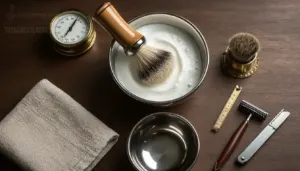
Bowl size comes down to two measurements, and getting them right saves you from lather on the counter. You’ll look at width and rim space first, then at how deep the walls run. Each one affects how freely your brush moves and how much soap stays where you want it.
Once your bowl suits your brush, these shaving cream application techniques for face show how to work the lather onto your skin.
Interior Diameter and Rim Width
Width decides whether your brush works or just sulks. Aim for an interior diameter of 4 to 5 inches, which gives the knot room to splay and swirl without clipping the walls. Go narrower and lathering turns into stirring.
Check rim width too. A thin rim at the top, under 4 inches, can snag bristles and cause splashing. One popular example measures about 125mm across the top, and its raised rib texture whips up a heady lather in 20-30 seconds.
Bowl Depth and Sidewall Height
Width gets the brush in the door, but depth decides how much lather you keep. Aim for 2.5 to 3 inches if you want a full face’s worth without a slow drip down your wrist.
Sidewall height matters too. Walls should sit taller than your brush knot height, so bristles don’t splay. Deeper bowls also hold heat longer, which keeps the lather friendlier.
Match Shaving Bowl Size to Your Brush
Once you know your bowl’s width and depth, hold those numbers up against your brush. A knot should take up roughly 40 to 60 percent of the interior diameter. A 22 to 24 mm knot is happy in a bowl between 100 and 125 mm wide. Go to 26 mm or larger and you’ll want at least 4.5 inches inside, or the bristles will scrape the rim.
Once the size is sorted, it’s worth comparing the best shaving bowl materials to see which suits your routine.
Loft matters just as much. Aim for a loft that’s 50 to 80 percent of the bowl’s depth, so the handle never knocks the bottom. Short brushes under 45 mm suit shallow bowls. Anything over 55 mm needs 2.5 inches or more of depth.
A long handle adds one more demand: sidewall clearance of at least 2 inches. Fan-shaped knots also want extra width.
Choose a Secure Grip and Comfortable Weight

Size gets the bowl onto your counter. Grip decides whether it stays in your hand. Lather is slippery by nature, so wet hand grip deserves as much thought as bowl size compatibility.
A good ergonomic grip usually comes from a few features:
- A finger well or contoured side that suits your palm
- An undercut rim or wide lip your thumb can catch
- Sandblasted or textured outer surfaces
- A silicone foot-ring or wrapped handle
- A bottom ridge to anchor your fingers
Weight is a trade-off. Heavy copper or stainless steel adds countertop stability, but it can tire your wrist mid-lather. Light polymer is easier to knock over. Aim for a material weight you can hold for two minutes without any strain.
Evaluate Interior Texture Without Sacrificing Brush Space
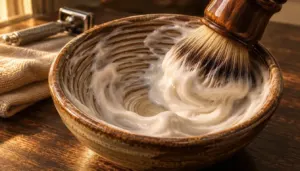
Why does a bowl with ridges lather faster than a smooth one? Shear. Good interior texture works like blender ridges, turning soap or cream into stable foam, and it can raise lather yield by 20 to 30 percent over a smooth bowl.
Pairing that textured interior with a ceramic or porcelain build also helps hold heat, so browse these best shaving bowls by material and design before you buy.
But texture costs you brush space. Keep a 4-inch interior diameter and 2.5 to 3 inches of depth so your brush swirls inside the textured zone without clipping the walls. A flat center spot helps too, since it holds cream and stops it sliding.
Choose gentle ridges over sharp ones, since bristles should flex slightly, not snag. Wood grain and spiral ridges manage that, though material porosity still varies. Better lather retention keeps foam ready until the blade arrives.
Compare Shaving Bowl Materials for Everyday Use
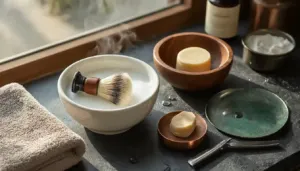
You’ll notice right away that material changes how a bowl behaves, not just how it looks. Ceramic holds heat well, so your lather stays warm through a full shave, but its smooth interior makes building lather slower, and one drop can end its career.
Wood is the opposite on texture. Its rough interior grips soap and brush bristles, so lather comes faster. Pre-soak it in hot water for decent heat retention, and dry it properly, or it warps and starts to smell.
Plastic and metal are the practical pair. They’re tough, cheap and easy to maintain, but they lose warmth quickly and build lather slowly. Some metals, copper especially, develop a patina.
Pick the trade-off you can live with every morning.
Pick a Bowl Design for Your Routine
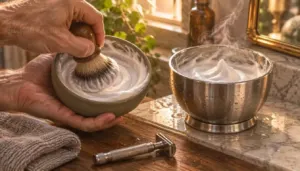
Size and material only get you so far, because the shape of the bowl decides how it fits into your morning. Some routines suit a bowl you can hold, while others call for one that stays put or keeps your lather warm. Here are the two design choices worth weighing before you buy.
Palm Bowls Versus Countertop Bowls
Think of it as a choice between a tool you hold and a tool that holds still.
Some shavers want a bowl cradled in the palm, others one that stays planted on the counter while the brush works
A palm bowl sits in your hand, so you can lather with real vigor and no slipping. It’s lightweight, travels well, and rewards a steady wrist. The catch is a smaller space, so lather can escape over the sides.
Countertop bowls are heavier and wider, which keeps them planted and gives your brush room.
When Mugs or Scuttles Fit Better
A bowl sits in your palm, but a mug or scuttle sits on the counter and asks for a different kind of attention.
Choose a mug if you load soap pucks or sticks and want a deep interior with a secure handle. Choose a scuttle for cold mornings and multi-pass shaves, since the hot water chamber keeps lather warm. In summer, skip it.
Frequently Asked Questions (FAQs)
Is a shaving bowl necessary for face lathering?
Is it true you need a bowl to make real lather? Not quite. Face lathering skips it entirely: wet the brush, load it, and work usable lather onto your skin in well under a minute.
How do you remove soap residue from a bowl?
Why let soap harden into a crust? Rinse the bowl with warm running water right after shaving. If buildup lingers, soak it, then scrub gently with a soft sponge or old toothbrush, and dry thoroughly.
Can a shaving bowl double as a soap storage container?
Yes, if it has a lid. A tight-fitting lid keeps dust and debris off your soap puck between uses. An open bowl won’t protect it, and the soap dries out. Match the bowl to the puck’s width.
Can you travel with a shaving bowl safely?
A collapsible silicone bowl weighs under 3oz, so yes, you can travel safely. Plastic is the most durable pick, while ceramic needs wrapping in socks. Pack it in a padded dopp kit before you fly.
How often should a shaving bowl be replaced?
A good shaving bowl ages like a cast-iron pan: it rarely quits, it just tells you when. Replace it when you spot cracks, chips, or rust, or when scratches ruin your lather quality.
Conclusion
Bowl, brush, and bristles belong together. Knowing how to choose the right size shaving bowl comes down to a few honest numbers: a diameter that gives your knot room to swirl, enough depth to keep lather home, and a weight your wrist won’t resent.
Grip, texture, and material are the fine tuning. Get the size right first, and the rest is preference. Your brush has been waiting for a proper partner, so give it one.