
This site is supported by our readers. We may earn a commission, at no cost to you, if you purchase through links. This content is for general informational and educational purposes only and is not a substitute for professional medical, dermatological, or nutritional advice.

Your dry whiskers are about as tough as copper wire of the same thickness. No wonder a dull pass of the razor leaves you red and tugging.
That’s where the benefits of using natural shaving soap start to show. Tallow-based lather holds its volume for 4 to 6 minutes, cushions the blade, and softens each hair before it gets cut. The payoff goes past comfort, too. Soap can trim your per-shave cost to about $0.30 and cut plastic waste.
Here are five reasons we think a humble puck deserves a spot on your sink, and how each one helps you shave with more control.
Table Of Contents
- Key Takeaways
- Natural Shaving Soap Supports Smooth, Protected Razor Glide
- Moisturizing Ingredients Help Maintain Skin Comfort
- Fragrance-Free Formulas Help You Avoid Fragrance Irritants
- Long-Lasting Shaving Soap Can Lower Per-Shave Costs
- Natural Shaving Soap Can Reduce Packaging Waste
- Frequently Asked Questions (FAQs)
- Conclusion
Key Takeaways
- A dense tallow-based lather cushions the blade, softens your whiskers, and leaves a thin slick film behind, so every pass glides with less tugging and irritation.
- Moisturizing ingredients like glycerin, shea butter, and coconut oil keep your skin comfortable, and some shavers find they can skip aftershave balm entirely.
- Freshly shaved skin absorbs fragrance easily, so choosing a truly fragrance-free soap (not just "unscented") can help you avoid allergic reactions.
- A single puck costs about $0.30 per shave and replaces cans, tubes, and plastic cartridges, so you save money and cut packaging waste at the same time.
Natural Shaving Soap Supports Smooth, Protected Razor Glide
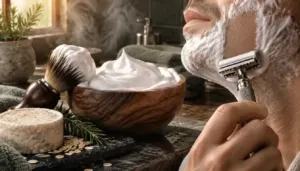
Lather is your first line of defense, and a good natural shaving soap builds a dense one. The stearic and palmitic acids in tallow-based soaps (about 50 to 60% of the fat content) create foam that holds its volume for 4 to 6 minutes. That’s plenty of time for a full shave.
Once you have a dense lather, mastering brush lather technique helps you work it up quickly and keep it stable through every pass.
Think of that lather as a cushion. It absorbs razor pressure so the blade doesn’t dig into your skin on each pass.
It also softens your whiskers. Dry facial hair is surprisingly tough, close to copper wire of the same thickness. Hydrated hair lifts away from the skin and cuts with less force, so you get fewer tugs.
Then there’s secondary slickness. Even after the first lather wipes away, a thin film stays behind, which keeps your second and third passes comfortable. This happens because stearic and palmitic acids saponify into long-chain molecules that form a low-friction film on skin, reducing drag between the razor blade and your beard.
Moisturizing Ingredients Help Maintain Skin Comfort
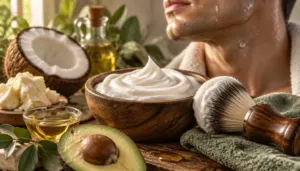
That thin film is only part of the story. The rest comes from what’s blended into the soap itself.
Glycerin pulls water toward your skin, so skin hydration holds up from the first pass to the last. Shea butter and coconut oil act as natural emollients, softening your beard and smoothing the surface your razor crosses.
Since the right cream depends on your razor type and skin, this guide to the best shaving creams for beards can help you pick one that suits you.
Many soaps combine these natural ingredients with tallow, avocado oil, or lanolin. Aim for a fat and glycerin content of 30 to 50%. That range gives you a rich lather that leaves your face moisturized, not tight.
Dry skin especially benefits. Some shavers find they can skip aftershave balm entirely, since extra product just feels sticky. That kind of skin comfort lasts all day.
Fragrance-Free Formulas Help You Avoid Fragrance Irritants

Soft skin is great, but your soap’s scent can undo it. Shaving scrapes away the top layer of skin and leaves tiny micro-cuts, so fragrance molecules slip in much more easily than they do on unshaved skin. Wet shavers face a 2.9 times higher risk of fragrance allergies than dry shavers.
Freshly shaved skin is wide open to irritants, which is why wet shavers are nearly three times as likely to react to fragrance
Limonene and linalool, common in citrus and lavender scents, can turn into contact allergens as they meet air. Redness, itching, or small blisters may show up 24 to 72 hours later.
Choosing artificial fragrance free soap helps. One review tied fragrance-free formulas to 30% fewer shaving-related reactions.
After shaving, pairing your soap with one of these facial moisturizers for after shaving can help keep sensitive skin calm and comfortable.
Watch the label, though. "Unscented" soaps can still hold essential oils like clove or rose. Look for truly fragrance-free wording to keep sensitive skin calm.
Long-Lasting Shaving Soap Can Lower Per-Shave Costs

A calm face is nice, but a calm wallet is better. The soap you choose can help with both.
A 4 to 5 oz tub usually gives you 100 to 150 shaves, so a $30 tub lands near $0.30 per shave. Cartridges run $0.67 to $1.50.
Stretch your soap further with these habits:
- Load your brush for 30 to 60 seconds. A thin, slick lather beats a fluffy pile.
- Pick a hard milled puck. It releases product slowly, so it lasts longer than soft tubs.
- Let it dry fully between uses. Properly stored pucks keep their texture for years.
- Track your loading. Efficiency improves, so you use less soap each time.
Switching systems can save about $507 over five years.
Natural Shaving Soap Can Reduce Packaging Waste
A shaving soap puck swaps a stack of cans and tubes for one small container. Here’s how the waste stacks up:
| Item | Foam or cartridges | Soap and safety razor |
|---|---|---|
| Can or tube | Replaced several times a year | One puck, up to a year |
| Razor heads | 260 to 520 plastic items in ten years | Zero plastic items |
| Packaging | Multi-material, hard to recycle | Paper box or tin |
| Refills | New container each time | Reuse your jar or bowl |
Those aluminum tins and glass jars are widely accepted in recycling, so you won’t wrestle with mixed materials.
It adds up fast. Plastic waste hit 353 million tonnes in 2019, and only 9% was recycled. Choosing natural shaving soap is a small, eco-friendly habit you control.
Frequently Asked Questions (FAQs)
How do I make lather with a shaving brush?
Think of your shaving brush as a storm cloud.
Soak it, shake out drips, then swirl it over the soap for 30 to 60 seconds. Whip in drops of water until it’s thick and glossy.
How should I store a shaving soap puck?
Let your puck air-dry with the lid off until the surface feels completely dry. Then keep it in a cool, dry spot with good airflow, away from sunlight and steamy showers. Sealing it damp invites mold.
Does natural shaving soap work with safety razors?
Think soap is too old-school for a safety razor? Not so.
It’s an ideal partner. A dense, rich lather cushions the blade, so hair cuts cleanly, and it helps you hold a steady blade angle.
Can I use soap to shave my pubic area?
Picture a razor gliding over a cloud of soft, slippery lather instead of dragging across dry skin. Yes, you can use soap to shave your pubic area. Choose a fragrance-free, gentle bar, wash first, and keep sensitive skin happy.
What shaving tools do beginners need to get started?
Disposable refills run $3 to $5 each, while a double-edge blade costs about $ For wet shaving, we’d start with a mild closed-comb safety razor, Astra blades, a synthetic shave brush, a bowl, and balm.
Conclusion
Slow down your strokes, soften your whiskers, and trust your lather. That’s the whole routine, and it works.
The benefits of using natural shaving soap add up fast: steadier glide, calmer skin, fewer irritants, lower costs, and less plastic in your bin. Each one gives you a little more control over the blade.
Lift that puck, build a thick lather, and take your time. Your face will notice. Your wallet and recycling bin will, too.