This site is supported by our readers. We may earn a commission, at no cost to you, if you purchase through links. This content is for general informational and educational purposes only and is not a substitute for professional medical, dermatological, or nutritional advice.

Rain hits the axe head. Your fingers sit inches from a dull edge. Wrong stone, wrong grit, wrong lubricant, and you ruin the bevel or your hand.
Honing stones for outdoor use face conditions a garage bench never sees. Water stones crack in freezing temperatures. Oil locks a stone out of water for good. Dry diamond plates run hot and need rest breaks. Full-length bench stones fit poorly on axe cheeks.
Six kits, pucks, and plates follow, each matched to a specific field job. Chipped edges, quick touch-ups, pocket carry. Pick the format and grit that fit yours.
Table Of Contents
Key Takeaways
- Match your grit to the damage: drop to 220–300 grit for chips, use 1000 then 3000 for dull but intact edges, and use 3000–6000 for quick field touch-ups.
- Pick your format by the job: pocket stones for small blades, 3-inch dual-grit pucks for axes and hatchets, and diamond plates for chip repair and heavy stock.
- Keep your lubricant consistent with your stone: water on water stones, never oil on them, and dry or lightly wetted use on diamond and ceramic stones.
- Protect your gear and your edge outdoors by switching to oil or dry sharpening in freezing temperatures, resting the blade when dry friction builds heat, and wiping off swarf.
6 Honing Stones for Outdoor Kits
These six stones cover the range from pocket-size touch-ups to full axe repair. Each entry lists the grit, the stone type, and what it grips best in the field. Pick the one that matches your blade and carry weight.
1. KEENBEST Dual-Grit Water Sharpening Stone Kit
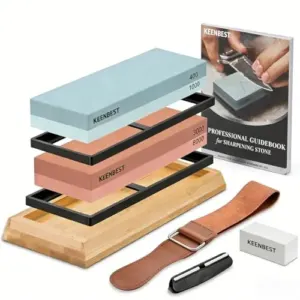
A dual-grit silicon carbide stone gives you two jobs in one block. The 400–1000 grit side repairs damaged edges. The 3000–8000 grit side polishes the bevel smooth.
For a pocket-sized take on this two-sided approach, these honing stones for pocket knives are easy to carry on the trail.
Soak it in water for 10–15 minutes, then sharpen. You don’t need oil. Pressure, soak time, and steel type all affect results, so adjust as you go.
The kit includes two whetstones, a bamboo base, non-slip rubber mats, an angle guide, and a white corundum flattening stone. Dress the stone regularly to keep it flat and expose fresh abrasive.
It works on chef knives, pocket knives, scissors, hatchets, axes, and chisels.
| Best For | Home cooks and hobbyists who want one soak-and-sharpen kit that handles everything from repairing a chipped chef knife to polishing a pocket knife, scissors, or chisel. |
|---|---|
| Grit Levels | 400/1000 & 3000/8000 |
| Abrasive Material | Silicon carbide |
| Weight | 16 oz |
| Lubricant | Water soak |
| Base Type | Bamboo base |
| Angle Guide | Included |
| Additional Features |
|
- Two grit ranges (400–1000 and 3000–8000) let you repair damaged edges and then polish the bevel with one block.
- The kit includes a white corundum flattening stone, bamboo base, non-slip rubber mats, and an angle guide, so nothing extra is needed to get started.
- It works on chef knives, pocket knives, scissors, hatchets, axes, and chisels, and it needs only water instead of oil.
- You must soak the stone for 10–15 minutes before each sharpening session, which slows down quick touch-ups.
- The stone needs regular dressing with the flattening stone to stay flat and expose fresh abrasive.
- Results vary with soak time, pressure, and steel type, and the grit numbers are only approximate, so expect some trial and error.
2. Smith’s TRI6 Three-Stone Sharpening System
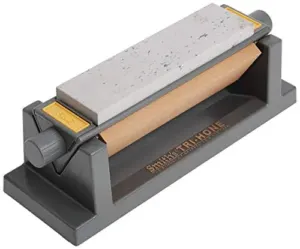
Where the KEENBEST kit uses water, this system uses oil. Three stones sit on a rotating triangular base: 300-grit coarse, 800-grit medium, and 1,000-grit fine. One is natural Arkansas, two are synthetic.
Use the coarse stone to reshape, then step up. The included angle guide holds your blade angle steady. Add a few drops of the 1 oz honing solution to stop clogging.
It works on pocket, hunting, buck, fishing, and kitchen knives. Very large blades may outrun the 6-inch stones. Clean after every use.
| Best For | Home cooks, hunters, and anglers who want an easy, guided way to sharpen pocket, hunting, fishing, and kitchen knives at three different grits. |
|---|---|
| Grit Levels | 300/800/1000 |
| Abrasive Material | Natural Arkansas, synthetic |
| Weight | N/A |
| Lubricant | Honing solution |
| Base Type | Rotating plastic base |
| Angle Guide | Included |
| Additional Features |
|
- Three stones (300, 800, and 1,000 grit) on a rotating base let you move from reshaping to a fine edge without swapping gear.
- The included angle guide keeps your blade angle steady for an even edge.
- The "V" trough catches oil drippings, and the nonskid rubber feet hold the base steady while you sharpen.
- Very large blades may be too long for the 6-inch stones.
- Some customers report the stones coming unglued from the base over time.
- The stones need cleaning after every use with water, liquid soap, and a stiff nylon brush.
3. Ultrasharp II Diamond Sharpening Stone Kit
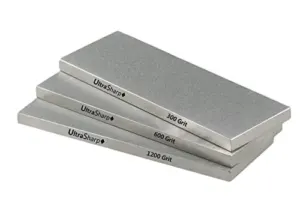
Smith’s kit used oil. This one skips the liquid entirely. Diamond abrasive is bonded to a steel base, so you sharpen dry or with a little water.
Whichever stone you choose, match its grit to your razor’s condition; this guide to honing stones for straight razors shows how.
You get three stones: 300, 600, and 1200 grit. Start coarse on dull edges, move to 600, then finish on 1200 for a razor edge. Each stone measures 6 inches long by 2 inches wide. The whole kit weighs 2.2 pounds.
Rapid sharpening cycles beat traditional stones. Check the width, though. Some buyers say it runs under 2 inches. Others report the 1200 stone wears fast.
| Best For | Home cooks and hobbyists who want a complete, low-mess sharpening kit to restore dull knives from coarse repair to a fine finish. |
|---|---|
| Grit Levels | 300/600/1200 |
| Abrasive Material | Diamond |
| Weight | 2.2 lbs |
| Lubricant | N/A |
| Base Type | Steel base |
| Angle Guide | N/A |
| Additional Features |
|
- Three diamond stones (300, 600, and 1200 grit) cover every stage of sharpening, from dull edges to a razor finish.
- Works dry or with a little water, so there is no oil to deal with.
- Rapid sharpening cycles compared to traditional stones.
- Some buyers say the stones measure under the advertised 2 inches wide.
- Some users report that the 1200 grit stone wears quickly.
- No accessories beyond the three stones are listed.
4. Straight Grain Axe Sharpening Puck
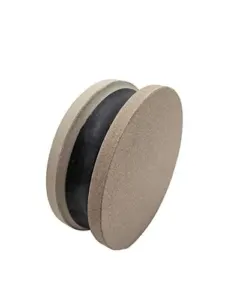
Drop the three-stone kit and go compact. This puck fits your palm and your pack.
It measures 3 inches across and weighs 5 ounces. Dual 220/400 grit surfaces give you two jobs: 220 reshapes a rolled or nicked axe edge, 400 refines it. Finger grooves keep your grip secure, and the removable EDPM rubber band adds traction. Use it on axes and hatchets, or any edged tool.
Run it with water, not oil. Model SGSP220400. Everything’s made in the USA.
| Best For | Campers, hikers, and outdoor workers who want a compact, portable sharpener to keep axes and hatchets sharp in the field. |
|---|---|
| Grit Levels | 220/400 |
| Abrasive Material | Aluminum oxide |
| Weight | 5 oz |
| Lubricant | Water |
| Base Type | N/A |
| Angle Guide | N/A |
| Additional Features |
|
- Dual 220/400 grit surfaces let you reshape a rolled or nicked edge and then refine it with one stone
- Finger grooves and a removable EDPM rubber band give you a secure grip
- At 3 inches across and 5 ounces, it fits in your palm and your pack
- It works best with water, so oil is not recommended
- The rubber band is meant to secure loose items only
- Its small size may be slower to use on larger tools than a full-size stone
5. KEENBEST Two-Sided Whetstone Knife Sharpener
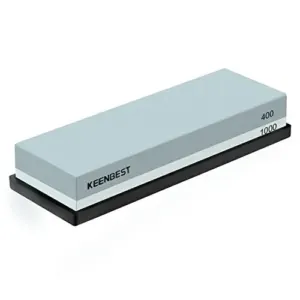
A dual-grit stone gives you a full sharpening cycle in one piece. The 400 side covers initial sharpening, and the 1000 side finishes the edge. Silicon carbide and white corundum do the cutting.
The non-slip rubber base keeps the stone steady while you work wet. Soak it in water for 10-15 minutes first. No oil needed.
It fits chef, hunting, Japanese, and pocket knives, plus scissors, hatchets, axes, chisels, and gardening tools. Results vary with steel type and pressure, and some buyers report mixed long-term durability.
| Best For | Home cooks, hunters, and DIY users who want one affordable stone to sharpen a wide range of knives and tools, from dull to polished. |
|---|---|
| Grit Levels | 400/1000 |
| Abrasive Material | Silicon carbide, white corundum |
| Weight | 16 oz |
| Lubricant | Water soak |
| Base Type | Non-slip rubber base |
| Angle Guide | N/A |
| Additional Features |
|
- The dual-grit design (400 and 1000) covers both initial sharpening and finishing in one piece.
- The non-slip rubber base keeps the stone steady during wet sharpening.
- It works on chef, hunting, Japanese, and pocket knives, plus scissors, axes, chisels, and gardening tools.
- It needs a 10-15 minute water soak before each use.
- Results vary depending on steel type, pressure, and how well you maintain the stone.
- Some buyers report mixed long-term durability.
6. Sharpal 162N Double-Sided Diamond Stone
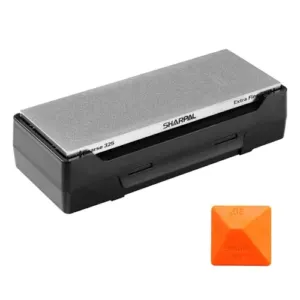
Diamond grit does the work here, so you can sharpen dry. No water, no oil, no mess at camp. Electroplated monocrystalline diamonds sit on a 0.35-inch stainless steel base, and MirrorFlat technology keeps the surface flat for even contact.
Grits are Coarse 325 (45 micron) and Extra Fine 1200 (12 micron). It works with high-speed steel, carbide, ceramic, and CBN. The guide sets 14°, 17°, 20°, or 25°.
At 1.4 kg, it’s heavy. Expect the fine side to wear after five to six uses.
| Best For | Campers, hikers, and home cooks who want a dry-use diamond sharpener that handles hard steels like carbide and ceramic without water or oil. |
|---|---|
| Grit Levels | 325/1200 |
| Abrasive Material | Monocrystalline diamond |
| Weight | 1.4 kg |
| Lubricant | None (dry) |
| Base Type | Stainless steel base |
| Angle Guide | Included (4 angles) |
| Additional Features |
|
- Sharpens dry, so there’s no water, oil, or mess to deal with at camp.
- Works with high-speed steel, carbide, ceramic, and CBN, and the included guide sets 14°, 17°, 20°, or 25°.
- Comes with a storage box and non-slip rubber pad that doubles as a sharpening base.
- The fine grit side may wear quickly, often after five to six uses.
- At 1.4 kg, it is heavier than standard water stones.
- The guide is limited to four angles, so you can’t set a custom one.
Pocket Stones, Axe Pucks, and Bench Kits
Your hatchet skips off wood on day two of a trip. Pull a 3-inch puck, dip it, work the edge. Back to work in minutes.
Each format fits a different job. Choose by tool, location, and finish.
- Pocket stones suit small blades. Swipe the blade across the stone, and watch your knuckles.
- Axe pucks keep fingers away from the edge. Use them in rain, snow, or a moving truck.
- Dual-grit pucks run about 240 on one face and 400 on the other.
- Bench kits pair 400/1000 and 3000/8000 stones with a flattening stone and nonslip base.
- Full-length bench stones fit poorly on axe cheeks, so go shorter for axes.
Build a camp sharpening system around speed, not a mirror finish. A few minutes with a puck after each session, matching the factory bevel at roughly 25 to 30 degrees, keeps an axe working without reaching for a file.
Diamond, Synthetic, and Natural Honing Stones
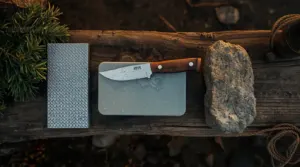
Natural stones cut slowly, but they hold an edge longer. Synthetics cut fast, but they wear evenly and predictably. Choose by what your knife needs, not by tradition.
Slow natural stones keep an edge alive, fast synthetics wear predictably, so pick whichever suits your blade over habit
Natural stones use silica or granite, only marginally harder than hardened steel. Irregular particles leave uneven edge teeth that wear at different rates, so your blade stays functional longer. Grit varies stone to stone.
Synthetic sharpening stones use silicon carbide or aluminum oxide. Harder, more jagged, faster cutting. Particle size is controlled. Grit stays consistent. A water whetstone sits in a soft binder, so it dishes and glazes. Plan on lapping it.
Diamond plates never dish. The abrasive doesn’t wear out, so they cut heavy stock. Pack one in your outdoor survival gear.
Grit Pairings for Touch-Ups and Edge Repair
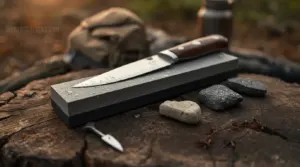
Match your grit to the damage, not the habit.
Dull but intact edge: use a 1000 and 3000 pairing. The 1000 grit shapes the bevel. The 3000 grit refines the edge and removes burr. Stopping at 1000 leaves a coarse scratch pattern that can chip during first cuts.
Light touch-ups in the field? Use 3000 to 6000 grit. You’ll remove less metal and extend blade life.
Chipped or flattened edge? Fine honing won’t fix it. Drop to 220 to 300 grit, where repair moves fast without excessive material loss. Then work up through whetstone grit levels: 1000, then 3000. Skip the coarse stage and finer stones fight existing deformation.
Carrying one kit? Pick a 30 micron and 9 micron pair.
Water, Oil, and Dry Sharpening Outdoors
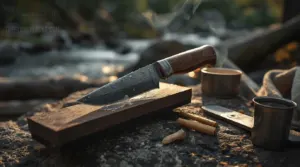
Your stone’s lubricant decides how well it cuts and how long it lasts.
Water suits water stones. It’s free on the trail, suspends swarf, and cuts faster than oil. Never put oil on a water stone. It ruins the surface for good.
Oil slows swarf removal but protects carbon steel from rust. Once a stone takes oil, it won’t accept water again.
Diamond and ceramic stones work fine for dry sharpening. Add a little liquid to cool the edge and wash away filings.
Before you leave, check these four:
- Freezing temperatures crack soaked water stones. Switch to oil or dry.
- Dry friction builds heat. Rest the blade often.
- Swarf scratches your edge. Wipe it off.
- Oil residue lingers. Pack detergent.
Frequently Asked Questions (FAQs)
What angle works best for field knife sharpening?
Why guess? Stick to 20° per side. Your field knife survives bone and hide. Use fixed angle sharpening with an angle guide to give outdoor enthusiasts steady sharpening angle control. Go 22–25° for heavy batoning.
How do I know when my edge is sharp?
Ironically, a sharp edge is the one you can’t see. Tilt it under bright light. A bright line means it’s dull.
Test on paper. A sharp blade slices cleanly, no snags. Snags mean sharpen again.
How do I store a honing stone while hiking?
Wipe your stone dry and wrap it in a soft cloth before sliding it into a watertight plastic case. Keep it out of direct sun and away from freezing drafts. Never stack stones. Diamond plates need no case.
Can honing stones be used on serrated blades?
Your flat honing stone is great at ruining serrated knives. It only touches the tips and grinds the teeth flat.
Use a tapered diamond rod instead, work the beveled side, then deburr the flat side.
How often should I sharpen my knife outdoors?
Think of your edge as a fuel gauge. Hone every use or every other use, and sharpen only when the edge rolls, bends, or chips. Honing won’t fix that. Don’t wait for a very dull blade.
Can WD-40 be used as honing oil?
Would WD-40 help? No. It’s too thin to float swarf, stalling abrasive grit progression. Aluminum oxide sharpening stones take water, and no lubricant is necessary in some honing techniques. Save WD-40 for post-sharpening edge maintenance.
Conclusion
Day three of a wet trip. Your hatchet’s edge has rolled on frozen oak. A coarse diamond plate resets the bevel. A fine stone finishes it. No water freezes, no oil spills.
Choose honing stones for outdoor use by job, not by price. Pocket stones handle touch-ups. Pucks fit axe cheeks. Diamond plates repair chips. Match grit to damage. Sharp tools are safer tools. Your next clean cut starts with the stone in your pack.