This site is supported by our readers. We may earn a commission, at no cost to you, if you purchase through links. This content is for general informational and educational purposes only and is not a substitute for professional medical, dermatological, or nutritional advice.
When researchers manipulated photos to add, remove, or alter facial hair on men’s faces, they discovered something unexpected: mustaches alone consistently ranked near the bottom of attractiveness scales, often losing even to clean-shaven faces. Yet walk through any major city today and you’ll spot them everywhere, from baristas to boardrooms, sported with the kind of deliberate confidence that suggests their wearers aren’t worried about statistical averages.
The disconnect reveals something curious about attraction—what wins in controlled studies doesn’t always match what works in real life, where grooming choices signal personality, cultural fluency, and a willingness to stand out. Your mustache might not dominate preference surveys, but attractiveness operates on multiple frequencies, blending biological signals with cultural codes that shift across contexts, relationships, and even your partner’s hormonal cycle.
Table Of Contents
- Key Takeaways
- Are Mustaches Attractive?
- Why Do Some Women Find Mustaches Appealing?
- How Mustache Trends Influence Perceptions
- What Role Does Context Play in Mustache Attractiveness?
- Most Popular Mustache Styles and Their Appeal
- Frequently Asked Questions (FAQs)
- Do ladies like mustaches?
- Is having a mustache creepy?
- What mustache is most attractive?
- Do mustaches look good?
- Is a mustache unprofessional?
- Do mustaches make you look older?
- How should men maintain a healthy mustache?
- Do mustaches make men look older or younger?
- Can mustaches affect professional career opportunities negatively?
- What face shapes look best with mustaches?
- Conclusion
Key Takeaways
- Mustaches rank near the bottom in controlled attractiveness studies—typically losing to stubble, beards, and even clean-shaven faces—but real-world appeal hinges on grooming quality, cultural context, and the confidence you project rather than statistical averages.
- Women who find mustaches attractive associate them with specific traits like masculinity, individuality, and self-discipline, while partner exposure and hormonal cycles shift preferences more than inherent style appeal.
- Context drives mustache attractiveness more than the facial hair itself—what signals dominance in one culture reads as ironic or retro in another, and relationship intentions (short-term versus long-term) alter which grooming styles women favor.
- The current mustache resurgence among younger men reflects social media influence and fashion cycles rather than universal preference shifts, with maintenance and precision separating attractive mustaches from creepy or unkempt ones.
Are Mustaches Attractive?
The answer depends on who you ask—and what the research actually shows. Studies on facial hair attractiveness reveal surprising patterns in how women rate mustaches compared to clean-shaven faces, stubble, and full beards.
Here’s what science and real women’s preferences tell us about the mustache’s appeal.
Scientific Research on Facial Hair Attractiveness
When you look at the science behind facial hair attractiveness, you’ll find researchers have gone to considerable lengths to understand what really works. Here’s what the data reveals:
- Study methodologies use computer-manipulated photos to test facial hair density across different styles, from clean-shaven to full beards
- Sample demographics include hundreds of women rating male attractiveness research on various metrics
- Cultural variations show that attractiveness scores shift across populations and time periods
The findings? Heavy stubble consistently wins for overall appeal, though mustaches alone remain less studied than broader beard styles. However, polls suggest that clean-shaven men are often perceived as more trustworthy.
Women’s Preferences for Mustaches
Regarding mustaches specifically, women’s preferences get complicated. Survey data shows 25% of women like mustaches, while men favor them more. Partners with mustaches shift women’s tastes—social exposure matters. Hormonal factors and cultural variation play roles too, but grooming matters most: 46% of women prefer trimmed facial hair over wild growth.
A recent study suggests that women generally find men with facial hair more attractive than those without. Your mustache’s appeal hinges less on the style itself than on how you maintain it.
How Mustaches Compare to Other Facial Hair Styles
When you stack mustaches against other facial hair styles, the data tells a clear story. Heavy stubble ranks highest in attractiveness rankings, followed by light stubble and full beards. Clean-shaven faces consistently score lowest. Where do standalone mustaches land? Unfortunately, they fall near the bottom—often ranked less attractive than beards and mustaches combined.
In the facial hair hierarchy, heavy stubble wins, mustaches lose—ranking below beards but above clean-shaven faces
Women’s preferences favor stubble over isolated mustaches, though masculinity perceptions remain strong across all facial hair styles.
Why Do Some Women Find Mustaches Appealing?
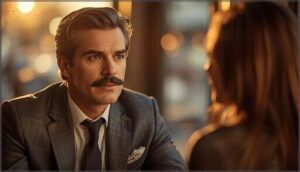
While the data show that mustaches aren’t universally loved, the women who do find them attractive often cite specific traits they associate with this distinctive facial hair.
These perceptions aren’t just about aesthetics—they’re rooted in signals that connect to deeper evolutionary and social cues. Let’s look at what draws these women to men sporting a well-groomed mustache.
Signals of Confidence and Masculinity
A mustache leverages evolutionary cues of masculinity, signaling dominance and sexual attraction through visible self-presentation.
Research shows facial hair increases perceived social status and confidence, with bearded men reporting stronger gender identity and masculine grooming choices.
For you, these cues translate into attraction—facial hair marks biological maturity, formidability, and a man comfortable asserting his presence, all traits rooted in deep-seated perceptions of male strength.
Air of Mystery and Individuality
Ambiguity fuels attraction when a mustache partially obscures emotional cues, leaving you wondering about hidden intentions beneath the surface. That sense of mystery resonates with niche attraction—some women are drawn to the unconventional persona that distinctive grooming signals.
- Identity obscuring: Facial hair conceals features, heightening perceived enigma
- Nonconformity markers: Mustaches flag artistic or alternative identities
- Unconventional persona: Rarer styles cultivate intrigue over mainstream appeal
- Niche attraction: Individual preferences reward originality, not universal standards
For you, individuality often outweighs consensus when judging a man’s allure.
Perception of Humor and Approachability
When stylized facial hair enters the frame, you may read playfulness into the man’s personality—media tropes and caricatures link oversized or exaggerated mustaches with comic characters and parody. Light stubble, on the other hand, boosts trust ratings in controlled experiments, signaling easygoing charm without full-beard formality. Cultural variation matters: traditional societies see mustaches as respectable, while Western dating contexts often tie them to ironic humor and approachability.
| Facial Hair Style | Trust in Experiments | Humor Associations |
|---|---|---|
| Light stubble | Highest (+20–30%) | Moderate, laid-back |
| Stylized mustache | Moderate | High, playful/ironic |
| Full beard | Lower in warmth tasks | Low, serious demeanor |
Sophistication and Personal Grooming
Precision matters when you shape hair above your lip—observers equate sharp edges and symmetry with discipline, translating a groomed mustache into signals of professionalism and self-care. Research shows well-maintained facial hair lifts competence ratings, while patchy growth undermines trustworthiness.
Grooming indicators women notice:
- Symmetrical trim lines convey attention to detail
- Even length suggests regular maintenance rituals
- Clean contours signal hygiene standards and pride
- Complementary hairstyle projects cohesive personal style
- Quality tools (oils, balms) hint at investment in masculine presentation
Controlled styling transforms facial hair from casual scruff into a deliberate dating asset.
How Mustache Trends Influence Perceptions
Mustache appeal doesn’t exist in a vacuum—it rises and falls with the cultural tides around you. What’s seen as rugged and masculine in one era can feel outdated or ironic in another, and media, fashion, and generational shifts all play a role in shaping these perceptions.
Let’s look at how these trends actually influence whether a mustache draws admiration or skepticism.
The Current Resurgence of Mustaches
You’re witnessing a full-blown mustache comeback—and the numbers don’t lie. Since 2020, around 9.6% of American men now sport mustaches, marking a 1.5 percentage-point yearly climb. Social media has fueled this resurgence, with TikTok’s #mustache tag hitting 3.8 billion views. Meanwhile, Movember’s global reach—raising $137.2 million in 2023–2024—keeps mustaches in the spotlight, normalizing experimentation and turning facial hair into a statement of confidence and individuality.
| Trend Driver | Impact on Mustache Popularity |
|---|---|
| Social Media | 3.8 billion TikTok views; grooming tutorials surge |
| Celebrity Influence | “Top Gun: Maverick” (2022) sparked Chevron mustache spike |
| Movember Campaign | $137.2M raised; millions grow mustaches annually |
| Market Growth | Fastest-growing facial hair category since 2020 |
| Style Evolution | Handlebar, Chevron styles dominate trend forecasts |
Cultural and Media Influences
Media stereotypes cast mustaches as markers of dominance and toughness, shaping your dating expectations before you ever swipe right. Celebrity influence—think Henry Cavill’s viral mustache or Bruno Mars’ stage looks—drives cultural shifts and online perceptions, with fashion advertising amplifying the association between facial hair and confidence.
Cultural symbolism varies: a mustache signals power in some contexts, traditionalism in others, making attractiveness deeply context-dependent.
Generational and Demographic Differences
Your age and cultural background shape how you perceive that mustache more than you’d guess. Data reveal measurable generational differences in taste:
- Younger women (18–25) rate full beards up to 0.4 points higher on attractiveness scales than older cohorts, reflecting Gen Z and millennial preferences for bolder facial hair
- Urban adoption drives fashion cycles—mustache revivals cluster in metropolitan areas where individualized grooming thrives
- Cultural variations matter: Hispanic women show stronger preferences for bearded men than Iranian women, illustrating how orientation influence and regional norms intersect with women’s preferences
What Role Does Context Play in Mustache Attractiveness?
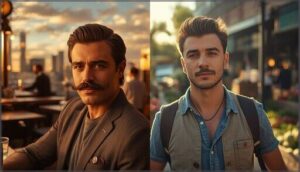
Context shapes whether a mustache registers as irresistible or off-putting, and those judgments shift depending on what you’re looking for in a partner, where you live, and what’s currently trending.
Women’s preferences aren’t fixed—they respond to cultural cues, relationship intentions, and the social meaning a mustache carries at any given moment.
Let’s examine how these contextual factors influence mustache attractiveness.
Long-Term Relationships Vs. Short-Term Flings
Notably, fertility desires and exposure effects also influence your preferences—single women wanting children often favor clean-shaven men, while those with bearded partners rate facial hair more favorably across all dating contexts.
This shows how partner investment signals compete with raw genetic benefits in the attractiveness of facial hair for longterm relationships.
Cultural and Temporal Shifts in Preferences
Your mustache’s appeal isn’t static—it shifts with fashion cycle history and cross-cultural norms. While dating trends in 2024 show renewed interest in retro appeal, generational attitudes vary widely. Younger cohorts see mustaches as bold and nostalgic, while older generations retain 1980s associations.
The cultural impact of facial hair depends on where you live and when. Indian men embrace mustaches as status symbols, whereas Western preferences fluctuate with media portrayals and broader trends interaction in grooming aesthetics.
Impact of Social Status and Fashion Trends
Fashion cycles and social media have turned mustaches into a status signaling tool. Research shows men with facial hair are consistently rated as higher in social status, and you’re witnessing a “mustache renaissance” among Gen Z and millennials who treat them as markers of individuality. Contextual attractiveness depends on your environment—creative sectors value nonstandard grooming, while dating trends reward the confidence and cultural capital a well-styled mustache conveys.
Here’s what drives the appeal:
- Bearded men score higher on perceived dominance and formidable presence in social hierarchies
- TikTok’s “Top Gun mustache” generated 3.8 billion views, proving media influence reshapes grooming norms overnight
- Urban millennials adopt mustaches faster than older cohorts, linking facial hair to subcultural belonging
- High-fashion campaigns now feature mustached models, elevating the style from retro to aspirational
- Younger men experiment more boldly, using mustaches to signal trend participation and creative edge
Most Popular Mustache Styles and Their Appeal
Not all mustaches send the same signal, and the specific style you choose can dramatically shift how others perceive you. Some styles project boldness and rebellion, while others suggest classic masculinity or creative flair.
Here’s a breakdown of the most popular mustache styles and what makes each one distinct in the eyes of those who notice.
Handlebar Mustache
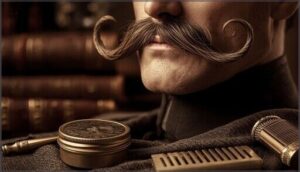
Picture a curled masterpiece sweeping from your upper lip—that’s the handlebar mustache, a style that peaked among 19th-century military officers like Buffalo Bill Cody and Wyatt Earp. This bold facial hair demands wax application and daily styling techniques to train those signature ends.
While only 9.6% of US men sport mustaches today, and women’s preferences show mixed sexual attraction to mustaches, modern variations with looser curls are trending in 2025.
Maintenance tips include dividing into sections for precise grooming.
Chevron Mustache

Think Tom Selleck or Freddie Mercury—the thick, bold Chevron dominated men’s grooming from the ’70s through today’s resurgence.
In a 2025 British survey, 19% of women ranked this style as most attractive, likely because it signals masculinity perception and authority without extra fuss.
You’ll need 4–6 weeks of growth and minimal maintenance, making the Chevron’s historical significance meet modern practicality.
Horseshoe Mustache
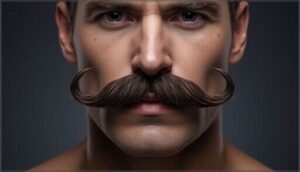
Two thick vertical bars drop from your mouth corners to your jawline—this inverted-U design projects dominance perception and cultural associations with toughness. You’ll need 3–4 weeks growth and weekly grooming to maintain clean edges.
While the horseshoe suits rounder face shapes by elongating your profile, this bold mens facial hair style carries stronger Movember context than everyday appeal for sexual attraction to mustaches.
Fu Manchu Mustache
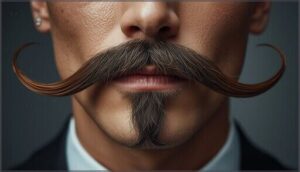
Long, tapered tendrils drop past your chin from your upper lip corners—this mustache style emerged from early 20th-century cinema’s stereotypical villain portrayals, carrying cultural appropriation concerns modern men should recognize.
Grooming challenges include daily shaving and wax maintenance over 3–6 weeks growth.
The Fu Manchu ranks among the least popular mustache styles today, with only 3% British approval, reflecting men’s grooming’s shift from theatrical facial hair toward understated appeal.
Frequently Asked Questions (FAQs)
Do ladies like mustaches?
Beauty lies in the eye of the beholder, and regarding mustaches, women’s preferences are surprisingly mixed.
Survey data reveal that roughly 25% of women find mustaches appealing, while cultural trends and grooming quality shape attraction.
Is having a mustache creepy?
Creepiness stereotypes about mustaches stem largely from media portrayal and social biases, not reality. Regional acceptance varies, and mustache length influences perception. However, research shows actual behavior doesn’t correlate with these negative associations.
What mustache is most attractive?
The chevron mustache ranks highest in attractiveness surveys, favored for its masculine, approachable appeal and symmetrical shape.
Handlebar styles attract attention through bold individuality, while horseshoe designs remain controversial despite their rugged aesthetic.
Do mustaches look good?
Whether mustaches look good depends on grooming importance, style variations, and mustache face shapes. A well-maintained mustache signals mens grooming standards, enhancing attraction and relationships through womens preferences for facial hair sophistication and masculine confidence.
Is a mustache unprofessional?
A mustache isn’t unprofessional if you maintain grooming standards, though industry variations matter—military regulations allow them, while client perception differs by context.
Stereotype impact shapes men’s appearance judgments, but facial hair trend acceptance is growing across men’s grooming cultures.
Do mustaches make you look older?
Yes, mustaches make you look older. Research shows men with facial hair appear up to 10 years older than clean-shaven versions—your mustache adds visual texture that signals maturity, masculinity, and post-adolescent status.
How should men maintain a healthy mustache?
Daily cleaning with gentle beard shampoo, trimming every 3-5 days, and moisturizing routines with beard oil keep men with mustaches looking sharp.
Styling tools help maintain facial hair trends while promoting health benefits through proper male grooming habits.
Do mustaches make men look older or younger?
Research confirms that facial hair trends push age perception upward. Mustaches add roughly 3–5 years to men’s appearance by signaling maturity and masculine features, countering the youthfulness association that clean-shaven faces generally convey.
Can mustaches affect professional career opportunities negatively?
Hiring bias against mustaches persists in conservative industries, where clean-shaven men dominate leadership roles. However, income data show mustached men can earn more than bearded counterparts, reflecting complex workplace policies shaped by industry norms and stereotype effects.
What face shapes look best with mustaches?
Oval faces accommodate nearly any mustache, from pencil to handlebar styles.
Square faces benefit from chevron or beardstache options that highlight the jawline, while round faces gain definition from angular pencil or horseshoe designs on the upper lip.
Conclusion
Sure, average attractiveness ratings don’t crown mustaches as winners—but attraction isn’t a popularity contest judged by strangers with clipboards. Whether mustaches are attractive depends on the signal you’re broadcasting, the woman decoding it, and the cultural moment framing both.
Your grooming choice communicates before you speak, filtering for partners who appreciate boldness over consensus. If you’re chasing universal approval, shave it off. If you’re signaling substance and self-possession, grow it with intention.