This site is supported by our readers. We may earn a commission, at no cost to you, if you purchase through links. This content is for general informational and educational purposes only and is not a substitute for professional medical, dermatological, or nutritional advice.
Your favorite baseball cap hasn’t caused a single hair to fall out. Despite decades of this stubborn myth, the science is crystal clear: hats don’t make you bald. What looks like thinning after removing your snapback is simply matted hair regaining volume, not follicles giving up the ghost.
The real drivers behind hair loss—genetics, hormones, and underlying health conditions—couldn’t care less whether you wear a beanie or go bareheaded. That said, extremely tight hats can stress already vulnerable follicles, and poor hat hygiene might create scalp issues that complicate existing hair loss.
Understanding what actually threatens your hairline helps you stop worrying about harmless accessories and focus on factors that genuinely matter.
Table Of Contents
Key Takeaways
- Hats don’t cause baldness—genetics, hormones (especially DHT), and underlying health conditions are the actual drivers of hair loss, not your favorite baseball cap.
- Extremely tight hats can cause traction alopecia by constantly pulling on vulnerable follicles, but normal hat-wearing poses virtually zero risk to your hair.
- The myth that hats suffocate your scalp is false—hair follicles get oxygen through blood supply beneath your skin, not from air exposure, and standard hats don’t restrict circulation enough to damage follicles.
- If you’re already genetically prone to pattern baldness, poor hat hygiene and overly tight fits can accelerate shedding you’d experience anyway, so choose breathable, well-fitted hats and wash them regularly.
Do Hats Make You Bald?
Here’s the truth: wearing a hat won’t make you bald. The impact of hats on hair loss is minimal for most people, and headgear doesn’t magically trigger balding. However, tight hats can stress already vulnerable follicles, potentially accelerating shedding if you’re genetically prone to thinning.
Hat friction damage and concerns about scalp blood flow are often overstated—your follicles get plenty of oxygen even under a beanie. The real culprits behind hair loss? Genetics, hormones, and health conditions, not your favorite baseball cap.
In reality, age is a factor in hair loss for most people.
How Hair Grows: The Hair Cycle
Before you can understand whether hats play any role in hair loss, you need to know how hair actually grows and what can disrupt that process. Your hair doesn’t just grow continuously—it moves through distinct phases that determine its length, health, and lifespan.
Let’s break down how this cycle works and what happens when things go wrong.
Anagen, Catagen, and Telogen Phases
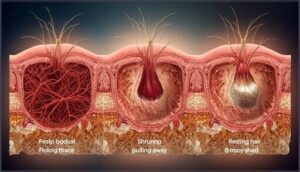
Your hair doesn’t grow continuously—it moves through distinct stages called the hair growth cycle. Here’s how it works:
- Anagen (Growth Phase): Lasting 2 to 8 years, this is when your hair actively grows about 1 cm per month. Roughly 85-90% of your scalp hairs are in anagen at any time, which explains why most of your hair is growing.
- Catagen (Change Phase): This brief 2-3 week catagen regression period cuts your hair off from blood supply as the follicle shrinks.
- Telogen (Resting Phase): Your hair rests for 3-4 months before telogen shedding occurs—that’s the 100-150 hairs you lose daily.
- Phase Proportions: A healthy scalp maintains balance, with about 10-14% in telogen and just 1-2% in catagen.
Supporting that active growth window with consistent scalp care — like the routines covered in this guide to making your hair grow faster — helps keep more follicles in the anagen phase longer.
This extended growth window is also why the anagen phase length varies so much from person to person, largely shaped by genetics as explained in this detailed breakdown of the hair growth cycle phases.
Understanding the hair growth cycles is essential for addressing hair loss. When cycle imbalance disrupts this rhythm, hair loss becomes noticeable.
Follicle Miniaturization and Hair Thinning

When follicles shrink over repeated cycles, you’re witnessing follicle miniaturization—the hallmark of pattern baldness. DHT impact drives this process: it shortens your anagen phase from years to months, flipping your growth-to-rest ratio from 12:1 to just 5:1. Each cycle produces thinner, shorter strands—miniaturization stages transform strong terminal hairs into fine vellus hairs under 0.03 mm in diameter.
Follicle miniaturization shrinks hair from thick terminal strands to fine vellus hairs as DHT shortens the growth phase from years to mere months
Over time, factors contributing to hair loss like hormonal shifts compound the problem. By your fifties, miniaturized follicles may stop producing visible hair entirely, though reversing thinning remains possible with early intervention.
Main Causes of Hair Loss

Before we get into the hat debate, let’s talk about what actually causes hair loss. Spoiler: it’s rarely just one thing. Your genes, hormones, health conditions, and daily habits all play a part in whether your hair sticks around or starts saying goodbye.
Genetic Factors and Family History
Your genes are in charge of pattern baldness. Twin studies reveal about 80% heritability for early-onset hair loss, meaning genetic factors outweigh nearly everything else.
If your father experienced balding, you’re facing roughly double the risk, while maternal history can push your odds even higher. Over 350 genomic loci influence your follicles’ fate.
Hormonal Imbalances and DHT
Beyond genetic factors, hormonal imbalances drive much of the hair loss you see in androgenic alopecia. Your body converts about 10% of testosterone into DHT—a potent androgen that shrinks sensitive follicles and shortens the hair cycle.
- DHT production rises when 5-alpha-reductase ramps up in balding scalp regions, triggering miniaturization.
- Follicle sensitivity depends on androgen receptor density, explaining why some people lose hair while others don’t.
- Hyperandrogenism in women frequently overlaps with thinning, since elevated local DHT or circulating androgens disrupt normal growth phases.
DHT suppression with medications like finasteride or dutasteride can slow this process by lowering scalp DHT levels.
Medical Conditions and Medications
On top of genetics and hormonal imbalances, several medical conditions causing hair loss can catch you off guard. Thyroid disorders disrupt growth cycles, while autoimmune alopecia targets follicles directly.
Chemotherapy hair loss affects over 75% of patients years later, and medications—like antidepressants or blood pressure drugs—trigger shedding.
Even vitamin D deficiency and CCCA impact Black women disproportionately, causing permanent scarring without early treatment.
Stress, Diet, and Lifestyle
The role of stress and diet in hair loss extends beyond common assumptions. Elevated cortisol from chronic stress reduces follicle density, while poor diet quality—particularly amino acid deficiencies and high-carb intake—increases baldness risk by 45% in metabolic dysfunction cases.
Key lifestyle factors include:
- Chronic psychological stress elevating cortisol levels
- Essential amino acid deficiencies weakening follicles
- Sleep deprivation impairing scalp microcirculation
- Low physical activity doubling hair loss odds
Lifestyle interventions targeting these areas show measurable improvement.
Myths and Facts About Hats and Baldness

You’ve probably heard someone say that wearing a hat too often will make you go bald. It’s one of those warnings that gets passed around like folklore, but what does the science actually say?
Let’s separate the myths from the evidence and see what research tells us about hats and hair loss.
Scientific Studies on Hat-Wearing
If you’ve worried about wearing hats every day, here’s some relief. A 2013 twin study found that regular hat wearers experienced 25% less frontal hair loss compared to those who skipped headwear entirely. Blood flow effects from normal hat pressure reduce scalp circulation by under 5%, far too minimal to trigger baldness. The consensus scientific view is clear: hats don’t cause androgenetic alopecia. The real risk is traction alopecia from tight-fitting caps that constantly pull on follicles, affecting up to 18% of those wearing constrictive headwear for extended periods.
| Study Focus | Key Finding | Impact on Hair |
|---|---|---|
| Twin study (92 pairs) | Daily wearers had 20% less temple balding | Protective effect |
| Blood flow research |