This site is supported by our readers. We may earn a commission, at no cost to you, if you purchase through links. This content is for general informational and educational purposes only and is not a substitute for professional medical, dermatological, or nutritional advice.
Black beard algae doesn’t politely announce its arrival—it barges in, clings to your plants like a bad hair day, and laughs at your half-hearted attempts to scrub it away. One week, your tank glows with lush, green ambition. The next, tufts of stubborn, inky fuzz start creeping down every nearby leaf, filter tube, or rock, shrugging off your warning stares.
Ignore it for a minute and you’ll have a bearded jungle worthy of an evil wizard’s brew. If you’re ready to reclaim your aquarium, buckle up—how to get rid of black beard algae calls for a real plan, not wishful thinking.
Table Of Contents
- Key Takeaways
- What is Black Beard Algae?
- Where Black Beard Algae Grows in Tanks
- Why Black Beard Algae Develops
- Effects of Black Beard Algae in Aquariums
- Physical Removal Techniques for BBA
- Chemical Treatments for Black Beard Algae
- Adjusting Tank Parameters to Inhibit BBA
- Natural Control: Algae-Eating Species
- Preventing Future Black Beard Algae Outbreaks
- Top 5 Products for Black Beard Algae Removal
- Frequently Asked Questions (FAQs)
- Can you get rid of black algae permanently?
- What is the cause of black beard algae?
- Will anything eat black beard algae?
- How to remove black beard algae?
- How do you get black beard algae in an aquarium?
- Is black beard algae a problem?
- Can black beard algae be removed from a fish tank?
- Why am I getting black beard algae?
- What eats black beard algae in aquarium?
- What is the best algaecide for black beard algae?
- Conclusion
Key Takeaways
- Black beard algae thrives when tank conditions—especially CO2, light, or phosphates—are unstable or out of balance.
- Manual removal with trimming, scrubbing, and safe chemical treatments like hydrogen peroxide or liquid carbon is essential for tackling infestations.
- Prevent future outbreaks by locking in stable CO2, dialing back light, reducing excess nutrients, and cleaning with ruthless consistency.
- Natural cleaners like Siamese algae eaters, Amano shrimp, and Nerite snails help but won’t solve BBA alone—you’ve got to fight on all fronts.
What is Black Beard Algae?
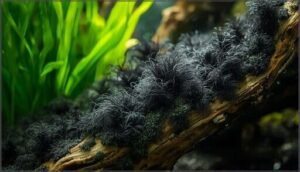
Black Beard Algae—or BBA, as you’ll hear me call it—looks like someone took a tiny, dark paintbrush and went wild on your plants, driftwood, and equipment. It’s actually a type of red algae (yeah, weird name, I know), but it shows up as black or deep greenish-gray tufts that cling like they’re never letting go.
Before you can fight this stuff, you need to know exactly what you’re dealing with, how to spot it versus its lookalikes, and where it loves to grow.
Identifying Black Beard Algae in Aquariums
You’ll spot Black Beard Algae—or BBA— by those telltale dark tufted growths clinging to plant edges, driftwood, and equipment like tiny black whiskers. Tank inspection reveals filamentous strands forming woolly clumps, ranging from deep green to black.
This aquarium diagnosis gets easier once you know BBA prefers rough textures and slow-flow corners. Water testing helps confirm nutrient imbalances driving this persistent algae. Preventive care should also address stable CO2 levels and water flow to limit BBA growth.
Common Misidentifications (e.g., Staghorn Algae)
The real misidentification risk? Confusing BBA with Staghorn Algae—those coarse, branching gray-green strands that fork like deer antlers instead of forming flat tufts. Here are key algae ID tips to nail your aquarium diagnostic:
- Staghorn grows in three-dimensional hornlike branches, not woolly clumps
- Red algae tests using alcohol reveal red color in both staghorn lookalikes and BBA
- Hair algae form threadlike filaments, easily mistaken on plant stems
- Staghorn anchors firmly to leaf edges and decorations, while BBA prefers rough surfaces
Master algae control through accurate algae removal targeting.
Typical Appearance and Growth Patterns
Once you know it’s BBA, watch how it grows—it starts as short dark fuzz, then extends into dense tufts over one to two weeks when CO2 drops or light spikes.
The algae texture feels slippery, color variations shift from green-black to jet-black depending on environmental factors like nutrient levels.
Growth rates accelerate in high-flow zones, creating uneven algae distribution across your aquarium that demands targeted algae removal.
Where Black Beard Algae Grows in Tanks
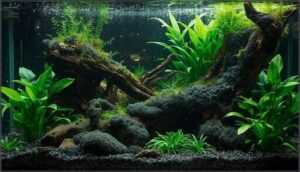
Black beard algae doesn’t discriminate—it’ll latch onto just about any surface in your tank if conditions are right. You’ll find this stubborn stuff coating everything from delicate plant leaves to your prized driftwood, and yeah, even the equipment you thought was safe. Here’s where this fuzzy menace loves to set up camp.
Plant Leaves and Edges
Black Beard Algae loves older leaves, especially those with compromised leaf anatomy or edge damage. You’ll spot it clinging to slow-growing plants where photosynthesis rates have dropped, creating the perfect breeding ground.
BBA targets margins and veins first, exploiting weakened plant defenses. Poor CO2 management accelerates this invasion, turning leaf adaptation into a liability.
Prioritize aquatic plant care and swift algae removal before entire leaves suffocate.
Driftwood, Rocks, and Hardscape
Your hardscape—those beautiful driftwood shapes and carefully chosen rocks—becomes prime real estate for BBA’s fuzzy invasion. Wood textures, especially rough, porous surfaces, trap spores that bloom into dark patches ruining your aquascape stability.
Here’s where it strikes hardest:
- Curved driftwood crevices where flow stagnates
- Porous lava rocks with uneven surfaces
- Rock placement near high-nutrient zones
- Older wood pieces releasing excess organics
Tackle algae removal on hardscape before it spreads to plants.
Filtration Equipment and Tubing
On filter outlets and CO2 diffusers, BBA clings like a stubborn beard. Poor water flow, old tubing materials, and neglected filter maintenance create perfect hiding spots.
If you’re ready to tackle algae for good, check out these proven methods for persistent BBA removal at this in-depth guide to managing stubborn aquarium problems.
Sump designs with tangled lines? Even worse. Upgrade equipment, reroute for better water circulation, and balance your water parameters—otherwise, algae will turn your tech into a fuzzy mess before you can blink.
Substrate, Gravel, and Decorations
Gravel selection is your frontline defense—choose round, stable grains that won’t trap detritus. Substrate depth matters; too shallow, roots can’t anchor, too deep, waste festers.
Tank decoration and design? Place driftwood and rocks for clever flow, not dead zones.
Gravel cleaning is essential. Scrub, vacuum, and rearrange to keep your aquascape design sharp and your ecosystem balanced.
Why Black Beard Algae Develops
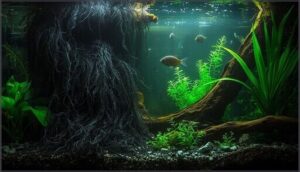
Black beard algae isn’t picky; it shows up whenever your tank gives it an open door.
Most outbreaks boil down to just a handful of easily-overlooked slip-ups. Here’s exactly what brings this nuisance to the party.
CO2 Fluctuations and Imbalances
Stop blaming your plants—pH swings are almost always a clue your CO2 is sabotaging you. Inconsistent CO2 metering or poor gas exchange throws everything out of line: plants slow, nutrients pile up, algae blooms erupt.
Nail steady CO2 levels with well-maintained diffusers, monitor with a drop checker, and keep flow high. That’s the bedrock of algae prevention.
Excess Light Exposure
Ever notice how your Aquarium Lighting feels more like a tanning bed than a fish tank? Crank up that Light Intensity and you’re basically sending Black Beard Algae an engraved invitation.
Poor Photoperiod Control, wild Lighting Schedule, and blue-heavy Light Spectrum all fuel Algae Bloom.
Dial back Lighting Conditions, use smart Algae Control Methods, and get ruthless about photoperiod management.
High Phosphate and Nutrient Levels
Think of phosphate as rocket fuel for Black Beard Algae—give it too much, and you’ll trigger a full-blown Algae Bloom. High nutrient levels from sloppy Fertilizer Management or ignored Nutrient Cycling tip Water Chemistry out of balance.
Phosphate Testing isn’t optional. Nail down Nutrient Balance, and you’ll strangle BBA’s food supply before it even gets started.
Poor Water Circulation
Cutting phosphates helps, but if your tank’s circulation patterns stink, you’re just swapping one headache for another.
Flow restrictions and dead zones create water stagnation—perfect breeding grounds for Black Beard Algae.
Messy tank layout, blocked return lines, or lazy pump placement? You’re sabotaging water flow management and ecosystem balance.
Fix water circulation or BBA will haunt every neglected corner.
For additional troubleshooting tips, review the importance of addressing pool pump performance and air leaks.
Effects of Black Beard Algae in Aquariums
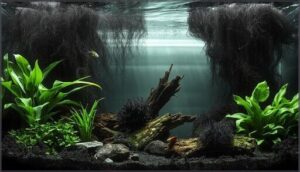
Black beard algae isn’t just an eyesore—it can mess with your tank’s balance in ways you mightn’t expect. Before you tackle removal, it’s smart to know exactly what’s at stake.
Here’s what black beard algae does to your plants, animals, and the look of your aquarium.
Impact on Plant Health and Growth
Domination—that’s what Black Beard Algae brings to your tank. Algal Competition means your aquatic plants fight for scraps, with Nutrient Depletion slowing new growth and Photosynthesis Reduction dropping leaf expansion by 20%.
Plant Suffocation? Absolutely—slimy mats block Gas Exchange, choking roots.
Want Aquatic Ecosystem Balance? Grab a Plant Essential Black Beard Remover before your prized greens wave goodbye.
Influence on Fish and Invertebrates
Plants aren’t the only victims—Fish Stress goes up fast. Picture grazing fish skirting BBA-infested turf, burning energy on detours. Invertebrate behavior shifts; snails and shrimp compete for shrinking turf. Nutrient Depletion from Algae Competition means weaker fish health and less vibrant tanks. Habitat Disruption? Absolutely. BBA transforms cozy refuges into stressful, oxygen-starved battlegrounds.
Black beard algae transforms safe tank spaces into stressful battlegrounds, forcing fish and invertebrates to struggle for food and oxygen
- Weaker foraging, more wasted energy
- Algae smothering hides, cramping invertebrate mobility
- Nighttime oxygen dips; stressed, gasping fish
- Juvenile shrimp/small fish with nowhere safe to shelter
- Patchy grazing—herbivores get picky, miss nutritious areas
Effects on Aquarium Aesthetics
You dial in your aquascape design, but Black Beard Algae wrecks it all—visual balance thrown off, bright leaves buried by black fuzz, and even glass panels lose their shine. Your tank’s Color Impact fades as aquascape order collapses into chaos.
| Before BBA | After BBA |
|---|---|
| Vibrant, clear views | Dark, patchy fuzz |
| Crisp plant lines | Blurred outlines |
| Inviting clarity | Moody shadows |
Physical Removal Techniques for BBA
If you’re staring down a tank full of stubborn black fuzz, don’t panic—there’s a hands-on way forward. Sometimes, brute force is exactly what your aquarium needs.
Here’s how you can start tackling black beard algae head-on.
Manual Trimming of Affected Plants
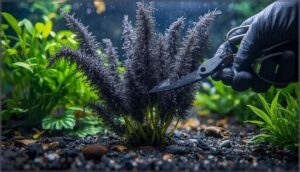
Ever notice how Black Beard Algae clings to leaves like an ex who won’t take a hint? Here’s your rescue plan: Use sharp pruning tools, snip just above a healthy node, and trim only what’s affected.
Immediate plant recovery means faster Algae Prevention. Dispose of trimmed scraps away from your tank, and you’re one step closer to real Aquarium Maintenance mastery.
Scrubbing Decorations and Equipment
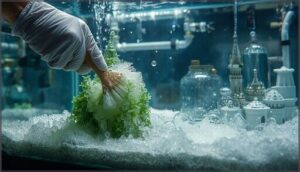
Roll up your sleeves—Decoration Cleaning is where Algae Removal gets gritty. I swear by these three moves:
- Scrub with a soft-bristled brush for stubborn BBA.
- Soak porous pieces in 3% hydrogen peroxide—five minutes max.
- Rinse everything with dechlorinated water.
Equipment Sanitizing isn’t glamorous, but it’s the backbone of real Aquarium Maintenance and Water Quality Management.
Disposing of Severely Infested Materials
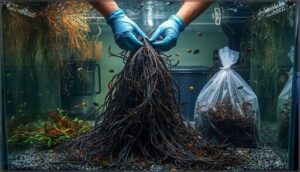
Chaos in a bag—seriously, don’t let infested material spread. Double-bag those Black Beard Algae casualties, seal tight, and haul straight to outdoor trash. Never compost! Wipe down everything with EPA-approved disinfection methods. Treat Tank Cleaning like hazardous waste disposal. It’s about Algae Control and Water Quality Management. Here’s your quick cheat sheet:
| Step | Pro Tip |
|---|---|
| Double-bag | Prevent leaks |
| Seal tightly | No escape routes |
| Outdoor disposal | Skip indoor bins |
| Disinfect surfaces | EPA-approved only |
| Don’t compost | Avoid future outbreaks |
Chemical Treatments for Black Beard Algae
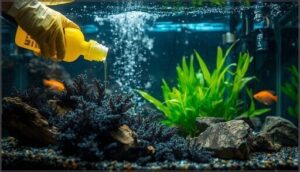
Maybe scrubbing hasn’t cut it and you’re ready to bring out the big guns. Sometimes, you need a chemical edge to put Black Beard Algae in its place.
Here’s what actually works—and how to use it without turning your tank into a disaster zone.
Hydrogen Peroxide Spot Treatments
Looking to nuke Black Beard Algae right at the roots? Hydrogen peroxide spot treatment is my go-to power play for stubborn outbreaks. Used in precise Peroxide Dosage, this method kicks off visible Algae Oxidation, leaving patches fizzing and fading fast:
- Syringe for direct Spot Treatment
- Boosts Tank Recovery, lowers regrowth
- Minimal byproduct, aids Aquarium Maintenance
- Prioritize Peroxide Safety, protect livestock
Using Liquid Carbon Supplements
Ready to turn Black Beard Algae into yesterday’s news? Liquid Carbon supplements, like Seachem Flourish Excel, are your precision toolkit for Algae Control. Carbon Dosing boosts plant growth, cuts BBA’s fuel, and slams the brakes on outbreaks. Used right, these Liquid Supplements plug holes in your tank’s CO2 defense and keep Carbon Cycling sharp.
| Strengths | Usage Tip |
|---|---|
| Instant Algae Removal | Dose daily, ramp up slowly |
| Tank Stability | Pair with good circulation |
| Boosted Plant Vigor | Time with light cycle |
| Flexible for beginners | Monitor for plant response |
Safety Considerations for Fish and Plants
Ever dose too much hydrogen peroxide or carbon? You’re gambling with Fish Health Risks and Plant Toxicity. Proper Aquarium Water Treatment means eyeing Water Parameter Balance like a hawk—dose, observe, wait. Overdosing nukes ecosystem balance.
Want true Aquarium Maintenance? Add one product at a time, test everything, and rescue shocked livestock fast to maintain Fish Health and Wellness.
Adjusting Tank Parameters to Inhibit BBA
Tweaking your tank’s environment is your secret weapon against stubborn black beard algae. A few small tweaks can shift the odds in your favor. Here’s exactly what to focus on next.
Stabilizing CO2 Levels
Nail your CO2 management first—wild swings open the floodgates for black beard algae. Invest in solid CO2 dosing systems, a calibrated CO2 meter, and monitor water pH balance like a hawk.
Tweak tank gas exchange, use reliable CO2 diffusers or liquid carbon, and check daily. Consistency is the secret. Trust me, stable CO2 levels equal fewer headaches.
Regulating Lighting and Photoperiod
CO2 locked down? Good—next, wrangle your Aquarium Lighting and Photoperiod as tightly as your tax returns. Use a Light Timer for a steady Lighting Schedule (aim for 7–8 hours), blend LED Spectrum for realistic Daylight Simulation, and fine-tune Light Intensity.
Photoperiod Control isn’t optional here—wild Lighting Conditions create an algae circus, and you’re the ringmaster.
Reducing Phosphate and Excess Nutrients
Once your lighting’s sorted, flip the script on black beard algae by attacking Phosphate head-on. Grab a Phosphate Testing kit—this is non-negotiable.
Cut overfeeding, swap in nutrient-hungry plants, and use Water Purification media that targets phosphates.
When you manage Nutrient Imbalance aggressively, you reinforce Ecosystem Balance and Stability, unlocking serious Algae Prevention and top-shelf Water Quality.
Natural Control: Algae-Eating Species
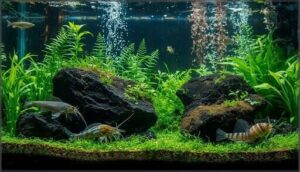
When scrubbing and chemicals just aren’t cutting it, some tank residents can pick up the slack.
Certain fish and inverts are famous for eating black beard algae—sometimes a little too enthusiastically.
Here’s the line-up of natural cleaners worth considering.
Introducing Siamese Algae Eaters
Tired of Black Beard Algae strong-arming your tank décor? Siamese Algae Eaters (SAEs) are your heavyweight champions—think of them as the relentless vacuum cleaners of the aquarium.
Here’s why you want them prowling your setup:
- Relentless Algae Grazing, especially on BBA
- Excellent Fish Compatibility in most community tanks
- Thrive on a proper SAE Diet with tank prep
Other Compatible Algae-Eating Fish and Invertebrates
Curious who else hustles alongside your Siamese Algae Eater? Your tank’s all-star cast includes Otocinclus, bristlenose plecos, Amano shrimp, and Nerite snails. Each has a specialty—think “team of janitors” for stubborn algae, detritus, and biofilm.
Here’s a quick glance:
| Fish/Invert | Algae-Busting Strength |
|---|---|
| Amano Shrimp | Hair, biofilm, detritus |
| Nerite Snails | Glass, hardscape, film |
| Bristlenose Pleco | Wood, rocks, tank glass |
Pros and Cons of Biological Control
Biological control isn’t some magic wand—more like hiring a squad of hungry janitors. Introducing biological agents like a Siamese Algae Eater, Amano Shrimp, or Nerite Snails harnesses natural predators for pest management.
It’s eco balance at work: algae eaters reduce black beard, require no harsh chemicals, but don’t expect them to solve every invasion overnight.
Preventing Future Black Beard Algae Outbreaks
You’ve booted out the black beard algae—now let’s keep it from crashing your tank again.
There are a few routines and quick habits that slam the door on any new outbreaks. Here’s what actually works.
Regular Water Changes and Maintenance
Want to know the biggest secret weapon for algae prevention? It’s ruthless consistency—water changes, every one to two weeks, like clockwork. Stick to a maintenance schedule: siphon out 15–25% with a gravel vacuum, hunt for detritus, then refill with treated, temperature-matched water.
Every session improves Water Quality, keeps Aquarium Hygiene high, and crushes black beard outbreaks before they start.
Monitoring Water Quality and Nutrients
Ever play whack-a-mole with algae? Master Water Testing and Tank Balancing instead. Log nitrates, phosphates, and monitor CO2 Management weekly—don’t just eyeball it.
Stable Water Quality and ironclad Nutrient Cycling mean fewer surprises and perfect Algae Prevention.
If you see spikes or Nutrient Imbalance, tweak Water Parameters fast or brace for black beard drama. Water Quality Management is power.
Quarantining New Plants and Decorations
Want to keep black beard algae out for good? Start a real Quarantine Setup for new plants and gear. Tank Isolation blocks invisible algae hitchhikers while you handle Plant Inspection and Equipment Sterilization.
Take two weeks, minimum—rinse, inspect, soak decor, scrub roots. Ignore this step, and you’re rolling out the green carpet for aquatic plant care headaches.
Trust me—Algae Prevention begins here.
Top 5 Products for Black Beard Algae Removal
Ready to kick black beard algae out of your tank for good? Here are five products that actually work—no wishful thinking required.
Let’s talk about real solutions you can grab right now.
1. Seachem Flourish Excel Carbon Supplement
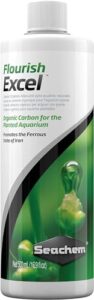
Here’s my not-so-secret weapon for black beard algae: Seachem Flourish Excel Carbon Supplement. Think of it as liquid dynamite for stubborn algae—while being plant-friendly.
You get a clean, measured dose of bioavailable carbon (just a capful does the trick in 40 liters), which also helps your aquarium thrive but also keeps pesky BBA on its toes.
Just watch your dosing—especially if you’re rocking sensitive plants or inverts. Used right, it’ll make your plants pop and BBA wilt.
| Best For | People with planted aquariums who want an easy, non-CO2 way to boost plant growth and fight off algae, including Blackbeard algae. |
|---|---|
| Form | Liquid |
| Aquarium Safe | Yes |
| Main Use | Plant Care |
| Volume/Size | 500ml |
| Brand/Manufacturer | Seachem |
| Primary Limitation | Not algae-proof |
| Additional Features |
|
- Supports healthy, lush plant growth without the need for complicated CO2 systems.
- Helps manage and reduce stubborn algae like Blackbeard algae.
- Safe for most fish and sensitive plants when dosed properly.
- Can get pricey for bigger tanks or frequent use.
- Needs careful dosing to avoid stressing certain plants, like Anacharis.
- Doesn’t completely eliminate all types of algae; results may vary depending on tank setup.
2. BN-Link Intermittent Timer
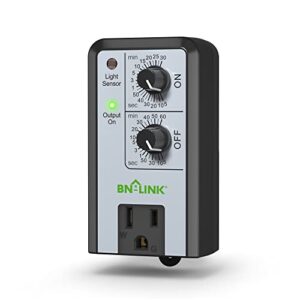
Right after boosting your plants with a carbon kick, it’s time to get clever about lighting. Enter the BN-Link Intermittent Timer—a plug-and-play lifesaver if you’re tired of algae drama.
No guessing games or endless button-mashing; just twist the dials to set exact on-off cycles. You’re in control, whether you want lights, CO2, or pumps to mimic natural sunrise or shut down after sunset.
It even senses day and night, so your tank lives by the sun—while that BBA struggles to keep up.
| Best For | Aquarists, hydroponic growers, and home tinkerers who want easy, hands-on control over lighting or device cycles without high-tech hassle. |
|---|---|
| Form | Outlet Timer |
| Aquarium Safe | Yes |
| Main Use | Equipment Control |
| Volume/Size | 2.3 x 4.1 x 2.2 in |
| Brand/Manufacturer | BN-LINK |
| Primary Limitation | Manual setup |
| Additional Features |
|
- Simple to set up and use, with clear on-off cycling and adjustable intervals.
- Versatile for a wide range of gear, from lights and fans to pumps and humidifiers.
- Built-in photocell allows dusk-to-dawn operation for hassle-free light control.
- Manual setup is needed for day, night, or 24-hour cycles—no automatic switching.
- The light sensor doesn’t swap between modes on its own.
- Complex schedules may require buying more than one device.
3. Purechem Food Grade Hydrogen Peroxide Cleaner
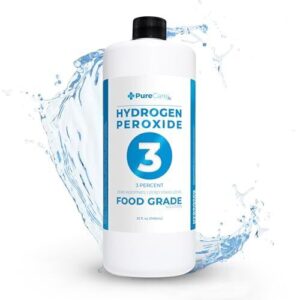
After your gear’s set to run smart, it’s time for the heavy artillery—Purechem Food Grade Hydrogen Peroxide Cleaner. This 3% solution is food grade and unscented, so you can spot-treat rocks or plants without your kitchen smelling like a science lab.
Grab a dropper or syringe, hit algae patches, wait until the fuzz goes from black to pinkish-white, then rinse. It’s safe for most surfaces and breaks down into water and oxygen—like leaving behind a clean slate for plants to thrive.
| Best For | Folks who want a versatile, eco-friendly cleaner that’s safe for food and plant use. |
|---|---|
| Form | Liquid |
| Aquarium Safe | Yes |
| Main Use | Surface Cleaner |
| Volume/Size | 32oz |
| Brand/Manufacturer | 3FGPER32OZD |
| Primary Limitation | Dilution quality issues |
| Additional Features |
|
- Food grade and unscented—safe for kitchens, veggies, and pet areas
- Breaks down into just water and oxygen, leaving no harsh residue
- Works for cleaning, whitening, gardening, and even oral care
- Some bottles arrive expired or lose effectiveness quickly
- Not as strong as higher-concentration hydrogen peroxide products
- Needs proper dilution for certain uses and care with sensitive skin
4. Api Aquarium Water Conditioner
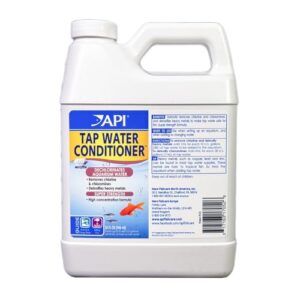
Now, let’s talk about getting your tank water squeaky clean before trouble starts. API Aquarium Water Conditioner is your no-nonsense shield. A few measured drops zap chlorine, chloramines, and heavy metals right out—you can smell the difference.
It’s fast, it’s foolproof, and it lets you replace water without holding your breath for stressed-out fish. Keep that cap handy, check the dosage, and treat every new batch—makes your maintenance routine smooth, and black beard algae loses one more excuse to stick around.
| Best For | Anyone with a freshwater or saltwater aquarium who wants to make tap water safe and stress-free for fish and plants. |
|---|---|
| Form | Liquid |
| Aquarium Safe | Yes |
| Main Use | Water Conditioner |
| Volume/Size | 32oz |
| Brand/Manufacturer | API |
| Primary Limitation | Compatibility caution |
| Additional Features |
|
- Neutralizes harmful chlorine, chloramines, and detoxifies heavy metals fast
- High-strength formula lasts longer and covers more water
- Works for new tanks, water changes, or even for watering sensitive houseplants
- Small cap makes precise measuring tricky for some
- Must follow directions carefully for best results
- May not be suitable for every type of aquatic life or plant, so a little research is needed
5. Orlushy Submersible Aquarium Heater

Heat swings invite chaos, and chaos is BBA’s favorite dance partner. That’s where your Orlushy Submersible Aquarium Heater steps in, keeping things calmly precise.
We’re talking a 2mm quartz glass shell, auto shutoff, and a dial that’s more reliable than your ex—plus a free thermometer, in case you’re the trust-but-verify type. Mount it snug with the included suction cups.
Stable temperature equals less plant stress, fewer algae breakouts, and one less opportunity for black beard algae to sneak back in.
| Best For | Anyone with a 40–55 gallon aquarium who needs reliable, steady heating for tropical fish, turtles, or aquatic plants. |
|---|---|
| Form | Heater Device |
| Aquarium Safe | Yes |
| Main Use | Temperature Control |
| Volume/Size | 11 x 1.2 x 1.2 in |
| Brand/Manufacturer | Unknown |
| Primary Limitation | Calibration required |
| Additional Features |
|
- Easily keeps water temperature stable for both freshwater and saltwater tanks.
- Durable 2mm explosion-proof quartz glass and auto shutoff for safety.
- Comes with a free thermometer and a 6ft cord for flexible setup.
- The temperature dial can be a bit off and needs calibration for true accuracy.
- Suction cups take patience to get firmly in place.
- Not ideal for tanks smaller than 40 gallons or for very cold rooms.
Frequently Asked Questions (FAQs)
Can you get rid of black algae permanently?
Here’s a tough one: can you give black beard algae the permanent boot? Not really. This stuff’s got more staying power than your in-laws at the holidays. Total eradication? Nope—long-term control is your real secret weapon.
What is the cause of black beard algae?
Black beard algae springs up when your tank’s CO2 fluctuates, the light’s on marathon mode, or phosphates creep too high.
Toss in weak water flow, and suddenly that fuzzy black menace thrives where you least want it.
Will anything eat black beard algae?
If you’re picturing a tank full of little BBA-gobbling terminators, slow down—most critters barely nibble it! Siamese algae eaters, Amano shrimp, and bristlenose plecos might take a taste, but don’t expect miracles.
How to remove black beard algae?
Start by trimming and removing affected leaves, then scrub hardscape and equipment with a stiff brush.
Treat stubborn spots with hydrogen peroxide or Seachem Flourish Excel, boost plant competition, and stabilize CO2 and lighting for lasting results.
How do you get black beard algae in an aquarium?
You get black beard algae when your tank’s CO2 swings like a yo-yo, light stays on too long, or phosphates run wild—usually after skipping water changes, letting flow stagnate, or forgetting plant maintenance for too long.
Is black beard algae a problem?
Ever found your plants wearing a scraggly black sweater overnight? That’s black beard algae, and while it won’t harm your fish, let it spread and it’ll smother plants, block light, and make your tank look downright haunted.
Can black beard algae be removed from a fish tank?
Absolutely—black beard algae can be removed from a fish tank. You’ll need a mix of manual trimming, scrubbing hard surfaces, and balancing your tank’s CO2 and light. Target the roots, not just the fuzzy black tufts.
Why am I getting black beard algae?
Think of black beard algae as that uninvited houseguest who thrives on chaos—unstable CO2, too much light, or high phosphates.
Usually, it invades when circulation lags or you slack on maintenance, creating the perfect messy buffet.
What eats black beard algae in aquarium?
Siamese algae eaters are your best allies for munching black beard algae, but Amano shrimp, Nerite snails, Florida flagfish, and Bristlenose plecos also pitch in. Each brings a unique appetite to your cleaning crew.
What is the best algaecide for black beard algae?
Like throwing water on a grease fire, not all algaecides are equal—glutaraldehyde-based liquid carbons (like Flourish Excel) and targeted hydrogen peroxide spot treatments hit black beard algae hard, especially when dosed directly, sparing plants if you’re careful.
Conclusion
Battling black beard algae begins with boldness, not backing down—banish bad habits, balance conditions, and strengthen your botanical defenses. Scrape, scrub, and snip alongside new strategies and spot-on products, but don’t forget: prevention packs the biggest punch.
When you ask how to get rid of black beard algae, you’re not just fixing a tank—you’re taking charge of your aquatic world. Take a breath, stare down that encroaching fuzz, and watch your aquarium swagger back into vibrant, algae-free brilliance.