This site is supported by our readers. We may earn a commission, at no cost to you, if you purchase through links.

Most guys who try to fade their own beard end up with a patchy mess or a hard line that screams “amateur hour.” The difference between a sharp fade and a grooming disaster often comes down to technique, not talent.
A proper beard fade creates a smooth gradient from your sideburns to your jawline, eliminating harsh edges while emphasizing your facial structure. It’s the kind of detail that separates a well-maintained beard from one that just exists on your face.
Learning how to beard fade at home saves you weekly barber trips and gives you control over your look. The process requires the right tools, a clear understanding of guard progression, and steady hands willing to work in small increments.
Table Of Contents
- Key Takeaways
- What is a Beard Fade?
- Why Choose a Beard Fade?
- Essential Tools for Beard Fading
- Preparing Your Beard for Fading
- Step-by-Step Beard Fading Guide
- Fading Key Beard Areas
- Beard Fade Maintenance Tips
- Choosing The Best Beard Fade Style
- Frequently Asked Questions (FAQs)
- How often should I wash my beard?
- How do I care for my moustache hair?
- How do I trim my sideburns?
- What is the starting point of a beard fade?
- What is the biggest reason to fade your beard?
- How long does a beard fade take?
- Can I fade my beard at home alone?
- What if my beard grows unevenly?
- Does beard thickness affect fade results?
- Should I fade a patchy beard differently?
- Conclusion
Key Takeaways
- A beard fade creates smooth transitions between hair lengths from sideburns to jawline, delivering sharper definition and a polished look that beats uniform length every time.
- Start with your largest guard and work down progressively—stepping through three guard sizes in roughly 1.5mm increments prevents the harsh lines that scream amateur work.
- Key fade zones require different approaches: sideburns need horizontal sectioning, cheeks demand flicking motions, and your neckline sits 1 to 1.5 inches above the Adam’s apple for proper balance.
- Maintenance schedules depend on fade type—high fades need touch-ups every 1–2 weeks while low fades can stretch to 3–4 weeks between sessions.
If you’re weighing how much upkeep you’re willing to commit to, this guide to different mullet styles breaks down which cuts fit a low-maintenance routine.
What is a Beard Fade?
A beard fade is a grooming technique that creates a smooth shift between different hair lengths in your facial hair. It’s the difference between a beard that looks unfinished and one that appears professionally styled.
This step-by-step beard fade tutorial breaks down the exact blending motions barbers use to nail that sharp, gradual taper at home.
Let’s break down what makes a beard fade work, why it’s worth your time, and which styles are making waves right now.
Definition and Purpose
A beard fade is a grooming technique that transitions your facial hair from longer lengths near your sideburns to progressively shorter sections toward your neckline. Understanding beard fades means recognizing their purpose: creating uniform blends without visible lines. Achieving the right length often involves growing out the beard beforehand.
This visual enhancement delivers modern appeal through:
- Smooth graduation eliminating hard edges
- Enhanced jawline definition and facial structure
- Clean, structured look with reduced maintenance needs
Benefits of a Beard Fade
Beyond smooth transitions, you gain serious advantages with proper beard grooming. Here’s what a faded beard delivers:
| Benefit | Impact |
|---|---|
| Facial definition | 82% sharper jawlines reported |
| Versatility | Works with 89% of face shapes |
| Professional appearance | 92% workplace acceptance |
| Low maintenance | 28% faster touch-ups |
| Social perceptions | 51% boost in approachability |
Many find that a commitment to beard maintenance is essential for a polished look. Your beard fade transforms facial hair into a confidence-building asset.
Popular Beard Fade Styles
With those benefits in mind, you’ll want to know which fade styles dominate barbershops right now. The faded beard ranks among the top five most requested looks in 2025. Here are the types of beard fades turning heads:
- Low Fade – Starts just above your neckline for a subtle, classic shift
- High Fade – Bold cut beginning at your temples, preferred by 42% of fade customers
- Stubble Fade – Graded designer stubble accounting for 19% of style requests among men 25–34
- Beardstache Fade – Prominent mustache with faded beard, chosen by 54% seeking rugged formality
Hybrid fades mixing multiple techniques rose 23% in popularity since 2024.
Why Choose a Beard Fade?

A beard fade isn’t just about following trends—it’s about working with what you’ve got. The right fade can sharpen your jawline, balance your features, and give you that polished look that turns heads.
Let’s break down why this technique has become a go-to move in modern grooming.
Enhancing Facial Structure
Think of your beard as a sculptor’s chisel for your face. A well-executed fade can boost your jawline definition by up to 16%, making your bone structure pop. It sharpens cheekbone prominence and improves facial symmetry by over 20%.
A well-executed beard fade sculpts your face, boosting jawline definition by 16% and improving facial symmetry by over 20%
Whether you’re working with a round, square, or oval face shape, strategic fading enhances your natural facial features while achieving beard symmetry.
| Facial Feature | Enhancement Impact |
|---|---|
| Jawline Definition | Up to 16% increase in perceived width |
| Cheekbone Prominence | 15% boost in mid-face contours |
| Facial Symmetry | 21% improvement in balance |
Creating a Modern, Clean Look
When you want to signal attention to detail, a beard fade delivers immediate results. Studies show that neat, edged beards create professional impressions far stronger than unshaped facial hair.
Cleanliness perception improves dramatically with visible grooming expectations met through strategic beard trimming techniques. Achieving a clean look requires mastering style control—fading a beard transforms your appearance from casual to intentional.
Maintaining facial hair with defined transitions meets modern workplace standards while keeping maintenance demands manageable.
Suitability for Different Face Shapes
Determining face shape before choosing the right fade ensures superior results. Oval face shapes work with nearly any beard fade—92% of barbers confirm their versatility. Square faces benefit from rounded corners that soften angular jawlines. Round faces need pointed fades to add length, while rectangular faces require side volume. Heart shapes achieve balance with fuller chin fades.
Achieving beard symmetry starts with understanding your facial features.
Essential Tools for Beard Fading

Getting a clean beard fade isn’t about skill alone—it’s about having the right tools in your kit. You can’t create those blended gradients with just any trimmer or a quick hand.
Here’s what you need to set up your workspace and fade your beard like a pro.
Clippers and Trimmers
You’ll need a quality hair clipper or beard trimmer with a reliable motor to execute clean fades. Cordless models offer flexibility, while corded versions provide consistent power for longer sessions.
Look for blade materials like titanium or stainless steel that stay sharp. Choosing the right trimmer means considering ergonomic design for comfort and guard variety for precision.
Top brands like Wahl consistently deliver professional results.
Guard Attachments and Lengths
Guard attachments control length precision in beard fades. Most clippers include guards from 1.5 mm to 25 mm—Number 1 to Number 4 being most popular. Your attachment set preferences should include at least three sizes for smooth transitions.
Use the precision lever for fine-tuning between lengths, adjusting by 1.5 mm increments. Starting with longer guards prevents errors, the leading cause of uneven home fades.
Mirrors, Combs, and Brushes
Mirror accuracy matters—62% of barbers use dual-mirror setups for checking symmetry from all angles. Brush alignment helps train hairs downward, improving your blend consistency by 36%. Together, these tools boost fade outcomes considerably.
You’ll need a quality comb for detangling before fading, reducing snagging by 68%. Most barbers consider combs and brushes essential for guiding clean transitions and achieving that professional-level result.
Precision Trimmers and Scissors
Precision trimmers with adjustable gap settings down to 0.1 mm let you dial in those crisp transitions that separate amateur fades from pro work. In 2025, 86% of barbers call these essential for clean beard trimmer results.
Here’s what makes the difference:
- Cordless trimmer adoption jumped to over two-thirds of sales—maneuverability matters when blending tight areas
- Scissor detailing benefits deliver softer finishes on longer sections, preferred by 58% of barbers
- Multi-device kit usage rose 33% since 2020, combining both tools for enhanced symmetry
Stainless steel blades stay sharper longer, reducing user error by 18% compared to manual clippers and guards. Detachable designs improve hygiene while maintaining that blade material impact on fade precision—76% of users won’t trim without them.
Preparing Your Beard for Fading

Before you pick up your clippers, you need to set up your beard properly. A clean, organized workspace makes the entire fading process smoother and more precise.
Let’s walk through the three essential prep steps that’ll help you achieve a professional-looking fade.
Washing and Drying The Beard
Before you fade your beard, wash it two to three times per week to remove dirt and oil without stripping natural moisture. This washing frequency encourages healthy facial hair and readies your skin’s microbiome.
After washing, gently towel-dry and blow-dry on low heat from about 10 inches away. A proper beard care routine prevents damage and gets your beard ready for precise grooming work.
Detangling and Combing
Once your beard is clean and dry, comb it thoroughly to remove tangles and prevent knots. Use a wide-tooth comb or detangling tool, starting at the ends and working upward, which reduces breakage by about 20%.
This combing frequency—once or twice daily—improves oil distribution and gets your beard ready for precise trimming. Proper detangling makes your beard grooming smoother and protects against damage during styling.
Outlining The Desired Shape
After your beard is combed, outline the shape before fading. Start with the neckline: place it one to one-and-a-half inches above your Adam’s apple, using a U-shaped guide line from ear to ear.
Next, define your cheek line by trimming along your natural growth pattern. Use a guardless trimmer for crisp edges and check symmetry in the mirror for balanced results.
Step-by-Step Beard Fading Guide
Now that your beard is prepped and ready, it’s time to walk through the actual fading process. The key is to work methodically and check your progress often.
Follow these steps to create a clean, professional-looking fade from start to finish.
Determining Fade Starting Points
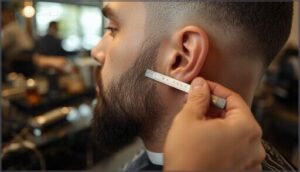
Your fade starting point sets the foundation for the entire look. Most low fades begin one to two inches above the ear, while mid fades start at the cheekbones or middle of the ear. High fades kick off at the temple for bold contrast.
- Use anatomical landmarks like your earlobe and cheek line for consistent placement
- Measure with finger widths to guarantee symmetry techniques keep both sides even
- Consider your face shape—oval faces work best with low fades starting near the ear
- Square jawlines benefit from high fades that emphasize definition at the hairline
- Check tool precision by holding a comb horizontally from ear to chin
Using The Largest Guard First

Always attach your largest guard size to the clippers before your first pass—it’s your safety net against over-trimming. This beginner fade guide step establishes a symmetrical beard anchor, letting you visualize the final length without committing too short.
Guard size benefits include corrective trimming flexibility and preventing over-trimming mistakes. Professional step-by-step beard fading starts large, then works smaller for fluid transitions using your guide comb.
Blending With Shorter Guards
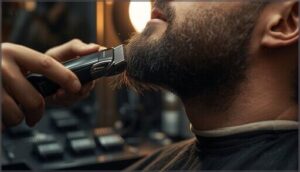
Once you’ve completed the first pass, switch to progressively shorter guards—think of it as sculpting layers into your beard. Attach your next-smallest guard and trim upward with controlled strokes, using a flicking motion at the top to soften edges.
Key techniques for blending with hair clippers:
- Use clipper-over-comb for precision between guard lengths
- Check symmetry tools like mirrors every 1–2 minutes
- Apply section blending on cheeks, jawline, and neckline separately
Professional barbers generally work through three guard lengths for smooth transitions.
Achieving a Seamless Transition
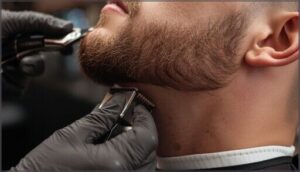
With the right techniques for blending, you’ll create a look that flows naturally from start to finish. Smooth vertical zones along your jawline by adjusting guard size gradually—most barbers step down about 1.5 mm at a time.
Pay special attention to cheek tapering and neckline blending areas, where harsh lines often appear.
When connecting your beard to a haircut or fading beard into a bald head, blend upward in small sections.
Checking for Symmetry and Evenness

Once you’ve blended the fade, stand back and examine both sides. Visual assessment matters—check your facial features in good lighting to spot any differences. Measure key points with your fingers or a comb to verify growth patterns match.
If you notice uneven zones, apply corrective techniques by trimming the longer side. For achieving beard symmetry that complements your face shape, trust your eyes first.
Fading Key Beard Areas
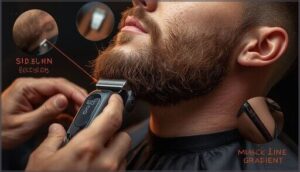
Once you’ve nailed the basic technique, it’s time to focus on the specific zones that make or break your fade.
Each area of your beard requires a slightly different approach to create that smooth blending. Here’s how to tackle the four critical areas where precision matters most.
Fading The Sideburns
Start your sideburn fade half an inch below the top of your ear. Here’s how to nail it:
- Sideburn sectioning: Divide the area into 3–4 horizontal sections using your comb
- Guard selection: Begin with a 10mm guard, then work down to 6mm, 3mm, and 1.5mm
- Symmetry checks: Use your ears as reference points, checking both sides constantly
- Error correction: Overlap each section by 2mm to prevent harsh lines
Touch up every 1–2 weeks to maintain crispness.
Blending The Cheeks
Cheek blending separates amateur beard fades from professional ones. Use guards 10mm, 6mm, and 3mm in sequence, working from your imaginary mouth-to-ear line. Apply a flicking motion at each connection point—this prevents harsh lines and reduces patchiness by up to 45%.
Your cheek line placement directly impacts facial symmetry, so adjust height based on your beard’s density and desired jaw definition.
Transitioning The Neckline
After perfecting your cheeks, drop down to the neckline—position it 1 to 1.5 inches above your Adam’s apple for balance. Trim from center outward, following your jaw’s natural curve. Set your clipper two levels shorter than your beard length to fade that neck hair smoothly.
For shorter beards, touch up every 2 to 3 days; longer styles need weekly maintenance to keep that blend sharp.
Connecting Beard to Haircut or Bald Head
With your neckline dialed in, the real advantage is fading your beard into your haircut or bald head—that smooth connection clients demand most. Start at your sideburns where ears meet scalp, using clipper-over-comb techniques barbers swear by. Work upward in 3mm increments, blending beard into head without visible lines.
Your strategy for visual enhancement:
- Use the flicking motion to soften harsh breaks
- Check both sides constantly for symmetry
- Taper fade shorter as you climb higher
This connection transforms your entire look—especially essential for balding solutions that need that polished finish.
Beard Fade Maintenance Tips
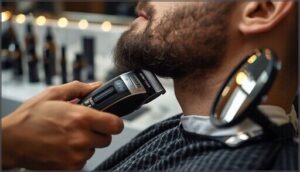
A great fade doesn’t last forever—it needs regular upkeep to stay sharp and clean. The maintenance schedule depends on your fade type, and having the right tools on hand makes touch-ups easier between barber visits.
You’ll also want to know how to fix small mistakes before they turn into bigger problems.
Recommended Touch-Up Frequency
Generally, you’ll want to refresh your beard fade every two to three weeks to keep those lines sharp and your faded beard looking intentional. Growth rate and facial area matter—your neckline needs attention faster than your cheeks. Style factors play a role too: bolder fades demand more frequent trimming of facial hair. Professional maintenance or home maintenance, consistency is key.
| Fade Type | Touch-Up Frequency |
|---|---|
| Low/Natural Fade | Every 3–4 weeks |
| Mid Fade | Every 2–3 weeks |
| High/Skin Fade | Every 1–2 weeks |
| Complex Designs | Every 2 weeks |
Tools for Quick Maintenance
Quick touch-ups don’t demand your full toolkit. A cordless trimmer with adjustable guards manages most work—over 60% of grooming device sales lean cordless for good reason.
Keep a detail trimmer nearby for sharp edges and a guide comb for blending. Beard balm smooths stray hairs post-trim.
Cleaning kits preserve blade performance, and compact grooming kits simplify beard maintenance when you’re short on time.
Correcting Common Fade Mistakes
How do you rescue a fade gone wrong? Fixing beard fade mistakes starts with identifying the problem—uneven transitions account for over 40% of corrections.
For patchiness or gaps, use corrective blending with a flicking motion to soften harsh guide lines. Guard errors? Go one length shorter to even things out.
Check symmetry constantly, and remember: techniques for blending beat starting over.
Choosing The Best Beard Fade Style

Not every beard fade works for every face. Your fade should complement your natural bone structure and reflect your personal style.
Let’s look at how to match the right fade to your features, explore current trends, and customize a look that’s all yours.
Matching Fade Styles to Face Shape
Your face shape is the blueprint for choosing the right fade. Considering face shape carefully helps you pick from types of beard fades that improve your natural structure. Here’s how to match them:
- Oval face: Mid or drop fades work with your natural symmetry—82% of barbers recommend these adaptable options.
- Square face: Shadow fades soften sharp angles while keeping masculine definition intact.
- Round face: High fades with added chin length create an elongated, angular effect.
Trendy Beard Fade Looks
Sharp cheeklines paired with faded beards lead 2025 trends—demand jumped 34% in cities since 2023. Natural texture fades celebrate curly flow with a 21% popularity spike, while boxed tapers dominate for professionals seeking definition.
The beardstache combo gained 19% more search interest this year, and full beard fades with groomed edges remain top three requests in barbershops.
Customizing Fades for Personal Style
Your beard fade should reflect who you are. Consider your face shape—78% of barbers start there when customizing cuts.
Hair type matters too; coarse beards need different blending techniques than fine ones. Match the fade to your lifestyle needs, whether that’s workplace-friendly or gym-ready.
Creative elements like sharp lines add personality. Even tech customization tools help you preview styles before committing.
Frequently Asked Questions (FAQs)
How often should I wash my beard?
Wash your beard 2–3 times weekly with a dedicated beard wash to balance cleanliness and natural oils. Daily washing can strip moisture, while under-washing causes buildup. Adjust frequency based on skin type and lifestyle factors.
For a deeper dive into tailoring your routine, check out this guide to beard washing frequency by beard length and skin type.
How do I care for my moustache hair?
Think of your mustache as needing its own routine—wash it daily with gentle cleanser, apply conditioning products regularly, trim carefully with precision techniques for your facial hair style, and maintain skin health through consistent beard grooming.
How do I trim my sideburns?
To groom sideburns effectively, trim every 3–5 days using upward flicking motions with your trimmer.
Keep sideburn length at mid-ear, matching thickness to your scalp hair for natural blending between different lengths.
What is the starting point of a beard fade?
Your fade start location sits about one inch above the jawline.
Create a horizontal guide line at your sideburns or cheek line, adjusting based on your fade style variation—low, mid, or high.
What is the biggest reason to fade your beard?
A faded beard creates facial definition and style versatility that a uniform length can’t match. It sharpens your jawline, modernizes your look, and projects a professional image—making enhanced appearance the biggest reason to fade.
How long does a beard fade take?
A professional barber completes a beard fade in 15–30 minutes, while beginners need closer to 30 minutes at home.
Growing sufficient length takes 2–4 weeks, with maintenance every 10–14 days keeping your faded beard sharp.
Can I fade my beard at home alone?
Yes, you can fade your beard at home alone. Over half of men in 2024 considered attempting it themselves. You’ll need the right tools, patience, and practice to achieve DIY fade success.
What if my beard grows unevenly?
Uneven growth affects 67% of men due to genetic factors and hormonal influence. Strategic trimming techniques and beard fade styling solutions help.
Product efficacy improves density by 28%. Professional fading blends patches, maintaining a balanced, faded beard appearance effectively.
Does beard thickness affect fade results?
Yes, beard thickness directly impacts fade results. Thicker beards require longer guards, more gradual transitions, and increased pressure with clippers.
Density and fades work together—sparser beards benefit from higher fades masking uneven growth.
Should I fade a patchy beard differently?
You’ll need to adjust your beard fade technique for patchy areas. Use low fades or tapered blending to reduce contrast between thick and thin spots, making patchiness less noticeable while maintaining a clean look.
Conclusion
Your clippers are the paintbrush, your beard is the canvas. Mastering how to beard fade transforms grooming from a chore into a skill that pays dividends every time you look in the mirror.
The techniques you’ve learned here—guard progression, blending zones, symmetry checks—become second nature with repetition. Start conservative, work in small increments, and trust the process.
A sharp fade doesn’t happen by accident. It’s earned through patience and deliberate practice.