This site is supported by our readers. We may earn a commission, at no cost to you, if you purchase through links. This content is for general informational and educational purposes only and is not a substitute for professional medical, dermatological, or nutritional advice.

A beard without clean lines looks unfinished, no matter how thick or full the growth. The difference between a polished beard and one that reads as sloppy comes down to two precise borders: the cheek line that frames your face and the neckline that separates beard from throat.
Most men either ignore these boundaries entirely or hack at them with guesswork, creating asymmetry that throws off their whole look.
Getting your beard line up right isn’t complicated, but it requires deliberate placement and the right technique. Once you know where these lines should sit and how to maintain them, you’ll transform your beard from something you grow into something you control.
Table Of Contents
- Key Takeaways
- What is The Ideal Beard Line Up?
- Essential Tools for Lining Up Your Beard
- How to Define Your Beard Neckline
- How to Shape Your Cheek Lines
- Maintenance Tips for a Sharp Beard Line Up
- Frequently Asked Questions (FAQs)
- What is the perfect line up for a beard?
- What are common beard line mistakes?
- How often should I trim my beard?
- How do I prevent razor burn when trimming my beard?
- What type of razor should I use to trim my beard?
- How do I keep an even beard line?
- What products should I use to maintain my beard?
- How often should I professionally line up my beard?
- Can I line up a short stubble beard?
- What if my beard grows unevenly on sides?
- Conclusion
Key Takeaways
- Your beard line up depends on two precise boundaries—the cheek line that frames your face along the cheekbones and the neckline that sits one to two fingers above your Adam’s apple, creating structure that separates a polished beard from an unkempt one.
- Face shape dictates where you place these lines: oval faces follow natural cheekbone contours, round faces need higher cheek lines for vertical length, square faces benefit from rounded corners, and heart-shaped faces require tapered lines for balance.
- Sharp tools make the difference—rotary motors hitting 7,000 to 9,000 RPM with stainless steel blades cut through dense growth without stalling, while barber’s pencils map your lines before you trim to prevent costly mistakes.
- Maintenance every 5 to 10 days keeps your lines sharp, and working in short controlled strokes with natural light prevents the most common errors: necklines too high, uneven cheek lines, and symmetry drift between sides.
What is The Ideal Beard Line Up?
A sharp beard line isn’t just about trimming random spots—it’s about creating two clean borders that frame your face. The cheek line and neckline work together to give your beard structure, but they serve different purposes and sit in different places.
A solid morning shave routine for busy men starts with defining these boundaries before you even touch the razor.
Your face shape, growth pattern, and personal style all determine where these lines should fall for the best results.
Cheek Line Vs. Neckline Explained
Your beard line up hinges on two boundaries: the cheek line and the neckline. The cheek line defines the upper edge along your facial contours, sitting above the cheek hollow and blending into sideburns.
Your beard neckline marks the lower border, usually two finger widths above the Adam’s apple. Together, these lines create edge definition and beard symmetry that frame your face with precision.
How Face Shape Impacts Line Placement
Your face geometry dictates where you place those boundaries. Oval faces thrive when cheek lines follow natural cheekbone contours, creating balanced facial proportions.
Round faces need a higher cheek line and longer neckline to build vertical length and sharper jawline alignment. Square faces benefit from rounded corners that soften the jaw, while heart shapes require a tapered beard line for symmetry.
Map your lines to match your structure.
Common Beard Line Up Goals
Now that you know your structure, let’s lock in what sharp beard line up actually delivers. Your goal is facial harmony through symmetry—both cheek lines within 1 to 2 millimeters height difference, creating balanced line precision around your jaw.
A sharp beard line up delivers facial harmony through symmetry, with both cheek lines balanced within 1 to 2 millimeters for precision around your jaw
Target these outcomes with proper grooming techniques:
- Clean neckline sitting one finger width above your Adam’s apple
- Cheek lines that emphasize cheekbones without exposing patchy spots
- Smooth transitions preventing harsh corners at the jawline
- Consistent beard trimming schedule every 1 to 2 days for style enhancement
For a deeper understanding of the tools and techniques involved, see this guide to precision grooming essentials.
Essential Tools for Lining Up Your Beard

You can’t shape a beard with just your hands and hope. The right tools make the difference between a clean line and a sloppy mistake.
Investing in quality clippers, scissors, and combs—plus learning natural beard grooming tips—helps you maintain sharp edges without the guesswork.
Here’s what you need in your arsenal to get those cheek and neck lines razor-sharp.
Choosing The Right Trimmer or Clippers
Your tool makes or breaks crisp lines. Look for rotary motors that hit 7,000 to 9,000 RPM—they cut through dense growth without stalling. Stainless steel blades stay sharp longer, while lithium ion batteries deliver 60 to 120 minutes of runtime. An adjustable taper lever beats swapping guards mid-session.
| Feature | Why It Matters |
|---|---|
| Rotary Motors (7,000–9,000 RPM) | Consistent cuts through thick hair |
| Stainless Steel Blades | Sharper edge, less corrosion |
| Adjustable Taper Lever | Micro adjustments without guard changes |
Lightweight bodies under 200 grams reduce hand fatigue. Water-resistant housings simplify cleanup under running water.
For a deeper understanding of blade types and settings, see this comprehensive trimmer guide.
Using Barber’s Pencils and Guides
Map out your lines before you cut—barber’s pencils and guide combs lock in precision. White or skin-tone pencils trace your neckline and cheek lines on dry hair, showing exactly where to trim. Light pencil pressure prevents heavy marks.
Pair pencil techniques with a guide comb set at your desired length for edge control. Rinse the pencil line after trimming for clean beard grooming techniques.
Recommended Beard Grooming Kits
Pick a beard grooming kit that covers all the essentials without wasting money on extras. A solid kit comparison starts with trimmer quality, guard variety, and product durability across brands.
- Basic kits bundle a beard trimmer, comb, oil, and brush—perfect for daily beard care and grooming techniques.
- Mid-range options add travel cases and extra guards for flexible grooming tools and equipment.
- Premium sets include steel scissors, luxury brushes, and scented balms for sophisticated beard grooming essentials.
How to Define Your Beard Neckline
Your neckline separates a clean beard from one that looks sloppy and unfinished. Getting it right means knowing exactly where to place that line and how to trim it without second-guessing yourself.
Here’s how to nail your neckline every single time.
Finding The Right Neckline Position

Your beard neckline sits 1 to 1.5 inches above the Adam’s apple—place two fingers there to mark your midpoint. This spot creates a clean border between beard and neck, visually lengthening your jawline and balancing facial proportions.
A well-positioned neckline follows your natural hair growth patterns and enhances beard symmetry, giving you control over how your facial hair frames your face.
Step-by-Step Neckline Trimming Guide
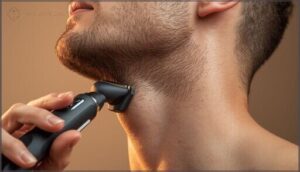
Start at the center of your neckline, where you placed your fingers above the Adam’s apple. Shave straight down with your trimmer, following natural hair growth patterns to prevent irritation.
Work outward from that midpoint in short, controlled strokes toward each ear, removing everything below your jawline. Use a handheld mirror to verify beard symmetry as you trim both sides.
Tips for Symmetry and Natural Look

Tilt your head back and check under your chin in natural light—shadows hide gaps that throw off symmetry. Measure equal distance from your nose centerline to each side of the neckline using your trimmer’s edge as a ruler.
For natural edges, blend the shift zone with a mid-length guard rather than carving a sharp border. This beard styling approach respects your facial structure while maintaining clean grooming habits.
How to Shape Your Cheek Lines

Your cheek line defines the top edge of your beard, running from your sideburn down to your mustache. Getting this line right makes the difference between a polished beard and one that looks wild or patchy.
Here’s how to map, trim, and adjust your cheek lines for a clean, sharp look.
Visualizing and Mapping The Cheek Line
Think of your cheek line as a frame that highlights jawline definition and cheekbone contour. Use a barber’s pencil to map the line from sideburn to mustache, following your facial alignment along the zygomatic arch. Check both sides against a vertical midline to verify beard symmetry.
This cheek line mapping prevents over-trimming and sets the foundation for clean men’s facial hair before any beard trimming techniques begin.
Techniques for Trimming and Smoothing
Once you’ve mapped the line, set your trimmer to 0.5 millimeters for beard edge control. Work in short, deliberate strokes along the cheek line, moving with hair growth for smoothing methods that prevent jagged edges.
Use a zero-gap clipper for crisp borders, then feather the blend with a mid-length guard for hair texture management that blends naturally into the beard.
Adjusting for Patchy or Uneven Growth
Patchy beard solutions start with facial hair mapping to reveal your growth pattern analysis. Lower your cheek line in sparse zones to hide thin coverage, working the border around fuller areas.
For uneven growth tips during beard patch repair, feather edges with a guard to soften harsh transitions. This beard grooming tips approach keeps your beard neckline and mens facial hair looking intentional, turning weak spots into clean beard care and maintenance wins.
Maintenance Tips for a Sharp Beard Line Up

Lining up your beard once won’t keep it sharp for long. Hair grows fast, and those clean lines blur within days if you don’t stay on top of them.
Here’s how to lock in your work and keep your beard looking precise every single day.
Routine Upkeep for Neckline and Cheeks
Keep your neckline and cheek lines sharp by scheduling touch-ups every 5–10 days, depending on your growth rate. Daily trimming irritates skin, so stick to precision passes with a short guard.
Use natural light to run symmetry checks on both sides, adjusting the higher line to match the lower. Clean your tools after each session to maintain edge sharpness and consistent grooming frequency for long-term beard maintenance.
Moisturizing and Aftercare Practices
Once you’ve cleaned your lines, apply a fragrance-free moisturizer to hydrated skin—this locks in water and prevents razor burn.
Work beard oil through the trimmed area using light pressure to soften edges and reduce roughness.
Make this part of your daily routine: moisturize right after grooming, then again before bed to support overnight repair and maintain consistent skin hydration for long-term beard care.
Troubleshooting Common Line Up Mistakes
When your lines drift or look uneven, fix them fast—small errors compound into bigger problems. Check for these five beard trimming and grooming mistakes:
- Neckline sits too high, casting chin shadow under natural light.
- Symmetry drift where one side drops lower after shaving.
- Dull blade edges create jagged lines and tugging during edge refining.
- Dry flaky skin makes your beard neckline look uneven and rough.
- Skipping symmetry checks with a central reference point causes visible imbalance.
Frequently Asked Questions (FAQs)
What is the perfect line up for a beard?
A sharp line up isn’t just trimming—it’s the blueprint for beard symmetry.
The perfect setup balances your facial structure: a clean neckline one finger above the Adam’s apple, paired with natural cheek lines following your bone structure.
What are common beard line mistakes?
Trimming your neckline too high creates a chin strap effect, while cutting too low leaves sparse throat coverage.
Uneven cheek lines and asymmetry between sides instantly break your beard’s visual balance and professional appearance.
How often should I trim my beard?
Think of your beard like a lawn—let it run wild and you’ll lose the shape.
Trim every two to four weeks to maintain growth, neckline definition, and sharp cheek lines that suit your style goals.
How do I prevent razor burn when trimming my beard?
Shave over clean, hydrated skin with proper Pre-Shave Prep and follow hair growth direction. Use sharp Razor or Trimmers with light strokes, rinse frequently, then apply fragrance-free Post-Shave balm to calm irritation.
What type of razor should I use to trim my beard?
Over 70% of men report nicks from the wrong razor.
Start with an electric beard trimmer for precision trimming and safety. Then use a double-edge safety razor for clean edges around your neckline and cheek lines.
How do I keep an even beard line?
Use a handheld mirror to check both sides from every angle. Mark your neckline and cheek lines with a barber’s pencil, then trim gradually while your beard is dry and freshly combed.
What products should I use to maintain my beard?
Keep your lines fresh with beard oil for hydration, beard balm for hold, and sulfate-free shampoo.
A quality beard trimmer, clippers, and preshave oil round out your arsenal for daily upkeep.
How often should I professionally line up my beard?
Professional line up schedules run every 2 to 4 weeks, depending on beard growth rates and grooming tips. Fast growers hit the barbering chair biweekly, while slower growth stretches maintenance intervals to monthly shaping timings.
Can I line up a short stubble beard?
Yes, short stubble beards benefit from clean line ups. Define your neckline two finger widths above the Adam’s apple and shape cheek lines along your natural contour using a 1-3mm trimmer guard for sharp, symmetrical edges.
What if my beard grows unevenly on sides?
Uneven growth stems from genetics and hormones—DHT and testosterone drive follicle density differently on each side.
Lower cheek lines hide patchy spots, while regular beard trimmer passes and strategic beard styling techniques create balanced facial symmetry.
Conclusion
Measure twice, cut once—your beard line up deserves the same precision as a carpenter’s work. Don’t just trust your instincts; use guides, mirrors, and steady hands. A sharp neckline and cheek line show intention, not luck.
When you master how to line up beard edges, your style speaks before you do. Remember, every clean border is a decision, not a guess.
Take control, maintain your lines, and let your beard reflect your discipline, not your doubts.