This site is supported by our readers. We may earn a commission, at no cost to you, if you purchase through links. This content is for general informational and educational purposes only and is not a substitute for professional medical, dermatological, or nutritional advice.

Leave 40 volume bleach in your hair for 15 to 30 minutes maximum, depending on your starting color, texture, and desired lift—and checking every 5 to 10 minutes is non-negotiable. That 12% hydrogen peroxide concentration doesn’t mess around; it aggressively breaks down melanin faster than gentler developers, which means the window between “perfect platinum” and “chemical disaster” is alarmingly narrow.
Your hair’s thickness, porosity, and history with dyes or relaxers all shift that timeline, sometimes dramatically. Dark hair may demand the full half-hour, while previously lightened strands could reach their limit in 15 minutes or less. Understanding these timing variables separates achieving your dream color from ending up with fried, breaking strands and a scalp that feels like it met a blowtorch.
Table Of Contents
- Key Takeaways
- What is 40 Volume Developer?
- When to Use 40 Volume Bleach
- How Long to Leave 40 Volume Bleach On
- Key Factors Affecting Bleach Timing
- Step-by-Step 40 Volume Bleach Application
- Monitoring Hair During Bleaching
- What Happens if You Over-Bleach
- Safe Rinsing and Neutralizing Techniques
- Essential Aftercare for Bleached Hair
- Top 5 Hair Bleach Kits for 40 Volume
- Frequently Asked Questions (FAQs)
- Does 40 volume developer lighten hair?
- How many levels of lift with 40 vol?
- Is 40 minutes too long for bleach?
- Is 40 volume bleach too much?
- Is 40 volume bleach suitable for all hair types?
- What is the difference between 30 and 40 volume bleach?
- How often should I bleach my hair?
- Can I use 40 volume bleach to lighten my hair gradually?
- Is it possible to reverse the effects of bleaching?
- Can I bleach hair twice in one day?
- Conclusion
Key Takeaways
- Leave 40 volume bleach on for 15 to 30 minutes maximum, depending on your hair’s thickness, porosity, starting color, and previous chemical treatments, checking progress every 5 to 10 minutes to prevent overprocessing and irreversible damage.
- The 12% hydrogen peroxide concentration in 40 volume developer breaks down melanin aggressively and requires shorter processing times than lower volumes, delivering 2 to 3 levels of lift but carrying higher risks of chemical burns, breakage, and scalp irritation.
- Hair type directly affects bleach timing—fine or high-porosity strands process in 10 to 15 minutes, while coarse, low-porosity, or dark virgin hair may need the full 20 to 30 minutes to achieve desired lift without turning orange or brassy.
- Stop processing immediately when hair reaches pale yellow, feels gummy when wet, shows uneven patches, or causes scalp burning, then rinse thoroughly with cool water for 5 to 10 minutes and follow with bond repair treatments and deep conditioning to restore moisture and prevent further damage.
What is 40 Volume Developer?
Before you mix that bleach powder, you need to understand exactly what you’re working with.
If you’re dealing with stubborn semi-permanent dye, check out proven methods to safely remove semi-permanent hair color before you reach for harsh bleach.
40 volume developer is one of the most aggressive lightening options available, and it’s not something you should use without knowing its power.
Let’s break down what makes this developer so potent and why timing matters more than with any other strength.
Hydrogen Peroxide Concentration
You’re working with 12 percent hydrogen peroxide when you pick up 40 volume developer, which makes it one of the most aggressive bleach strengths available for hair lightening. This concentration risks significant hair damage if you don’t respect proper bleaching time limits, usually maxing out at 20 minutes of processing.
Key facts about 40 volume concentration:
- Contains 12% hydrogen peroxide for maximum lifting power
- Triggers intense chemical reactions that break down melanin rapidly
- Requires shorter bleach processing time than gentler peroxide levels
- Carries higher concentration risks including burns and irreversible damage
For more information on the risks and uses of hydrogen peroxide, consult this guide to.
Purpose in Hair Bleaching
Your 40 volume developer plays one primary function in bleaching: it supplies the hydrogen peroxide needed to activate bleach powder and trigger rapid melanin breakdown. This combination opens cuticle scales, allowing deeper pigment removal and aggressive lift to pale yellow or near-white levels.
That oxidation power makes 40 volume the go-to choice for dramatic color correction, but only when you control bleaching time strictly to prevent irreversible hair damage.
Differences From Lower Volumes
Compared to 20 or 30 volume developer, 40 volume delivers noticeably faster hair lift and stronger oxidation, often achieving 1 to 2 additional levels of lightening in a single session.
That bleach strength demands shorter processing time to avoid severe hair damage, while lower volumes allow longer contact with reduced damage risk. Understanding this volume comparison helps you bleach hair safely without sacrificing the aggressive lift you need.
When to Use 40 Volume Bleach

You don’t reach for 40 volume developer on a whim, it’s reserved for situations where you need serious lifting power and understand the risks involved.
This isn’t a one-size-fits-all solution, and knowing when it’s appropriate versus when it’s overkill can save your hair from unnecessary damage. Let’s break down the specific scenarios where 40 volume actually makes sense.
Suitable Hair Types and Colors
You’ll get the best results with 40 Volume Developer on naturally level 6 to 9 hair—think dark blonde to light brown—without heavy previous processing.
Hair Type matters: fine strands lift faster and risk overprocessing, while coarse Hair Texture needs more time for controlled Hair Lightening.
Hair Porosity also affects Bleach Compatibility, since high-porosity hair accepts Bleach in hair more quickly but can turn brassy if you don’t watch closely.
Desired Lightening Results
Your Lift Expectations dictate Bleach Timing and ultimately shape Color Outcomes—40 volume bleach can lift four to five levels under ideal conditions, pushing dark hair toward orange or pale yellow tones beyond level 9.
Hair Porosity affects Bleach Processing Time since porous strands grab faster, so Hair Lightening Techniques demand you balance ambition with Damage Control by monitoring processing time every ten minutes during Hair Bleaching.
Professional Vs. At-Home Use
Licensed cosmetologists assess your scalp health and follow strict Safety Protocols including patch tests before applying 40 volume bleach, making Professional Guidance essential for Bleaching Hair Safely and Hair Damage Prevention.
At Home Risks escalate without proper training, since kits often lack adequate Supervision Needs despite warning labels, and you’re mixing chemicals without the first aid resources salons maintain for burns.
Licensing Requirements exist to protect you from permanent damage during aggressive Bleach in Hair applications requiring PostBleach Hair Care expertise.
How Long to Leave 40 Volume Bleach On
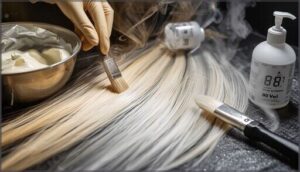
Timing is everything when you’re working with 40 volume bleach, and getting it wrong can mean the difference between a stunning transformation and serious damage.
With 40 volume bleach, timing separates stunning transformation from serious damage
You need to know exactly how long to process, what signals tell you it’s time to rinse, and what happens if you push it too far. Here’s what you need to watch for to keep your hair safe while achieving the lift you’re after.
Recommended Processing Time
Your processing time with 40 volume bleach hinges on taking full control without gambling with your hair’s integrity. Developer strength at 12 percent hydrogen peroxide accelerates hair lightening, but you can’t treat every session the same.
- Virgin, medium-brown hair: 20–30 minutes for moderate lift
- Dark or resistant hair: 30–40 minutes with careful monitoring
- Fine or previously treated hair: 15–25 minutes to prevent overprocessing
- High porosity strands: 15–20 minutes since chemical absorption happens faster
- Room temperature above 75°F: Reduce time by 5–10 minutes due to increased activity
Bleach timing and bleach safety demand precision, not guesswork. Processing factors like texture and condition determine damage risks during each application.
Signs It’s Time to Rinse
Recognizing when to rinse requires sharp observation, not passive clock-watching. Visual cues tell you precisely when your bleach timing has hit the sweet spot, preventing unnecessary damage and ensuring consistent hair lightening across every strand.
| Visual Indicator | What You’ll See | Action Required |
|---|---|---|
| Pale yellow tone | Hair reaches desired lightness at 15–20 minutes | Begin rinse immediately |
| Even root lift | Roots 1–2 levels lighter than midshaft | Perform strand test, then rinse |
| Orange tint persists | Incomplete lift with warm undertones | Continue processing 5–10 minutes |
| Chalky, dry patches | Product stops lifting, shows crusty texture | Rinse to prevent overprocessing |
Strand test results confirm lift progress at 10-minute intervals, guiding your rinse techniques and damage prevention strategy. When that single tested strand matches your target shade, your 40 volume bleach has done its work—don’t push beyond that point, regardless of hair porosity differences across sections.
Risks of Leaving Too Long
Push past that 20-minute mark, and you’re gambling with your hair’s integrity. Chemical burns, severe scalp irritation, and structural breakage accelerate rapidly once overprocessing begins, especially on porous or previously treated strands.
- Hydrogen peroxide continues oxidizing protein bonds, weakening the cortex beyond repair
- Skin contact with concentrated bleach triggers dermatitis and painful burns
- Excessive processing time strips all pigment, leaving translucent, brittle strands prone to snapping
Damage prevention means respecting those timeframes—no exceptions.
Key Factors Affecting Bleach Timing

You can’t rely on a one-size-fits-all timer when working with 40 volume bleach, because your hair’s unique characteristics will determine how quickly it lifts.
What works for someone else’s hair might leave yours damaged or under-processed, so you need to understand the variables at play.
These four factors will directly impact how long you should leave the bleach on and what results you can safely expect.
Hair Thickness and Texture
Your hair’s texture and thickness control how fast bleach penetrates the shaft. Fine hair with smoother cuticles processes quicker than coarse hair, which has a rougher keratin structure that slows absorption.
High porosity levels from previous chemical treatments accelerate bleach action, while low-porosity strands resist it. Thicker follicles demand longer exposure to achieve even lift, so adjust your timing based on your specific hair type to prevent damage.
Starting Hair Color
Your natural shade is the most decisive factor in the bleaching process timing. Darker base tones—level 1 to 4—contain dense pigment layers that resist lift, requiring the full 15 to 20 minutes with 40 volume bleach. Lighter starting points, like level 7 or 8, need less exposure since there’s less pigment to strip, reducing processing time and damage risk.
- Level 1-3 (black to darkest brown): Expect maximum processing time, usually 20 minutes
- Level 4-6 (medium to light brown): Process in 15-18 minutes for effective pigment lift
- Level 7-8 (blonde shades): Reduce time to 10-15 minutes to prevent overprocessing
- Previously dyed hair resists bleaching due to artificial color molecules layered over natural shade
- Virgin hair lightens predictably, following standard hair color theory and bleaching techniques
Before starting, it’s helpful to review the basics of to protect hair health and achieve the best results.
Hair Porosity and Condition
Porosity testing reveals how your hair cuticle absorbs and retains moisture levels, directly affecting bleach timing.
Low porosity hair resists chemical penetration and needs the full 20 minutes, while high porosity hair—already damaged—lifts rapidly in 10 to 15 minutes but risks severe breakage.
Check strand elasticity and water absorption before applying bleach on hair to control damage and plan protein repair strategies for postbleach care.
Previous Chemical Treatments
Chemical treatments like relaxers and perm solutions, and keratin formulas alter your hair’s disulfide bonds and protein structure, making strands more fragile during bleaching.
These processes increase breakage risk and accelerate lift speed, so reduce your 40 volume processing time by 5 to 7 minutes. Check your chemical history before mixing bleach to prevent catastrophic damage and maintain control over your transformation.
Step-by-Step 40 Volume Bleach Application
Applying 40 volume bleach requires precision and technique to achieve even lightening without compromising your hair’s integrity.
The process begins before you ever open the bleach powder, with strategic preparation that sets you up for success.
Here’s how to execute each critical step with the confidence and control that delivers professional-quality results.
Sectioning and Preparation
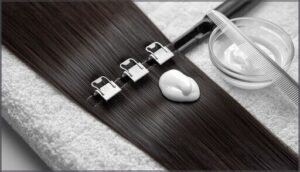
Before you apply 40 volume bleach, proper sectioning techniques and protective measures lay the foundation for even lift without disaster. Divide your hair into 4 to 8 uniform panels using sectioning tools like tail combs and clips, ensuring each strand receives equal processing time.
Apply barrier cream around your hairline, wear gloves, and perform a strand test to gauge hair porosity and bleaching response before full application.
Mixing Bleach and Developer
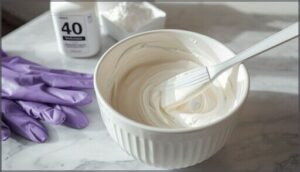
Combine one part bleach powder with two parts 40 volume developer in a non-metal bowl using a plastic spatula to prevent chemical reactions that generate excess heat. Mix until you achieve a thick, yogurt-like consistency that clings to strands without dripping onto your scalp.
Work quickly since the bleaching process begins immediately, and proper bleach ratio ensures predictable lift while reducing your risk of uneven results or unnecessary damage.
Applying Evenly for Best Results
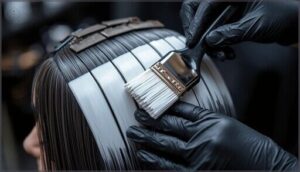
Start by working from mid-lengths to ends, saving your roots for last since scalp heat accelerates the bleaching process and causes uneven lift. Use horizontal hair sectioning in thin, one-inch segments, applying bleach distribution with a stiff brush to lay down consistent layers no thicker than two millimeters, ensuring you control developer contact and can monitor lift monitoring without missing strands.
- Lay 40 volume bleach in uniform coats using a brush technique that prevents air pockets
- Refresh edges every five to ten minutes to connect lifted sections and maintain even application
- Check each segment visually to confirm hair lightening and bleaching progression across all zones
- Work quickly but methodically, as the hair bleaching techniques you use determine your final tone
Monitoring Hair During Bleaching
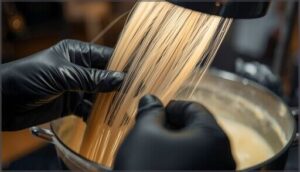
Watching your hair closely during the bleaching process isn’t optional, it’s how you protect your strands from turning to straw. You can’t just set a timer and walk away when you’re working with 40 volume developer, which lifts color aggressively and demands your attention every step of the way.
Here’s how to stay in control and catch problems before they spiral into damage.
Checking Lift Progress
You control the outcome by watching lift progression through strand tests every 10 minutes, pulling a narrow section from beneath your crown to judge color shift without committing your entire head.
Hair lightener with 40 volume bleach usually shows visible change from your starting shade toward pale yellow within 15 to 20 minutes, so processing intervals and careful hair monitoring prevent you from overshooting your target level during processing time.
Recognizing Signs of Overprocessing
Your hair speaks before permanent damage sets in, signaling overprocessing through texture changes, scalp reactions, and lift irregularities that demand immediate rinsing to prevent irreversible hair damage during processing time.
Watch for these red flags when you leave bleach on hair:
- Strands feel gummy or stretch excessively when wet, indicating compromised keratin structure
- Scalp burns, stings, or develops visible redness within minutes of application
- Uneven patches appear lighter than surrounding sections, revealing porosity issues
- Hair snaps near the midshaft when brushed gently
- Ends turn translucent or white, signaling complete pigment loss and breakage risk ahead
Using Timers and Intervals
Set a loud timer to alert every 5 minutes during your 40 volume bleach processing time, allowing precise bleach monitoring without constant clock-watching. These interval checks prevent hair damage by tracking lift progress at consistent milestones, giving you control over the outcome.
Keep the timer visible, reset after each alert, and perform a strand test during safety precautions to confirm you’re not leaving bleach on hair beyond ideal timing.
What Happens if You Over-Bleach

Over-bleaching doesn’t just push your hair past the desired shade—it damages the hair structure from the inside out, leaving you with consequences that range from cosmetic to painful.
When you leave 40 volume bleach on too long, you’re risking everything from severe breakage to chemical burns on your scalp. Here’s what actually happens when bleach crosses the line from transformation to destruction.
Hair Damage and Breakage
When you push 40 volume bleach past the 20-minute mark, you’re inviting hair fracture that begins at the molecular level, weakening keratin bonds until strands snap under the slightest tension.
Over-processed hair develops extreme porosity and brittle ends, transforming healthy texture into straw-like strands that resist moisture and break during combing. Damage control starts with timing precision, protecting your hair health through vigilant monitoring and breakage prevention strategies.
Scalp Irritation and Burns
Beyond hair damage and repair, your scalp health hangs in the balance when chemical hair processing crosses safe limits. Scalp sensitivity and chemical reactions escalate quickly, with burn prevention depending on recognizing irritation signs during bleach in hair applications:
- Redness and stinging that intensifies beyond mild tingling
- Swelling around the hairline with persistent burning
- Blistering or white patches requiring immediate damage repair
Stop processing at the first warning.
Uneven or Unwanted Tones
Over-bleaching with 40 volume bleach triggers stubborn brassiness and patchy color results demanding precise tone correction. Hair porosity drives uneven toner absorption, leaving you with streaky bands where porous sections grab violet casts while resistant roots stay orange.
Color balancing requires strategic toner application matched to each section’s lift, transforming bleach in hair disasters into controlled color correction methods that neutralize unwanted warmth through targeted color correction and toning.
Safe Rinsing and Neutralizing Techniques

Once you’ve reached your desired lift, the way you rinse and neutralize bleach determines whether your hair stays healthy or suffers lasting damage.
Proper rinsing technique removes all chemical residue, prevents continued processing, and readies your hair for recovery treatments. Here’s how to safely move from bleach to post-treatment care without compromising your results or scalp health.
When and How to Rinse Thoroughly
The moment your hair reaches pale yellow lift, you control the next critical move: rinsing thoroughly under cool water at 20 to 29 degrees Celsius stops the bleaching process cold.
Here’s how to execute residue removal like a pro:
- Direct a medium stream onto your scalp, targeting all sections systematically
- Use gentle massaging motions—no harsh scrubbing that triggers breakage
- Rinse for 5 to 10 minutes until water runs completely clear
- Check for tackiness or white film; continue rinsing until hair feels clean
- Finish with a cool water rinse to seal cuticles and lock moisture in
This post bleach care step prevents chemical lingering and scalp irritation.
Using Post-Bleach Treatments
Right after rinsing, you reclaim strength with targeted post-bleach care treatments that rebuild what 40 volume developer stripped away.
Bond repair formulas reconnect broken disulfide links, while moisture-rich hair masks restore hydration levels within 10 to 15 minutes.
Layer on leave-in treatments to lock in that moisture balance, shield against heat, and maintain hair health and beauty between washes.
Removing Residual Chemicals
After the bleaching process, you must flush away every trace of developer to prevent residual effects and ongoing chemical processing damage. Here’s how you neutralize and complete post bleach care:
- Rinse with cool to lukewarm water for at least five minutes to remove surface chemicals.
- Apply a clarifying shampoo to dissolve mineral buildup and lingering bleach in hair.
- Use an acidic rinse—vinegar or citric acid—for pH balancing after alkaline exposure.
- Finish with a deep conditioner to restore moisture and support hair care and hygiene.
Proper chemical removal protects your scalp and prevents further damage from neutralizing agents working overtime.
Essential Aftercare for Bleached Hair

Your hair’s been through a chemical war, and now it needs a strategic recovery plan. What you do in the hours and weeks after bleaching determines whether your hair thrives or falls apart.
The three pillars of post-bleach care—intensive moisture, chemical avoidance, and long-term maintenance—will protect your investment and keep your lightened hair strong.
Moisturizing and Repair Masks
Your hair’s survival after bleaching depends on what you do next. Apply a moisturizing treatment 1–2 times weekly to restore moisture balance and rebuild the cuticle through deep conditioning.
Look for formulas with hydrolyzed proteins for protein restoration and argan oil to seal in hydration, reducing breakage while improving elasticity. This simple step turns hair damage and repair from crisis to complete control.
Avoiding Heat and Chemicals
After chemical processing, your hair can’t tolerate more assault from hot tools or harsh treatments. Give it 3–4 weeks of breathing room before introducing heat styling or additional bleach, which protects weakened bonds and prevents catastrophic breakage.
- Skip flat irons and curling tools entirely during the first month
- Avoid chemical treatments like perms, relaxers, or permanent dyes
- Choose gentle, sulfate-free cleansers that won’t strip moisture
- Embrace heatless styling methods like braids or foam rollers instead
Maintaining Hair Health Long-Term
Building resilience after bleach demands more than quick fixes—you need sustainable habits that fortify every strand. Daily Hydration through lightweight leave-in conditioners paired with weekly Hair Oiling seals moisture into porous sections.
Incorporate Scalp Massage to stimulate circulation, supporting Hair Nutrition from within. Gentle Combing with wide-tooth tools prevents breakage, while consistent Hair Moisturizing and Conditioning maintains Hair Color Maintenance without compromising Scalp Health and Irritation thresholds, ensuring lasting Hair Health and Wellness.
Top 5 Hair Bleach Kits for 40 Volume
Choosing the right bleach kit makes all the difference when you’re working with 40 volume developer, because quality formulas minimize damage while maximizing lift.
Not all kits are created equal, and some include bonding treatments or conditioning agents that protect your hair during the intense lightening process.
Here are five professional-grade options that deliver consistent results when you’re ready to take control of your color transformation.
1. Xarchy Hair Bleach Kit

When you’re ready to take control of your bleaching routine, the Xarchy Hair Bleach Kit delivers everything you need in one complete package. This 19-piece set includes multiple mixing bowls, precision brushes for root application, sectioning clips, and protective gloves to keep your process safe and professional.
You’ll find durable tools built for repeated use, complete with a storage case that keeps everything organized between sessions. The kit’s latex-free gloves minimize allergic reactions, while the included cape protects your clothing from spills during mixing and application.
| Best For | Home users looking for a complete starter kit to bleach or dye their hair without needing to buy separate tools. |
|---|---|
| Primary Use | Hair dyeing application |
| Hair Type | All hair types |
| Form | Tool kit |
| Suitable For | Home and professional |
| Reusability | Reusable tools |
| Brand | Xarchy |
| Additional Features |
|
- Comes with all the essentials in one package—bowl, brushes, clips, and earmuffs
- Silicone bowl folds for easy storage and cleanup after each use
- Precision brushes let you apply color exactly where you want it
- Mixing bowl might feel too small if you have thick or long hair
- Hair clips can sometimes snag or pull hair during sectioning
- Earmuffs included may not fit comfortably for everyone
2. Clairol Professional Hair Lightener Powder
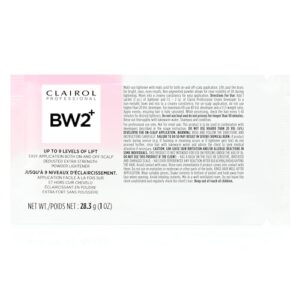
If you need professional-grade lift without the salon markup, Clairol Professional BW2 Lightener Powder delivers up to 9 levels of lift for both on-scalp and off-scalp applications.
You’ll mix this dedusted powder with a cream developer to create a smooth, controlled consistency that processes highlights, balayage, and full-head lightening with equal precision. The formula contains malic acid for even processing, and you can expect results within 20 to 50 minutes depending on your hair’s starting color and porosity.
| Best For | Stylists and experienced home users who need reliable, high-lift bleach for highlights, balayage, or all-over lightening at a budget-friendly price. |
|---|---|
| Primary Use | Hair lightening/bleaching |
| Hair Type | All hair types |
| Form | Powder |
| Suitable For | Home and professional |
| Reusability | Single-use product |
| Brand | Clairol Professional |
| Additional Features |
|
- Lifts up to 9 levels and works for both on-scalp and off-scalp techniques
- Mixes into a smooth, creamy consistency that’s easy to control during application
- Vegan formula with malic acid for more even processing
- Can dry out or damage hair if you don’t time it carefully
- Strong smell requires good ventilation during use
- Small 1 oz packets may not cover larger applications
3. Manic Panic Hair Bleach Kit
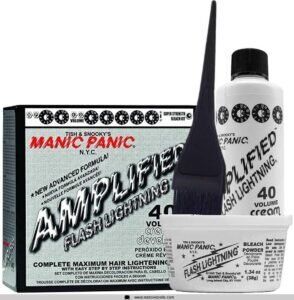
Manic Panic Flash Lightning Bleach Kit pairs dust-free powder with 40 volume cream developer to lift up to 7 levels, making it a strong choice for dark hair transformations. You’ll get a mixing tub, tint brush, gloves, and a plastic cap in the vegan, cruelty-free kit, designed to prep your hair for the brand’s vibrant semi-permanent colors.
Processing takes up to 40 minutes depending on your starting shade, and you should check progress at regular intervals to avoid overprocessing.
| Best For | People with dark hair who want to go significantly lighter or create a blank canvas for bright, vibrant colors like pastels or neons. |
|---|---|
| Primary Use | Hair lightening/bleaching |
| Hair Type | Normal hair |
| Form | Cream |
| Suitable For | DIY at-home use |
| Reusability | Single-use product |
| Brand | MANIC PANIC |
| Additional Features |
|
- Lifts up to 7 levels, which is strong enough for most dark-to-light transformations
- Dust-free powder makes mixing cleaner and easier than traditional bleach
- Comes with everything you need in one kit—tint brush, gloves, mixing tub, and cap
- Can dry out your hair if you’re not careful with timing or skip deep conditioning afterward
- Has a noticeable chemical smell during application
- You might need multiple boxes if you have long or really thick hair
4. Dark and Lovely Hair Bleach Kit
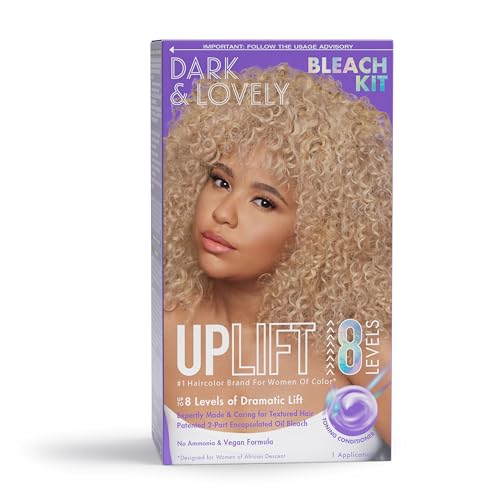
Dark and Lovely Uplift Bleach Kit switches gears with an ammonia-free powder and encapsulated oils in the cream developer, targeting textured and curly hair types that need aggressive lift without losing curl integrity.
You’ll achieve up to 8 levels of lightening on dark bases, and the included Violet Toning Care Conditioner neutralizes brass while delivering 4x more hydration than untreated hair. Processing times follow standard 40 volume guidelines, but you should monitor closely since the formula works differently on coily textures.
| Best For | People with textured or curly dark hair who want significant lightening (up to 8 levels) without the harsh effects of ammonia-based bleaches. |
|---|---|
| Primary Use | Hair lightening/bleaching |
| Hair Type | Curly/dark hair |
| Form | Cream |
| Suitable For | Home use |
| Reusability | Single-use product |
| Brand | SoftSheen-Carson |
| Additional Features |
|
- Ammonia-free formula with encapsulated oils protects curl integrity while lifting up to 8 levels
- Includes violet toning conditioner that neutralizes brass and provides 4x more hydration than untreated hair
- Simplified two-part system makes the bleaching process easier to manage at home
- May require multiple applications on very dark or virgin hair to achieve desired results
- Can still cause dryness without proper follow-up deep conditioning treatments
- Not suitable for already damaged or over-processed hair
5. Hair Bleach Powder for Lightening
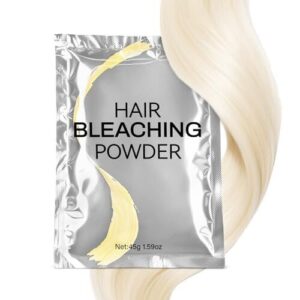
Cosmpro Hair Bleach Powder flips the script by giving you the powder component solo, letting you pair it with any 40 volume developer you trust. This 45g ultra-fine formula works across all hair types and stays pH-balanced to minimize scalp discomfort during the standard 20-30 minute window.
You’ll get salon-grade lift with smooth, even coverage, and the dermatologist-approved blend reduces irritation risk while delivering dramatic color change—perfect when you want control over your developer choice.
| Best For | Anyone wanting professional-level lightening results at home with the flexibility to choose their own developer strength and brand. |
|---|---|
| Primary Use | Hair lightening/bleaching |
| Hair Type | All hair types |
| Form | Powder |
| Suitable For | Home and professional |
| Reusability | Single-use product |
| Brand | cosmpro |
| Additional Features |
|
- Ultra-fine powder mixes smoothly for even application without clumps or streaks
- PH-balanced and dermatologist-approved formula is gentler on sensitive scalps than many competitors
- Works fast (20-30 minutes) and lifts effectively on all hair types, whether you’re going for highlights or full-head lightening
- You need to buy developer separately, which adds an extra step and cost
- Can still damage hair if you don’t follow instructions carefully or use it on already over-processed strands
- Results aren’t guaranteed to be consistent since they depend on your specific hair condition and how you mix it
Frequently Asked Questions (FAQs)
Does 40 volume developer lighten hair?
Absolutely—40 volume developer is the heavyweight champion of hair lightening. With 12 percent hydrogen peroxide, it aggressively breaks down melanin, lifting your hair two to three levels faster than gentler formulas.
How many levels of lift with 40 vol?
40 volume developer usually delivers 2 to 3 levels of lift in a single session on most hair types, though virgin hair with thick processing can sometimes reach up to 4 levels.
Is 40 minutes too long for bleach?
Yes, 40 minutes exceeds safe limits for 40 volume developer. You risk severe scalp burns, brittle strands, and irreversible damage. Stick to 10–20 minutes maximum, checking lift every five minutes.
Is 40 volume bleach too much?
It depends on your hair’s condition and experience level. For virgin dark hair with healthy structure, 40 volume delivers powerful lift, but damaged or previously lightened strands risk severe breakage and chemical burns.
Is 40 volume bleach suitable for all hair types?
Not every head of hair can handle the heavy lifting. Fine or fragile strands quickly overprocess, while chemically treated hair faces serious damage risk with 40 volume developer’s aggressive 12 percent hydrogen peroxide concentration.
What is the difference between 30 and 40 volume bleach?
The key difference lies in hydrogen peroxide content: 30 volume contains 9 percent, while 40 volume holds 12 percent, delivering faster, more aggressive lift with increased risk of damage and scalp irritation.
How often should I bleach my hair?
You should wait 4 to 6 weeks between bleach sessions to allow your hair and scalp to recover, minimize damage, and maintain structural integrity for consistent, controlled lightening results.
Can I use 40 volume bleach to lighten my hair gradually?
Although 40 volume packs powerful lift, it’s not designed for gradual lightening—you’ll risk cumulative damage with repeated sessions.
Instead, opt for 20 or 30 volume across spaced-out applications to protect your hair’s integrity.
Is it possible to reverse the effects of bleaching?
Bleaching permanently alters your hair’s structure, and you can’t truly reverse the chemical damage once it’s done.
However, protein treatments, deep conditioning, and careful maintenance can improve appearance and minimize breakage over time.
Can I bleach hair twice in one day?
One client insisted on double processing, only to watch her strands snap like dry twigs.
You shouldn’t bleach hair twice in one day—cumulative damage to the cuticle and cortex makes breakage nearly inevitable.
Conclusion
Think of 40 volume bleach as a controlled burn—utilize it correctly, and you transform your hair; lose focus for even five minutes, and you risk irreversible damage.
Mastering how long to leave bleach in hair 40 vol isn’t about following rigid rules; it’s about reading your hair’s signals, respecting the chemistry, and checking obsessively. Time it right, monitor relentlessly, and you’ll walk away with the platinum you envisioned—not the disaster you feared.