This site is supported by our readers. We may earn a commission, at no cost to you, if you purchase through links. This content is for general informational and educational purposes only and is not a substitute for professional medical, dermatological, or nutritional advice.

You can master the mechanics of wet shaving in under a month, but choosing between a straight razor and safety razor will shape your entire grooming routine for years.
The straight razor delivers superior precision and zero blade replacement costs, yet demands daily stropping and a steady hand that most beginners don’t develop until their third or fourth week.
Safety razors cut that learning curve down to a few shaves while their protective guard drops irritation incidents to just 4.1%, though you’ll trade some closeness and long-term savings for that convenience.
Your skin sensitivity, morning schedule, and whether you view shaving as a two-minute necessity or a fifteen-minute ritual ultimately determine which blade belongs in your hand.
Table Of Contents
Key Takeaways
- Straight razors deliver superior closeness (0.1–0.2 mm per stroke) and eliminate blade replacement costs entirely, but demand 4-6 weeks to master technique and daily stropping before each shave.
- Safety razors cut the learning curve to 1-2 weeks and reduce irritation risk from 9.8% to 4.1%, though you’ll sacrifice some precision and pay $15-60 yearly for replacement blades.
- Your skin sensitivity and morning schedule determine the right choice—straight razors require 13-15 minutes initially (dropping to 5-7 with practice), while safety razors deliver consistent results in 2-3 minutes regardless of skill level.
- Long-term value favors straight razors for committed users ($100-200 upfront, zero ongoing blade costs) versus safety razors’ lower barrier to entry ($15-50) but perpetual blade expenses over decades of use.
Straight Razor Features and Benefits
A straight razor isn’t just a shaving tool—it’s a precision instrument that demands respect and rewards skill. From the exposed blade design to the ritual of daily maintenance, everything about this razor separates the committed from the casual.
Let’s break down what makes a straight razor tick and who it’s really built for.
Blade Design and Precision
The straight razor’s blade design delivers superior precision through its full hollow grind and 13–17 degree edge geometry. You control the cutting angle continuously across 60–80 millimeters of exposed edge, with no safety guard interrupting contact.
High-carbon steel composition, often hardened to the low 60s Rockwell C scale, allows razor sharpness that you can hone to sub-micron precision for surgical control over every stroke.
Shaving Experience and Results
That cutting precision translates directly into results you’ll feel. With proper razor technique and skin preparation, you’ll achieve closeness measurable in the sub-millimeter range—hair cut at skin level with 1.2–2.0 fewer passes than cartridge systems demand.
Your shaving experience rewards mastery:
- Tactile feedback guides every stroke with surgical precision
- Post shave care requirements drop as irritation falls to 6–8%
- Shaving frequency flexibility increases with reduced ingrown hairs
- Satisfaction scores consistently reach 4.0–4.5 among experienced users
- Each shave becomes a deliberate ritual, not a rushed chore
Understanding the main theme identification techniques is essential for effective communication.
Maintenance and Longevity
Your blade demands discipline. Carbon-steel straight razors need stropping before each shave and professional honing every 1–2 years to maintain edge retention. Blade honing preserves that surgical precision, while corrosion control through proper drying and oiling prevents rust within days. Razor storage in cool, dry conditions extends lifespan decades beyond disposables.
Master these maintenance schedules, and your razor becomes an heirloom—not a consumable. Regular maintenance involves understanding the importance of literature reviews to guarantee the best practices are followed.
Ideal Users and Skill Level
This isn’t a tool for everyone. You’ll need solid hand-eye coordination and the patience to invest 20+ shaves before feeling confident. If you’re moving from cartridges or electric razors, expect a learning curve—68% of straight razor users had at least a year of traditional shaving experience first.
Here’s who thrives:
- Intermediate to expert shavers with traditional wet-shaving experience
- Detail-oriented groomers who value precision beard and mustache work
- Individuals willing to dedicate 18–22 minutes per shave during the learning phase
- Shavers with steady hands and fine motor control for angle maintenance
- Enthusiasts seeking maximum closeness and a traditional shaving ritual
Safety Razor Features and Benefits

Safety razors earned their reputation in barbershops for good reason—they strike a balance between performance and practicality that works for most shavers. The design puts a protective barrier between you and the blade, which changes everything about how you approach the shave.
Let’s break down what makes these razors dependable tools and why they might be the right fit for your routine.
Blade Design and Safety Guard
What sets safety razors apart from straight razors is their protective guard mechanism. This barrier sits between the razor blade and your skin, reducing deep nicks during those first passes. You’ll notice the blade exposure stays consistent—usually 1.0–1.2 mm—thanks to standardized head clips that lock the razor edge in place.
| Guard Type | Blade Gap | Best For |
|---|---|---|
| Closed Comb | Narrow | Sensitive skin |
| Open Comb | Wide | Thick beards |
| Adjustable | Variable | Personalized control |
The guard mechanism transforms shaving safety. Whether you choose open or closed comb designs, you’re getting built-in razor safety and precautions that forgive minor technique errors while maintaining effective blade geometry for a clean shave.
Maintenance and Blade Replacement
Simplicity defines safety razor upkeep. You won’t need honing techniques or strop materials—just swap blades every 5–7 shaves and you’re set.
Your maintenance routine:
- Blade replacement takes under two minutes per session
- Razor sanitizing with mild soap prevents limescale buildup
- Drying after use cuts corrosion risk by 15–25%
- Edge maintenance happens through fresh blades, not sharpening
Proper razor maintenance and care extends your handle’s lifespan by months.
Shaving Performance Comparison
When you’re standing in front of the mirror with a razor in hand, performance is everything. The way each razor grips, how close it cuts, and how your skin reacts afterward can make or break your morning routine.
Let’s break down the key differences so you know exactly what you’re getting into with each option.
If you’re weighing commitment against convenience, this dreads vs braids comparison guide breaks down which style actually fits your lifestyle.
Closeness of Shave
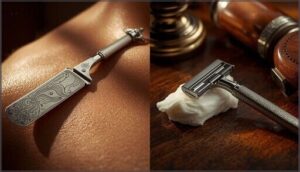
When you’re chasing that no-stubble finish, blade geometry makes all the difference. The quality of your shave depends on razor sharpness, blade angle (15–30 degrees), skin preparation, hair texture, and the shaving techniques you’ve mastered.
Straight razors cut hair at skin level—0.1–0.2 mm per stroke—delivering 60–70% no-stubble results on the first pass when your technique’s dialed in. Safety razors land around 0.18–0.25 mm, solid but requiring two passes for comparable closeness.
| Razor Type | First-Pass Closeness | Pass Count for Best Results |
|---|---|---|
| Straight Razor | 0.1–0.2 mm stubble | 1–2 passes |
| Safety Razor | 0.18–0.25 mm stubble | 2–3 passes |
Both deliver a premium shaving experience—it’s your skill and setup that seal the deal.
Skin Sensitivity and Irritation

Your skin type dictates tolerance. Straight razors increase razor burn risk—9.8% versus 4.1% for safety razors in beginners—demanding disciplined shaving techniques to avoid microtears and contact dermatitis.
Proper post-shave care (oils, moisturizers) cuts irritation by 22–28%. Shaving safety and precautions matter: master blade angle and pre-shave prep, and skin irritation drops 60% after four weeks of consistent practice.
| Razor Type | Irritation Risk (Beginners) |
|---|---|
| Straight Razor | 9.8% razor burn incidence |
| Safety Razor | 4.1% razor burn incidence |
Control and Maneuverability

Maneuverability tips begin with understanding your tool. Straight razors demand excellent angle precision—58% of experienced users report finer grip control with balanced tangs, while 65% of professionals favor weighted grips for micro-adjustments. Safety razors offer predictable stroke techniques thanks to knurling and guards. Razor handling preferences vary: 72% find safety razor control consistent, but 77% of barbers prefer the precision of straight razors, especially on jawlines. Ultimately, razor balance determines mastery of shaving techniques.
| Feature | Straight Razor | Safety Razor |
|---|---|---|
| Grip Stability | 41% slip incidents on damp skin | 72% consistent grip (knurling) |
| Angle Mastery | 77% emphasize blade alignment | 52% protected by safety guard |
| Contour Control | 71% excel on jawlines/necklines | Easier curved-area navigation |
Learning Curve and Ease of Use

Mastering a straight razor isn’t for the faint of heart—72% of first-timers face a steeper learning curve than safety razor users. Safety razors deliver shaving confidence faster—58% achieve comfort within two weeks, making ease of use their strongest advantage. Your skill development accelerates with practice techniques: audible feedback boosts angle correction by 18%, while consistent blade familiarity drops cut risk from 40% to 12% monthly.
| Aspect | Straight Razor | Safety Razor |
|---|---|---|
| Initial Learning Period | 4-6 weeks for basic competence | 1-2 weeks for comfortable results |
| Technique Mastery | Angle control, stropping, blade alignment | Guard-assisted stroke consistency |
| User Experience Progress | 40% to 12% cut risk (monthly improvement) | 58% achieve comfort in 14 days |
| Shaving Confidence Timeline | Gradual with deliberate practice | Rapid with protected blade design |
| Razor Handling Complexity | High precision, continuous adjustments | Moderate skill, natural grip control |
Cost and Long-Term Value

When you’re comparing straight razors and safety razors, the price tag tells only half the story. What you spend upfront doesn’t always match what you’ll pay over the years.
Let’s break down the real costs so you can see which razor makes sense for your wallet in the long run.
Initial Investment
Your initial outlay shapes everything that follows. A quality straight razor usually runs $100 to $200, with starter kits including strop and accessories reaching $200 to $320. Safety razors offer budget options at $15 to $50 for the handle, with complete starter kits around $60 to $100.
The razor cost comparison is clear: straight razors demand a higher initial investment upfront, while safety razors keep that barrier low.
Ongoing Maintenance Costs
Beyond your upfront cost, you’re looking at distinctly different maintenance demands. Straight razors need stropping before every shave, plus periodic honing—expect $20 to $200 yearly for stones and strop maintenance, with conditioning products adding another $5 to $20.
Safety razors require less technique but demand regular cleaning solutions at $3 to $12 annually, alongside occasional head replacements at $5 to $25 per unit.
Blade Replacement Expenses
Replacement fees tell a different story. Safety razor blades run you $0.15 to $0.50 each—seemingly cheap until you’re swapping them every 3-5 shaves. That’s $15 to $60 yearly for most shavers.
Your straight razor? Zero ongoing blade costs. You’re investing in professional honing ($25 to $80 per session every 6-12 months) instead, which preserves the blade indefinitely rather than tossing metal every week.
Straight razors eliminate ongoing blade costs—you pay $25 to $80 for professional honing twice yearly instead of replacing disposable blades weekly
Durability and Lifespan
Those recurring costs matter because durability shifts the equation. Your straight razor can outlast 20 years with proper razor maintenance—stropping, oiling, and dry storage extend blade longevity dramatically.
Safety razors built from quality steel last 30-50 years themselves, but you’re still buying blades. Handle durability and storage methods determine whether your investment pays off or corrodes in a drawer.
Choosing The Right Razor for You

You’ve weighed the pros and cons, compared the costs, and now it’s time to make the call. The right razor for you depends on more than just performance—it comes down to your daily routine, your grooming style, and how you actually use the tool.
Let’s break down the key factors that’ll point you in the right direction.
Skin Type and Shaving Frequency
Your skin type and shaving frequency determine which razor minimizes irritation factors and maximizes shave quality. If you’re dealing with sensitive skin or daily shaving, a safety razor reduces razor burn by 14–22% compared to aggressive blades.
Dry skin experiences 20–30% more drag with conventional edges, while oily skin tolerates closer passes. Match your shaving technique to your skin sensitivity for best results.
Grooming Goals and Preferences
Your grooming goals shape the razor you’ll reach for each morning. If personal style demands precision for facial hair sculpting—sideburns, goatees, or sharp lines—a straight razor delivers supreme control. Safety razors excel for straightforward, consistent shave quality in your grooming routine.
Lifestyle and shaving habits matter: enthusiasts prioritizing skin care and shaving experience lean toward straight razors, while practical preferences favor safety razors’ simplicity.
Time Commitment and Convenience
Your morning routine dictates razor choice more than you might expect. Straight razors demand 13–15 minutes initially—dropping to 5–7 per pass with practice—plus stropping before each shave. Safety razors deliver consistent results in 2–3 minutes once your shaving technique clicks, regardless of shaving frequency and skin type.
Daily maintenance and prep time favor safety razors for rushed mornings, while straight razors reward leisurely shaving habits with unequaled ease of use through mastery.
Travel and Portability Considerations
Packing a razor for trips reveals sharp contrasts between your options. Safety razors slip into travel kits with minimal fuss—lightweight, compact, and blade storage that breezes through airport security. Straight razors demand protective razor cases and portable sharpening gear, adding bulk while raising eyebrows at checkpoints.
Maintenance on the road tilts heavily toward safety razors unless you’re committed to hauling strops and dealing with international blade restrictions.
Frequently Asked Questions (FAQs)
Can women use straight razors and safety razors?
Absolutely. Both razors work for anyone willing to learn proper technique and skin preparation—gender doesn’t determine shaving capability.
Female shaving tips emphasize the same fundamentals: blade angle, pressure control, and grooming discipline that make gender-neutral razors effective for all users.
How do disposable razors compare to these options?
The cheapest option upfront costs you the most over time. Disposable razors lack the shave quality, razor durability, and cost efficiency of straight razor or safety razor alternatives, creating greater environmental impact through waste reduction failures.
What shaving cream works best with each razor?
Glycerin-based shaving creams enhance blade glide for straight razors, reducing drag by 12–18%. Oil-rich lathers boost safety razor cutting efficiency by 9–14%.
Choose emollient formulas with lanolin or shea for excellent cushioning and skin comfort.
Are there environmental benefits to either razor type?
Both blade types bring better environmental benefits than disposables. Straight razors slash waste reduction dramatically—zero blade purchases mean genuine green shaving.
Safety razors using sustainable materials and eco-friendly steel blades still beat cartridges, though ongoing replacement affects your environmental impact and budget.
Can you shave body hair with these razors?
You can shave body hair with both razors, though safety razors offer better protection on sensitive areas like underarms and groin.
Proper skin preparation and shaving techniques reduce razor burn prevention concerns markedly.
Conclusion
Your morning mirror will reflect one truth: the straight razor vs safety razor decision isn’t about which blade cuts better—it’s about which ritual fits your life.
If you’ve got the patience to master stropping and crave that unequaled closeness, the straight razor rewards dedication.
Need reliable results without the ceremony? The safety razor delivers precision without demanding your mornings. Pick the steel that matches your discipline, not just your beard.