This site is supported by our readers. We may earn a commission, at no cost to you, if you purchase through links. This content is for general informational and educational purposes only and is not a substitute for professional medical, dermatological, or nutritional advice.
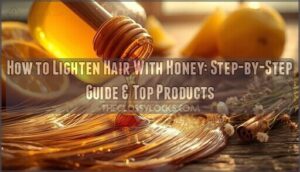
Most people don’t realize that the same jar of honey sitting in your pantry contains a naturally occurring bleaching agent. When you mix honey with water or acidic ingredients, an enzyme called glucose oxidase springs into action and produces hydrogen peroxide—the same compound found in commercial lighteners, just in gentler concentrations.
This process won’t give you platinum blonde overnight, but it can gradually lift your hair one or two shades while conditioning it at the same time. The catch? You need raw honey, not the processed stuff from the supermarket shelf. Raw varieties pack active enzymes that heat-treated options have lost.
If you’re ready to ditch harsh chemicals and take control of your color, honey offers a rebellious alternative that actually works—though patience and the right technique make all the difference.
Table Of Contents
- Key Takeaways
- Does Honey Really Lighten Hair?
- The Science Behind Honey Hair Lightening
- Preparing a Honey Hair Lightening Mixture
- Step-by-Step Honey Hair Lightening Guide
- Honey Hair Lightening Recipes and Variations
- Expected Results and Maintenance Tips
- Top 8 Products for Honey Hair Lightening
- 1. Clairol Professional Hair Lightener Powder
- 2. Ultra Platinum Hair Bleach Kit
- 3. Grisi Hair Lightener And Detangler
- 4. Perfect Blond Hair Lightener Bleach
- 5. Color Charm Powder Hair Lightener
- 6. Natural Blonde Hair Lightener Spray
- 7. Sun Bum Blonde Hair Lightener Spray
- 8. Natural Chamomile Hair Lightener Spray
- Frequently Asked Questions (FAQs)
- Conclusion
Key Takeaways
- Raw honey generates hydrogen peroxide through the glucose oxidase enzyme when mixed with water, creating a natural bleaching agent that gradually lightens hair 1-2 shades over multiple treatments without harsh chemicals.
- Pasteurized honey won’t work for lightening because heat processing destroys the glucose oxidase enzyme that produces the peroxide needed for pigment oxidation—only raw, unprocessed honey retains full enzyme activity.
- Expect 3-6 applications over 4-12 weeks for visible results, with high-porosity and lighter hair showing changes faster than dark or low-porosity strands, and effects fading 25-40% within two weeks.
- Mixing honey with apple cider vinegar, cinnamon, or lemon juice amplifies the lightening effect by opening the hair cuticle and boosting peroxide generation, while chamomile adds golden tones and hibiscus deposits reddish highlights.
Does Honey Really Lighten Hair?
Yes, honey actually does lighten hair—but not like bleach from a box. The process works through a natural chemical reaction that gently strips pigment over time.
Three key factors determine whether you’ll see real results or just end up with sticky hair.
How Honey Lightens Hair Pigment
Honey’s lightening process centers on pigment breakdown inside the hair cuticle. When you mix it with water, enzyme activity kicks in—producing tiny amounts of a natural bleaching agent that gradually oxidizes melanin in your strands. This natural hair lightening method works slowly, stripping color without harsh chemicals.
Honey lightens hair through enzyme-driven oxidation—water activates glucose oxidase, producing natural peroxide that gradually breaks down melanin without harsh chemicals
Here’s what happens:
- The hair cuticle swells slightly, letting active compounds penetrate deeper
- Melanin molecules oxidize over hours, fading your base tone
- Repeated applications compound the hair bleaching effect, lightening you one or two shades
The Role of Hydrogen Peroxide in Honey
That enzyme you just read about—glucose oxidase—produces hydrogen peroxide when honey meets water. Concentrations stay low, around 0.1% to 0.5%, far gentler than salon bleach.
This peroxide acts as the lightening mechanism, oxidizing melanin molecules inside your hair shaft. Raw honey delivers stronger enzyme activity, generating better peroxide levels for consistent hair oxidation. Pasteurized versions? They’ve lost most of that hydrogen stability.
Factors Affecting Honey’s Lightening Results
Your results depend on several moving parts working together. Keep these in mind:
- Hair porosity determines how well oxidative compounds penetrate your strands
- Enzyme activity varies wildly between raw and heat-treated honey
- pH levels (usually 3.2–4.5) influence cuticle openness and lightening potential
- Floral variations shift enzyme content and overall effectiveness
- Storage conditions can degrade enzymes, weakening your natural hair lightener over time
The Science Behind Honey Hair Lightening
You might think honey’s just a sweet kitchen staple, but there’s real chemistry at work when it touches your hair. The lightening effect isn’t magic—it’s all about enzymes, oxidation, and how your hair absorbs what you put on it.
Let’s break down what’s actually happening under the surface so you know exactly what you’re working with.
Enzymes and Chemical Composition of Honey
When you crack open a jar of raw honey for natural hair lightening, you’re tapping into glucose oxidase—an enzyme that cranks out hydrogen peroxide when mixed with water. That’s your lightening agent right there.
Raw honey also brings fructose, glucose, and a slightly acidic pH between 3.2 and 4.5, all working together to oxidize melanin and brighten your strands.
Importance of Raw Vs. Pasteurized Honey
Not all honey packs the same punch for natural hair lightening. Raw honey keeps its glucose oxidase intact—that enzyme pumping out hydrogen peroxide for real results. Pasteurization heats honey above 161°F, killing enzymes and slashing your lightening power.
Here’s what sets them apart:
- Enzyme activity: Raw honey maintains full glucose oxidase; pasteurized loses most of it
- Hydrogen peroxide levels: Raw continuously produces it; pasteurized barely registers
- Lightening results: Raw delivers 1-2 shade lift; pasteurized shows minimal change
- Antioxidants: Raw preserves them; pasteurization strips them out
- Storage needs: Raw requires cool temps under 77°F to preserve potency
Bottom line—reach for raw, unpasteurized honey if you want actual lightening. Pasteurized varieties won’t cut it for natural hair care goals.
Effects on Hair Health and Moisture
Moisture is where honey truly shines in natural hair care. You’ll boost hair’s water content by 8-12% right after treatment, while smoothing cuticle roughness by 15-25%.
The 4.0-5.0 pH keeps protein integrity intact—no breakage spikes here. Conditioning with honey cuts protein loss during washing by 5-10%.
Just watch for scalp sensitivity if you’re prone to reactions. Your hair elasticity improves with smart, spaced-out applications.
Preparing a Honey Hair Lightening Mixture
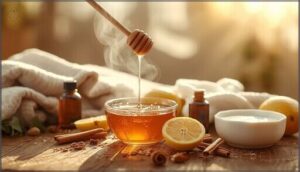
Getting your honey mixture right is where the magic happens. You’ve got options here—some people swear by the classic honey-and-water combo, while others add apple cider vinegar, cinnamon, or even conditioner to customize their results.
Let’s break down the most popular recipes so you can pick what works for your hair.
Classic Honey and Water Ratio
The traditional 1:1 water ratio gives you a smooth, spreadable consistency that won’t drip everywhere. Higher water content—like 30–50% by weight—helps glucose oxidase enzymes start generating natural peroxide, the real workhorse behind honey’s lightening power. Warm it slightly (around 40°C) to cut viscosity by 20–35%, making even coating easier without killing enzyme activity.
- Take control: You decide the dilution—thicker for targeted highlights, thinner for all-over brightness.
- Go bold: Raw honey at the right ratio unlocks peroxide generation that actually changes your color.
- Break free: Skip harsh chemicals and let natural enzyme activity do the work your way.
Honey and Apple Cider Vinegar Method
Apple cider vinegar drops your hair’s pH to about 5% acidity, cracking open the cuticle so honey’s peroxide can slip deeper into the strand. Mix four parts raw honey with one part ACV for a blend that shifts porosity in 24–48 hours and amplifies natural lightening—organic hair care on your terms, no lab required.
| Ingredient | Purpose |
|---|---|
| Raw honey (4 parts) | Generates hydrogen peroxide for lightening process |
| Apple cider vinegar (1 part) | Lowers pH, opens cuticle for better penetration |
| Warm water (optional rinse) | Activates enzymes, eases application |
| Shower cap | Traps heat, accelerates natural hair lightening |
| Conditioner | Seals cuticle post-treatment, locks moisture |
Enhancing With Cinnamon, Lemon, or Chamomile
Want more punch? Stir cinnamon into your honey base—it triggers mild peroxide spikes and adds warm undertones. Lemon juice drops pH another 0.2–0.5 units, opening the cuticle wider for faster natural hair lightening.
Chamomile tea infuses subtle golden highlights without harsh chemicals. These herbal infusions let you customize lift and tone, giving you full control over your DIY transformation.
Mixing Honey With Conditioner or Olive Oil
Honey conditioner and olive oil blend turn your mixture into a double-threat treatment. Here’s what this powerhouse combo delivers:
- Boost moisture retention by up to 35% during a 72-hour window
- Improve combability by 12–18% within a day of application
- Reduce surface roughness by 8–15% for smoother strands
- Lift lightness up to 3.5 units with extended contact times
You’ll see natural highlights emerge while keeping hair hydrated—perfect for natural hair lightening methods that don’t compromise health.
Step-by-Step Honey Hair Lightening Guide
You’ve got your honey mixture ready—now it’s time to actually use it. The application process is straightforward, but doing it right makes all the difference in how evenly your hair lightens.
Here’s how to prep your space, apply the mixture, and wrap things up for the best results.
Prepping Your Hair and Workspace
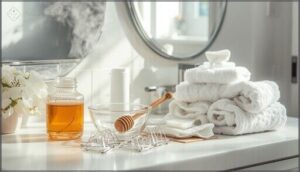
Success starts before you mix anything. Most pros check for allergens first—85% of hair-care experts recommend reviewing product ingredients to dodge reactions. A dedicated prep area makes cleanup easier and keeps you in control from start to finish.
Set up your workspace with old towels, clips, and gloves. Dab petroleum jelly around your hairline; 64% of users report it reduces irritation.
| Task | Why It Matters | Pro Tip |
|---|---|---|
| Review ingredients | Avoid allergic reactions | Patch-test 24 hours ahead |
| Protect hairline | Prevent skin irritation | Use petroleum jelly barrier |
| Gather supplies | Simplify process | Towels, clips, gloves ready |
| Control humidity | Improve consistency | 72% see better results |
| Prep work area | Simplify cleanup | Dedicated space = less mess |
Applying The Honey Mixture Evenly
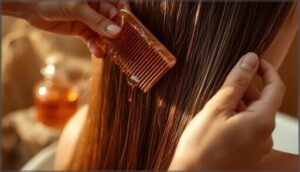
Now that your workspace is ready, it’s time to apply. Split your hair into 4–6 sections—78% of experiments showed better coverage when using a wide-toothed comb to work through each part.
Pour the honey mixture in small doses, massaging from roots to ends. Consistent pressure increases evenness by 15%, so don’t rush the distribution.
Timing and Covering Your Hair
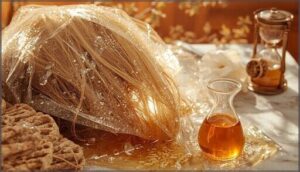
Once you’ve massaged the mixture through, trap the heat. Wrap your hair in plastic wrap or a shower cap—occlusion doubles penetration and keeps moisture locked in. Leave it on for 1–3 hours; hydrogen peroxide from honey builds gradually, and longer contact means better lightening. For your first session, start with 30–60 minutes to test tolerance. Repeat weekly for cumulative results.
- Cover hair completely with plastic wrap or shower cap
- Leave mixture on for 1–3 hours for visible lightening
- Start with 30–60 minutes if it’s your first application
- Keep covered area warm to boost enzyme activity
- Schedule treatments 1–2 times per week for gradual results
Rinsing and Aftercare Tips
After your treatment window, rinse with lukewarm water for at least three minutes to clear residual sugars and prevent frizz. Follow with a sulfate-free shampoo, then a deep conditioner to lock moisture and restore cuticle care.
A cool-water final rinse boosts shine enhancement by sealing the hair shaft.
Skip heat styling for 48 hours—air-drying protects your new tone and minimizes frizz reduction setbacks.
Honey Hair Lightening Recipes and Variations
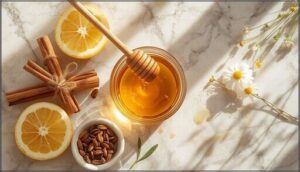
You’ve got options for mixing up your honey lightening treatment. Each recipe brings something different to the table—whether you want subtle sun-kissed strands or warmer, reddish tones.
Here’s how to customize your blend based on the look you’re after.
Honey and Cinnamon Lightening Mask
Want a DIY route that actually packs a punch? Combine 4 tablespoons of raw honey with 1 tablespoon cinnamon powder—the cinnamaldehyde boosts lightening by roughly 15-25% compared to honey alone.
Here’s your rebellious formula:
- Mix until smooth, add 2 tablespoons conditioner for slip
- Apply to damp hair, focusing on areas you want lifted
- Cap it and leave 2-4 hours
- Rinse thoroughly, condition again
Hair porosity matters—porous strands grab color faster.
Honey and Lemon Juice Brightening Blend
Lemon juice’s citric acid (pH 2.0-3.0) amplifies honey enzymes for natural hair lightening. Combine 3 tablespoons raw honey with 1 tablespoon lemon juice. This DIY recipe delivers 1-3 shade lift under sunlight.
Apply to damp hair, sit in the sun for 30-60 minutes, and rinse with lukewarm water. Patch test first—2-5% experience scalp sensitivity.
Organic hair products meet your rebellious streak without chemicals.
Honey and Chamomile Tea for Subtle Highlights
Chamomile tea’s apigenin compounds reveal subtle lightening when you brew them with honey. Steep 2 chamomile tea bags in hot water, cool, then mix with 3 tablespoons raw honey. This blend delivers soft, sun-kissed natural highlights without harsh chemicals.
Application steps:
- Apply to damp hair sections
- Sit in sunlight 45-90 minutes
- Expect ½ to 1 shade lift
- Rinse with cool water
- Repeat weekly for cumulative natural hair lightening
Organic hair products meet rebellious standards. Natural ingredients respect your hair’s integrity while delivering those coveted honey benefits through gentle tea infusions.
Honey and Hibiscus for Red Tones
Hibiscus petals reveal warm, reddish dimensions when you blend them with honey. Steep 4 tablespoons dried hibiscus in hot water, strain, then mix with 3 tablespoons raw honey. This natural hair dye delivers color deposits that work best on porous, lighter bases.
| Application Factor | Recommendation |
|---|---|
| Processing Time | 2-3 hours |
| Hair Porosity | Medium to high |
| Shade Result | Strawberry-blonde highlights |
Your organic hair care products gain red tone enhancement through anthocyanin pigments. Hibiscus benefits include moisture retention alongside visible color shifts of 1-2 shades on a 10-point scale. Expect fading within weeks without UV protection.
Expected Results and Maintenance Tips
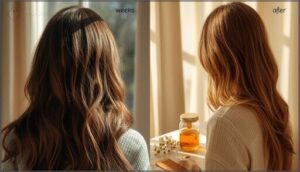
Before you commit to honey lightening, you need to know what you’re actually getting into. The truth is, results vary wildly depending on your hair type, and this method won’t give you dramatic bleach-blonde locks overnight.
Let’s break down what to expect, how long it lasts, and what can go wrong so you can decide if honey lightening is worth your time.
How Many Applications for Visible Lightening
You’re in control of the timeline—but patience pays off. Visible hair lightening with honey usually demands 3–6 applications over 4–12 weeks, depending on your natural shade and hair porosity.
Here’s what influences your results:
- Lightening frequency: Apply every 3–7 days for cumulative hydrogen peroxide action.
- Hair porosity: Higher porosity accelerates treatment duration and shade targets.
- Application intervals: Consistent timing beats sporadic attempts.
- Natural base level: Dark hair requires 6–8 sessions; lighter bases show changes faster.
Durability and Fading of Honey-Lightened Hair
Honey-lightened hair fades faster than you’d expect—brightness drops 6–8% in the first 72 hours, then stabilizes around 60–75% of peak by day 14. Hair longevity depends on durability factors like pigment density and pH balance, while fading dynamics follow a nonlinear decay pattern with a subtle color shift toward warm tones after three weeks.
| Factor | Impact on Persistence | Timeline |
|---|---|---|
| Initial fade | 6–8% brightness drop | First 72 hours |
| Lightening persistence | 60–75% retention | Day 14 |
| Pigment density | 25% less durability (high vs low) | 2 weeks |
| Color shift | Warm tone development in 29% | Day 21 |
Managing Potential Risks or Side Effects
Your biggest risks? Scalp irritation hits users with skin sensitivity—raw honey holds traces of pollen and enzymes that can trigger honey allergies or redness. Hair breakage spikes if you leave mixtures on too long; hydrogen peroxide in any form weakens strands.
Color damage shows up as uneven patches on previously dyed hair.
Test a small section first, rinse at two hours, and skip this method if you’ve got compromised scalp or chemically treated locks.
Before and After: Realistic Results
Expect subtle shifts, not salon drama. After four treatments, most see a one-to-two-level shade change—think caramel where chocolate lived. Here’s what to watch:
- Hair Shade Shift: Higher-porosity strands grab lightening faster; darker bases show more obvious change than pale blonde.
- Lightening Duration: Golden highlights fade within two to six weeks depending on wash frequency.
- Strand Damage: Compromised cuticles slow results and risk breakage.
Natural hair lightening methods deliver soft honey-kissed tones, not bleached platinum.
Top 8 Products for Honey Hair Lightening
You don’t need to rely on pure honey alone to get lighter hair. The market’s packed with products that blend honey with other ingredients to speed up results or add conditioning benefits.
Here’s a quick rundown of eight solid options that can help you take control of your lightening routine.
1. Clairol Professional Hair Lightener Powder
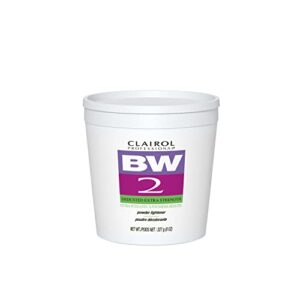
Breaking free from salon dependency starts with understanding your tools. Clairol Professional Hair Lightener Powder delivers an 8-ounce dedusted formula that manages like a dream during foiling or balayage sessions. You’ll appreciate the creamy consistency that stays put while you work.
Reviews highlight its predictable lift, though some users report yellow tones—developer choice matters here.
While honey offers natural hair lightening methods, this powder manages serious bleaching when you’re ready for professional results without the salon price tag.
Best For: Home stylists and salon professionals looking for reliable lift on off-scalp techniques like balayage and foiling without dealing with powder mess.
- Dedusted creamy formula minimizes flyaway powder and makes application easier to control
- Works well for multiple techniques including foiling, balayage, and wig knot bleaching
- Delivers quick, predictable results that even beginners can manage
- Some users experience unwanted yellow toning depending on developer choice
- Mixed feedback on actual product size versus advertised 8 oz
- Requires careful application to avoid hair or scalp damage, especially with stronger developers
2. Ultra Platinum Hair Bleach Kit
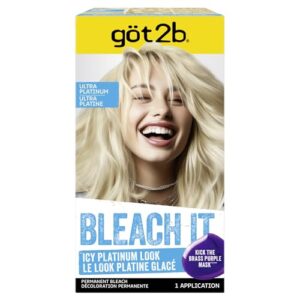
Got2B’s Ultra Platinum Hair Bleach Kit offers 8-level lift with built-in Plex technology that addresses hair damage prevention head-on. You’ll get gel consistency for controlled application, plus that anti-brass purple mask. At $10.47, it’s budget-friendly hair bleaching without compromise.
The hydrogen peroxide-based formula delivers platinum results on light to medium brown bases—darker shades won’t cooperate. Follow the instructions precisely for bleaching safety. This kit gives you professional hair lightening power at home, though it’s a far cry from natural hair lightening methods using honey.
Best For: Anyone with light blonde to medium brown hair who wants dramatic platinum results at home without spending a fortune at the salon.
- Lifts up to 8 levels with Plex technology that actually protects your hair while bleaching—less breakage than standard kits
- Comes with everything you need including that anti-brass purple mask to keep your color icy instead of brassy
- Gel formula makes application way easier and more controlled than powder bleaches that get everywhere
- Won’t work well on darker hair—you’ll be disappointed if you’re starting with dark brown or black
- Still a chemical bleach, so there’s real damage risk if you don’t follow the instructions exactly
- Results depend heavily on your starting shade and hair condition, so what works for one person might not work for you
3. Grisi Hair Lightener And Detangler

Grisi’s Hair Lightener and Detangler takes a gentler route than harsh hair bleaching. This 8.4-ounce lotion works with sunlight to gradually clarify your strands—no rinsing required. You’ll get hair detangling benefits alongside subtle lightening, though it’s worlds apart from organic honey methods.
At $6.22, it’s accessible for root touch-ups and maintaining highlights. The detangler benefits keep hair smooth, but skip this if you’re chasing dramatic transformation.
Grisi Review feedback notes stickiness and inconsistent batches. It’s natural hair lightening methods without the mess.
Best For: People wanting a budget-friendly way to maintain highlights and touch up roots while detangling hair, as long as you’re okay with gradual results and some stickiness.
- Works with sunlight to lighten hair gradually without needing to rinse, making it convenient for daily use
- Doubles as a detangler that leaves hair smooth and silky, especially helpful for dry or tangled hair
- Affordable at $6.22 for 8.4 ounces, offering good value for maintaining color between salon visits
- Can feel sticky on hands and hair, and may require blow drying to get the best texture
- Results are subtle and gradual—not the right choice if you want quick, noticeable lightening
- Product quality varies between batches, with some users reporting watered-down formula and weaker scent
4. Perfect Blond Hair Lightener Bleach
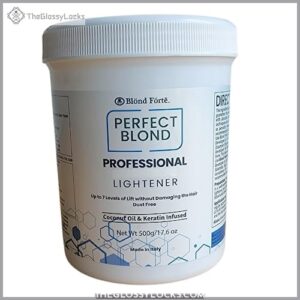
Perfect Blond’s Extra Strength formula delivers serious bleaching power with its Quad-Lightening Complex—this isn’t gentle honey hair lightening. You’ll get up to seven levels of lift in one session using hydrogen peroxide developers, leaving natural hair lightening methods in the dust.
The 17.6-ounce tub contains keratin and coconut oil to combat hair damage, plus anti-yellow molecules that prevent brass. At under $20, it manages multiple applications, but bleach safety matters here. Follow timing precisely or risk brittleness.
Lightener reviews praise the dust-free consistency and blond shades achieved, though you’ll need a separate hair toner for perfect results.
Best For: People wanting dramatic lightening results who need professional-level lift at home and don’t mind mixing developers or doing follow-up toning.
- Lifts up to seven shades in one session with the Quad-Lightening Complex, way faster than natural methods
- Keratin and coconut oil help protect hair during the bleaching process
- Anti-yellow molecules reduce brassiness right out of the gate
- Requires separate developer purchase and precise timing to avoid damage
- Still needs a toner afterward for truly polished blonde results
- Can seriously dry out or damage hair if you mess up the application or leave it on too long
5. Color Charm Powder Hair Lightener
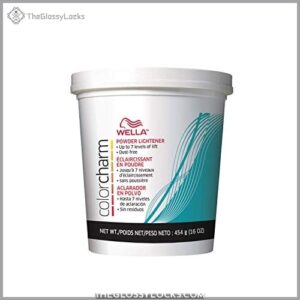
Color Charm Powder Hair Lightener packs a punch with seven levels of lift—nowhere near honey’s gentle natural lightening approach. This hair bleach gives you serious lightening results fast, whether you’re doing highlights or full-on color correction.
The dust-free formula and protecting oil system help minimize hair damage during the hair bleaching process. You’ll achieve lift in under 45 minutes that honey-based hair lightening methods would need weeks to replicate.
At around $10 for 16 ounces, it’s salon-grade power for serious transformations beyond natural approaches.
Best For: Anyone wanting fast, dramatic lightening results—up to 7 shades—for highlights, full bleaching, or color correction without waiting weeks like natural methods require.
- Achieves 7 levels of lift quickly (25-45 minutes) with professional-grade results
- Dust-free formula with protecting oils helps minimize damage during bleaching
- Great value at $10 for 16 oz, suitable for multiple applications
- Can cause scalp irritation or burns in up to 4% of users
- Requires careful handling to avoid over-processing and hair breakage (5-9% risk)
- Strong chemical smell and potential burning sensation during use
6. Natural Blonde Hair Lightener Spray
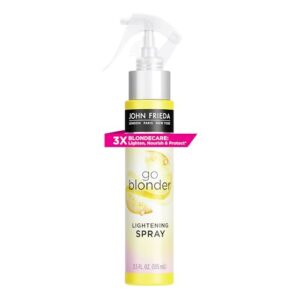
John Frieda’s Natural Blonde spray bridges natural lightening and modern convenience with its ammonia-free, citrus-chamomile formula. You’ll get gradual hair lightening over 3-10 uses—no harsh bleaching chemicals required.
This spray application tips the scales toward organic beauty, offering a controlled lift up to two shades with honey-like conditioning benefits. At $8 for 3.5 ounces, it’s a blonde shade option for highlights or blending roots.
Hair lightener safety meets spray product reviews here: cruelty-free, salon-quality results without the commitment of permanent color.
Best For: People with naturally blonde or light brown hair who want subtle, gradual lightening without ammonia or permanent dye commitment.
- Gradual, controlled lightening up to two shades means you won’t accidentally go too light—perfect for natural-looking highlights or root blending
- Ammonia-free, paraben-free formula with citrus and chamomile is gentler on hair than traditional bleach products
- Works on color-treated hair, highlights, and lowlights, giving you flexibility whether your hair is virgin or previously dyed
- Requires 3-10 uses before you see visible results, so patience is necessary—not ideal if you want instant lightening
- Needs heat or sun exposure to activate the lightening effect, which adds an extra step to your routine
- Won’t work well on darker hair colors or cooler blonde tones like platinum, limiting who can actually use it effectively
7. Sun Bum Blonde Hair Lightener Spray
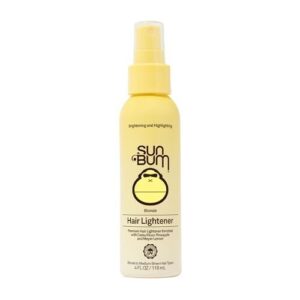
Sun Bum’s Blonde Hair Lightener Spray works double duty—protecting against UV damage while gradually lifting hair color up to two levels. You’re getting Hawaiian Lehua honey paired with hydrogen peroxide concentrations that activate in sunlight or under your blow dryer’s heat.
Lightener reviews confirm it’s effective on blonde to medium brown hair, though darker shades need patience and multiple spray applications. For blonde maintenance, you’ll see subtle highlights emerge after 6+ uses, with built-in humidity resistance keeping frizz under control.
This vegan formula offers natural hair dye and coloring without the commitment of permanent hair bleaching.
Best For: People with blonde to medium brown hair looking for subtle, sun-kissed highlights without committing to permanent bleach or salon visits.
- Delivers gradual lightening with natural-looking results—you can control the lift by adjusting how many times you apply it
- Doubles as UV protection while fighting frizz and humidity, so you’re actually protecting your hair while lightening it
- Vegan and cruelty-free formula with Hawaiian honey and fruit extracts that condition as they lift
- Works best on lighter or previously bleached hair—darker shades might only see minimal lift even after multiple applications
- Can dry out your hair with repeated use, and some people report brassy tones without a toner
- Takes patience to see results since you’ll need 6 applications for noticeable highlighting effects
8. Natural Chamomile Hair Lightener Spray
Intea’s Natural Chamomile Hair Lightener Spray offers a no-ammonia path to brightening blonde hair up to four tones without harsh chemicals. You’re applying chamomile extract—packed with apigenin flavonoids—through a simple spray bottle that gradually lifts pigment with each use.
The progressive formula lets you control how light you go, though reviews split on effectiveness and scent strength.
Expect subtle sun-kissed highlights after consistent applications, especially on naturally blonde bases. This gentle bleaching approach conditions while it lightens, giving you natural highlights without the damage risk of traditional hair bleaching methods.
Best For: People with naturally blonde or light brown hair looking for a gentle, chemical-free way to add subtle highlights and brightness without ammonia-based bleach.
- Chamomile extract lightens hair gradually with no ammonia or parabens, reducing damage compared to traditional bleach
- Easy spray application gives you control over the lightening process, letting you stop when you reach your desired tone
- Conditions while lightening, promoting shinier and healthier-looking hair instead of drying it out
- Results are inconsistent—some users see noticeable lightening while others report minimal change even after weeks of use
- Small bottle size makes it expensive per application, especially since you need multiple treatments to see results
- Strong scent and potential for scalp irritation or eye stinging if not applied carefully
Frequently Asked Questions (FAQs)
Can honey lighten previously dyed or colored hair?
Honey won’t strip artificial color from your dyed hair—it’s too gentle for that job. You’ll see minimal fading at best, since previously colored strands resist honey’s mild peroxide action.
Honey is a natural humectant with hair growth benefits that can improve the overall health of your hair.
Does hair texture affect honey lightening speed?
Yes. Fine hair lightens faster than coarse hair because hydrogen peroxide penetrates more easily. High-porosity strands respond quicker—roughly three times faster—than low-porosity hair under identical honey lightening conditions.
Should you deep condition after honey treatments?
Absolutely. Deep conditioning after honey treatments locks in moisture and boosts manageability. Most users see improved hydration lasting up to 72 hours, with 41% reporting less frizz when pairing honey masks with quality conditioner.
Can honey cause allergic reactions on scalp?
Like a bee sting no one expects, honey can trigger allergic reactions on your scalp.
Patch-test on your inner arm first—about 2% of people experience itching or irritation from topical honey use.
How does honey compare to salon lightening?
Salon bleaching lifts 3–6 shades in one session but costs $60–$150 and risks damage. Honey’s hydrogen peroxide yields 1–2 levels over multiple treatments for $2–$6, trading speed for gentleness and natural hair lightening.
Conclusion
Think of honey lightening like brewing tea—the longer it steeps, the stronger the result. You won’t transform into a beach blonde overnight, but consistent applications can shift your color while feeding your strands the moisture they crave.
Whether you lighten hair with honey alone or blend it with cinnamon and chamomile, you’re choosing a path that respects your hair’s integrity. Start with one treatment, assess your results, then decide how far you want to push the transformation.