This site is supported by our readers. We may earn a commission, at no cost to you, if you purchase through links. This content is for general informational and educational purposes only and is not a substitute for professional medical, dermatological, or nutritional advice.

Your hair feels dry and brittle despite using conditioner regularly. You might be rinsing it out too quickly—or leaving it in too long. Conditioner timing directly affects how well your hair absorbs moisture and nutrients.
Most people don’t realize that rinse-out formulas need just one to three minutes to work, while deep conditioners require 15 to 30 minutes to penetrate the hair shaft. The difference between healthy, shiny hair and product buildup often comes down to those key minutes in the shower.
Your hair type, porosity, and the specific conditioner formula all determine the ideal timing that transforms your routine from ineffective to restorative.
Table Of Contents
- Key Takeaways
- How Long to Leave Conditioner in Hair
- Choosing The Right Conditioner for Your Hair
- Conditioner Timing for Different Hair Types
- Step-by-Step Guide to Applying Conditioner
- Benefits of Proper Conditioner Timing
- Risks of Leaving Conditioner in Too Long
- Common Conditioning Mistakes to Avoid
- Frequently Asked Questions (FAQs)
- Can I use conditioner on dry hair?
- Is it necessary to use a leave-in conditioner?
- How often should I deep condition my hair?
- Can I use conditioner before shampooing?
- Can I leave my rinse-out conditioner in my hair overnight?
- Can I sleep with conditioner in my hair?
- Does water temperature affect conditioner effectiveness?
- Should I condition hair before or after shampoo?
- How often should I use deep conditioner weekly?
- Can I mix different conditioner types together?
- Conclusion
Key Takeaways
- Rinse-out conditioners work in 1-3 minutes, deep conditioners need 15-30 minutes, and leave-in formulas stay until your next wash—timing depends entirely on the product type you’re using.
- Apply conditioner only to mid-lengths and ends to prevent scalp buildup and irritation, then rinse with lukewarm water until it runs clear to avoid greasy, weighed-down hair.
- Leaving conditioner in too long causes product buildup, scalp irritation, and hygral fatigue—a condition where strands swell and shrink repeatedly, losing elasticity and snapping under tension.
- Match your conditioner formula to your hair type and porosity: fine hair needs lightweight products for 1-2 minutes, while thick or damaged hair requires richer formulas and longer application times.
How Long to Leave Conditioner in Hair

The time you leave conditioner in your hair depends entirely on which type you’re using. Each formula works on a different schedule, and following the right timing prevents both waste and damage.
Here’s what you need to know about the three main conditioner categories.
Typical Timing for Rinse-Out Conditioner
Most rinseout conditioners work best when you leave them in for 1 to 3 minutes. This conditioner timing lets cationic surfactants bind to your hair strands, improving moisture balance and detangling time.
Brands like P&G and L’Oréal recommend at least 2 minutes for effective conditioner absorption, though going beyond 5 minutes won’t boost results and may cause buildup regardless of hair type or hair porosity.
Deep Conditioner and Hair Mask Timing
Deep conditioners and hair masks demand more patience—usually 15 to 30 minutes—to deliver serious moisture levels and product penetration. Heat application, like wrapping your hair in a warm towel or shower cap, can boost absorption within that window. Without heat, you might stretch to 40 minutes, but going longer rarely adds benefit and risks over-conditioning.
Your hair type and porosity dictate where in that range you land. For best results, understanding deep conditioning techniques is essential.
Leave-in Conditioner Duration
Leave-in conditioners break the time rule entirely—you don’t rinse them at all. Apply them to towel-dried hair and let them work until your next wash.
If you’re dealing with a bare scalp, look for a leave-in conditioner designed for bald heads that hydrates without weighing down fine regrowth or causing buildup.
These lightweight formulas with glycerin and panthenol deliver daily maintenance without causing product buildup when you use the right amount.
Reapply as needed based on your hair type, hair moisture levels, and the specific leave-in benefits your hair care routine demands.
Choosing The Right Conditioner for Your Hair

Timing alone won’t fix your hair if you’re using the wrong product. Different conditioners serve different purposes, and matching the formula to your hair’s actual needs makes all the difference.
Here’s how to choose the right type for your specific situation.
If you’re planning to use it daily, check out our guide to aftershave balms designed for everyday application to find options that won’t irritate or dry out your skin over time.
Rinse-Out Vs. Deep Vs. Leave-in Conditioners
Understanding the core differences between conditioner types puts you in control of your hair care routine. Here’s what each delivers:
Pairing the right conditioner with natural oils for frizzy hair can amplify moisture and manageability even further.
- Rinse-out conditioner smooths cuticles in 1-5 minutes, perfect for daily detangling without product buildup.
- Deep conditioners penetrate over 10-45 minutes, restoring moisture and elasticity to damaged strands.
- Leave-in conditioners shield your hair all day, reducing frizz while protecting against environmental stress.
- Choose based on your hair type, porosity, and scalp health needs for ideal conditioning frequency.
Protein-Rich and Moisturizing Conditioners
Protein balance and moisture levels work together to keep your hair strong without stiffness. Protein-rich conditioners—packed with keratin or silk—repair damage by reinforcing weak strands, while moisturizing formulas with glycerin and natural oils lock in hydration.
When choosing a formula, check out top-rated leave-in conditioner options that balance both protein and moisture for your specific hair type.
Choose based on hair porosity: damaged or curly hair thrives on both, but fine strands need lighter protein doses to avoid brittleness.
If you’re dealing with breakage from protective styles, check whether durags might be contributing to hair loss and adjust your nighttime routine accordingly.
Selecting Based on Hair Type and Needs
Hair texture and porosity levels determine which product ingredients deliver real results. Fine or low-porosity hair needs lightweight, humectant-based formulas to prevent buildup, while thick or curly hair types demand richer deep conditioners to satisfy moisture needs.
Damaged strands thrive on bond-building treatments, and color-treated hair requires UV protection.
Match your hair goals to your hair care routine—that’s how you take control.
Conditioner Timing for Different Hair Types
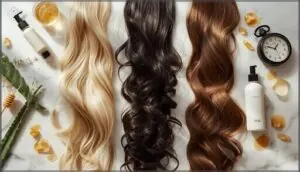
Your hair type determines how long conditioner should stay on your strands. Fine hair needs a lighter touch and shorter times, while thick or textured hair requires more exposure to absorb the benefits.
The sections below break down exact timing for your specific hair needs.
Fine or Oily Hair
If you’re wrestling with flat, greasy strands, your conditioner timing matters more than you think. Fine hair and oily scalp treatment demand a lighter touch to avoid conditioner buildup.
Here’s your five-point game plan for fine hair care and hair oil control:
- Keep rinse-out conditioner on for just 1–2 minutes
- Focus application on mid-lengths and ends only
- Use leave-in conditioners once or twice weekly at most
- Rinse thoroughly to prevent greasy hair solutions backfiring
- Choose lightweight, oil-free formulas designed for your hair type
Understanding the importance of regular hair conditioning is key to achieving healthy and manageable hair.
Thick, Dry, or Curly Hair
Dense, parched strands need a generous moisture soak—not a quick rinse. Leave rinse-out conditioner in for 3–5 minutes and deep conditioners for 10–30 minutes to penetrate thick hair and restore hair hydration.
For dry hair and curl definition, apply leave-in formulas on damp locks and skip the rinse entirely.
Pay attention to hair porosity: high-porosity curls absorb moisture fast but lose it quickly, so frequent conditioning aids frizz control and scalp health.
Colored or Damaged Hair
Color protection and damage repair demand strategic timing. Your dyed or damaged hair has lifted cuticles and increased hair porosity, so leave rinse-out conditioner in for 3–5 minutes.
Deep conditioners work best at 15–30 minutes for cuticle care and hair moisturizing.
Balance protein treatments with moisture-rich formulas to rebuild strength without stiffness—key for hair damage repair and frizz control.
Step-by-Step Guide to Applying Conditioner
How you apply conditioner matters just as much as how long you leave it in. The right technique ensures even coverage and maximum benefits without wasting product.
Follow these steps to get the most out of every application.
Prepping Hair Before Application
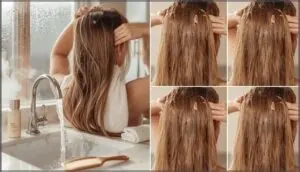
Before your conditioner application even begins, proper prep sets the stage for real transformation. Don’t skip these critical pre-shampoo and dampening hair steps—they determine whether your hair care routine delivers or disappoints.
- Rinse with lukewarm water to clear away surface oils and debris that block conditioner absorption.
- Towel-dry gently until damp, not dripping—excess water dilutes product effectiveness.
- Use hair sectioning (four or more portions) for even distribution across all strands.
- Detangle first with a wide-tooth comb to prevent breakage and ensure smooth coverage.
Where and How to Apply Conditioner

Your conditioner placement makes all the difference—apply it only to the mid-lengths and ends of your damp hair, never the scalp. This conditioning tool strategy prevents buildup while targeting dry, damaged areas.
For thick or curly hair types, use a pea-sized amount and adjust based on density. Hair sectioning helps product distribution reach every strand without weighing down your hair care routine.
Even Distribution Techniques

After applying your product, run a wide-tooth comb through damp sections for uniform coverage—this gentle stroke method prevents uneven patches and maximizes hair hydration.
For deep conditioning or leave-in conditioner, divide your hair into quadrants using hair sectioning clips to guarantee product dispersion reaches every strand.
This even application technique works across any hair type, from fine to thick textures.
Rinsing for Best Results

Once your product is evenly distributed, focus on how you rinse. Use lukewarm water temperature—hot water strips moisture and irritates your scalp, while a cool final rinse seals the cuticle for shine. Thorough product removal prevents buildup that weighs down fine hair or dulls any hair type.
Apply these rinsing techniques for complete rinse-out conditioner removal:
- Work in sections – Lift hair at the nape and crown using hair sectioning to reach trapped product
- Direct water flow at multiple angles – Don’t just let water run down; actively squeeze lengths
- Rinse longer than you think – Thick or curly textures need extra passes under running water
- Prioritize scalp care – Spend more time rinsing roots than you did applying to avoid greasiness
- Adjust for your hair type – Fine strands need exhaustive rinsing; coarse hair tolerates minimal residue on lengths
For deep conditioning treatments, rinse until water runs clear. Reserve leave-in conditioners and their intentional slip for after towel-drying—never confuse incomplete rinsing with leave-in benefits. Your hair hydration depends on removing what should go and keeping what should stay.
Benefits of Proper Conditioner Timing

Getting the timing right with conditioner isn’t just about following instructions on a bottle. When you leave conditioner in for the proper amount of time, your hair gets real benefits that you can see and feel. Here’s what happens when you nail the timing.
Moisture Retention and Shine
Your hair’s ability to hold onto moisture depends on how well your cuticle lies flat after conditioning. Humectants pull water from the air to your hair’s surface, while silicones like dimethicone lock it in by forming a protective barrier.
This moisture balance improves hydration levels and shine enhancement—smooth cuticles reflect light evenly, giving you that healthy gloss. A quality leave-in conditioner or hair moisturizer extends these benefits between washes, keeping hair hydration steady.
Detangling and Smoothing
Friction is what causes breakage when you comb wet hair. That’s where hair detangling and hair slip come in—cationic surfactants coat each strand, aligning cuticles so your detangling tools glide through without yanking.
Smoothing techniques using leave-in conditioner or deep conditioning reduce the combing force you need, creating uniform cuticle alignment that reflects light and prevents damage. Hair nourishment through proper hair smoothing keeps your strands intact.
Damage Repair and Prevention
Protein repair fills gaps in your cuticle and cortex, boosting tensile strength by up to 20 percent in damaged hair. Humectants pull water into dry strands, cutting visible dryness by 30 percent.
Silicone films shield against moisture loss and heat styling abrasion, while bond-building ingredients lower hair breakage rates over six weeks.
Thermal protection components keep cuticle restoration on track, preventing future hair damage.
Risks of Leaving Conditioner in Too Long

Leaving conditioner in your hair for too long doesn’t give you better results—it actually works against you. The extra time allows ingredients to build up on your strands and scalp, creating problems you didn’t have before.
Here’s what happens when you cross the line from conditioning to over-conditioning.
Product Buildup and Greasiness
When you exceed recommended conditioner timing, you’re inviting product residue to settle on your strands like unwanted houseguests. Film formation from silicones and heavy oils creates visible buildup, leaving hair dull and coated.
This residue traps dirt and combines with sebum, triggering grease control problems—especially frustrating for oily hair. Your scalp health suffers as pores struggle under that thick layer, and even leave-in conditioners can turn problematic without proper application limits.
Scalp Irritation and Weigh-Down
Trapped conditioner residue doesn’t just sit on your strands—it wreaks havoc on your skin. Prolonged exposure to fragrances, preservatives, and surfactants triggers irritant reactions and allergic responses, especially when product residue lingers on your scalp for hours after rinsing.
- Scalp sensitivity flares: Burning, itching, and flaking develop from barrier disruption
- Follicles clog: Occlusive buildup promotes folliculitis and scalp acne
- Fine hair collapses: Excess polymer deposits cause visible weigh-down and limpness
- Microbiome imbalance: Disrupted flora increases dandruff and inflammation risk
- Contact dermatitis spreads: Product transfers to face, neck, and pillowcases
Keep conditioner off your scalp and rinse thoroughly—your skin will thank you.
Over-Conditioning Effects
Think conditioning more means healthier hair? Over-conditioning flips that logic on its head. Excessive moisture triggers hygral fatigue—your strands swell and shrink repeatedly, losing elasticity and snapping under tension. Moisture overload leaves hair mushy when wet, while product buildup creates a greasy film that blocks treatments. High-porosity and damaged fibers suffer most, developing permanent fiber damage and chronic fragility you can’t reverse.
Over-conditioning causes hygral fatigue, leaving strands swollen, mushy, and prone to permanent damage you can’t reverse
| Condition | Physical Signs | Long-Term Risk |
|---|---|---|
| Hygral fatigue | Gummy texture when wet, abnormal stretch | Permanent cuticle damage, reduced strength |
| Moisture overload | Limp, lifeless strands lacking volume | Increased breakage, protein depletion |
| Product buildup | Heavy, greasy appearance after washing | Dull surface, treatment interference |
| Scalp irritation | Itching, bumps, follicular inflammation | Contact dermatitis, clogged pores |
| Fiber damage | Split ends, chronic dryness despite conditioning | Loss of moisture retention capacity |
Balance protein and moisture—your hair’s resilience depends on it.
Common Conditioning Mistakes to Avoid

Even when you know the right timing for conditioner, simple missteps can undo your efforts. These mistakes often happen on autopilot, costing you the healthy hair you’re working toward.
Here are the most common conditioning errors and how to skip them.
Not Leaving Conditioner in Long Enough
Rushing through your rinse-out conditioner—less than a minute of contact—stops conditioning agents from coating each strand evenly. Your hair pays the price with frizz control issues, cuticle damage, and detangling problems. Here’s what under-conditioning triggers:
- Moisture loss rebounds within 24–48 hours after washing
- Hair breakage increases during combing from poor strand coating
- Fine or damaged hair loses measurable tensile strength
- Deep conditioning benefits vanish when you skimp on time
- Hair hydration drops below ideal levels, leaving strands dry
Give your hair type the full 1–3 minutes it needs.
Applying to The Scalp
Slathering conditioner on your scalp—unlike the mid-lengths and ends—clogs follicles and sparks folliculitis, dandruff, and oiliness. Rinse-off formulas aren’t designed for direct scalp exposure. Focus conditioner below your roots to protect follicle care and oil balance while avoiding scalp irritation that undermines scalp health.
| Scalp Issue | Cause | Prevention |
|---|---|---|
| Folliculitis | Clogged follicles from conditioner residue | Keep conditioner off scalp entirely |
| Dandruff flare-ups | Added oils trap sebum on oily scalps | Use lightweight, scalp-friendly formulas on lengths only |
| Contact dermatitis | Fragrances, preservatives irritate sensitive skin | Choose fragrance-free products; apply mid-lengths down |
Inadequate Rinsing
Skipping a thorough rinse traps residue buildup on every strand, leaving hair greasy, flat, and dull. That film attracts dust and pollutants, while product accumulation clogs follicles and triggers scalp irritation or folliculitis.
Rinse until water runs clear and conditioner slip disappears—lukewarm water lifts rinseout conditioner best without triggering overconditioning or hair weight that sabotages your styling routine.
Using The Wrong Conditioner for Your Hair
Even impeccable rinsing won’t rescue your hair if you’re coating it with a formula that fights your natural texture or needs. Hair type analysis guides every choice—mismatch conditioner ingredients to your scalp sensitivity or strand structure, and you’ll trigger product overload, breakage, or chronic grease. Hair damage prevention starts here:
- Fine hair drowns under heavy creams.
- Curly hair starves without leave-in conditioner.
- Oily scalps revolt against rich formulas.
- Damaged strands crack under protein-free products.
Match hair types and conditioning formulas to protect hair health.
Frequently Asked Questions (FAQs)
Can I use conditioner on dry hair?
Most mainstream conditioners crave contact with clean, damp strands—dry hair blocks absorption. Leave-in formulas work on dry lengths, but rinse-out types risk buildup, greasiness, and lackluster results without proper moisture.
Is it necessary to use a leave-in conditioner?
Leave-in conditioner isn’t required for everyone, but it offers daily moisture, hair protection, and frizz control.
If your hair type is fine or oily, you risk product buildup and scalp sensitivity from overuse.
How often should I deep condition my hair?
Deep conditioning isn’t a one-size-fits-all affair—your hair’s porosity and damage level call the shots.
Most healthy hair thrives with monthly treatments, while curly or damaged strands benefit from weekly deep conditioner sessions to restore hair elasticity and moisture.
Can I use conditioner before shampooing?
You can try reverse washing—applying conditioner as a pre-shampoo primer to protect your lengths before cleansing.
This reverse conditioning technique works well for fine hair types, reducing weigh-down while maintaining hair health and scalp care balance.
Can I leave my rinse-out conditioner in my hair overnight?
Don’t let a rinse-out conditioner sit overnight—it’s a trap. You’ll wake up to buildup, scalp irritation, and limp strands.
Overnight risks outweigh any benefit; use leave-in conditioners designed for extended wear instead.
Can I sleep with conditioner in my hair?
Sleeping with standard rinse-out conditioner risks scalp irritation and buildup. Only use overnight hair masks or leave-in conditioners formulated for sleep safety—apply to mid-lengths and ends, avoiding roots to prevent weigh-down and greasiness.
Does water temperature affect conditioner effectiveness?
Water temperature directly impacts conditioner effectiveness by influencing cuticle behavior and product penetration. Lukewarm water opens the cuticle for better absorption, while a cool rinse seals moisture in and enhances shine.
Should I condition hair before or after shampoo?
You’d think the answer is obvious, yet reverse conditioning—applying conditioner before shampoo—works for fine, oily hair by lifting weight.
Thick or frizzy types still need post-shampoo moisture for real smoothing.
How often should I use deep conditioner weekly?
Most hair types benefit from deep conditioning once weekly to maintain hair moisture and prevent dryness.
Dry, curly, or damaged hair may need it twice weekly, while fine or oily hair works best with biweekly treatments.
Can I mix different conditioner types together?
You can mix conditioner types in your hand right before applying, but avoid permanently combining them in a bottle. Formulation compatibility issues and product stability problems can cause scalp sensitivity or even hair damage over time.
Conclusion
Your next shower is a chance to rewrite your hair’s story. Understanding how long to leave conditioner in hair shifts your routine from guesswork to precision.
One to three minutes for daily formulas, 15 to 30 for deep treatments—these windows determine whether your strands absorb nourishment or just collect residue.
Match timing to your hair type, rinse thoroughly, and watch your hair transform from brittle to resilient, dull to vibrant.