
This site is supported by our readers. We may earn a commission, at no cost to you, if you purchase through links.
Your scalp maintains a slightly acidic pH between 4.5 and 5.5 for a reason—this natural acidity forms a protective barrier called the acid mantle, which defends against harmful bacteria, regulates oil production, and keeps your hair cuticles sealed. When this delicate balance shifts too far in either direction, you’ll notice the consequences: persistent itching, unexpected dryness or greasiness, stubborn dandruff, or hair that suddenly feels rough and breaks easily.
Most people unknowingly disrupt their scalp’s pH daily through alkaline shampoos, chemical treatments, or even their tap water, creating a cascade of scalp issues that seem to appear without explanation.
Understanding the difference between acidic vs alkaline scalp health gives you the framework to identify what’s happening on your scalp and select products that restore rather than further damage your protective barrier.
Table Of Contents
- Key Takeaways
- What Does PH Mean for Your Scalp?
- Acidic Scalp: Characteristics and Effects
- Alkaline Scalp: Characteristics and Effects
- How PH Imbalance Disrupts Scalp Health
- What Causes Scalp PH Imbalance?
- Recognizing PH Imbalance on Your Scalp
- How to Test Your Scalp’s PH
- Restoring Balance With PH-Friendly Hair Care
- Daily Habits for Maintaining Scalp PH
- Long-Term Effects of Balanced Scalp PH
- Frequently Asked Questions (FAQs)
- Conclusion
Key Takeaways
- Your scalp’s natural pH between 4.5 and 5.5 creates an acid mantle that protects against harmful bacteria, regulates oil production, and seals hair cuticles—but this balance gets disrupted daily by alkaline shampoos, chemical treatments, and hard water.
- Excessive alkalinity (above 5.5) lifts hair cuticles and weakens your protective barrier, causing dryness, breakage, and frizz, while excessive acidity (below 4.5) triggers burning sensations, oiliness, and heightened sensitivity.
- pH imbalances weaken your scalp’s defense systems by compromising the lipid barrier, enabling microbial overgrowth like Malassezia fungi that cause dandruff, and creating inflammatory cycles that increase sensitivity to products and environmental irritants.
- Restoring balance requires consistent use of pH-appropriate shampoos (4.5-5.5 range), limiting chemical treatments and heat styling, and supporting your acid mantle through proper hydration, strategic washing frequency, and nutrient-rich nutrition that maintains follicle health from within.
What Does PH Mean for Your Scalp?
Your scalp’s pH isn’t just a chemistry lesson—it’s a fundamental aspect of how your skin and hair function day to day. The pH scale measures acidity and alkalinity on a spectrum from 0 to 14, and where your scalp falls on that scale directly influences everything from oil production to your vulnerability to irritation.
If you’re experiencing dryness, excess oil, or persistent itching, those could be signs of scalp pH imbalance that need attention.
Your scalp’s pH directly controls oil production, irritation levels, and how your hair functions every single day
Understanding what pH means in practical terms helps you make informed choices about the products you use and the habits that either support or disrupt your scalp’s natural balance.
A closer look at what causes poor scalp health reveals how pH imbalances can trigger issues like dryness, irritation, and excess oil production.
Understanding The PH Scale in Hair Care
The pH scale measures hydrogen ion concentration from 0 to 14, with 7 as neutral. Your scalp’s natural pH sits between 4.5 and 5.5—slightly acidic—which protects the acid mantle and scalp barrier.
When your scalp pH rises above 5.5—often from harsh shampoos or buildup—it can trigger irritation, and understanding why your hair itches when you sweat helps you recognize when your scalp’s natural balance is disrupted.
This acidic property keeps hair porosity controlled and maintains natural balance. Products outside this range can disrupt your scalp pH, weakening defenses and altering hair texture, so understanding pH level matters for long-term scalp health.
Why Your Scalp’s Natural PH is Acidic
Your scalp maintains a naturally acidic pH between 4.5 and 5.5 because the acid mantle—a protective film of sebum and sweat acids—creates this environment.
This acidity nourishes your scalp microbiome, helping beneficial bacteria thrive while inhibiting harmful organisms.
This pH homeostasis isn’t accidental; it’s essential for scalp health, reducing irritation and regulating sebum production to prevent excessive dryness or oiliness.
The Role of The Acid Mantle
This thin, slightly acidic film works as your scalp’s first line of natural defense, blending sebum with sweat gland secretions to maintain pH balance around 4.5 to 5.5. The acid mantle structure creates an acidic environment that strengthens your skin barrier, controls microbial populations by favoring helpful organisms over harmful ones, and prevents moisture loss that would otherwise leave your scalp vulnerable to irritation.
- Physical and chemical barrier: The mantle structure combines lipids and antimicrobial peptides to block pathogenic microbes while maintaining scalp moisture
- Microbial control through acidic balance: This acidic environment naturally inhibits harmful bacteria and fungi, supporting a healthy scalp microbiome
- Moisture retention: By reducing transepidermal water loss, the acid mantle keeps your scalp hydrated and comfortable
- Immune defense support: Antimicrobial compounds within the mantle help modulate your scalp’s immune responses without disrupting beneficial microbes
- Hair shaft protection: Proper mantle function reduces friction on hair, improving cuticle adhesion and minimizing breakage from surface roughness
Acidic Scalp: Characteristics and Effects
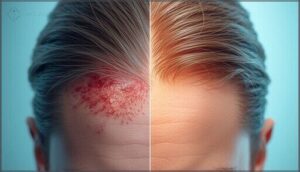
While a slightly acidic scalp is healthy, pH levels that drop too low can create their own set of problems. When your scalp becomes excessively acidic, it can trigger discomfort, alter your hair’s feel, and require specific adjustments to restore balance.
Here’s what happens when acidity goes too far and how you can recognize and address it.
Signs Your Scalp is Too Acidic
When your scalp’s pH balance drops too far below the ideal 4.5–5.5 range, discomfort becomes unmistakable. You might notice persistent burning or stinging sensations, especially after washing—your acid mantle signaling distress. Excessive oiliness, unusual flaking, and heightened scalp irritation are telltale acidic symptoms. An overly acidic environment can compromise the scalp’s protective function, leading to redness and sensitivity that acidic products may inadvertently worsen.
| Sign | What It Indicates |
|---|---|
| Burning or stinging | pH imbalance disrupting nerve sensitivity |
| Excessive oil production | Overcompensation from stressed sebaceous glands |
| Persistent redness | Inflammatory response to acidic irritation |
| Unusual flaking | Altered skin turnover from disrupted scalp pH |
| Increased breakage | Hair damage from compromised cuticle integrity |
How Low PH Affects Hair Texture
Texture transformations under acidic conditions stem from keratin bonding changes within the cuticle layer. When scalp acidity drops below the ideal pH balance, hydrogen bonds tighten, creating smoother surfaces and reduced frizz—your hair feels silkier. However, this acidic environment can also temporarily increase coarseness if pH falls too low.
Smoothness factors depend on your individual scalp pH, making tailored assessment essential for avoiding hair damage.
Managing Excessive Scalp Acidity
Restoring equilibrium requires targeted pH Balance Tips rather than harsh interventions. Acidic Scalp Care should begin with Gentle Shampooing products formulated within the 4.5–5.5 range to support your barrier function.
Conduct Scalp Acidity Tests with pH strips over several days to track progress accurately. Natural Remedies like properly diluted rinses can help, but verify complete removal to avoid perpetuating the Acidic Environment and worsening pH Imbalance.
For stubborn cases, exploring a natural remedy for scalp inflammation alongside pH monitoring can speed up recovery and soothe irritation.
Alkaline Scalp: Characteristics and Effects
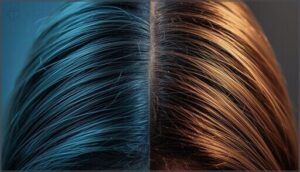
When your scalp shifts too far toward the alkaline end of the spectrum, the protective acid mantle weakens and your hair’s structural integrity becomes compromised.
Fortunately, restoring balance to your scalp pH naturally can reverse this damage and strengthen your hair from the root.
You’ll notice distinct physical changes that affect both comfort and appearance, from texture shifts to persistent dryness.
Understanding these alkaline-related effects helps you identify imbalance early and take corrective action before damage progresses.
Signs Your Scalp is Too Alkaline
When your scalp’s pH tips too far into alkaline territory—above 5.5, you’ll often notice a constellation of uncomfortable symptoms that signal your skin’s protective barrier is struggling to maintain its natural defenses. Persistent itching and scalp irritation usually appear first, followed by visible dryness, tight sensation, and increased sensitivity to products you previously tolerated.
You might see flaking or dandruff, experience hair breakage, or notice your strands feeling rough and unmanageable shortly after washing.
How High PH Damages Hair Cuticles
Elevated pH levels—anything above 5.5—trigger a cascade of structural harm to your hair cuticles, the protective outer layer that shields your hair shaft from environmental stress and moisture loss. Alkaline conditions weaken the bonds holding cuticle scales flat, causing them to lift away from the cortex and creating gaps that compromise your hair’s integrity.
Here’s what happens to your hair cuticles under high pH conditions:
- Cuticle lifting increases, exposing the inner cortex to damage and allowing essential proteins to leak out
- Disulfide and hydrogen bonds destabilize, reducing the structural integrity and tensile strength of each strand
- Hair shaft swelling occurs, making cuticles more vulnerable to mechanical stress from brushing and styling
- Surface roughness intensifies, leading to increased friction, tangling, and visible frizz even after conditioning
- Porosity escalates, causing moisture imbalance, dullness, and accelerated breakage at the cuticle-cortex junction
This cuticle damage doesn’t reverse itself easily—repeated exposure to alkaline shampoos, chemical treatments, or hard water compounds the erosion over time, leaving your hair visibly dull, rough to the touch, and prone to splitting. Your strands lose their natural shine because lifted cuticles scatter light rather than reflecting it smoothly, and the compromised acid mantle on your scalp struggles to maintain its protective barrier against irritation and microbial overgrowth.
Understanding how high pH levels disrupt cuticle structure helps you make informed choices about the products you use daily and the treatments you pursue for long-term hair health.
The Link Between Alkalinity and Dryness
Scalp alkalinity disrupts your acid mantle, stripping away the protective layer that locks moisture into your skin. When pH rises above 7, your scalp loses water faster through the stratum corneum, creating persistent dryness and flakiness you can’t ignore.
Restoring pH balance with acidic care—targeting the 4.5–5.5 range—helps your scalp rebuild its barrier and reclaim natural hair hydration.
How PH Imbalance Disrupts Scalp Health
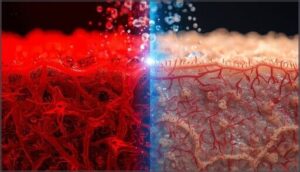
When your scalp’s pH shifts too far in either direction, it doesn’t just feel uncomfortable—it compromises the biological systems that keep your scalp functioning properly. The disruption affects multiple layers of protection and can create a cascade of issues that worsen over time if left unaddressed.
Understanding the specific mechanisms behind these disruptions helps you recognize what’s happening beneath the surface and why restoring balance matters for long-term scalp health.
Weakening of The Protective Barrier
Your scalp’s protective barrier relies on lipid-rich layers and an intact acid mantle to shield against water loss and irritants. When pH balance shifts, barrier disruption occurs—lipid depletion weakens the skin barrier, pH elevation triggers microinflammation, and increased scalp sensitivity follows.
This compromised acidic environment can’t hold moisture effectively, leaving your scalp vulnerable to dryness, discomfort, and further damage. Maintaining a healthy scalp requires understanding the importance of scalp pH balance to prevent damage and promote overall scalp health.
Microbial Overgrowth and Infections
Beyond barrier breakdown, pH shifts create fertile ground for microbial imbalance and scalp dysbiosis. Your acid mantle normally keeps fungal infections and bacterial overgrowth in check, but elevated pH above 5.5 fuels yeast colonization—especially Malassezia species tied to dandruff.
This disrupted microbial balance invites opportunistic organisms to flourish, transforming your scalp’s healthy ecosystem into one prone to irritation and infection.
Increased Sensitivity and Inflammation
When microbial imbalance takes hold, inflammatory responses often follow—and pH disturbances heighten this cycle. Barrier disruption allows irritants to penetrate deeper, triggering your scalp’s immune cells to release cytokines that fuel redness and discomfort. Meanwhile, acidic microenvironments sensitize nerve fibers, lowering pain thresholds and intensifying burning sensations. These neuroimmune interactions create a feedback loop where sensitivity triggers perpetuate inflammation, making your scalp hypersensitive to products, temperature changes, and even gentle touch.
- Damaged barriers let allergens activate immune responses, raising inflammatory mediator levels
- Acidic pH activates sensory neurons, heightening scalp irritation and burning
- Nerve sensitization promotes neuropeptide release, sustaining neurogenic inflammation
- Dysbiosis correlates with elevated systemic cytokines, linking scalp pH to broader inflammatory burden
Understanding the impact of chlorine damage effects is vital for maintaining scalp health.
What Causes Scalp PH Imbalance?

Your scalp’s pH doesn’t shift on its own—it reacts to what you expose it to, both externally and internally. From the products you lather on to the water you rinse with, multiple factors can nudge your scalp away from its ideal acidic range.
Understanding these triggers helps you identify what might be throwing your scalp off balance.
Harsh Shampoos and Alkaline Products
Many store-bought shampoos contain surfactants like sodium lauryl sulfate that push the pH level well above your scalp’s natural 5.5 range, sometimes reaching pH 9.
These alkaline products damage the acid mantle, increase hair porosity, and lift cuticles, which leads to frizz and breakage.
You’ll notice scalp irritation, dryness, and rougher texture when pH balance gets disrupted repeatedly.
Chemical Treatments and Hair Coloring
Hair dyes, relaxers, and bleach treatments can spike your scalp’s pH to 10 or higher, stripping away protective oils and weakening the barrier that keeps irritation and infection at bay. Perms carry similar risks, as their alkaline formulas compromise the acid mantle and increase susceptibility to chemical burns, dye allergies, and color damage. You’re basically forcing your scalp into a hostile environment that disrupts microbial balance and accelerates hair damage.
Environmental Factors Like Hard Water
If your tap water contains high levels of calcium and magnesium—often exceeding 120 mg per liter—you’re dealing with hard water that disrupts scalp pH balance by depositing minerals on your skin and hair.
This mineral buildup forms insoluble films that:
- Raise scalp pH above the healthy 5.5 range, weakening your acid mantle
- Trap sebum and dead cells, fueling Malassezia overgrowth and dandruff
- Reduce shampoo effectiveness, leaving irritating residues behind
- Increase hair porosity and scalp irritation through barrier compromise
Studies link hard water exposure to worsening atopic dermatitis and seborrheic flares.
Diet, Hormones, and Internal Influences
Your body’s internal chemistry—shaped by what you eat, hormonal shifts, and metabolic processes—directly influences the pH environment your scalp maintains, often in ways you mightn’t immediately connect to flaking or irritation.
Nutrient deficiency disrupts internal balance, while hormonal fluctuations alter sebum composition and inflammatory responses.
Poor gut health can trigger systemic changes that compromise scalp health, affecting both pH balance and hair growth promotion through altered microbial signaling and nutrition absorption.
Recognizing PH Imbalance on Your Scalp
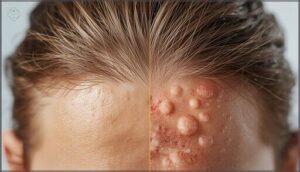
Your scalp often signals pH imbalance before you fully understand what’s happening. These symptoms can overlap with other scalp conditions, which is why recognizing the specific patterns matters for effective intervention.
The following signs indicate that your scalp’s pH may have shifted outside the protective 4.5 to 5.5 range.
Persistent Itching and Irritation
Persistent itch often signals that your scalp pH has drifted from its ideal range, weakening the acid mantle and allowing irritants deeper access to nerve endings. When pH balance falters, you may notice:
- Constant scratching urges that don’t resolve with washing
- Burning or stinging sensations when applying routine products
- Visible redness or flaking alongside the itching
These neuroimmune responses point to barrier dysfunction, making targeted itch relief methods and barrier repair strategies essential.
Excessive Oiliness or Severe Dryness
When sebum regulation breaks down, you’ll see extremes—either greasy roots within hours of washing or tight, scaly dryness that no conditioner seems to fix. Both patterns trace back to scalp barrier dysfunction and disturbed pH balance, which either triggers reactive overproduction or shuts down lipid output entirely.
Restoring your acid mantle through pH-conscious hydration tips and gentle cleansing resets oil balance and fosters long-term scalp health.
Dandruff, Flaking, and Hair Shedding
Flaking isn’t just cosmetic—it signals microbial dysbiosis, often driven by Malassezia fungi thriving when scalp pH shifts alkaline, breaking down sebum into irritating free fatty acids.
This disrupts your scalp microbiome, triggering inflammation, itching, and accelerated hair shedding that resembles telogen effluvium.
Persistent dandruff with noticeable hair loss patterns warrants evaluation, since restoring pH balance tackles both flaking causes and the follicular disturbances fueling shedding.
How to Test Your Scalp’s PH
Testing your scalp’s pH doesn’t require a dermatologist’s office—you can assess it at home with simple tools and a few minutes of your time. Understanding how to collect an accurate reading, interpret the color-coded results, and track changes over weeks will help you make informed decisions about your hair care routine.
Here’s what you need to know about measuring and monitoring your scalp’s pH level.
Using PH Test Strips at Home
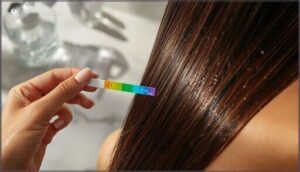
Testing scalp pH at home is straightforward but requires attention to detail. Choose pH strips calibrated in 0.5-unit increments across the 4.0 to 7.0 range for better pH strip accuracy.
Before testing, skip washing your hair for several hours and avoid styling products for 24 hours—this scalp preparation minimizes pH artifacts.
Saturate clean hair in distilled water, then press the strip against wet strands to assess your pH level and acid mantle status.
Interpreting Your Results Accurately
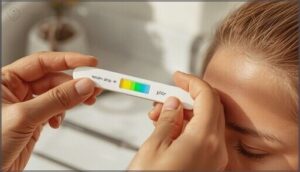
Once you’ve run your pH test, look for readings within 4.5 to 5.5—that’s where your acid mantle thrives. Don’t panic if you see slight pH fluctuation; your scalp pH naturally shifts throughout the day.
A single reading above 6 or below 4 doesn’t confirm imbalance. Data interpretation requires context: repeat measurements at the same scalp mapping site over several days to identify true result variability before adjusting your routine.
When to Retest for Progress
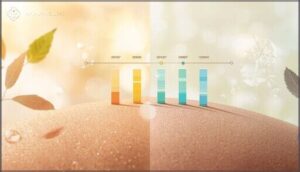
After confirming your baseline scalp pH level, you’ll want to track whether your acid mantle is recovering. Short-term follow-up matters because your scalp evaluation needs time to reflect real change, not just daily variation.
Schedule your first retest intervals strategically for pH monitoring:
- Within 4–8 weeks when starting new pH-balanced products or treating active irritation
- At 3-month checkpoints to assess whether progress tracking justifies continuing your current regimen
- Quarterly or seasonally once your pH balance stabilizes, catching environmental shifts before symptoms appear
Restoring Balance With PH-Friendly Hair Care

Once you’ve identified a pH imbalance, the next step is selecting products and practices that actively support your scalp’s natural acidity. This doesn’t require a complete overhaul of your routine, but it does mean being more intentional about what you’re using and how often.
Let’s look at three practical strategies that can help you restore and maintain a healthy scalp environment.
Choosing Shampoos in The 4.5-5.5 Range
You’ll want to look for shampoos explicitly labeled with pH values between 4.5 and 5.5, since many pH balanced shampoos still exceed that range. Sulfate-free, gentle cleansers with ingredients like cocamidopropyl betaine support your acid mantle without stripping natural oils.
For color-treated or high hair porosity, acidic formulas around 4.5 preserve cuticle integrity and scalp comfort, protecting your scalp pH level long-term.
Benefits of Acidic Rinses Like Apple Cider Vinegar
Apple cider vinegar, diluted properly, offers acidic rinse benefits by lowering your scalp pH toward the protective acidic environment your acid mantle needs.
This vinegar therapy nourishes your scalp microbiome through its antimicrobial properties, while pH balancing rinses smooth hair cuticles for improved shine.
Among natural remedies, apple cider vinegar stands out for restoring scalp pH when used moderately within a balanced routine.
Ingredients That Support Optimal PH
Formulas that maintain your scalp pH rely on specific pH balancers and acidic formulas designed to support the acid mantle. Look for hair care products with ingredients that preserve your scalp’s natural pH level:
- Lactic acid gently exfoliates while keeping pH within the protective acidic range
- Natural humectants like hyaluronic acid bind water to strengthen barrier function
- Gentle surfactants such as cocamidopropyl betaine cleanse without disrupting your scalp’s physiologic pH
Citrate buffers and scalp soothers like aloe vera further protect this delicate environment.
Daily Habits for Maintaining Scalp PH

Maintaining your scalp’s pH balance doesn’t require complicated treatments—it’s about building consistent, protective habits into your routine. The choices you make every day, from how often you wash your hair to what you eat, directly influence the acid mantle’s integrity and your scalp’s overall resilience.
Let’s look at three core areas where small adjustments can make a measurable difference in long-term scalp health.
Proper Washing Frequency and Techniques
Washing frequency should match your scalp’s oil production—finer, oilier hair often benefits from daily or every-other-day gentle cleansing with pH-balanced shampoo to prevent sebum accumulation.
Focus shampoo application directly on your scalp using fingertip pads in circular motions for scalp massage, not scrubbing with nails.
Use lukewarm water temperature around 37-40°C to protect your acid mantle, then confirm thorough rinsing techniques to remove all residue that disrupts scalp pH.
Avoiding Over-Processing and Heat Damage
Chemical treatments like bleaching, perming, and frequent coloring can strip away your scalp’s protective acid mantle, pushing pH into the alkaline range and leaving follicles vulnerable to inflammation and breakage. Limit chemical damage through strategic scheduling and professional application while protecting scalp health:
- Space chemical treatments at least six weeks apart
- Apply thermal protection before heat styling above 150°C
- Choose air-drying or low-heat settings when possible
- Practice gentle handling during brushing and detangling
Supporting Scalp Health Through Hydration and Nutrition
Your scalp’s pH balance doesn’t exist in isolation—it reacts to what you put into your body just as much as what you apply topically, making hydration and nutrient intake essential partners in maintaining that ideal 4.5 to 5.5 range.
Adequate water intake directly influences sebaceous gland function and the scalp’s ability to maintain its protective acid mantle, while deficiencies in essential fatty acids, zinc, or B vitamins can compromise barrier integrity and shift pH toward alkalinity. This connection between nutrition and scalp pH explains why restrictive diets or poor hydration often coincide with dandruff, irritation, and hair loss—your follicles simply can’t maintain ideal conditions without proper internal support for hair care and overall scalp health.
| Hydration Techniques | Dietary Balance | Nutrient Supplements |
|---|---|---|
| Drink 8-10 glasses daily | Omega-3 rich foods support healthy oils | Biotin strengthens follicles |
| Monitor water intake timing | Zinc regulates sebum production | B-complex vitamins aid scalp health |
| Increase during heat exposure | Antioxidants reduce inflammation | Consult before supplementing |
Long-Term Effects of Balanced Scalp PH
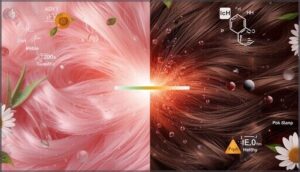
When you maintain your scalp’s pH within that 4.5 to 5.5 range consistently, the benefits extend far beyond immediate comfort. Over time, a balanced acid mantle strengthens your hair from root to tip, supporting resilience against common scalp disorders and environmental stressors.
Let’s examine three key areas where sustained pH balance delivers measurable, lasting improvements to your hair and scalp health.
Stronger Hair Growth and Reduced Breakage
Maintaining balanced pH offers concrete benefits for the quality and quantity of your hair. When pH stays near 5.5, the cuticle integrity remains intact, reducing friction and mechanical stress during combing.
Evidence shows:
- Hair fiber strength is preserved because keratin bonds stay stable at near-physiological pH
- The scalp microbiome thrives in slightly acidic conditions, supporting follicle function
- Your hair growth cycle remains stable, limiting excessive shedding linked to inflammation
- Exposome management through pH balance protects against cumulative damage from styling and environmental stressors
Prevention of Dandruff and Scalp Conditions
Consistent pH balance creates a hostile environment for Malassezia, the fungus behind over half of all dandruff cases. When your scalp pH hovers between 4.5 and 5.5, the acid mantle suppresses fungal overgrowth while your scalp microbiome—including beneficial Cutibacterium acnes—produces propionic acid that maintains microbial harmony.
This natural defense reduces flaking, itching, and inflammation, making a pH-conscious hair care routine and scalp exfoliation part of effective dandruff treatment and long-term scalp health maintenance.
Enhanced Shine, Softness, and Manageability
Beyond preventing problems, balanced pH unlocks visible aesthetic rewards. When your scalp pH stays between 4.5 and 5.5, cuticle smoothing creates hair gloss enhancement—studies show up to 20% more light reflection.
Softness factors improve through better moisture retention and reduced friction between fibers, while manageability tips become easier to implement.
Shine retention depends on this acid mantle support, making pH balance foundational to hair health and daily hair care success.
Frequently Asked Questions (FAQs)
Can stress or sleep quality alter scalp pH?
Stress hormones like cortisol can disrupt your acid mantle’s integrity, while poor sleep patterns may shift scalp pH by altering barrier function—though direct evidence remains limited and individual responses vary considerably.
Does scalp pH vary by age or ethnicity?
Population studies show minimal age factors or ethnic hair differences in baseline scalp pH levels. Most demographic variations stem from product use and environment rather than biology, though individual scalp sensitivity requires tailored pH balance assessment.
How does chlorine from swimming pools affect pH?
Swimming exposes you to water buffered at pH 2–8, temporarily shifting your scalp toward alkaline. This disrupts the acid mantle, often triggering dryness, irritation, and increased vulnerability to microbial overgrowth.
Are there pH differences between oily and dry scalps?
Yes, oily scalps tend toward slightly lower, more acidic pH levels due to excess sebum breakdown into free fatty acids, while dry scalps often shift higher—toward less acidic or more alkaline pH—compromising barrier function and moisture retention.
Can medication side effects cause pH imbalance?
Certain medications can shift scalp pH by altering sweat, oil production, or hormonal pathways. Topical corticosteroids and antifungals may disrupt your barrier temporarily, while systemic drugs affect moisture balance and acidity levels over time.
Conclusion
Like a thermostat regulating temperature, your scalp’s pH controls the environment where healthy hair grows. Understanding acidic vs alkaline scalp health enables you to recognize imbalance before it progresses into chronic conditions.
When you choose pH-appropriate products, test periodically, and maintain consistent care habits, you’re not simply treating symptoms—you’re preserving the protective barrier that determines whether your scalp thrives or struggles. That distinction makes all the difference.
- https://pubmed.ncbi.nlm.nih.gov/28396101
- https://www.verywellhealth.com/ph-balance-significance-function-associated-conditions-5205825
- https://www.sciencedirect.com/science/article/pii/S0749208123000268
- https://pmc.ncbi.nlm.nih.gov/articles/instance/9553038/bin/pone.0275964.s005.docx
- https://www.scribd.com/document/356795007/Research-Methods-Knowledge-Base