
This site is supported by our readers. We may earn a commission, at no cost to you, if you purchase through links.
Your father’s thick beard doesn’t guarantee you’ll grow one, and your brother’s patchy stubble doesn’t mean you’re doomed to the same fate. Beard growth genetics and ethnicity create a complex blueprint that explains why some men develop full facial hair by 18 while others wait until their late twenties—or never see more than sparse coverage.
Roughly 60% of beard thickness comes down to inherited factors, but the remaining 40% involves hormonal sensitivity, lifestyle choices, and environmental influences that shift throughout your life. Genetic variants like LNX1 and EDAR control follicle density and development rates differently across ethnic groups, while your androgen receptors determine how forcefully your body reacts to testosterone.
Understanding these biological mechanisms reveals why East Asian men usually grow less facial hair than their Middle Eastern counterparts, and why two brothers with identical testosterone levels can end up with dramatically different beards.
Table Of Contents
Key Takeaways
- Your beard’s potential is roughly 60% genetic—determined by inherited follicle density, androgen receptor sensitivity, and specific gene variants like LNX1 and EDAR—while the remaining 40% stems from hormonal levels, nutrition, stress management, and lifestyle factors you can actually influence.
- Ethnic ancestry dramatically shapes facial hair patterns, with Caucasian and Middle Eastern populations typically showing 60-70% denser follicle distribution than East Asian groups due to genetic variations in androgen receptor pathways and DHT responsiveness, not just testosterone levels.
- The AR gene controls how aggressively your follicles respond to testosterone and DHT, explaining why two men with identical hormone levels can have vastly different beard density—receptor sensitivity matters more than raw hormone counts.
- Most beards don’t reach full maturity until ages 25-30, with some men continuing to see density improvements into their thirties as androgen receptor activity and DHT sensitivity evolve beyond the initial puberty-driven growth phase.
How Genetics Shape Beard Growth
Your beard isn’t a blank slate—it’s written in your DNA long before the first stubble appears. Genetic blueprints determine everything from follicle density to how your facial hair reacts to hormones, and these inherited instructions explain why some men grow thick beards while others struggle with patchy coverage.
Your beard’s thickness and growth pattern are written in your DNA long before the first stubble appears
Let’s break down the three genetic factors that control your beard’s potential.
Inherited Beard Growth Patterns
Your father’s beard isn’t just a coincidence—it’s a blueprint. Twin studies confirm that genetics account for roughly 60% of beard thickness variation, with familial traits passed down through hair follicle density and androgen sensitivity.
A study of 1,000 men revealed that paternal grandfather beard patterns correlated markedly with sons’ facial hair, proving genetic inheritance shapes your beard long before lifestyle ever steps in.
Understanding the role of genetics is similar to studying for AP Biology exams to grasp complex hereditary concepts.
Key Genes Involved in Facial Hair
Beyond inheritance patterns, specific genetic variants determine whether your follicles will produce a lush beard or patchy growth. The LNX1 gene on chromosome 4 influences facial hair density, while EDAR variants affect follicle development rates. Your IRF4 gene shapes both hair color and growth patterns.
These genetic factors work together—think of them as the control panel for androgen receptors and gene expression in every hair follicle on your face. Understanding the role of facial hair genetics is essential for predicting beard growth.
AR Gene and Androgen Receptors
The AR gene codes your androgen receptors—specialized proteins that determine how strongly your follicles respond to testosterone and DHT. Genetic variations in this gene explain why two men with identical hormone levels can have drastically different beard density.
Higher receptor sensitivity amplifies the hormonal influence on beard growth, transforming circulating androgens into thick, terminal facial hair through enhanced follicle response and activation.
Ethnic and Racial Differences in Beards
Your genetic ancestry doesn’t just influence your beard’s thickness—it shapes whether you can grow one at all. Follicle density, androgen receptor sensitivity, and DHT responsiveness vary dramatically across different populations, creating distinct patterns you’ve probably noticed.
Here’s how ethnic background influences facial hair across major ancestry groups.
Caucasian Beard Density and Patterns

Caucasian genetics generally favor denser beard follicle distribution, especially along your chin and jawline. Northern European ancestry groups often show higher hair follicle density than Southern European cohorts, reflecting genetic variation in androgen receptor sensitivity.
Your beard thickness, facial hair texture, and hair growth rate depend on inherited factors that determine how responsive your follicles are to circulating DHT—explaining why racial and ethnic differences in beard growth exist even within populations sharing similar testosterone levels.
East Asian and Indigenous American Traits

If your East Asian or Indigenous American ancestry leaves you wondering why your beard remains sparse, genetic variants in androgen sensitivity and hair follicle size provide the answer. Ethnic differences in beard growth reflect:
- Facial hair density reductions of 60–70% in East Asian populations
- Lower androgen sensitivity in many Indigenous American lineages
- Finer follicle diameter and reduced terminal hair prevalence
- Later onset of visible growth compared to European cohorts
These racial and ethnic differences in beard growth stem from genetic variation in AR pathway expression—not lifestyle alone.
Middle Eastern, South Asian, and African Variations
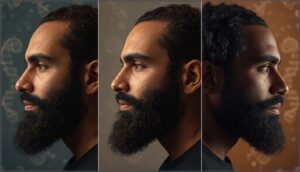
Middle Eastern and South Asian men often inherit denser cheek coverage and earlier facial hair onset due to ancestry-specific genetic variations near androgen receptor pathways. Regional admixture from West Asia and North Africa influences beard color genetics and facial hair texture, while Sub-Saharan African populations display broad density spectrums shaped by diverse evolutionary histories.
These ethnic differences in beard growth reflect population density patterns and racial differences rooted in genetic factors.
Hormonal Influence on Beard Development

Your genetics load the gun, but hormones pull the trigger regarding beard growth. Testosterone and DHT work together with your androgen receptors to determine whether you’ll grow a full beard or just patchy stubble.
Let’s break down how these hormonal factors shape your facial hair across different life stages and ethnic backgrounds.
Role of Testosterone and DHT
Your beard growth hinges on hormone regulation—specifically testosterone and its powerhouse derivative, DHT. When 5-alpha-reductase converts testosterone into DHT, it creates a molecule that binds androgen receptors with exceptional strength, driving facial hair development in follicles primed for growth.
Higher testosterone levels correlate with denser beards, though androgen sensitivity ultimately determines whether those hormonal influences translate into the beard you’re genetically wired to grow.
Androgen Receptor Sensitivity by Ethnicity
Your follicles’ response to androgens isn’t universal—genetic variance across ethnic groups shapes receptor expression and androgen signaling differently.
Small cohort studies reveal that androgen receptor sensitivity and local hormone regulation vary among populations, influencing how effectively DHT stimulates growth.
While genetic factors in beard growth show ethnic diversity in androgen sensitivity patterns, larger multi-ethnic studies are needed to quantify these hormonal influences precisely.
Hormonal Changes Across Age Groups
Your hormonal landscape shifts dramatically from adolescence through midlife, directly influencing beard density and growth velocity. Testosterone peaks in your late teens to early twenties, then declines roughly 1% annually after age 30, while DHT sensitivity and androgen receptor activity interact with genetic factors to determine your beard’s final expression.
- Puberty onset generally triggers facial hair between ages 12–16, with peak density reaching full potential by 18–25 in most men
- Hormonal influence on hair intensifies during your twenties when testosterone levels are highest, driving maximal beard regrowth rates
- Age factors gradually reduce growth velocity as declining hormone levels interact with inherited androgen receptor patterns
- DHT sensitivity remains vital throughout adulthood, with receptor responsiveness often mattering more than total testosterone decline
Environmental and Lifestyle Effects

Your genes set the foundation for your beard, but they don’t work in isolation. What you eat, how you live, and where you spend your time can all shift the trajectory of facial hair growth in measurable ways.
Let’s break down the environmental and lifestyle factors that influence your beard’s density, health, and overall development.
Nutrition and Beard Health
Your diet shapes your beard’s destiny more than you might think. Vitamin D levels correlate with beard density when status reaches ≥30 ng/mL, while zinc (8–11 mg/day) supports follicle function—but excess zinc backfires. Iron supplements help when ferritin drops below 50 ng/mL, and omega fatty acids (1.0–1.6 g/day EPA/DHA) reduce inflammation. Biotin effects remain unproven for non-deficient individuals, despite marketing claims.
| Nutrient | Role in Facial Hair |
|---|---|
| Vitamin D | Enhances beard density at sufficient levels; bolsters follicle health beyond genetic factors |
| Zinc | Maintains follicle function; deficiency impairs growth, excess blocks copper absorption |
| Iron | Prevents shedding when ferritin exceeds 50 ng/mL; critical for hormonal levels stability |
| Omega-3 | Reduces follicle inflammation; improves hair condition independent of mineral deficiency |
Stress, Health, and Hair Growth
Chronic stress wreaks havoc on your facial hair follicle biology, reducing growth by 25–40% as follicles slip into extended resting phases. Your health factors—iron deficiency, thyroid dysfunction, even smoking—thin beard nutrition pathways and disrupt hormone levels. Managing stress and prioritizing health and wellness directly improve growth patterns through better keratinocyte function and sebaceous activity.
- Acute stress cuts hair matrix proliferation by 30% within weeks
- Iron below 30 ng/mL triggers diffuse shedding and patchy density
- Smoking thins individual hairs by 6–10% on average diameter
- Metabolic disorders delay onset and reduce overall fullness considerably
Climate, Sun Exposure, and Beard Density
Your geographic location shapes beard density through UV radiation and sunlight patterns—higher latitude zones correlate with distinct facial hair phenotypes across ethnic groups.
Climate zones influence vitamin D synthesis, altering hormonal levels and follicle cycling. Genetic factors interact with environmental exposure, producing beard growth variation you can’t ignore.
Populations near the equator show different density profiles than northern cohorts, reflecting complex interplay between genetics and sun-driven androgen metabolism.
Beard Growth Patterns and Hair Characteristics
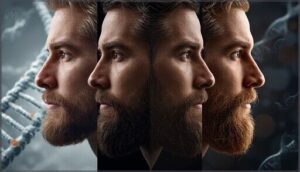
Your beard doesn’t follow a universal blueprint—it develops on its own timeline, shaped by the genetic and hormonal factors we’ve explored. Understanding when facial hair usually emerges, how density and texture vary, and why color differs across your face gives you realistic expectations for what your genetics have programmed.
Let’s break down the key characteristics that define your beard’s unique growth pattern.
Onset and Timeline of Facial Hair
Your facial hair onset generally follows a predictable timeline shaped by genetics and hormone shifts. Most of you’ll notice first growth during puberty timing between ages 12 and 16, though genetic predisposition creates wide variation:
- Upper lip hair emerges first in many populations
- Cheek and jawline follicles activate progressively
- Beard maturation peaks between 18 and 25 for most men
- DHT levels during puberty directly correlate with growth rate
- Some individuals reach full density into their 30s
Your hair growth cycle depends heavily on androgen receptor sensitivity, not just hormone levels alone.
Density, Thickness, and Texture Variation
Beyond onset timing, your beard’s density, thickness, and texture reveal profound genetic variation. Caucasian males generally achieve 25–35% full coverage by their early twenties, while East Asian populations show under 10% near-full density.
Beard follicles respond differently to androgens across ethnic groups—Middle Eastern cohorts often display 15–25% higher chin density than East Asian peers, and hair shaft thickness varies by 5–15% depending on your AR gene variants.
Beard Color and Growth Regions
Your beard pigmentation reflects melanin concentration differences across ethnic groups. Northern European populations show lighter facial hair texture due to higher pheomelanin, while darker eumelanin predominates in most ethnic beard characteristics.
Regional growth patterns vary by androgen receptor distribution. Caucasian and Middle Eastern hair follicle distribution creates denser jawline coverage. These genetic factors of beard growth shape where and how your facial hair develops.
Cultural Perspectives on Beard Growth

Your beard doesn’t just reflect your genes—it carries cultural weight that varies dramatically around the world. From symbols of wisdom and rebellion to markers of professional identity, facial hair has shaped how men express themselves across centuries and continents.
Let’s examine how different societies view beards and what these perspectives reveal about masculinity, heritage, and personal choice.
Societal Attitudes Across Cultures
Your beard isn’t just biology—it’s a statement that shifts meaning across borders. Cultural norms dictate whether facial hair signals wisdom or disrupts professional polish, and these attitudes shape your daily reality:
- Religious practice drives acceptance: Half of Muslim men in surveyed countries wear beards as devotion, with rates exceeding 80% in Pakistan and Afghanistan.
- Workplace bias persists: About 21% of U.S. hiring managers view full beards as less professional than clean-shaven faces.
- Attractiveness perceptions vary: Studies show bearded men are rated 10–20% more suitable for long-term relationships in Western samples.
- Discrimination remains documented: Muslim and Sikh men report 18–25% experiencing harassment related to facial hair annually.
Understanding these beard stereotypes and the cultural significance of beards reveals how masculine ideals clash with social acceptance. Ethnic groups navigate facial hair stigma differently—what enhances moral credibility in Jordan may trigger callbacks to drop 20% in French customer-service roles. That’s the reality of cultural attitudes toward beards today.
Masculinity, Identity, and Heritage
Identity formation through your beard draws on ancient heritage influence and modern masculine norms. Your genetic predisposition creates a canvas, but cultural expression decides what it means: across diverse populations, 72% of men feel validated when facial hair aligns with regional ideals of masculinity.
| Cultural Context | Dominant Social Perception | Heritage Influence |
|---|---|---|
| Middle Eastern | Maturity, wisdom | Prophetic traditions |
| Western professional | Variable acceptance | Shifting style trends |
| East Asian | Less emphasized | Smooth-face ideals |
Your facial hair and heritage intertwine—what genetic traits and ethnicity provide, cultural attitudes toward beards interpret. Don’t underestimate how deeply social perception shapes your beard’s meaning beyond biology.
Grooming Practices and Trends
Your grooming habits reflect cultural shifts as much as genetic expression—62% of men now maintain daily trimmed beard routines, shaping facial hair styles that signal identity. Product ingredients matter: 72% read labels, driving beard oil trends toward antioxidant-rich formulas and hypoallergenic options.
Regional preferences diverge:
- Middle East: fuller, longer beards aligned with heritage
- North America: 28% higher spend on grooming tools and beard maintenance products
- East Asia: minimalist mens grooming with 22% fewer steps
- Europe: 17% rise in professional trimming techniques services
Grooming tips now merge dermatologic safety with beard care and grooming traditions.
Frequently Asked Questions (FAQs)
Can beard growth supplements actually increase density?
You’ve likely heard the promises, but here’s the reality: supplements rarely increase density, rarely transform follicle count, and rarely override genetic factors.
Most trials show minimal gains beyond placebo, leaving thickness largely unchanged regardless of marketing claims.
Does shaving more frequently stimulate faster growth?
No—shaving frequency doesn’t change your growth rate or beard thickness. Hair follicle development and facial hair density depend on genetics and hormonal levels, not razor frequency. That stubble just feels coarser as it emerges.
Are patchy beards permanent or temporary issues?
You’d think patchy beards would stick around forever, but that’s not always true. Genetics and hormonal levels often shape initial patchiness, yet 78% see improvement by age 30—beard growth evolves with time, not static fate.
Can medical conditions cause sudden beard loss?
Yes, medical conditions like alopecia areata, hypothyroidism, and telogen effluvium can trigger sudden beard loss.
Autoimmune disorders, hormonal imbalances, and fungal infections disrupt hair cycles, causing patchy shedding or diffuse thinning that often requires targeted treatment.
Do twins always have identical beard patterns?
Twin studies reveal facial hair traits show 40–70% heritability rates, yet genetic variation and epigenetic factors mean monozygotic twins can develop different beard genetics—your identical twin won’t necessarily mirror your facial hair pattern exactly.
Conclusion
What if the beard you’re chasing already exists in your genetic code, waiting for the right hormonal trigger? Beard growth genetics and ethnicity establish your follicle density and androgen sensitivity, but lifestyle choices—nutrition, stress management, and patience—activate that potential.
You can’t rewrite your DNA, but understanding these biological realities lets you work with your unique blueprint instead of fighting it. Your beard won’t mirror anyone else’s, and that’s precisely how inheritance intended it.