This site is supported by our readers. We may earn a commission, at no cost to you, if you purchase through links.
Your coworker just complimented your five o’clock shadow, but your Asian friend mentions he shaves maybe once a week. You might wonder if genetics plays a role in who can grow a thick beard and who can’t. The short answer is yes—can Asians grow beards? Absolutely, though the fullness and pattern vary widely based on genetic ancestry, hormone sensitivity, and ethnic background.
A gene variant common in East Asian populations affects follicle density, while men with South or Central Asian heritage often develop dense facial hair early in life.
Understanding the biological factors behind beard growth helps separate myth from reality and points toward practical strategies that work with your unique genetic blueprint.
Table Of Contents
- Key Takeaways
- Can Asians Grow Beards?
- Genetics and Hormones in Beard Growth
- Factors Affecting Beard Growth in Asians
- Cultural Influences on Asian Beard Growth
- Why Some Asians Have Patchy or Sparse Beards
- Methods to Stimulate Beard Growth for Asians
- Top Products to Support Beard Growth
- Frequently Asked Questions (FAQs)
- Can Asian men grow beards?
- Do Asian men have a patchy beard?
- What makes Asian beards unique?
- What Asian beard style should you choose?
- Do Asian men have a less dense beard?
- Can Asian men grow a Balbo beard?
- Does facial hair look good on Asian men?
- How can you grow a full Asian beard?
- Why can’t Asian men grow a beard?
- Why do the Chinese don’t have beards?
- Conclusion
Key Takeaways
- Yes, Asian men can grow beards, but genetic factors like the EDAR gene variant common in East Asian populations affect follicle density and distribution, leading to different growth patterns across ethnic groups—South and Central Asian men typically develop fuller beards while East Asian men often experience sparser, patchier growth concentrated around the chin and upper lip.
- Beard thickness in Asian men depends more on androgen receptor sensitivity and DHT conversion rates than overall testosterone levels, which means normal hormone levels don’t guarantee full beard growth if your follicles don’t respond strongly to those hormones.
- Cultural workplace expectations and beauty standards in many East Asian countries favor clean-shaven faces over beards, which has historically reinforced misconceptions about Asian men’s ability to grow facial hair even though the capacity exists genetically.
- Practical methods like topical minoxidil, derma rolling, proper nutrition with zinc and vitamin D, adequate sleep, and stress management can help stimulate dormant follicles and maximize your genetic beard potential, though results vary based on your individual follicle density and take several months to become visible.
Can Asians Grow Beards?
Yes, Asians can grow beards, but the reality looks different from what many stereotypes suggest. Genetics, hormones, and cultural factors all shape how facial hair develops across Asian populations.
Let’s clear up the myths, explore how beard growth varies among different ethnic groups, and look at what typical patterns you might expect.
Common Misconceptions About Asian Beard Growth
You’ve probably heard the stereotype that Asian men can’t grow beards, but that’s not the full story. This misconception stems from confusing population averages with individual ability.
The Testosterone Myth suggests sparse facial hair equals low hormones, yet studies show Asian men often have normal testosterone levels. Genetic factors greatly influence beard growth.
Cultural reinforcement plays a role too, as workplace norms in many East Asian countries encourage clean-shaven faces, masking the natural genetics of facial hair growth in Asians.
Variations Among Different Asian Ethnic Groups
Not all Asian men face the same beard growth challenges. Your ethnic background within Asia plays a huge role. Here’s how facial hair varies across Asian ethnicities:
- East Asian men (Chinese, Japanese, Korean) have sparse beards due to the EDAR gene variant, which limits follicle density.
- South Asian men (Indian, Pakistani) often grow thick, full beards comparable to European populations.
- Southeast Asian men (Thai, Vietnamese, Filipino) show moderate facial hair with wide individual variation.
- Central Asian men (Turkish, Iranian) usually develop dense beards early in life.
- Intra-ethnic differences mean genetics matter more than ethnicity alone—some East Asians grow impressive beards despite lower population averages.
Your family heritage and specific gene combinations determine your beard potential far more than broad ethnic labels. Genetics and hormonal factors play a significant role in this process.
Typical Beard Growth Patterns in Asian Men
Most East Asian men develop facial hair around the chin and upper lip first, while cheek coverage stays patchy or sparse. Your beard likely grows thicker in the mustache area than along the jawline—that’s the typical Asian facial hair pattern.
Individual hair shafts are often coarse and dark, but follicle distribution remains lower overall. Growth onset usually happens later, sometimes into your mid-20s.
Genetics and Hormones in Beard Growth

Your beard potential is written in your DNA long before your first shave. The genes you inherit determine how your body reacts to hormones like testosterone, which directly affects whether you can grow a full beard or just a few sparse patches.
Let’s break down the genetic and hormonal factors that shape facial hair growth in Asian men.
Role of Genetics in Facial Hair Development
Your genetic blueprint sets the stage long before your first whisker appears. Twin studies reveal that genetic factors control roughly 86% of hair shaft thickness, meaning your beard’s potential is written in your DNA.
- The androgen receptor gene on your X chromosome determines how follicles respond to hormones
- Inherited traits shape follicle density, distribution, and whether hair grows thick or stays fine
- Ethnic genetic variation explains why some Asian men grow sparse beards while Middle Eastern men often have fuller coverage
Androgen Receptor Sensitivity and DHT
When testosterone converts to DHT in your body, about 10% of it binds to androgen receptors in beard follicles to trigger growth. Your follicle’s receptor density determines how strongly it responds, while shorter CAG repeats in the androgen receptor gene boost sensitivity.
Ethnic variation in these genetic factors explains why some Asian men face challenges growing thick beards despite normal hormone levels.
Family Heritage and Beard Thickness
Because your father or grandfather had a thick beard, you’re more likely to grow one yourself—genetic inheritance passes through both sides of your family. Twin studies show about 74% of beard thickness comes from familial patterns, not lifestyle.
If your ancestry includes East Asian heritage, ethnic variations in follicle density often lead to finer beards, while Mediterranean backgrounds generally support thicker growth across generations.
Factors Affecting Beard Growth in Asians

Genetics aren’t the only thing that shapes your beard growth. Several other factors can speed up or slow down how much facial hair you’re able to grow, and some of them are within your control.
Let’s look at what influences beard development beyond your DNA.
Age and Puberty Timing
Your facial hair journey doesn’t start on a fixed schedule. Puberty age range for Asian boys varies, with testicular growth generally beginning around 11.5 years and pubic hair appearing near age 12. Facial hair timeline lags behind, often emerging between 13 and 16, but complete beard development can stretch into your mid-20s.
- Native Hawaiian and Pacific Islander boys hit puberty earliest among Asian groups
- Chinese boys tend to start puberty several months later than other Asian populations
- Adolescent beard growth appears last in the puberty sequence, after voice changes
Testosterone and Hormonal Balance
Your hormone levels don’t tell the whole story. Asian men generally show testosterone around 5.5–6.0 ng/mL, yet beard density varies widely due to androgen sensitivity and DHT conversion rates.
Follicles in some Asian populations respond less to circulating hormones, even when testosterone levels sit in the normal range.
Thyroid influence, PCOS effects in family lines, and hormone therapy all alter facial hair outcomes beyond baseline hormonal influences alone.
Diet, Nutrition, and Lifestyle
What you eat shapes your beard more than you’d think. Hair follicles thrive on protein, healthy fats, and key micronutrients like zinc, vitamin D, and biotin.
Sleep quality directly affects hormone levels—cutting rest to five hours drops testosterone by 10–15 percent.
Managing oxidative stress through a balanced diet, regular exercise, and limiting alcohol fosters healthier lifestyle patterns that realize your natural hair growth potential.
Medical Conditions Impacting Facial Hair
Medical conditions affecting facial hair often fly under the radar, but they can quietly dismantle your beard’s potential. Thyroid disorders trigger diffuse shedding, while hypogonadism—low testosterone—limits development from the start.
Consider these key culprits:
- Hormone imbalances reduce follicle activity
- Autoimmune alopecia creates patchy loss
- Telogen effluvium shifts hairs into shedding phase
- Follicular disorders cause inflammation and breakage
- Metabolic factors cluster with testosterone deficiency
Each warrants evaluation if your beard thins unexpectedly.
Cultural Influences on Asian Beard Growth

Culture shapes how men wear their facial hair, and Asia’s approach to beards isn’t just about genetics. What society values, what workplaces expect, and how traditions evolve all play a role in whether men choose to grow beards at all.
Let’s look at how cultural forces influence beard growth and grooming choices across Asian communities.
Beauty Standards in East Asian Countries
Because cultural influences shape how East Asian men see beards, you need to understand regional beauty trends. In South Korea and Japan, hairless ideals dominate, with smooth skin seen as youthful and refined.
Media influence reinforces this, portraying clean-shaven faces in K-pop and advertising. Jawline preferences emphasize contour over coverage, while gendered associations link hairlessness to cleanliness, though shifting ideals show some men now experimenting with light stubble.
Workplace and Social Expectations
Beyond beauty standards, you face real workplace pressures. In Japan, some municipal offices and transit agencies banned beards outright, citing professionalism perceptions and public complaints.
Hospitality sectors across Asia enforce strict grooming policies, linking clean-shaven faces to hygiene and brand image.
Studies show appearance discrimination affects hiring, with bearded applicants receiving fewer callbacks in client-facing roles, reflecting cultural norms that equate hairlessness with respectability.
Traditional and Modern Views on Beards
Historical grooming norms in imperial China once prized facial hair as a sign of maturity—Confucian texts taught men to preserve their parents’ gift. Buddhist monks, however, shaved faces to mark religious devotion.
Today, modern trends flip that script: social media showcases diverse Asian beard styles, and rising grooming-product sales signal shifting cultural perspectives on beards, even as some workplaces cling to older cultural influences on facial hair.
Why Some Asians Have Patchy or Sparse Beards
If you’ve noticed your beard coming in patchy or thin, you’re not alone—it’s a common experience for many Asian men. The explanation comes down to a mix of biological and environmental factors that shape how your facial hair grows.
Let’s look at the key reasons why your beard might be sparse and what influences these patterns.
Follicle Density and Distribution
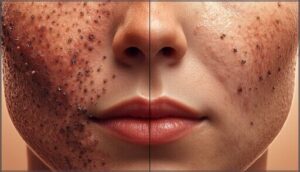
If you’ve noticed your beard growing thicker around your chin than your cheeks, you’re seeing follicle density at work. Research reveals key patterns explaining why Asian men often experience uneven facial hair:
- Follicle density on Asian cheeks averages 20–25 units per cm², considerably lower than chin regions in the same individuals.
- East Asian men show beard follicular density around 48 units per cm² in neck areas, compared to 79 units per cm² on the scalp.
- Genetic factors like the NRP2 gene variant directly influence how densely hair follicles populate your facial skin.
- Terminal facial hair concentrates around your mouth and chin first, where androgen-sensitive follicles cluster more densely than on lateral cheeks.
- Ethnic follicle variation shows Middle Eastern and South Asian men generally display higher facial hair density than East Asian men, even with similar testosterone levels.
Your beard’s patchiness isn’t about low testosterone—it’s about where your follicles are distributed. The cheek versus chin difference means you might rock a solid goatee while struggling with full-beard coverage. This genetic predisposition affects how hair patterns develop, with functional implications for achieving your desired beard style.
Genetic Evolution and Environmental Factors

When your ancestors adapted to East Asia’s climate, evolutionary factors shaped your beard genes. The EDAR V370A variant—present in over 80% of East Asians—thickens scalp hair but reduces facial follicles, a climate adaptation favoring heat loss.
The EDAR gene variant in East Asians evolved to favor heat loss by thickening scalp hair while reducing facial follicles
Your androgen receptors also evolved longer CAG repeats, lowering follicle sensitivity to testosterone. These genetic factors explain ethnic differences in facial hair across ethnicities, not hormone deficiency.
Regional Differences Across Asia
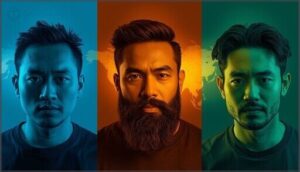
Your beard potential shifts dramatically depending on where in Asia you’re from. East Asian density ranks in the lowest third globally, while South Asian thickness puts India, Pakistan, and Bangladesh in the top six for full-beard genetics.
- South and Himalayan regions produce the thickest beards, rivaling Middle Eastern styles
- Southeast Asian patterns fall between sparse East Asian and dense South Asian growth
- Middle Eastern populations show universally high facial hair prevalence
This explains why Asian facial hair patterns vary more by region than any other continent.
Methods to Stimulate Beard Growth for Asians

If you’re looking to boost your beard growth, there are several methods that can help stimulate facial hair follicles and improve overall density. These approaches range from topical treatments and physical techniques to nutritional support and lifestyle adjustments.
Below, you’ll find practical options that can work alongside your genetics to encourage healthier, fuller beard growth.
Minoxidil and Topical Treatments
If you want to speed up beard growth, minoxidil for beard growth can help. This topical liquid works by waking up dormant hair follicles and lengthening the growth phase. Clinical trials show men using 3% minoxidil twice daily saw thicker beards after 16 weeks. For Asian men, results may take longer due to naturally fewer follicles, but patience pays off.
| What Minoxidil Does | What to Expect |
|---|---|
| Widens blood vessels, boosts follicle activity | Visible changes in 8–12 weeks |
| Shifts hairs from thin to thick | Full results need 3–6 months |
| Works best with consistent daily use | Some initial shedding is normal |
Beard Rollers and Derma Rolling
A derma roller creates tiny channels in your skin, triggering collagen production and better blood flow to follicles. Use a 0.5 mm needle length once or twice weekly, rolling gently in multiple directions.
Most men notice finer hairs filling in after 8–12 weeks. Clean your beard roller with alcohol before each session to reduce infection risk, and expect mild redness that fades quickly.
Herbal Remedies Like Mucuna Pruriens
Mucuna Pruriens—also known as velvet bean—contains L-DOPA content that may support hormone modulation, including testosterone and DHT levels. Studies show it can improve semen quality and raise testosterone by roughly 30–40% in some men, yet beard evidence remains limited.
Safety concerns include nausea and dizziness with high doses, so start cautiously if you’re exploring beard growth supplements.
Multivitamins and Supplements
Multivitamins that include vitamin D, zinc, and biotin can bolster your beard’s foundation, though supplement limitations matter. Biotin efficacy often appears in nutrient-deficient individuals rather than healthy men, and VitaBeard results showed only a 20% growth improvement after 33 days. Safety outcomes remain generally positive.
Consider these hair growth supplements:
- Biotin strengthens existing follicles, not new growth
- Vitamin D aids follicle health if you’re deficient
- Zinc aids testosterone conversion to DHT
Healthy Lifestyle Changes
Beyond supplements, your daily habits can shift hormone levels that control beard growth. Diets impact follicle health—proteins, zinc, and vitamin D strengthen hair.
Exercise benefits include a 15% testosterone boost after six months of strength training. Sleep quality matters too, since poor rest drops testosterone by 10–15%. Stress reduction lowers cortisol, which otherwise blocks growth.
Routine practices like consistent beard care complete your healthy lifestyle for beard growth.
Top Products to Support Beard Growth
If you’re looking to support beard growth, certain products can make a real difference in your routine. Some treatments target the follicles directly, while others nourish your skin and hair from the outside in.
Here are four products that many men find helpful when working on fuller facial hair.
1. Men’s Rogaine Hair Regrowth Treatment Foam
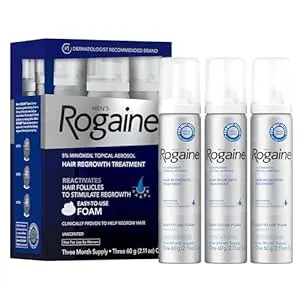
If you’re exploring beard growth methods, Men’s Rogaine Hair Regrowth Treatment Foam deserves your attention. This 5% Minoxidil formula can stimulate hair follicles, and some Asian men have used it off-label for facial hair with mixed results.
You’ll need patience, though—treatment duration usually spans 16 to 24 weeks before you notice changes. Watch for scalp irritation or temporary hair shedding, which can occur as weaker hairs fall out.
Foam application is straightforward, but consistent twice-daily use matters most for seeing any improvement in beard density.
Best For: Men dealing with thinning hair on top of their head who want a clinically proven, easy-to-use foam that can regrow thicker hair with consistent daily application.
- Clinically proven to work—studies show 4x more regrowth than control after 16 weeks, with visible results often showing up around 12 weeks of regular use.
- Easy, no-mess foam application that’s unscented and fits into your daily routine without the sticky feel of liquid solutions.
- Higher 5% minoxidil concentration delivers about 45% more hair regrowth than the 2% version, giving you stronger results.
- You might see some initial shedding as old, weaker hairs fall out to make room for new growth—it can be unsettling at first.
- Results take time and vary person to person, plus you need to keep using it indefinitely or your regrown hair will fall out again.
- Some guys experience scalp irritation, dryness, or headaches, and it doesn’t work for everyone—a few users report no improvement or continued hair loss.
2. Optimum Nutrition Opti-Men Multivitamin Tablets
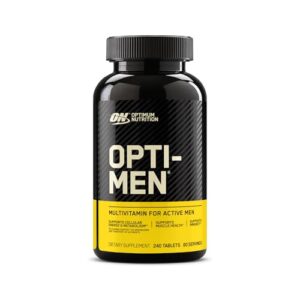
While topical treatments target follicles directly, beard growth supplements like Optimum Nutrition Opti-Men work from within. You’ll get over 75 ingredients—including B vitamins, zinc, and the Viri Men blend—organized to support cellular energy and nutrient absorption. Each daily serving includes 1 gram of amino acids plus an enzyme blend that may improve how your body uses nutrients.
Asian men with dietary gaps often see better results when vitamin dosages meet their increased needs. Take note of safety precautions: the shellfish-derived ingredients can trigger allergies, and high B-vitamin levels require careful timing to avoid sleep disruption.
Best For: Active men who want comprehensive nutritional support for energy, metabolism, and immune function, especially those with demanding physical routines or dietary gaps.
- Over 75 active ingredients including high-dose B vitamins, 1g amino acids, and digestive enzymes to support energy production and nutrient absorption
- Contains immune-supporting vitamins C, D, and zinc plus botanical extracts targeting men’s vitality and wellness
- Large 240-tablet container provides an 80-day supply at three tablets per day, offering good value for long-term use
- Large tablet size and three-times-daily dosing may be inconvenient or difficult to swallow for some users
- Contains shellfish-derived ingredients that can trigger allergies, and very high B-vitamin doses require careful timing to avoid sleep disruption
- Some bottles may arrive with expiration dates too close to purchase date, and the tablets can have a strong smell
3. Viking Revolution Beard Grooming Kit
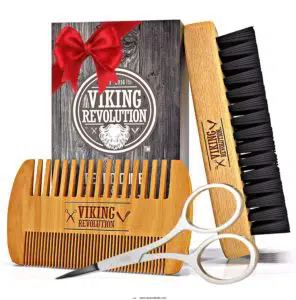
Once your body has the nutrients it needs, daily maintenance becomes your next priority. The Viking Revolution Beard Grooming Kit provides essential tools: a wooden boar-hair brush, dual-tooth comb, unscented oil, citrus balm, and scissors, all in a metal tin priced around $24–$30.
The kit offers versatility for different needs. The lightweight oil is ideal for warmer months, while the balm helps style without leaving heavy residue. Asian men with sparser growth find the fine-comb teeth particularly effective for shorter beards. However, some users note that the brush may shed bristles over time.
Best For: Men seeking a complete starter grooming set with versatile tools for detangling, styling, and maintaining beards of varying lengths.
- Comprehensive kit includes all essential grooming tools (brush, comb, oil, balm, and scissors) in portable metal tin packaging
- Lightweight unscented oil and citrus balm work well together without leaving heavy residue or overpowering scents
- Dual-tooth comb with fine and wide options provides flexibility for different beard lengths and styling needs
- Brush quality concerns with reports of bristle shedding and durability issues over time
- Oil’s thin consistency may require multiple applications throughout the day, especially in dry or humid conditions
- Some users report inconsistent product quality and difficulty reaching customer service for defective items
4. Viking Revolution Beard Oil Variety Pack
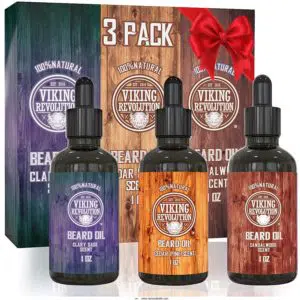
If you prefer variety in scent profiles, the Viking Revolution Beard Oil Variety Pack delivers three one-ounce bottles—Bay Rum, Sandalwood, and Unscented—for about $23. Argan oil, jojoba oil, and grape seed oil form the ingredient analysis, targeting moisture without heaviness.
Customer reviews on Walmart average 4.5 stars, praising oil benefits like itch reduction and softened facial hair. Asian men appreciate the quick absorption and versatility for sparser Asian beard growth patterns.
Pricing details position this variety pack as a practical entry point for exploring different scents in your Asian male grooming techniques routine.
Best For: Men who want to try different scents before committing to a full-size bottle, or those who like switching up their beard oil fragrance depending on mood or occasion.
- Three scent options in one pack let you experiment without buying separate bottles
- Natural ingredients like argan and jojoba oil absorb quickly without leaving a greasy feel
- Helps reduce itchiness and softens beard hair, especially helpful for men with coarser or sparser growth
- Some users find the scents either too strong or fade too quickly
- Easy to over-apply and end up looking oily if you’re not careful with the amount
- Pricier than single-bottle options, which might not be worth it if you only end up liking one scent
Frequently Asked Questions (FAQs)
Can Asian men grow beards?
Picture a young man in Seoul, noticing a few chin hairs in his twenties. Yes, Asian men can grow beards, though genetics and hormonal influences mean beard growth potential varies widely—often resulting in patchy or sparse Asian beard growth.
Do Asian men have a patchy beard?
Many East Asian men experience patchy beards because genetics and beard growth factors like lower follicle unit density and hormonal receptor activity produce sparse cheeks, creating a patchy goatee pattern that drives grooming product demand across Asian populations.
What makes Asian beards unique?
Your facial hair often grows straighter and coarser, with fewer follicles per square inch. Genetic variants like EDAR influence this texture, while lower DHT levels contribute to patchier, less dense patterns.
What Asian beard style should you choose?
Choose beard styles for Asian men based on your face shape, hair density, and maintenance needs. Goatees suit 60% with patchy growth, while stubble works for 56% starting out.
Cultural trends and personal style also guide your choice.
Do Asian men have a less dense beard?
Yes, studies show Asian men average 175 hairs/cm² versus 226 hairs/cm² in Caucasians.
Lower DHT concentration levels and androgen receptor sensitivity, combined with genetic predispositions and hair follicle density variations, contribute to sparser East Asian beard growth.
Can Asian men grow a Balbo beard?
Growing a Balbo beard is like sculpting with what you’ve got. Asian men can grow this goatee-style beard, though DHT sensitivity and genetics often create uneven growth, making stimulation methods or cultural grooming choices necessary for fuller results.
Does facial hair look good on Asian men?
The attractiveness of facial hair on Asian men depends on cultural beauty standards, grooming style, and context. Heavy stubble often rates well, while professional settings in East Asia may favor clean-shaven looks over full beards.
How can you grow a full Asian beard?
Topical Minoxidil application and derma roller technique both stimulate Asian beard growth by activating follicles.
Lifestyle adjustments—like balanced nutritional intake, adequate sleep, and stress management—support your genetic potential for fuller facial hair growth over time.
Why can’t Asian men grow a beard?
The premise is misleading—Asian men can grow beards, though East Asian genetics often mean fewer androgen receptors and lower follicle density, reducing facial hair growth compared to other populations.
Why do the Chinese don’t have beards?
Many Chinese men face genetic factors like lower follicle density and reduced hormone sensitivity in facial hair growth.
Cultural norms in East Asian societies also favor clean-shaven faces, reinforcing beard misconceptions about Chinese ethnicity.
Conclusion
Studies show that follicle density can vary by up to 50 percent among different Asian ethnic groups, which explains why some men develop thick beards while others see sparse growth. Your genetic blueprint, hormone sensitivity, and lifestyle choices all shape the answer to “can Asians grow beards?”
If you’re working with patchy coverage, topical treatments and targeted nutrition often bridge the gap. Embrace your unique pattern and adjust your grooming routine to match what your follicles deliver.
- https://www.thebeardstruggle.com/blog/what-ethnicity-cant-grow-facial-hair
- https://pmc.ncbi.nlm.nih.gov/articles/PMC3412231/
- https://www.beardbrand.com/blogs/urbanbeardsman/where-are-all-the-asian-beardsmen
- https://thebeardclub.com/blogs/beard-culture/asian-beard
- https://www.reddit.com/r/RandomThoughts/comments/1beuscs/in_the_west_a_beard_is_attractive_and_manly_in/