
This site is supported by our readers. We may earn a commission, at no cost to you, if you purchase through links.
A blade’s edge is only as good as what protects it. Beneath the surface of every razor, utility knife, or surgical scalpel lies a decision that shapes how the blade performs, wears, and survives—coated or bare steel.
That choice isn’t cosmetic. A titanium nitride coating deposited at less than one micron thick can reduce surface friction, resist oxidation, and extend edge life well beyond what raw steel can hold on its own.
Uncoated blades, stripped of any secondary treatment, cut differently—sometimes more aggressively, always more vulnerably. Knowing which one fits your application means understanding the physics, not just the marketing.
Table Of Contents
Key Takeaways
- Coatings like PTFE and TiN aren’t cosmetic upgrades — they cut friction, resist corrosion, and extend edge life by up to 50% compared to bare steel.
- coated blades win in humid, high-volume, or skin-contact applications, while uncoated steel is the only safe call in cleanrooms where contamination tolerance is zero.
- coated edges need soft brushes and gentle solvents, while uncoated steel demands immediate drying and light oiling to prevent oxidation.
- Cost math favors coated blades over time — fewer replacements, less downtime, and lower friction-related wear offset the higher upfront price in most real-world applications.
Coated Vs Uncoated Blades: Key Differences
Not all blades are built the same, and that difference starts at the surface.
From steel grade to coating, what separates a smooth shave from irritation often comes down to factors most people overlook when choosing a razor blade.
A microscopic coating — or the absence of one — can shift how a blade cuts, how long it lasts, and how it feels in use.
Here’s what separates the two.
What is a Coated Blade?
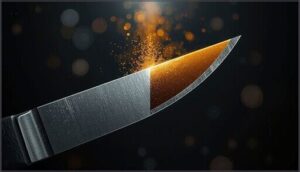
A coated blade starts as ground steel — then manufacturers apply a Blade Coating through Physical Vapor Deposition, bonding Coating Materials like PTFE or Titanium Nitride at sub‑micron Layer Thickness. Surface Chemistry changes completely at that scale, enabling Friction Reduction and enhanced Edge Retention.
Titanium nitride coating offers low friction and high hardness, as detailed in the Titanium nitride coating (https://www.ecogeonline.com/en/guide-to-industrial-blade-coating-options/).
| Feature | Detail | Impact |
|---|---|---|
| Application Process | PVD deposition | Uniform coverage |
| Layer Thickness | The right blade depends entirely on what you’re cutting, where, and how much margin for error you have |
Here’s how coated and uncoated blades stack up across the applications that matter most.
Shaving and Personal Grooming
Your razor blade choice matters more than most people realize. For skin irritation prevention, coated razor blades win decisively — PTFE (Teflon) cuts required shaving force by over 50%, making it ideal for skin care and razor burn reduction. Shaving technique variations aside, here’s what drives the decision:
- Sensitive skin — PTFE coated blades last 7–10 shaves with minimal drag
- Blade longevity strategies — coatings seal steel against humidity-driven corrosion
- Cost-benefit analysis — fewer replacements offset higher upfront cost
- Eco-friendly blade options — longer-lasting coated blades reduce waste per shave
Industrial and High-Volume Cutting
Scaling up production changes everything.
In industrial cutting applications, coated slitter knives outlast uncoated slitter knives by 4–10× — that’s a dramatic cut to your Tool Change Frequency.
The same principle applies at home — choosing the right blade for your skin and hair type can mean fewer replacements and a consistently closer shave.
TiN and DLC blade coatings drop friction coefficients to near-zero, enabling Feed Rate Optimization and Heat Dissipation Strategies that protect both material and edge.
Factor in Coating Cost Analysis and Environmental Impact, and coated slitter knives consistently win at volume.
Cleanroom and Precision Environments
Cleanroom work is where coating choices get serious. Particle Contamination Control drives every decision — coated razor blades risk microscopic flake‑off, violating ISO 14644 Compliance thresholds instantly.
That’s why uncoated stainless steel dominates here.
Pair them with proper Degreasing Procedures and Dispenser Packaging Standards, and you’re controlling contamination at every touchpoint:
- Edge Geometry Precision ensures clean separation without particulate generation
- Degreased blades eliminate manufacturing oils below detectable levels
- Steel‑back designs outperform aluminum for Surface Treatment integrity
Outdoor, Tactical, and Survival Uses
Outdoor and tactical work punishes the wrong blade fast.
Matching your blade steel to your environment is just as critical as choosing the right protective treatment for your conditions.
DLC and Cerakote coatings deliver genuine Rainforest Durability — resisting rust for weeks without oiling in high humidity.
PTFE-coated edges handle Stealth Cutting through wet vegetation with 30% less drag.
For Fire Starting and Signal Sparking, black oxide spines expose steel quickly on a ferro rod.
Knife Blade Coatings and Corrosion Resistance aren’t marketing — they’re survival math.
Maintenance Tips for Both Blade Types
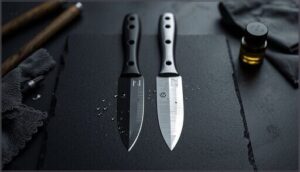
good blade doesn’t take care of itself — but it doesn’t ask for much either.
How you clean, store, and handle your blade directly impacts how long it performs at its best, whether it’s coated or bare steel.
Here’s what you need to know for both types.
Cleaning Coated Vs Uncoated Blades
Treat your blade like the precision instrument it is. Cleaning protocols diverge sharply between coated and uncoated edges — get it wrong and you’ll compromise the surface treatment you paid for.
- Rinse Techniques: Warm water and gentle pressure for coated blades; hot running water for uncoated stainless.
- Cleaning Tools: Soft nylon brushes protect knife coating technologies; brass brushes suit uncoated edges only.
- Safe Solvents & Disinfection Methods: Isopropyl alcohol or Simple Green for coated finishes; hydrogen peroxide works on bare steel.
Drying strategies matter too — air-dry coated blades completely; wipe uncoated ones immediately.
Preventing Corrosion and Edge Wear
Corrosion starts where you can’t see it. PTFE moisture barrier coatings block water ingress at the micron level, while Cerakote salt spray resistance exceeds 3,000 hours — serious protection for harsh environments.
DLC abrasive shield and TiN heat resistance both extend edge wear prevention substantially. For uncoated steel, mirror polishing, oxidation control, and a light oil application maintain blade durability between uses.
Storage and Handling Recommendations
Where you store a blade matters as much as how you clean it. Keep edges in dry environment storage — humidity below 50% prevents oxidation on bare steel and keeps coatings intact.
Use protective blade containers or labeled compartment organization to separate coated/uncoated blades; harder coated surfaces can mar unprotected steel. Always practice safe edge handling — grip the spine, never the edge.
Choosing The Right Blade for Your Needs
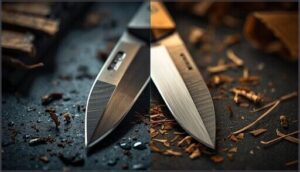
Picking the right blade isn’t complicated once you know what to look for.
A few key factors — your budget, your environment, and what you’re actually cutting — will point you in the right direction fast.
Here’s what to weigh before you decide.
Factors to Consider: Performance, Budget, Environment
Three variables drive every blade decision: cutting performance, cost per shave, and your environment.
Coatings like PTFE dramatically improve friction efficiency, dropping the friction coefficient below 0.1 — coated blades run roughly $0.07 per shave versus $0.10 uncoated.
Factor in corrosion resistance, lifecycle impact, and temperature sensitivity, too.
Humid conditions demand surface treatments that deliver durability; eco‑friendly materials matter if sustainability is part of your calculus.
Matching Blade Type to Skin Sensitivity or Material
Your skin type drives the coated vs. uncoated call more than anything else.
Sensitive skin match? Go PTFE — Teflon blade coatings cut razor burn by slashing friction up to 30%.
Coarse hair pairing calls for chrome or platinum blade coatings that hold edge under repeated stress.
Dry skin considerations favor light platinum glide; oily skin solutions need non-stick coated razor blades that rinse clean between strokes.
When to Opt for Coated Vs Uncoated Blades
Match the blade to the job.
Reach for coated razor blades when cost efficiency, corrosion resistance, and tool longevity matter — PTFE coatings prevent adhesive buildup, while TiN coatings extend life by up to 50% in demanding cuts.
Choose uncoated when regulatory compliance or cleanroom purity demands zero coating contamination.
Your user skill level and environmental impact goals should seal the decision.
Frequently Asked Questions (FAQs)
Can coated blades be resharpened without losing effectiveness?
Yes — like a well‑maintained engine, coated blades hold up through repeated sharpening.
Edge geometry retention matters most.
Light abrasive passes preserve coating thickness impact, keeping corrosion resistance intact and long‑term performance trade‑offs minimal.
Do coatings affect blade flexibility or overall thickness?
Coatings won’t change how your blade bends.
At 5 to 5 micrometers thick, micron‑thickness impact on bending stiffness stability is negligible — edge geometry preservation stays intact, and negligible flexibility shifts keep surface treatment performance honest.
Are coated blades safe for food preparation use?
Some coatings are food-safe, some aren’t.
PTFE food safety is FDA-confirmed, DLC bacterial resistance is clinically proven, and TiN contamination control meets packaging standards.
Cerakote? Keep it off your cutting board entirely.
How do coatings perform in extreme temperature conditions?
temperature is where coatings separate the amateurs from the pros.
PTFE heat limit tops out at 260°C — push past that, and your non-stick surface softens fast.
TiN thermal stability holds strong up to 600°C.
Conclusion
Like a medieval armorer choosing between polished plate and raw iron, you’re weighing protection against edge purity.
The debate over coated vs uncoated blades always circles back to one variable: your environment.
Coatings buy longevity and smoothness; bare steel buys bite and feedback.
Neither wins universally.
Define your cut first—the material, the frequency, the stakes—and the blade selects itself.
Choose wrong, and even the finest steel becomes a liability before its time.
- https://maxtormetal.com/industrial-blade-coatings-guide/
- https://www.razorbladeco.com/faq-coated-vs-non-coated-razor-blades-the-definitive-guide
- https://www.tgwint.com/2022/10/19/understanding-industrial-blade-coating-options/
- https://fitzallblades.com/blogs/news/how-to-choose-between-coated-and-uncoated-blades
- https://mrmk.co.uk/the-ultimate-guide-to-blade-coatings-and-their-benefits/