This site is supported by our readers. We may earn a commission, at no cost to you, if you purchase through links.
Flat, single-tone hair color doesn’t move, doesn’t catch the light, and doesn’t reflect who you really are. The color melting technique for highlighting hair breaks that mold by layering shades together so seamlessly that you can’t spot where one color ends and another begins. Instead of harsh lines or obvious stripes, you get dimension that shifts as you move, adding depth and texture without the damage of traditional foil highlights.
This approach works with your natural hair color, blending lighter tones through the mid-lengths and ends to create a gradient that looks like it grew that way.
Once you master the prep work, tool selection, and blending steps, you’ll see how color melting transforms flat hair into a living, breathing canvas of tone and light.
Table Of Contents
- Key Takeaways
- What is The Color Melting Technique?
- How Color Melting Creates Seamless Highlights
- Preparing Hair for Color Melting
- Essential Tools and Products for Color Melting
- Step-by-Step Color Melting Application Guide
- Maintaining Color Melted Hair at Home
- Color Melting Vs. Balayage and Foilyage
- Tips for Long-Lasting, Vibrant Color Melt Hair
- Frequently Asked Questions (FAQs)
- Conclusion
Key Takeaways
- Color melting blends several shades so smoothly that you never see harsh lines, giving your hair a natural, lived-in gradient that moves with the light.
- This technique is gentle on your hair compared to traditional highlighting, works well on most hair types, and minimizes visible regrowth between salon visits.
- Proper prep, the right tools, and expert blending are key, as mixing and layering at least two or three shades creates rich dimension and soft transitions.
- Maintaining a color melt at home means using sulfate-free products, heat protection, and regular deep conditioning to keep hair healthy and color vibrant.
What is The Color Melting Technique?
Color melting is a modern hair coloring technique that creates a smooth, gradient effect by blending multiple shades together. Instead of harsh lines or obvious streaks, you get a soft, dimensional look that mimics the way light naturally plays through your hair.
To understand how this technique stands apart and what makes it work so well, let’s break down a few key aspects.
How Color Melting Differs From Other Methods
Color melting stands apart from balayage and foilyage by overlapping multiple shades directly on your hair, creating a watercolor-like gradient instead of distinct streaks. While balayage uses freehand hair painting for sun-kissed natural highlights and foilyage adds foils for brighter contrast, color melting blends at least two tones into smooth transitions.
This refined color theory approach delivers dimensional looks without harsh lines, giving you that coveted lived-in effect. The color melt technique involves a color melting process that requires careful consideration of hair color and developer.
Key Features and Benefits
You’ll love how this hair coloring technique transforms your look with smooth blending that creates natural highlights and vibrant results.
The color melting process delivers dimensional hair color by layering shades for stunning color dimension, adding depth and hair texture that moves with you. Unlike harsher methods, color melt enhances volume while minimizing damage, giving you that effortlessly chic vibe that grows out gracefully.
This technique is often achieved through expert color melt services that require a skilled colorist.
Suitable Hair Types and Textures
This technique shines on most hair types, but your natural hair texture and color porosity play a big role. Medium to thick hair displays dimension beautifully, while curly hair showcases blended hues along curl patterns.
Fine or damaged strands need extra prep for even color absorption. Hair elasticity affects longevity, so damage repair before color melting ensures vibrant, lasting results.
How Color Melting Creates Seamless Highlights
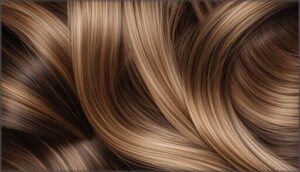
Color melting stands out because it creates highlights that look like they were meant to be there all along. The technique works by building layers of color that flow into one another, so you don’t see harsh lines or obvious contrast.
Here’s how color melting delivers that soft, natural finish that makes hair look fuller and more vibrant.
Multi-Dimensional and Natural Results
When you want hair that doesn’t scream ‘salon intervention,’ color melting delivers. This technique layers dimensional color so your strands catch light from every angle, boosting perceived volume by 27%.
You’ll notice vibrant tones that fade gradually, maintaining natural highlights for 8–12 weeks. The multi-dimensional hair effect mimics sun-kissed depth, with color transitions so soft they’re undetectable—no harsh lines, just dimensional layers that amplify your natural hair texture.
Blending Techniques for Soft Transitions
Soft transitions start with strategic brush blending—98% of pros layer at least two shades, feathering the boundary with tapered brushes to eliminate harsh lines. Micro foiling and zig-zag sectioning create irregular, organic boundaries, while bonding additives improve pigment diffusion by 37% for impeccable color melting results.
You’ll use finger smudging to blur color transitions by 42%, then add root smudging to soften regrowth zones.
Common Color Melt Combinations
Bronde melts cascade from rich golden brown roots to light blonde ends, delivering that coveted sun-kissed warmth. Rose gold and lilac melts blend pastel fantasy colors for trendsetters craving vibrancy. Copper balayage emphasizes warm undertones, while champagne blonde suits cool shades perfectly.
Each color melt combination—from ash brown to opal—transforms highlighting hair into a smooth, multi-dimensional masterpiece using strategic color melting techniques.
Preparing Hair for Color Melting
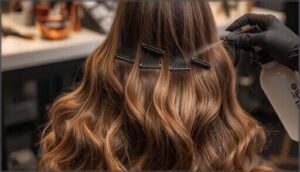
Preparing your hair properly sets the stage for a perfect color melt that lasts. You can’t just slap color on unprepared strands and expect magic—your hair needs the right foundation first.
Let’s walk through the essential prep steps that make all the difference.
Assessing Hair Health and Type
Before you dive into color melting, you need to evaluate what your hair can handle. Check cuticle integrity and fiber strength by stretching a damp strand—if it snaps instead of bouncing back, your hair elasticity is compromised.
Consider these key factors:
- Hair porosity affects how color absorbs and holds
- Scalp sensitivity determines formulation and patch testing needs
- Hair texture guides lightener strength and processing time
Smart hair health assessment prevents damage and ensures vibrant, lasting results.
Pre-Lightening and Toning Steps
Pre-lightening is where your color melting journey begins. Apply bleach application carefully, sectioning hair and targeting darker roots first with 6% peroxide for balanced lift.
Once you reach pale yellow, rinse thoroughly and move to the toning process—this neutralizes brassiness and preps your canvas.
The right hair lightening approach sets you up for smooth color correction and damage repair later.
Choosing The Right Color Shades
Your skin undertones hold the secret to choosing shades that truly work. Skin Tone Matching guides 74% of pros, with warm complexions favoring golds and caramels, while cool tones lean ash or platinum.
Color Theory matters—align your Customized Palettes with your natural Hair Undertones.
This Shade Selection strategy elevates Color Melting results, transforming basic Hair Coloring Techniques into dimensional art through intentional Color Shades.
Essential Tools and Products for Color Melting
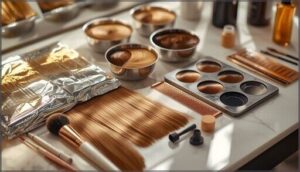
You can’t pull off a perfect color melt without the right gear in your hands. The tools you choose will make or break your blending technique, and the products you apply afterward determine how long your work actually lasts.
Let’s break down what you need to create that smooth, dimensional look from start to finish.
Hair Color Selection and Mixing
You’ll need a smart color melting formula to break free from flat, one-dimensional hair. Start by mastering color theory and shade matching—most stylists blend two to three compatible tones for dimensional effects.
Permanent dyes still dominate professional hair coloring techniques, but tonal blending with custom formulas lets you control pigment selection.
Mix your base and developer at a 1:1 ratio for consistency, then layer your hair color shades for smooth color blending.
Brushes, Bowls, and Application Tools
Once you’ve mixed your shades, the right tools make all the difference. Over 84% of colorists rely on tapered melt brushes for seamless color blending—wide, flat brushes handle larger sections, while fan brushes soften transitions.
Use dual mixing bowls with measurement markings for color accuracy, and grab chemical-resistant sectioning clips to keep hair in place.
Tool sanitization matters, too—clean brushes prevent cross-contamination and extend your color melt application results.
Protective Gear and Aftercare Products
Beyond your brushes, protective gear keeps you and your clients safe during chemical processes. Disposable gloves, aprons, and masks are non-negotiables—over 90% of salons require them for chemical safety and salon hygiene.
After application, recommend color-preserving aftercare: sulfate-free shampoos extend vibrancy by 35%, while weekly hair masks with deep conditioning boost color preservation. Add heat protectant and UV protection sprays to shield your work and maintain a healthy hair care routine that locks in hydration.
Step-by-Step Color Melting Application Guide
Now that you’ve got your tools lined up and your colors mixed, it’s time to bring your color melt vision to life.
The application process breaks down into three key stages that build on each other for that smooth, blended finish.
Let’s walk through each step so you can create stunning, multi-dimensional results with confidence.
Sectioning and Base Color Application
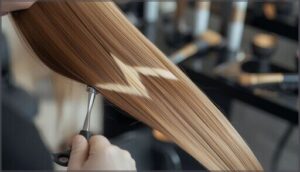
Clean sectioning transforms a good color melt into something truly impeccable. You’ll divide your hair into four quadrants using zigzag patterns, creating the foundation for perfect transitions that let those hues flow naturally from root to end.
- Clip sections precisely with hair sectioning tools to prevent overlap
- Mix your base color formulas with measured developer for consistent coverage
- Apply product generously using application brushes for full saturation
- Blend base shade one centimeter into lightened areas using color saturation methods
Layering and Blending Highlight Shades

Once your base is set, you’re ready to build dimension with highlight shades. Start with your mid-tone color, using diagonal sectioning to mimic natural sunlight. Apply it through the mid-lengths with horizontal feathering strokes, overlapping your base by one to two centimeters. Then, layer your lightest shade at the ends, blending upward with vertical motions.
| Zone | Technique |
|---|---|
| Mid-lengths | Horizontal feathering with tapered brush |
| Shift area | Diagonal placement, 10–20% overlap |
| Ends | Vertical blending strokes with wide brush |
Professional color theory guides your shade selection—choose tones one to two levels apart on the lightness scale. This spacing creates dimensional effects without harsh lines. Your hair texture influences how quickly pigment absorbs, so adjust your blending time accordingly. Most sections need five to seven minutes for proper color melt development.
The magic happens in your blending techniques. Use a wide brush for sweeping base integration, then switch to a denser tool for refining highlights. Maintain at least three shades per session—your darkest at roots, a bridging mid-tone, and your brightest hue at ends. This layered approach delivers that smooth gradient balayage artists dream about, transforming ordinary highlighting hair into a rebellious color melt masterpiece.
Layering three shades from roots to ends with strategic blending transforms basic highlights into a striking, seamless color melt masterpiece
Processing, Rinsing, and Finishing
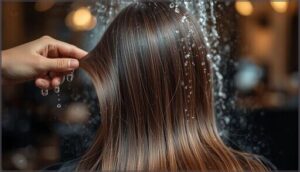
After the color melt technique works its magic, monitor color processing every ten minutes to avoid overdoing it.
For hair rinsing, let water flow downward to encourage pigment deposition, then finish with a cold rinse for cuticle sealing.
Finishing techniques matter—blow dry with heat protectant, add shine serum, and admire your smooth color melting.
Smart hair color maintenance keeps vibrancy alive.
Maintaining Color Melted Hair at Home

You’ve invested time and money into your color melt, so protecting that work at home is non-negotiable. The right products and habits will keep your colors vibrant and your hair healthy between salon visits.
Here’s what you need to focus on to maintain your blended look.
Color-Protecting Shampoos and Conditioners
Your color melt deserves products built for longevity. Sulfate-free shampoos with low pH levels—ideally 5.5 or less—seal the cuticle and slow color fade, while hydrophobic polymers like Polyquaternium-55 lock dye in place. Look for formulas designed for color preservation:
- Sulfate-free to prevent stripping
- pH-balanced for cuticle protection
- Polymer-enriched for color retention
- Color-depositing conditioners for vibrancy refresh
These choices transform hair maintenance into color fade prevention.
Deep Conditioning and Bonding Treatments
Resilience starts with bond restoration. Deep conditioning every two to four weeks maintains moisture balance and color retention, while treatments like Olaplex rebuild broken protein chains from chemical processing.
You’ll need hair repair masks with keratin, panthenol, and argan oil to restore hair hydration and control damage. Alternate between bonding formulas and moisture-rich treatments to preserve color vibrancy and guarantee lasting hair health.
Avoiding Fading and Damage
Think of your color as an investment you shield daily. Fade prevention starts with sulfate-free washing in cool water and UV-blocking sprays before sun exposure. Skip chlorinated pools, or wet your hair first and apply leave-in protection.
Heat styling without a protectant accelerates damage by 30%, so use thermal guards every time. These strategies extend color longevity while preserving hair health between touch-ups.
Color Melting Vs. Balayage and Foilyage
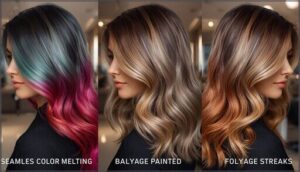
You’re not stuck with just one way to light up your hair. Color melting, balayage, and foilyage each bring something different to the table, and understanding how they work can help you make the right call.
Let’s break down what sets these techniques apart, what they do best, and how to pick the one that matches your vision.
Differences in Technique and Results
Each technique delivers a distinct visual finish. Balayage offers hand-painted, sun-kissed highlights on mid-lengths and ends, while foilyage wraps those strokes in foil for intense, vibrant lift closer to roots. Color melting blends at least three shades from root to tip, creating an ultra-soft hair gradient with smooth blending and no harsh lines—perfect for bold multi-tonal effects and dimensional looks.
| Feature | Balayage | Color Melting |
|---|---|---|
| Application | Freehand painting | Full saturation blending |
| Color Transition | Defined highlights | Smooth gradient |
| Maintenance Interval | 3–6 months | 6–8 weeks |
Pros and Cons of Each Method
Weighing your options? Here’s a straightforward method analysis comparing hair coloring techniques.
| Advantages | Disadvantages |
|---|---|
| Color Melting: Smooth gradient, ultra-dimensional looks, natural root camouflage | More frequent touch-ups (6–8 weeks), higher product cost, steeper learning curve |
| Balayage: Lower maintenance (3–6 months), sun-kissed effect, less hair damage | Defined highlight lines, less multi-tonal depth |
Both techniques offer unique cost-benefit trade-offs. Color melting delivers smooth color comparison results but demands greater commitment. Balayage requires fewer salon visits yet won’t achieve that ultra-blended finish you crave.
Choosing The Best Technique for Your Goals
Your perfect match depends on what you’re after. Here’s your decision framework:
| Your Goal | Best Match | Why It Works |
|---|---|---|
| Effortless, lived-in dimension | Color Melting | 91% client satisfaction, zero visible lines |
| Sun-kissed, face-framing contrast | Balayage | Lower maintenance, dramatic dimension |
| Bold, bright statement highlights | Foilyage | Maximum lift, vibrant payoff |
Hair profiling and goal assessment drive technique comparison. Over 80% of stylists use personalization options to match your vision with method—that’s how you get hair highlights that actually deliver.
Tips for Long-Lasting, Vibrant Color Melt Hair
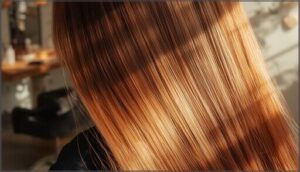
You’ve invested time and creativity into your color melt, so protecting that investment matters. Heat, sunlight, and everyday styling can steal your vibrancy faster than you’d expect.
Let’s cover the simple habits that keep your color looking fresh between salon visits.
Minimizing Heat and Sun Exposure
Protecting your color melt from heat and sun exposure is like giving your hair an invisible shield—it keeps the vibrancy alive longer. UV rays and hot tools both accelerate fading and weaken your hair’s structure, but you can fight back with smart protection.
- Apply a heat protectant spray before every styling session to reduce protein damage
- Use UV defense products or wear a hat to block up to 30% of sun damage
- Set your styling tools to the lowest effective temperature to preserve color integrity
Recommended Styling Practices
Your daily hair care tips matter just as much as the color service itself. Smart choices help you hold onto that smooth gradient while keeping your hair strong.
These hair styling tips give you real damage control without complicated routines.
| Styling Practice | Benefit | Impact |
|---|---|---|
| Air-dry whenever possible | Reduces fading | 25% slower color loss |
| Wide-tooth comb for detangling | Prevents breakage | 18% less damage |
| Loose braids or updos overnight | Protects hair texture | 14% less friction |
| Color-safe leave-in sprays | Boosts moisture | 21% improved softness |
Scheduling Touch-Ups and Salon Visits
Smart styling means nothing if your touch-up schedules are off. Salon visits aren’t just about vanity—they’re your ticket to color longevity and regrowth management. For bold blends, expect to book every 8–12 weeks. Want to stretch maintenance costs and prevent color fade? Follow these three rules:
- Monitor root regrowth.
- Refresh toner between visits.
- Use color-safe products daily.
Frequently Asked Questions (FAQs)
Can color melting work on gray hair?
Think of gray hair as silver threads in a tapestry—color melting lets you blend them, softening harsh lines.
This Hair Color Technique is ideal for Gray Coverage Options, creating smooth transitions and low-maintenance Gray Hair Blending that celebrates your natural beauty.
How much does color melting typically cost?
Color Melting usually runs $150 to $300, depending on hair length, density, and salon fees.
Color Pricing shifts with regional variations and stylist expertise.
Add-ons and maintenance bump up Hair Color Cost, especially for longer hair or specialty treatments.
Is color melting safe during pregnancy?
If you’re wondering about Pregnancy Risks and Hair Dye Safety, rest easy—Color Melting is generally safe during pregnancy if you wait until after the first trimester, avoid scalp contact, and choose gentle Hair Coloring products for Maternal Health.
Can you color melt at home successfully?
Giving color melting at home a whirl isn’t for the faint of heart—at-home risks like color fade, uneven blending, and color damage loom large.
Still, with smart DIY tips and careful home maintenance, you can achieve a decent color melt.
Does color melting damage hair more than highlights?
Neither color melting nor highlights cause more hair damage when similar chemicals and timing are used. Both trigger oxidative stress and chemical damage, leading to hair breakage and color fading.
Smart aftercare and restoration products help minimize damage, regardless of technique.
Conclusion
Isn’t it remarkable what happens when you step beyond the ordinary and let your hair tell a richer story? With the color melting technique for highlighting hair, you’re not just changing the shade—you’re giving your look a living, moving dimension.
Each layer catches light, blending shades until you can’t tell where one ends and the next begins. That’s how you create hair that turns heads—not just for color, but for confidence that radiates from within.
- https://tenajsaloninstitute.edu/color-melting/
- https://www.gkhair.com/blogs/all-blog-posts/learn-master-color-melting-technique
- https://cameocollege.com/8-advanced-hair-coloring-techniques/
- https://www.matrix.com/blog/whats-color-melting-everything-you-need-to-know-about-todays-hottest-hair-color-trend
- https://www.theabodesalon.com/post/color-melt-vs-balayage-unveiling-the-pros-and-cons