This site is supported by our readers. We may earn a commission, at no cost to you, if you purchase through links.
Your barber can nail a perfect fade on someone else, then give you the same cut and it looks off. That disconnect happens because fade styles aren’t one-size-fits-all—they’re built on geometry.
A high fade that sharpens an oval face will exaggerate roundness on someone with fuller cheeks. A low fade that softens a square jawline might drown out the angles on a diamond face.
The difference between a haircut that clicks and one that misses comes down to matching fade height and shift points to your specific proportions. A face shape fade compatibility chart eliminates the guesswork, showing you which fade techniques complement your bone structure instead of working against it.
Table Of Contents
Key Takeaways
- Your face shape dictates which fade height works—high fades add vertical length to round faces, low fades soften square jaws, and mid fades balance oval proportions without distortion.
- Fades aren’t purely aesthetic choices; they’re geometry-based solutions where the taper’s starting point must counterbalance your widest facial measurement (cheekbones, forehead, or jawline).
- Hair texture, beard length, and maintenance capacity matter as much as bone structure—coily hair holds sharp high fades, fine hair needs careful blending, and skin fades demand touch-ups every one to two weeks.
- Effective barber communication requires stating your face shape analysis, bringing one to three reference photos matching your proportions, and specifying fade depth at temples and neckline rather than describing styles in vague terms.
Face Shape Types and Key Features
Your face shape determines which fade will actually work for you. Different structures need different approaches—what flatters an oval face can make a square jaw look blocky or a round face look wider.
If you’re also rocking a bald head, check out beard styles that complement a bald head to see how facial hair can balance your overall look.
The right fade depends on your face shape—what suits one structure can make another look unbalanced or wider
Here’s how to identify your face shape and understand what makes each one unique.
Oval Face Shape Characteristics
Your oval face shows the most balanced face proportions in the game. The vertical length runs about one-and-a-half times the width across your cheekbones, giving you facial features that taper smoothly from forehead to a rounded chin. Your cheekbone structure forms the widest point, while your jawline curves gently without sharp angles.
This face structure works with nearly any fade because everything’s already dialed in. To better understand what sets oval faces apart, see the common that make this structure so adaptable.
Round Face Shape Characteristics
Your round face shows equal length and width, creating that circular outline when you look straight ahead. The widest point hits at your cheekbones, while your jawline curves softly without sharp corners.
Your forehead, cheeks, and jaw measure nearly identical widths—that’s the key to round face analysis. This face structure demands strategic fade placement to add vertical length and break up the fullness across your facial proportions.
For a deeper understanding of these proportions, you can consult a detailed guide on round face structure characteristics.
Square Face Shape Characteristics
Your square face shows angular proportions: forehead, cheekbones, and jawline all measure about the same width. That bold jawline definition meets at sharp corners instead of soft curves—your face structure reads strong and symmetrical.
Your hairline features usually run straight across, reinforcing those straight vertical sides. This face shape analysis reveals equal width and length, creating that characteristic boxy outline that demands smart fade placement to soften those prominent facial features.
Heart-Shaped Face Characteristics
Where square faces show uniform width, your heart-shaped face runs wide at the forehead and tapers to a pointed chin—like an upside-down triangle. Face shape analysis reveals your high cheekbones as the widest point, often matching that broad upper face structure.
Your facial features create distinct proportions:
- Forehead width exceeds jawline definition by a noticeable margin
- Cheekbone accent sits high and prominent in your midface
- Hairline styles often feature a widow’s peak or gentle curve
This facial symmetry demands fade placement that balances your narrower lower face.
Diamond and Triangular Face Features
Diamond and triangular faces represent opposite width distributions that demand precise fade techniques. Your diamond face structure peaks at the cheekbones—your widest point—then narrows sharply toward the forehead and chin. Triangular faces flip that, carrying maximum width at the jawline while the forehead stays compact.
Face shape analysis reveals these distinct facial features and proportions:
| Feature | Diamond Face | Triangular Face |
|---|---|---|
| Widest Point | High, prominent cheekbones | Broad, angular jawline |
| Forehead | Narrow, temples often recessed | Narrow, compact upper third |
| Chin/Jaw | Pointed, tapered chin | Strong, wide jaw dominates lower face |
Both face shapes need fade placement that counterbalances their natural width concentration. Hair texture and jawline styles play secondary roles, but cheekbone structure dictates where your fade should start and how aggressively it tapers.
Fade Haircut Styles Overview

Not all fades are created equal. Each style starts at a different height on your head and creates a distinct contrast between your longer hair on top and the shorter sides.
Before you can match a fade to your face shape, you need to understand the five core fade styles barbers work with.
Low Fade
A low fade starts its taper just above your ears and neckline, keeping the shortest clipper work close to the bottom of your head. This fade haircut style gives you subtle contrast between longer top hair and gradually shortened sides.
Barbers place the fade line about half an inch above your ear, making low fade styles adaptable across different face shapes and hair textures while requiring less aggressive fade maintenance than higher cuts.
Mid Fade
A mid fade starts its shift between your temples and ear tops, sitting around four inches above the ear for balanced fade haircut styling. This fade shift works across most face shapes because it removes bulk from your head’s midsection while leaving enough length above to style.
Mid fade styling suits varied hair textures and face structures, needing touch-ups every two to three weeks for cut maintenance.
High Fade
A high fade starts above your temples or along the parietal ridge, cutting a hard contrast between tight sides and longer top hair. This fade placement draws the eye upward, adding vertical lines that reshape your face structure.
High fade styles suit thick or curly hair texture best, removing side bulk while leaving 2 to 4 inches on top for textured crops, quiffs, or pompadours that command facial balance.
Taper Fade
A taper fade keeps hair visible at your shortest points instead of cutting down to the bare scalp, creating a subtle gradient that frames your face shape without harsh contrast. This adaptable haircut works across most face proportions because the gentle blend softens angles while maintaining clean structure.
Taper fade styles offer you:
- Smooth transitions using incremental clipper guards for a polished, professional look
- Hair texture flexibility, working well on thick, wavy, or straight hair types
- Conservative appearance suitable for formal workplaces and dress codes
- Fade maintenance every 2–3 weeks to keep edges sharp
- Styling tips focused on top hair while faded sides stay brushed down
Your barber adjusts the taper height—low, mid, or high—to match your specific face structure and personal style.
Skin and Bald Fade
Skin and bald fades expose bare scalp at your hairline, creating the sharpest contrast between your top hair and shaved sides. Barbers use foil shavers or straight razors after the initial clipper work to remove all stubble, giving you a clean, defined outline that highlights your face shape and jawline.
This bald fade style demands hair maintenance every two to three weeks to keep that crisp, fresh look as stubble returns quickly at the base.
| Fade Techniques | Clipper Tips |
|---|---|
| Start with 000 guideline | Use overlapping passes |
| Blend with adjustable guards | Remove visible lines |
| Finish with foil shaver | Create smooth gradient |
| Pair with textured top | Balance face shape proportions |
| Touch up every 1–2 weeks | Maintain sharp edges |
Fade Compatibility by Face Shape
Your face shape isn’t just something to factor in—it’s the blueprint for choosing the right fade. Each fade style interacts differently with your bone structure, either highlighting your strengths or working against them.
Here’s exactly which fades match each face shape and why they work.
Best Fades for Oval Faces
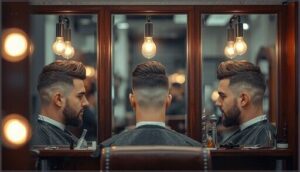
You carry a balanced face shape that unlocks nearly every fade height. Mid fade stays adaptable for work and weekends, while high fade adds edge without warping facial proportions. Low fade keeps things subtle and professional.
- Mid fade balances your temples and keeps clean lines from every angle
- High fade creates bold contrast when paired with textured tops or pompadours
- Low fade grows out softer and needs fewer sharp touch-ups
- Hair texture and lifestyle considerations determine which fade height fits your maintenance schedule
- Bring reference photos showing top length—almost any fade underneath will still suit your oval face
Best Fades for Round Faces
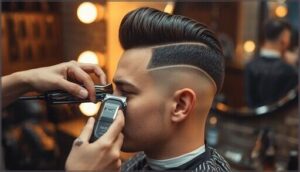
Round faces gain length and angles when you lift volume up top and strip weight from the sides. A high fade pulls eyes upward and sharpens cheek contours, while a mid fade works if your barber stacks serious height above. A low fade risks adding width unless your quiff or pompadour towers. Pair skin fades with textured crops or side parts, and use beard fading at the jawline to carve the structure your round face craves.
| Fade Height | Effect on Round Face |
|---|---|
| High Fade | Removes side bulk, adds vertical stretch |
| Mid Fade | Balances when top has clear volume |
| Low Fade | Less ideal; needs very tall styling |
| Skin Fade | Maximum slimming with textured top |
| Drop Fade | High front, shaped back for balance |
Best Fades for Square Faces
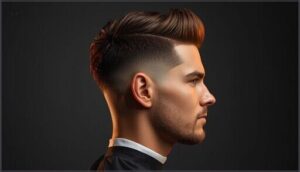
Square faces bring powerful angles—wide forehead, sharp jawline—that low and mid fades balance beautifully. A low fade softens that boxy edge by keeping side length near your ear, while a mid fade strips weight at temple level without overdoing it.
Your barber should pair either with textured tops or pompadours to add height. High fades work when you stack serious volume up top, and burst fades curve around your ear to break rigid lines.
Best Fades for Heart-Shaped Faces

Heart-shaped faces flip the script—widest at the forehead, narrowing toward the chin. Low fades keep side fullness near your ear, balancing that broad top without exposing too much temple.
Mid fades work when you keep top volume controlled and textured.
High fades risk widening your forehead further, so avoid them unless you’re committed to moderate height and soft styling products that add face balance.
Best Fades for Diamond and Triangular Faces
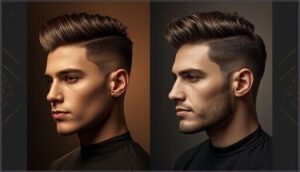
Diamond faces feature prominent cheekbones and a narrow forehead, while triangular faces show a strong jaw with less width up top.
Low and mid fades deliver the best cheekbone balancing by keeping some side length. Pair your fade with textured volume on top for jawline softening—high fades strip too much bulk and exaggerate angles.
Face shape analysis matters: preserve temple fullness to offset your widest points.
Factors Influencing Fade Suitability
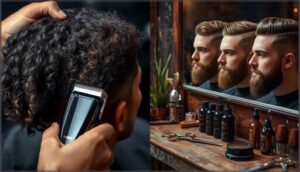
Your face shape isn’t the only thing that determines which fade works best. Hair texture, facial features, your beard style, and how much time you’re willing to spend on upkeep all play a role in finding the right cut.
Here’s what else you need to keep in mind before sitting in the chair.
Hair Texture and Type
Your hair texture and type matter as much as your face shape when choosing a fade. Curl pattern, hair density, and texture types all change how a fade sits on your head.
Coily hair holds dramatic high fades with sharp contrast, while fine straight strands need careful blending to avoid patchiness. Thick, wavy textures work with most fade heights, but frizz control becomes essential where the taper meets longer curls.
Match haircut guidance to both your hair type and face structure for the cleanest result.
Facial Features and Proportions
Forehead balance, cheekbone structure, and jawline definition all steer your fade choice beyond basic face shape. A high forehead needs a lower fade to avoid stretching your face, while wide cheekbones demand height on top to slim the middle. Your nose proportions and eye alignment also matter—prominent features look sharper with structure at the jaw and gradual fades near the temples.
- Forehead height – Lower fades prevent long faces from looking taller; mid fades reduce width on heart-shaped faces.
- Cheekbone width – High fades slim round or diamond faces by adding vertical length.
- Jawline strength – Low to mid fades soften square jaws without creating top-heavy imbalance.
Beard and Fade Combinations
Your beard and fade work together to frame your entire face, not just your hairline. Short stubble pairs best with high or skin fades because the minimal facial volume matches the tight sides. Medium to full beards need low or mid fades to balance the added weight along your jaw. A boxed beard with a classic fade creates sharp definition around your cheekbones and neckline.
| Beard Length | Best Fade Styles |
|---|---|
| Short stubble | High fade, skin fade |
| Medium beard | Low fade, mid fade |
| Full long beard | Low fade, taper fade |
Lifestyle and Maintenance Needs
Your daily schedule and personal style directly shape which fade works best. High fades and skin fades demand touch-ups every one to two weeks, while low fades stretch to three or four weeks between appointments.
- Daily grooming for textured tops takes 10 to 20 minutes with hair product and heat tools
- Fade maintenance costs add up when prebooking every two to three weeks year-round
- Conservative workplaces prefer softer tapers over sharp skin fades
- Active lifestyles benefit from shorter crops that style in under five minutes
- Lifestyle costs include clippers, trimmers, and quality mens grooming products for home upkeep
Matching haircut maintenance to your routine keeps your personal style sharp without eating your time.
Barber Consultation and Fade Maintenance
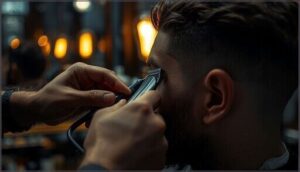
Getting the right fade isn’t just about knowing your face shape—it’s about working with your barber to nail the execution and keeping that cut sharp between visits.
A solid consultation sets the foundation, but maintenance is what separates a good fade from one that looks tired after a week.
Here’s how to communicate what you want, stay on top of upkeep, and style it right.
Communicating Your Face Shape and Goals
Your barber consultation starts with a clear face shape analysis. State whether you have an oval, round, square, heart, or diamond face structure. Point out which parts of your face proportions feel widest—jawline, cheeks, or temples. This face analysis gives your barber the foundation for tailored cut planning.
Then explain your hair goal setting: professional, bold, or low maintenance. Simple client-barber communication drives fade style selection that actually works.
Bringing Reference Photos
Bring one to three clear reference images showing the exact fade height and haircut styles you want. Visual communication beats describing a mid fade or skin taper in words alone. Choose photos that match your face proportions, hair texture, and face shape so your barber sees realistic haircut inspiration.
During the consultation process, point to specific details—temple fade depth, neckline finish, and top volume—to lock in your vision.
Fade Upkeep and Touch-Ups
Once you’ve locked in your vision, fades demand regular Touch Up Tips to stay sharp. Most styles need a barber visit every 2 to 4 weeks, depending on Hair Regrowth speed and fade height. High fades show new growth fastest. Between cuts, use detail trimmers for neckline cleanup and maintain Scalp Care with gentle shampoo. Daily brushing keeps the blend smooth, extending Fade Longevity without blurring your lines.
- Skin fades need touch ups every 1 to 2 weeks for razor sharp edges
- Low fades stretch 2 to 3 weeks before regrowth becomes obvious
- Clean necklines and sideburns at home between full barber appointments
- Wash hair every few days to prevent oil buildup blurring the fade
- Sleep on satin pillowcases to reduce friction and keep sides smooth
Recommended Styling Products
Styling your fade right keeps the contrast sharp. Matte finish products like clays and texture powders add natural separation without gloss, while pomade types—water-based for easy wash-out or oil-based for slick hold—suit structured tops.
Hair texture considerations matter: fine hair needs volumizing dust, thick hair demands firm gels. Fade enhancers and styling creams boost definition, making your grooming tips work harder between barber visits.
Frequently Asked Questions (FAQs)
What fade for what face shape?
Regarding fades, one size doesn’t fit all. Oval faces rock mid fades, round faces need high fades for length, square faces suit low fades, and heart-shaped faces look sharp with taper fades.
What is the 3 2 1 rule for haircuts?
The 3 2 1 rule uses clipper guards—3 on top, 2 on sides, 1 at edges—to create a simple, even fade. It’s a beginner-friendly barber training technique that works across most hair texture types.
Can fade styles work with receding hairlines?
Like camouflage in plain sight, fade techniques help receding hairlines by keeping sides tight and drawing eyes upward.
Your barber can pair fades with textured styling to soften thinning while working with your hair texture.
How does age affect fade style choices?
Your age shapes which fade works best. Teens rock high skin fades for bold looks, while professionals lean toward low tapers.
Hair thinning and lifestyle impact maintenance, so choose a fade matching your stage.
Do fades complement different skin tones differently?
Yes. Skin tone affects fade contrast—darker skin makes bald fades bolder, while lighter skin shows irritation more.
Your barber adjusts fade depth and hair texture blending based on skin tone, face shape, and hair color matching for clean results.
Can women wear fade haircuts effectively?
Despite dated stereotypes, women pull off fades brilliantly when barbers match fade height and styling tips to face shape, hair texture, and personal edge—making gender-neutral cuts a sharp, liberating choice through skilled female barber services.
What fade works best for thinning hair?
Low fade and mid fade both excel for thinning hair. Low fade keeps more coverage on sides, reducing contrast with sparse tops.
Mid fade works when temples recede but crown holds density, shifting focus from hairline gaps.
Conclusion
Your face isn’t a variable—it’s the constant. The fade is what adapts. A face shape fade compatibility chart hands you the blueprint to stop gambling with cuts that clash with your proportions.
You wouldn’t force a square peg into a round hole, so why accept a high fade on a round face? Match geometry to geometry. Walk into the chair knowing which fade amplifies your structure instead of sabotaging it. That’s not vanity—that’s precision.
- https://houseofcuts.ae/choosing-the-perfect-fade-a-guide-for-every-face-shape/
- https://beardburys.com/en/blog/news-beardburys/low-face-vs-mid-fade-vs-high-face-key-differences
- https://joelcma.com/blog/fade-haircut-complete-guide/
- https://haroldsoc.com/the-ultimate-guide-to-matching-your-haircut-to-your-face-shape/
- https://www.myrendezvous.ca/paper/how-to-choose-the-right-fade-for-your-face-shape