This site is supported by our readers. We may earn a commission, at no cost to you, if you purchase through links.

A sharp fade walks into a room before you do. That’s not hyperbole—it’s the first thing people clock, the clean gradient from skin to scalp that either commands respect or quietly falls apart.
Most guys get the cut and call it done. They skip the daily maintenance, and within a week, that crisp line starts looking like it lost a fight.
Keeping a fade haircut daily routine locked in isn’t complicated, but it demands consistency. The difference between a fade that stays razor-sharp and one that unravels comes down to what you do between barber visits.
Table Of Contents
- Key Takeaways
- What is a Fade Haircut?
- Daily Grooming Routine for Your Fade
- Styling and Product Application Tips
- How Often Should You Trim Your Fade?
- Scalp and Skin Care for a Fresh Look
- Frequently Asked Questions (FAQs)
- How often should I maintain a fade haircut?
- What is the 3 2 1 rule for haircuts?
- What should be a daily hair care routine?
- How does diet affect fade hair health?
- Can weather or climate impact fade maintenance?
- What hairstyles work best with fades?
- How do hormones influence fade growth patterns?
- Are there genetic limits to fade results?
- Conclusion
Key Takeaways
- Consistency between barber visits—not the cut itself—is what separates a fade that holds its edge from one that falls apart within days.
- Your daily routine locks in with three non-negotiable moves: wash with sulfate-free shampoo every one to two days, brush crown-to-sides at a 45-degree angle twice daily, and moisturize your scalp to keep flakes and dryness from wrecking your lines.
- Trim frequency isn’t one-size-fits-all—high skin fades demand a touch-up every 2–3 weeks, while low tapers can stretch 3–5 weeks before regrowth starts blurring the gradient.
- Scalp health is the foundation everything else is built on—skip moisturizing, use the wrong products, or ignore heat damage, and no amount of fresh cuts will keep your fade looking sharp.
What is a Fade Haircut?
A fade haircut is a gradual progression from short hair to even shorter hair—or straight to skin.
The sides taper seamlessly from skin upward, and styling tips for fade haircuts can help you make the most of that contrast.
The magic happens on the sides and back, where your barber uses clippers to create a smooth gradient that blurs into nothing.
Here’s what makes a fade different from any other cut and why it demands your attention every single day.
Understanding The Gradient Transition
The gradient progression is your fade’s backbone—a smooth slope from skin to crown with zero visible steps. It hinges on precise clipper settings and blending methods across progression zones. Poor blade alignment or skipped passes? You’ll see harsh lines. Master fade layers through consistent motion and guard selection, and your edge maintenance becomes second nature as hair growth reshapes those zones weekly.
- Guards 0-6 create the gradient—higher numbers lengthen progression zones
- Freehand detailing softens edges where fade layers meet
- Regular trimming preserves flawless blending as scalp health affects growth patterns
Different Fade Types and Their Maintenance Needs
Each fade haircut demands its own maintenance schedule—high skin fades need touch-ups every 2-3 weeks to keep that scalp-to-hairline snap, while low tapers stretch 3-5 weeks before regrowth blurs your edge maintenance.
Hair texture drives your clipper settings and style variations: coarse curls require different fade techniques than straight strands. Burst fades? You’re looking at tight 2-week intervals to preserve that curved contour.
It’s also important to bear in mind factors like hair type and face shape when determining your ideal fade style and upkeep routine.
Why Fades Require Daily Attention
Your fade maintenance won’t maintain itself—hair sprouts roughly a third of an inch monthly, and that constant growth disrupts your gradient daily. Daily vigilance keeps your fade haircut sharp between barber visits, protecting your investment in edge maintenance and style consistency.
Hair never stops growing, so your fade never stops demanding—daily vigilance is the only thing keeping your gradient sharp
Here’s why fade enhancement demands consistent attention:
- Hairline maintenance prevents uneven regrowth from blurring your edge
- Daily grooming redistributes oils that dull your fade’s definition
- Scalp health routines stop flaking that compromises your clean lines
- Product buildup removal maintains your fade’s crisp visual gradient
- Hair maintenance habits extend time between professional touch-ups
Daily Grooming Routine for Your Fade
You can’t just get the fade and forget it—keeping it sharp takes a real daily commitment.
From the right brush to the best-hold products, fade haircut styling essentials make that daily routine a whole lot easier.
This isn’t about vanity; it’s about control, making sure your look stays tight between barber visits.
Here’s what you need to lock down every single day to maintain that crisp gradient.
Washing and Conditioning Your Hair

Your haircare routine starts at the sink—and that’s where most guys mess it up. Use a sulfate-free shampoo every one to two days, massaging your scalp in small circles for 60 seconds to loosen dirt without stripping natural oils.
Rinse with lukewarm water to keep cuticles smooth. Follow with a light conditioner on mid-lengths and ends for hair moisture and healthy scalp health.
Brushing Techniques to Maintain Shape
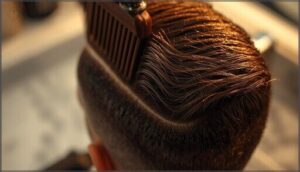
After conditioning, grab a boar bristle or mixed-fiber brush—your fade maintenance weapon. Brush from the crown toward the sides at a 45-degree angle, following your natural fade haircut line for two to three minutes twice daily. This daily routine distributes oils evenly and locks in shape retention.
For best results:
- Use short strokes near the hairline to prevent frizz
- Lift slightly at the crown to reinforce height
- Finish with a gentle sweep along the sides
Daily Moisturizing for Scalp Health

Your scalp craves hydration—skip it and you’ll see flakes, itchiness, and sluggish hair growth.
After brushing, massage a lightweight, non-comedogenic moisturizer into your scalp for 60 seconds using your fingertips. Look for glycerin or ceramides to lock in moisture balance without clogging hair follicles.
This daily routine step keeps your scalp care sharp and promotes healthy hair growth between barber visits. For more on the importance of proper scalp moisturizing routines, check out expert guidelines for maintaining scalp health.
Cleaning Your Grooming Tools

Between trims, your grooming tools are picking up oils, hair, and bacteria—cleaning them daily keeps your fade fresh and your scalp infection-free.
- Remove hair debris from your clippers and trimmer using a small brush after each use
- Disinfect blades with alcohol spray to eliminate bacteria buildup
- Brush cleaning involves soaking combs in warm soapy water weekly
- Equipment storage in a dry case prevents rust and extends tool lifespan
Styling and Product Application Tips

Your fade’s already clean—now it’s time to make it work for you.
The right products and techniques keep your cut looking sharp without turning your bathroom into a lab.
Here’s how to style with confidence and skip the guesswork.
Choosing The Right Products for Your Hair Type
Your hair texture and type are crucial—haircare products need to match them. Fine strands demand lightweight styling products that won’t flatten roots, while coarse hair craves heavier moisture balance.
Run a quick porosity testing check: does water bead up or sink in? That tells you if you need sulfate free options or protein-rich formulas. Product ingredient lists matter—choose based on what your hair actually needs.
Applying Pomade, Clay, or Cream Correctly
Start with a pea-sized amount—less is always more with styling products. Warm pomade, clay, or cream between your palms until it emulsifies, then work through damp hair from roots to mid-lengths using your fingers as styling tools.
Product layering builds control without clumping. Focus on hair texture when choosing hold techniques: fine strands need lighter application, while thick hair tolerates stronger formulas. Let it set before final touches.
Blow-Drying Techniques for Volume and Control
Your blow dryer isn’t just a time-saver—it’s a volume weapon when you know how to wield it. Master Air Flow Control and Heat Protection, and you’ll turn flat, awkward post-wash hair into a polished powerhouse every single time.
Blow Dry Tips for Volume Enhancement:
- Keep the nozzle 6 to 8 inches from your scalp to prevent heat damage
- Use cool-to-medium heat and direct airflow slightly away from roots
- Work in 1-inch sections, alternating between lift and cool blast
- Apply heat protectant spray before drying to shield from damage
Non-Wash Day Maintenance With Leave-in Products
Not every day needs to be a wash day—and honestly, it shouldn’t be. Leave-in conditioners are your secret weapon for hair maintenance between washes.
A few pumps of a lightweight spray delivers hair hydration for up to six hours—no weighing things down. Focus product application along the crown and hairline for fade preservation. That’s your scalp soothing, fade maintenance sorted.
How Often Should You Trim Your Fade?

Your fade doesn’t stay sharp on its own—hair keeps growing whether you’re ready or not.
Knowing when to trim is what separates a fresh cut from a grown-out mess.
Here’s what you need to know to stay on top of it.
Understanding Hair Growth Rates
Your hair doesn’t wait for you—it grows roughly half an inch every month, whether your fade is sharp or not. Understanding the Hair Cycle and its Growth Phases is how you stay ahead of it.
- Follicle Health directly controls your hair growth patterns — damaged follicles slow everything down
- Hormone Balance and genetics set your natural pace; no product overrides that
- Nutrition Impact is real — protein, iron, and zinc fuel steady hair growth and maintenance
- Hair care built around these factors keeps your fade looking clean longer
Signs Your Fade Needs a Touch-Up
Now that you know how Hair Growth Patterns work, spotting when your fade needs attention becomes second nature. Watch for Edge Line Shift—that’s when the contrast between shaved skin and hair starts losing its bite.
Fade Line Blur creeps in as stubble fills the perimeter. Visual Crispness drops fast without proper Scalp Oil Balance. These signs mean it’s trimming time—no guessing needed.
Scheduling Regular Barber Appointments
Once you’ve spotted those signs, it’s time to lock in your Barber Scheduling. Most fades demand Appointment Frequency of every two to four weeks—no exceptions.
That’s your Fade Maintenance window. Pair Hair Growth Tracking with Regular Trims, and your barber visits stay sharp. A solid grooming routine between sessions keeps your haircut maintenance tight.
Barbering isn’t guesswork—it’s rhythm.
DIY Touch-Ups Between Professional Visits
Honestly, you can keep that fade looking sharp between visits—if you’ve got the right Touch Up Tools. A trimmer with a zero guard maintains Edge Control near the skin without overcutting.
Use a pocket comb for Hairline Refining, and a clean razor restores crisp lines. Master these Clipper Techniques, and your fade maintenance stays tight. Simple grooming tips—real barbering techniques—keep touch-ups seamless.
Scalp and Skin Care for a Fresh Look
A sharp fade starts at the scalp — not just the hair. If you’re skipping scalp care, your cut’s going to look dull and dry no matter how fresh the lines are.
Here’s what actually keeps your skin and hair looking tight between visits.
Preventing Dryness and Flakiness
Dry, flaky scalp? That’s your skin barrier breaking down—plain and simple. Dryness causes this more than anything else in your grooming routine.
Lock moisture in by applying cleanser with lukewarm water, never hot. Wash twice daily max, pat dry—don’t rub. These hydration tips keep flake prevention real.
Think of it as hair maintenance meets scalp care—non-negotiable grooming tips for healthy hair growth and lasting hair care tips.
Moisturizing Your Scalp and Hairline
Moisture balance is everything—your scalp and hairline won’t stay fresh without it. A lightweight serum with hyaluronic acid delivers hydration fast, no heaviness. Exfoliation tips matter too—once a week max clears the path for better absorption. This is real scalp health and care in action.
- Use a hydrating serum daily for scalp hydration and hairline care
- Exfoliate gently once weekly to boost moisturizer penetration
- Apply a pea-sized amount of jojoba or argan oil to damp skin
- Seal moisture with ceramide-rich products for barrier repair
- Massage 3–5 minutes to improve blood flow and distribute moisture
Protecting Hair From Heat Damage
Heat protectants form a barrier that shields your strands up to 450°F—skip them and thermal styling becomes a fast track to hair damage. Keep heat settings low, apply protectant to damp hair, and respect your hair texture. That’s real hair care and hair maintenance working together to protect hair growth.
| Hair Texture | Recommended Heat Settings | Styling Products |
|---|---|---|
| Fine | Under 300°F (149°C) | Lightweight heat protectant spray |
| Medium | 300–350°F (149–177°C) | Silicone-based serum |
| Thick / Curly | Up to 400°F (204°C) | Richer leave-in with polymer film |
| Color-Treated | Under 350°F (177°C) | Polymer-film heat protectant |
| Damaged | Under 300°F (149°C) | Ceramide-based protective serum |
Selecting Non-Irritating Products
Your scalp isn’t something to gamble with—wrong products can wreck everything you’ve built. Stick to these rules when picking haircare products and styling products for your grooming routine:
- Go Fragrance Free — fragrance is the number one scalp irritant out there.
- Choose Hypoallergenic Formulas built for a Sensitive Scalp and your specific hair texture.
- Swap harsh shampoos for Gentle Cleansers with mild surfactants.
- Prioritize scalp care products maintaining proper pH Balance — around 4.5 to 5.5.
- Patch test everything first—48 hours, small area, no exceptions.
Frequently Asked Questions (FAQs)
How often should I maintain a fade haircut?
Most guys need fade maintenance every 1 to 3 weeks — but fade frequency really comes down to growth impact and personal preference.
Shorter fades demand tighter schedules. The sharper you want it, the more often you’re back in the chair.
What is the 3 2 1 rule for haircuts?
The 3 2 1 rule breaks your fade into three Haircut Layers using Clipper Guards — longest on top, mid Blending Zones blending down, shortest near the hairline.
Three lengths, two steps, one clean Gradient Control.
What should be a daily hair care routine?
Your hair care routine is the backbone of everything—wash smart with Hair Washing Tips, add a quick Scalp Massage, and layer in Morning Styling products.
Nail daily grooming consistently, and your grooming routine takes care of the rest.
How does diet affect fade hair health?
What you eat builds what grows. Protein intake strengthens your strands—aim for 1 gram per kilogram of body weight.
Iron levels, Vitamin D, B vitamins, and Omega-3s all fuel hair growth and scalp health directly.
Can weather or climate impact fade maintenance?
Like a fresh coat of paint in a rainstorm, your fade fights the elements daily.
Humidity effects soften edges, temperature control matters for scalp care, and smart climate adaptation through seasonal maintenance keeps your grooming routine sharp year-round.
What hairstyles work best with fades?
Your fade haircut unlocks serious versatility.
Pompadour Variations and Quiff Techniques thrive over tight Undercut Designs—especially with textured tops.
From cropped curls to slicked-back mens hairstyles, matching your hair texture to the right Fade Styles makes any haircut styles pop.
How do hormones influence fade growth patterns?
Your body’s hormone balance quietly runs the show—androgens reshape hair density and follicle health, while hormonal fluctuations across growth cycles alter scalp hair texture and hair growth patterns, directly impacting hair growth and maintenance.
Are there genetic limits to fade results?
There’s no single genetic limit—multiple inherited traits work together.
Your hair texture, growth patterns, and follicle density all shape fade depth.
Work with what you’ve got, and a skilled barber does the rest.
Conclusion
A blade doesn’t stay sharp on its own—it needs the hand that wields it. Your fade haircut daily routine works the exact same way.
The barber hands you the starting point, but you’re the one who decides whether that cut holds its edge or dulls out by Friday. Wash, style, maintain—repeat.
Skip those steps, and the gradient unravels. Lock them in, and you own every room you walk into—like you never left the barber’s chair.
- https://getsquire.com/booking/book/kingdom-barber-studio-bryan
- https://www.groomers-online.com/blog/2023/04/top-tips-for-cleaning-your-dog-grooming-salon
- https://waggz.com/blog/dog-grooming-clippers-care-101-extend-the-life-of-your-grooming-tools
- https://www.omegasonics.com/knowledge-center/blog/cleaning-mens-grooming-tools-with-an-ultrasonic-cleaner
- https://www.kaercher.com/int/professional/know-how/cleaning-power-tools.html