This site is supported by our readers. We may earn a commission, at no cost to you, if you purchase through links. This content is for general informational and educational purposes only and is not a substitute for professional medical, dermatological, or nutritional advice.
Black hair with a midnight blue tint doesn’t require bleach damage or a colorist’s chair—you just need the right approach.
Traditional hair dye formulas bounce right off dark strands because they’re designed for pre-lightened canvas, but newer high-pigment options work differently.
These specialized formulas penetrate darker hair by adjusting pH levels and cranking up color molecules that can actually show up against natural melanin. The secret lies in choosing dyes labeled “for dark hair without bleach” and prepping your strands to accept color by opening the cuticle just enough.
Your reward is that coveted blue-black dimension that catches light like a raven’s wing, no chemical stripping required.
Table Of Contents
- Key Takeaways
- Choosing Blue Hair Dye for Black Hair
- Preparing Black Hair for Dye Application
- Applying Blue Dye Without Bleach
- Caring for Blue-Tinted Black Hair
- Troubleshooting and Maintaining Color
- Frequently Asked Questions (FAQs)
- How to turn black hair blue without bleach?
- How to get a blue tint on black hair?
- What colors can I dye my black hair without bleaching it?
- Can you add a blue tint to black hair?
- How can I tint my black hair without bleach?
- How to get rid of blue undertones in black hair?
- How to make black hair look blue?
- How long does blue tint last on hair?
- Can I use food coloring for blue tint?
- Does blue tint show on natural black hair?
- Conclusion
Key Takeaways
- You can achieve a midnight blue tint on black hair without bleach by using high-pigment dyes specifically formulated for dark hair—these adjust pH levels and increase color molecules that show up against natural melanin.
- Semi-permanent blue dyes last 4-12 washes, while demi-permanent options hold for 24-28 washes, with navy or midnight blue shades requiring the least maintenance and delivering the most natural-looking dimension on black hair.
- Proper prep work matters more than you’d think—assess your hair’s porosity, wash with sulfate-free shampoo at 105-125°F, and section hair into 1-inch partings to ensure even color deposit from root to tip.
- Protect your blue-black color investment by rinsing with cool water to seal the cuticle, using sulfate-free products exclusively, and refreshing the tint monthly with blue-violet conditioner treatments between full dye applications.
Choosing Blue Hair Dye for Black Hair
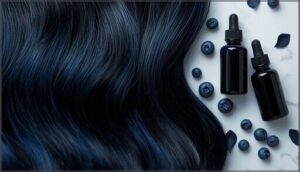
The right dye makes all the difference when you’re going for that mysterious blue-black shade without bleach.
If you’re still deciding, checking out the best black hair dye options can help you find a formula that delivers rich color and stays vibrant.
You’ll need a formula that actually works with dark hair instead of fighting against it.
Let’s break down the key factors that’ll help you pick the perfect blue dye for your hair.
Semi-Permanent Vs. Demi-Permanent Dyes
Your dye longevity decision starts here. Semi-permanent blue tint formulas fade within 4 to 12 washes, depositing color without penetrating deeply—perfect for commitment-free experimentation on black hair. Demi-permanent options last 24 to 28 washes, working slightly deeper for stronger fade resistance.
Consider your hair porosity when choosing:
- Semi-permanent coats the cuticle without lifting natural pigment
- Demi-permanent penetrates deeper with developer or activator
- Both deposit color rather than lighten
- Your wash frequency directly impacts how long the blue holds
Dyes Formulated for Dark Hair
Not all blue black hair dye delivers on dark hair. Look for formulas advertising high pigment load—these pack concentrated color molecules that overcome your natural melanin.
Semipermanent options designed for dark hair include pH-adjusted formulations that boost color deposit without ammonia, letting blue undertones shine through. Products labeled “for dark hair” or “without bleach” account for hair porosity and existing color depth, giving you visible results.
For more details on hair dye options for dark hair, learn how certain tones and formulas can improve your look while maintaining hair health.
Selecting The Right Blue Shade
Once you’ve found a formula built for dark hair, the next step is zeroing in on the right hue. Shade selection matters because blue undertones vary wildly—from deep sapphire to electric cobalt—and each reads differently on black hair.
- Navy or midnight blue preserves your natural depth and minimizes upkeep
- Royal or cobalt blue strikes a balance between vibrancy and wearability
- Teal-leaning blues add dimension but need careful layering to prevent muddiness
- Purple-toned blues complement warm skin and boost color pop
- Cool sapphire shades create vivid contrast but may appear flat indoors
Your skin’s undertone influences how blue tint translates, so match tone for the most flattering finish.
Choosing the best red lipstick for dark skin means finding shades with blue undertones that enhance your complexion’s warmth and depth.
Preparing Black Hair for Dye Application
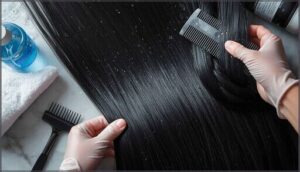
Before you crack open that blue dye, your hair needs a little prep work to grab onto the color properly. Think of it like priming a canvas—you wouldn’t skip that step if you wanted your artwork to last, right?
Here’s what you need to do to set yourself up for the best blue-tinted results possible.
Assessing Hair Porosity and Condition
Before you go rogue with that blue dye, you need to know how your hair responds to hair color. Hair porosity tests, like the simple float test, reveal whether your cuticles are tight or lifted.
Check moisture levels and assess any damage—heat-styled strands or chemically treated hair might show signs of breakage. Elasticity matters too; healthy hair bounces back when stretched, signaling it’s ready for color.
Washing and Drying Hair Properly
Clean hair opens the door to even blue color absorption. Before you apply dye, wash with sulfate-free shampoo using warm water around 105 to 125 degrees Fahrenheit—this temperature lifts cuticles just enough to cleanse without stripping natural oils. After conditioning mid-lengths to ends for 2 to 5 minutes, rinse with cool water.
Follow these steps for ideal hair health and color protection:
- Massage scalp gently with fingertips in circular motions for 20 to 30 seconds
- Rinse thoroughly until no residue remains on hair strands
- Blot excess water with microfiber towels to minimize friction and breakage
- Air dry or use low heat with a diffuser attachment
- Skip leave-in products before dyeing to guarantee a clean application surface
This hair care routine respects hair porosity while prepping color-treated hair for maximum dye deposit—you’re setting yourself up for that commanding blue-black finish.
Protecting Skin and Workspace
Before you crack open that bottle, safeguard your skin and surroundings with smart Chemical Safety moves. Apply petroleum jelly along your hairline and ears for Skin Protection, then slip on chemical-resistant gloves.
Lay down newspapers or a polyethylene sheet for Spill Prevention, and keep cotton swabs handy. This Workspace Setup shields you from stains while maintaining hair health and proper Hygiene Practices throughout your color protection routine.
Applying Blue Dye Without Bleach
Now comes the moment you’ve been prepping for—getting that blue dye onto your hair without a single drop of bleach.
The secret lies in how you mix, section, and apply the color to enhance that subtle blue shimmer on your dark base. Let’s break down the technique so you get even, vibrant results from root to tip.
Mixing and Sectioning for Even Coverage
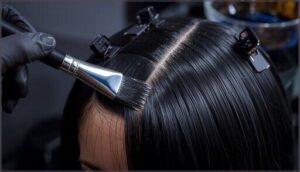
Getting even color saturation starts with smart sectioning techniques. Use narrow hair partings no wider than 1 inch, working from back to crown, then sides.
This ensures your blue tint deposits uniformly across black hair. Mix your dye to developer ratio precisely, then clip manageable sections.
Zigzag partings help blend color transitions naturally, preventing those dreaded patchy spots on color treated hair.
Application Techniques for Best Results
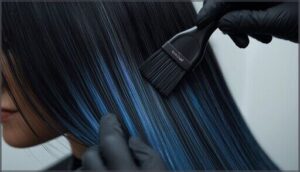
Your tint brush strokes matter more than you’d think when applying demipermanent blue black hair dye. Work from midshaft to ends first, then lightly feather color toward roots for flawless blending.
Here’s what transforms good color deposition into stunning blue tint on black hair:
- Start application at the back sections where hair absorbs slowest
- Use smooth downward brush strokes following the hair shaft direction
- Comb through each section immediately after applying for uniform saturation
- Layer thin coats rather than globbing product for controlled color intensity
Processing Time and Heat Use

Timing your blue tint dye application separates amateur results from salon-worthy color on black hair. Most demi-permanent formulas need 20 to 40 minutes for proper color development without bleach—but your hair’s porosity rewrites those rules.
| Processing Timing Factor | Recommended Adjustment |
|---|---|
| High porosity black hair | Reduce time by 5-10 minutes |
| Low porosity strands | Use full manufacturer window |
| Heat application (optional) | Keep under 120°F with towels |
| Dye formulation strength | Follow label for temperature control |
Check a test strand every seven minutes to prevent overprocessing your blue-black masterpiece.
Caring for Blue-Tinted Black Hair
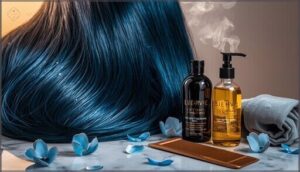
You’ve successfully applied your blue dye, and now the real work begins—keeping that color vibrant and your hair healthy hair.
The aftercare routine you follow will determine whether your blue-black tint stays rich and glossy or fades into a muddy mess within a few washes.
Let’s break down the essential steps to lock in your color and maintain that rebellious, head-turning shine.
Rinsing and Conditioning After Dyeing
Once the processing time wraps up, your post dye care makes or breaks color deposit longevity. Rinse with cool to lukewarm water to support hair cuticle closure and slash color runoff by roughly 40 percent compared to hot water—that’s massive for color treated hair care.
Here’s your rinse-down routine:
- Rinse until water runs clear to prevent pigment transfer and staining
- Use a final cold rinse to boost shine and seal the cuticle
- Pat hair dry gently rather than rubbing to avoid frizz
- Skip washing for 24 to 48 hours so color sets deeply
- Apply barrier cream around your hairline to prevent skin staining
After your rinse, wait 24 to 72 hours before using a deep conditioning treatment with glycerin and natural oils to restore moisture balance without stripping that fresh blue tint. Protein-rich conditioners repair minor cuticle damage and lock in color—your secret weapon for hair damage prevention. Leave masks on for 3 to 5 minutes, then rinse cool again for enhanced shine and better hair color maintenance.
One more thing: rinse water quality matters more than you’d think. Hard water minerals can neutralize blue pigments and speed up fading, so consider filtered or distilled water for your final rinse if your tap water’s harsh. A chelating conditioner helps remove mineral buildup that increases porosity and pigment loss. These color lock techniques keep your blue-black vibrant and your hair healthy long after dye day.
Using Color-Safe and Sulfate-Free Products
Your shampoo choice controls how long that blue black hair stays bold. Sulfate free formulas skip harsh detergents like SLS, protecting color treated hair by keeping the cuticle intact and preventing rapid pigment washout.
Look for gentle cleansing products with moisture agents such as glycerin or coconut derivatives. Color depositing conditioners refresh blue hair dye between applications while supporting hair moisture and overall hair color maintenance through UV filters and antioxidants.
For extra hair protection, you can learn about the benefits of sulphate-free shampoo for color-treated and sensitive hair types.
Reducing Fading and Enhancing Shine
Beyond the right shampoo, protecting your blue tint from fading demands a smart UV Protection routine. Apply heat protectant sprays under 350°F, skip clarifying washes, and use weekly deep conditioners for Hair Moisturizing that locks in Shine Enhancement.
Color depositing treatments every four weeks refresh blue tones, while cool water rinses seal the cuticle for lasting Color Preservation on color treated hair.
Troubleshooting and Maintaining Color
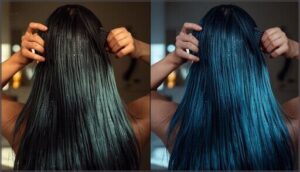
Even with the perfect dye job, you’ll run into a few bumps along the road—that’s just part of the color game.
The good news is that most issues with blue-tinted black hair have simple fixes you can handle at home. Let’s tackle the most common problems and learn how to keep your color looking fresh between applications.
Preventing Uneven Tones and Greenish Hues
Green neutralization starts with identifying the culprit—usually uneven hair porosity or a dye formulation that clashes with your black hair’s underlying tones.
To keep your blue tint from turning murky, choose blue-black hair dye with violet undertones and apply color correction techniques like tone balancing during each session.
Consistent moisture levels and careful sectioning prevent patchy deposits that compromise your color maintenance routine.
Refreshing Blue Tint Between Dyes
Your blue tint won’t stay vibrant forever, but you can take control with smart Color Refresh Tips between full dye sessions.
To keep your color looking its best, consider the following tips:
- Mix a blue-violet shade with conditioner for a quick refresh that won’t darken your base—apply for 2 to 5 minutes.
- Choose tinted conditioner for weekly Tint Maintenance to boost fading blue black hair without harsh chemicals.
- Target porous sections with Blue Dye Boosters since Porosity Effects determine how fast color disappears.
- Rinse with cool water and UV spray for serious Fading Prevention that keeps your rebellious color treated hair care routine intact.
Keeping Hair Healthy After Coloring
Resilience is what separates thriving color from faded disappointment—your Post Dye Care determines everything.
Maintain Hair Moisture Balance with weekly deep conditioning, and limit heat under 350 degrees for serious Hair Damage Prevention.
Run Hair Porosity Tests to customize your Color Treated Hair Care routine, then protect with sulfate-free products and UV shields.
These Color Protection Tips transform rebellious blue tint into lasting Hair Health and Beauty.
Frequently Asked Questions (FAQs)
How to turn black hair blue without bleach?
You’ll need a semi-permanent blue dye formulated for dark hair.
Apply it to clean, dry strands, ensuring even saturation throughout. Process fully, then rinse with cool water to lock in your blue tint.
How to get a blue tint on black hair?
You’ll want a semi-permanent blue dye formulated for dark hair.
Apply it to clean, dry strands and let it process fully—this deposits color without lifting your base, creating that coveted blue-black shine.
What colors can I dye my black hair without bleaching it?
For darker bases, jewel tones like deep purple, rich burgundy, or navy deliver dimension, while emerald or sapphire create subtle shimmer—all without lifting your natural pigment.
Can you add a blue tint to black hair?
Yes, you can add a blue tint to black hair using semi-permanent or demi-permanent blue hair dye formulated for dark hair.
These dyes deposit pigment onto your hair shaft without lifting your natural color first.
How can I tint my black hair without bleach?
Looking to switch things up without the bleach commitment? Use semi-permanent Blue Hair Dye designed for dark hair—it deposits blue pigment directly onto black hair, creating subtle Blue Black Hair without lifting your natural Color Depth.
How to get rid of blue undertones in black hair?
To neutralize blue undertones in black hair, apply a color correction treatment with copper or red tones, which balance the unwanted blue by color theory principles, restoring your natural depth without harsh stripping.
How to make black hair look blue?
Blue pigment reflects differently on black hair depending on hair porosity and lighting.
You’ll spot vibrant tones in bright sunlight where color depositing shines through your base, revealing that subtle blue black hair dimension.
How long does blue tint last on hair?
Your blue hair tint usually lasts 5 to 14 washes, depending on hair porosity and dye type.
Semi-permanent hair dye fades faster than demi-permanent formulas, with color fading factors like heat and harsh shampoos accelerating blue pigment loss.
Can I use food coloring for blue tint?
You can test food coloring for temporary tints, but cosmetic grade dyes perform better.
Food Coloring Risks include skin staining and unpredictable fading factors, while proper hair dye ensures DIY Dye Safety.
Does blue tint show on natural black hair?
Yes, natural black hair often reveals subtle blue undertones when light hits it, thanks to how Blue Pigment Visibility works on the Black Hair Spectrum—but you’ll catch those cool reflections best outdoors.
Conclusion
The boldest color transformations happen without destroying what you started with. You’ve just proven you can get black hair with blue tint without bleach by working with your natural melanin instead of against it.
That midnight shimmer catching light as you move? It’s yours now—no damage tax required. Keep those cuticles sealed with sulfate-free formulas, refresh the tint monthly, and watch heads turn every time that blue-black depth reveals itself under different lighting.