
This site is supported by our readers. We may earn a commission, at no cost to you, if you purchase through links.

That trendy balayage you’ve been eyeing? It’ll run you anywhere from $180 to $350, and that’s just the starting point. Hair color pricing operates on its own logic—a single-process color might cost $70 at your neighborhood salon but hit $150 at an upscale studio across town, and suddenly you’re wondering if you’re paying for skill or just zip code.
The truth is, both matter, along with your hair’s length, the technique’s complexity, and whether you’re covering grays or going platinum.
Whether you’re ready to commit to salon-grade results or testing the DIY waters with a $15 box kit, understanding the real costs—upfront fees, maintenance schedules, and those sneaky extras like toners and glosses—puts you in control of your color budget without compromising the look you want.
Table Of Contents
- Key Takeaways
- How Much Does It Cost to Dye Your Hair?
- Key Factors Affecting Hair Dye Costs
- Salon Hair Coloring: Price Breakdown
- At-Home Hair Dyeing: What to Expect
- Comparing Salon Vs. At-Home Hair Dye Costs
- Maintenance and Ongoing Hair Color Expenses
- Tips to Save Money on Hair Dyeing
- Frequently Asked Questions (FAQs)
- Conclusion
Key Takeaways
- Hair dye costs range from $5 for DIY box kits to $350+ for complex salon techniques like balayage, with single-process color ($70-$150) and highlights ($150-$300) falling somewhere in between depending on your location, hair length, and stylist expertise.
- Annual maintenance costs reveal the real financial gap: salon devotees spend $1,000-$2,500 yearly on touch-ups and treatments, while at-home color enthusiasts keep it under $400 by handling root touch-ups and toning themselves.
- Your hair’s physical stats—length, thickness, and existing damage—directly impact product usage and chair time, which can spike your bill by 40% or more when you’re dealing with waist-length or severely compromised hair.
- Root touch-ups every 4-6 weeks aren’t optional if you want consistent color, and skipping deep conditioning treatments between dye sessions will cost you more in damage repair than you’ll ever save by cutting corners on maintenance.
How Much Does It Cost to Dye Your Hair?
Hair dye costs swing wildly depending on whether you’re going pro or DIY, and what you’re asking your hair to do. You’re looking at anywhere from $5 for a box kit to $200-plus for complex salon work.
Let’s break down what you’ll actually pay for the most common services and products, so you can plan your color budget without any surprises.
Average Salon Prices by Service Type
Salon prices shift depending on what you’re asking for. A single-process color runs $70 to $150, while partial highlights jump to $85 to $200. Want full highlights or balayage? Expect $150 to $350, especially at high-end studios. Glosses and toners add another $20 to $60.
Color consultations might cost up to $25, though many stylists roll that into your service fee. Understanding the importance of methodological rigor can help in making informed decisions about hair dye services.
At-Home Hair Dye Kit Costs
You can grab a DIY hair dye kit for $5 to $40, depending on what you’re after. Temporary color sprays start around $5, while semi-permanent kits run $8 to $20. Permanent formulas and bleaching kits usually cost $10 to $30.
The kit price comparison shows serious DIY cost savings—at-home application cuts your hair dyeing costs dramatically compared to salon visits.
Cost Ranges for Popular Techniques
Now let’s break down what you’ll actually pay for specific hair dyeing costs across popular salon services and techniques. Each color pricing tier reflects the complexity, time, and materials your stylist needs:
- Single-process color: $70–$150 for all-over coverage
- Partial highlights: $80–$150 for dimension around your face
- Full highlights: $150–$300 depending on density
- Balayage or ombré: $180–$350 for hand-painted technique costs
- Color correction: Add $50–$150+ for fixing previous dye jobs
Key Factors Affecting Hair Dye Costs

You’ve seen the price ranges, but here’s the thing: what you actually pay depends on a handful of variables that can swing your total by hundreds of dollars. Some factors are obvious, like where you live or how long your hair is, while others might catch you off guard if you’re booking your first appointment.
Hair dye costs swing by hundreds depending on location, hair length, and factors that catch first-timers off guard
Let’s break down what really moves the needle on your final bill.
Salon Location and Regional Variations
Where you live shapes what you’ll pay—sometimes dramatically. Urban pricing on the West Coast and Northeast runs markedly higher than Midwest or Southern markets, while coastal costs consistently outpace inland areas even at similar income levels.
City variations mean a colorist in Manhattan or San Francisco charges double what you’d pay in Omaha, and neighborhood discounts within the same geographic location can swing prices 30% depending on the salon’s zip code.
Stylist Experience and Expertise
Your stylist’s credentials can shift what you fork over by 50% or more. Junior colorists charge entry rates while master colorists command premium prices—and that gap reflects years behind the chair, not arbitrary salon reputation.
- State licensing ensures baseline safety and color theory knowledge
- Higher certifications in balayage or corrective work justify steeper styling services costs
- A color specialist with a strong portfolio usually delivers fewer corrections, saving you money long-term
Hair Length, Thickness, and Condition
Your hair’s physical stats—length, thickness, and condition—govern how much dye you’ll burn through and how long you’ll occupy the chair. Shoulder-length hair adds 15–25 minutes over short cuts, while waist-length strands can tack on an hour and spike product costs by 40%.
Dense or damaged hair absorbs color unpredictably, often requiring extra toner or bond treatments that inflate your final salon bill.
Complexity of Color and Technique
The artistry behind dimensional color—balayage, ombre, highlights—drives prices up fast. Custom techniques demand precise weaving and multiple formulation steps, stretching chair time beyond basic single-process work.
Color correction for previous mishaps? You’re looking at premium rates, since fixing botched dye jobs requires expert skills and aggressive color treatment to neutralize unwanted tones and rebuild hair texture.
Salon Hair Coloring: Price Breakdown
When you walk into a salon, the price tag changes dramatically depending on what you’re asking for. A single process color runs cheaper than a full transformation, and specialized techniques like balayage come with their own pricing logic.
Here’s what you’ll actually pay for the most common salon services, broken down by technique and complexity.
Single Vs. Double Process Color

Want vibrant, dramatic color? You’ll choose between single and double process—and the cost difference is real.
Single process color runs $50 to $100, depositing pigment in one step with minimal color damage risk and shorter process timing.
Double process hits $100 to $175, lightening first then toning for precise shade matching, but demands longer sessions and greater attention to hair porosity for color longevity.
Highlights, Balayage, Ombre, and Sombre
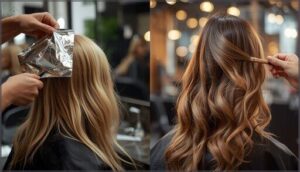
Looking for dimension without commitment? Here’s what you’ll pay. Highlights cost $50 to $70 through strategic foiling, while Balayage hits $100 to $200 for that hand-painted, sun-kissed gradient requiring serious technique. Ombre and Sombre both land between $100 and $200, creating dark-to-light transitions with Sombre offering softer blending.
Salon Consultations determine your Hair Texture compatibility, Color Techniques needed, and Hair Damage Prevention strategies—protecting Dye Durability long-term.
Root Touch-Ups and Color Corrections

Maintenance hits different when you’re battling Root Regrowth—Root TouchUps run $50 to $150 every 4-8 weeks, while Color Correction at the Salon starts around $100 and explodes past $500 for major fixes involving Hair Damage or Color Fade disasters.
At-home kits ($8-$35) tempt budgets, but Color Matching errors and botched Correction Techniques often demand professional intervention anyway, doubling your Cost.
- Root touch-ups preserve color consistency between full services
- Color corrections rescue previous Hair Dye mistakes or resistant grays
- Salon expertise prevents compounding damage during complex corrections
- At-home maintenance risks uneven results without proper technique
Additional Costs (Toner, Gloss, Styling)

Beyond the base color, you’re paying $20 to $100 for Toner Prices that neutralize brassiness, plus $20 to $80 for Gloss Effects that seal and shine. Styling Fees tack on another $15 to $65, depending on your Hair Upkeep needs.
These Beauty Service Pricing add-ons stack fast—bundle them during promotions to slash Hair Dyeing Costs and keep Color Maintenance from bleeding your wallet dry every visit.
At-Home Hair Dyeing: What to Expect

Dyeing your hair at home puts you in the driver’s seat, but the drugstore aisle can feel overwhelming if you don’t know what you’re looking at. Box dyes come in different formulas that stick around for vastly different amounts of time, and the price tags reflect that staying power.
Here’s what you need to know about the main types of at-home color, plus the bleaching kits that make dramatic transformations possible.
Temporary, Semi, Demi, and Permanent Dyes
Your at-home arsenal breaks down into four tiers, each with different longevity and commitment levels. Temporary hair dye washes out in 1–2 shampoos, semi-permanent lasts 4–12 washes without lifting natural color, demi-permanent penetrates deeper for 24–28 washes, and permanent hair color delivers lasting results but demands root touch-ups every 4–8 weeks. Understanding hair porosity helps prevent color fading and potential dye allergies—test patches matter.
- Temporary formulas ($5–$10) coat the surface for quick experiments without damage repair worries
- Semi-permanent options ($8–$15) fade gradually, ideal for testing bold shades before committing
- Demi-permanent choices ($10–$20) blend grays and refresh existing color between salon visits
- Permanent hair color kits ($8–$12) deliver dramatic transformations but may require eventual color correction
Bleaching and Lightening Kits
Bleaching kits ($8–$25) give you radical freedom to strip natural pigment before applying vibrant shades—but they demand respect. Most formulas use persulfate bleach and hydrogen peroxide developers at 20–30 volume, with higher concentrations lifting darker hair faster while increasing damage risk.
Understanding hair porosity and performing strand tests prevent over-processing disasters that cost hundreds in salon damage repair.
Featured Product: L’Oreal Hair Color and Highlights Kit
L’Oréal’s dual-purpose kits ($8–$15) bundle permanent color crème, developer, gloves, and applicator for single-session highlights and all-over hue shifts. Unopened shelf life spans several months when stored properly.
Consumer reviews confirm solid at-home results with careful strand testing, though formulation consistency can’t match salon custom-mixing. You’ll get affordable convenience—just expect potential staining and shades that don’t always mirror box photos.
Comparing Salon Vs. At-Home Hair Dye Costs

You’ve got your color picked out, now it’s decision time: salon chair or bathroom mirror. The price gap between these two routes is huge, but so are the trade-offs in results, convenience, and long-term costs.
Let’s break down what you’re really paying for with each option and what that money gets you over the course of a year.
Upfront Vs. Ongoing Expenses
You’ll see two spending categories when you dye your hair: what you pay today and what you’ll keep paying. Salon and at-home hair dye options differ in initial investment and ongoing expense tracking for smart budget planning.
| Cost Type | Salon | At-Home |
|---|---|---|
| Initial Investment | $60–$300 per session | $5–$30 per kit |
| Root Touch-Ups (4–6 weeks) | $40–$120 each visit | $5–$25 per refresh |
| Toner/Gloss Treatments | $20–$60 every 4–8 weeks | Included in some kits |
| Conditioning Treatments | $25–$60 per session | $8–$20 for at-home products |
| Color Corrections | $150–$500+ if needed | Minimal unless professional fix required |
Salon services front-load costs with precision and expertise, while DIY options offer financial savings upfront but demand consistent maintenance purchases. Your price commitment depends on whether you want professional results or hands-on control.
Annual Cost Breakdown
Over twelve months, salon hair dye habits can run you $1,000 to $2,500 in most urban markets—that’s root touch-ups every six weeks, toner refreshes, and conditioning treatments stacking up.
At-home color budgeting flips the script: you’ll spend closer to $100 to $400 annually on kits and maintenance products, slashing expense tracking stress while keeping control in your hands.
| Annual Route | Cost Range |
|---|---|
| Salon Maintenance | $1,000–$2,500 |
| At-Home DIY | $100–$400 |
Pros and Cons of Each Method
Which route owns your schedule—and your wallet? Salon color gives you professional stylist consultation, targeted application, and access to specialized techniques like balayage, but you’re paying $60 to $250 per session and booking around their hours.
At-home dye kits deliver cost-effectiveness and immediate control, slashing prices by half or more, though color damage and uneven hair regrowth risks climb without expert hands guiding dye longevity.
| Method | Pros | Cons |
|---|---|---|
| Salon | Professional application, quality products, expert consultation | Higher cost per visit, scheduling constraints |
| At-Home | Lower price, flexible timing, experimentation freedom | Uneven results, color damage risk, correction expenses |
Maintenance and Ongoing Hair Color Expenses

Your upfront dye cost is just the beginning—keeping that color looking fresh means regular trips back to the salon or stock-ups on at-home products, and those expenses stack up faster than you’d think. Root growth doesn’t wait for your budget to catch up, and damage control isn’t optional if you want healthy hair.
Here’s what you’ll actually spend to maintain your new color over time.
Frequency of Root Touch-Ups
Your hair growth rate dictates how often you’ll be tied to the chair—or your bathroom sink. Most salon visits for root touch-ups land every 4 to 6 weeks, though rapid growers might need intervention closer to 3 weeks to keep that demarcation line from screaming ‘neglect.’
Professional rule of thumb: address roots once you hit 1.5 to 2 cm of regrowth—that’s when maintenance costs start adding up fast if you’re salon-bound.
- Natural blondes and light brunettes habitually stretch 4 to 6 weeks between touch-ups
- High-contrast permanent color demands attention every 4 to 8 weeks to maintain even coverage
- Semi-permanent systems buy you freedom, often lasting 6 to 8 weeks before color fading becomes noticeable
Deep Conditioning and Preventing Damage
Color preservation demands more than just touch-ups—your cuticles take a beating with every dye session. Weekly deep conditioning treatments using keratin or silicone-based masks restore moisture balance and lock in pigment, keeping your hair care routine ahead of breakage.
Pair that with heat protectants below 450°F and pH-balanced, sulfate-free shampoos to maintain cuticle protection. At-home damage control separates vibrant color from faded regret.
Tips to Save Money on Hair Dyeing

You don’t have to drain your bank account every time you want to switch up your color. A few smart moves can cut your hair dye expenses in half without sacrificing the look you’re after.
Here’s how to keep more cash in your pocket while still rocking fresh color.
Leveraging Discounts and Promotions
You can slash your salon hair dye price by hunting down first-visit discount codes and promo offers—many spots knock 15-30% off your initial color.
Loyalty programs rack up points you’ll actually use, while seasonal deals bundle treatments at better rates.
Don’t sleep on referral rewards or student discounts, and always check booking apps for member-only cost cuts before you commit.
DIY Techniques and Maintenance
Once you’ve scored those deals, mastering at-home color protection and damage repair keeps you out of the salon chair longer. Root touch-up kits run $8–15 and handle regrowth every six weeks, while DIY hair dyeing with semi-permanent formulas lets you refresh tone between appointments.
Pair your home highlights with sulfate-free shampoo and weekly hair masking to lock in pigment and dodge costly color corrections.
Bundling Services and Advance Scheduling
Booking color alongside a cut or blowout slashes your total salon services outlay—most salons reward bundled appointments with 10–20% off. Lock in advance scheduling for flash-sale pricing on hair coloring, and you’ll dodge peak-hour markups while snagging loyalty points.
- Package deals pair color with conditioning treatments at one price
- Weekday appointments access dual-service discount policies
- Prepaying bundles secures reduced rates versus pay-per-visit
- Off-peak scheduling strategies trigger lower labor charges
- Multi-appointment planning stacks referral savings with service integration discounts
Frequently Asked Questions (FAQs)
Are there any additional costs associated with hair coloring that should be considered?
Yes—toner and gloss treatments ($20–$60), protective bond builders ($15–$40), consultation fees ($15–$40), and taxes (6–10%) all add up beyond the base price. Mobile stylists or peak-time bookings increase costs further.
Can I dye my hair while pregnant?
Most health pros say you can dye your hair during pregnancy, but stick with ammonia-free formulas, wait until after the first trimester, and work in a well-ventilated space to minimize chemical exposure.
How long does hair dyeing actually take?
Hair Dye application and Color Processing take 30 to 150 minutes at a Salon depending on technique. Hair Bleaching extends Labor Time, while Root Touchups finish faster.
Hair Length and Toner Timing influence total Cost.
Does insurance ever cover hair dye costs?
Standard insurance won’t touch cosmetic hair dye—it’s considered elective. However, policies occasionally reimburse when medical necessity applies, like post-chemotherapy restoration, requiring physician documentation and prior authorization for any reimbursement process.
Whats the best season to dye hair?
Forget the “perfect season” myth—your hair doesn’t care about the calendar.
That said, fall and spring see lower salon demand, which can mean better appointment slots and occasional promotions on hair dye costs.
Do salons charge consultation fees for color?
Many salons charge consultation fees ranging from $20 to $75, though boutique studios often waive these costs if you book color analysis services that day.
Virtual consults and promotional scheduling policies can eliminate fees entirely.
Conclusion
Your hair color budget isn’t a cage—it’s a blueprint. Now that you know how much it costs to dye your hair, from $8 box kits to $400 balayage appointments, you can choose the path that matches your wallet without settling for less than you deserve.
Whether you’re booking that seasoned colorist or mastering root touch-ups in your bathroom, you’re no longer guessing at price tags or scrambling when the bill arrives. You’re calling the shots.
- https://www.rachaelrayshow.com/articles/should-i-color-my-hair-at-home-or-stick-to-the-salon-hairstylist-to-the-stars-answers
- https://www.huffpost.com/entry/how-to-color-hair-home-avoid-mistakes_l_5e7b68ecc5b6b7d809595ab4
- https://stylecaster.com/beauty/hair-dye-tricks/
- https://x.com/godofprompt/status/1990526288063324577
- https://academichelpexpress.blog/2024/08/please-use-the-bulleted-points-and-the-rubric-below-to-guide-your-work-your-pa/