
This site is supported by our readers. We may earn a commission, at no cost to you, if you purchase through links.

Your skin loses up to 300 milliliters of water every single day through a process called transepidermal water loss—and if you’re not replacing that moisture consistently, you’re fighting a losing battle. Most people think moisturizing is about adding hydration, but it’s actually about preventing your skin from losing the water it already has.
The dermatologist-recommended standard is twice daily: once in the morning to protect against environmental stressors, and again at night to support your skin’s natural repair cycle.
But here’s where it gets interesting—your skin type, climate, and even the season dramatically change how often you should apply face moisturizer and what kind of formula will actually work for you.
Table Of Contents
- Key Takeaways
- How Often Should You Apply Face Moisturizer?
- How Skin Type Affects Moisturizing Frequency
- Adjusting Moisturizer Use for Climate and Seasons
- Choosing The Right Moisturizer for Your Skin
- The Best Time to Apply Face Moisturizer
- How Much Moisturizer Should You Use?
- How to Apply Moisturizer for Maximum Benefits
- Recognizing Signs of Over or Under-moisturizing
- Moisturizing for Specific Concerns and Conditions
- Tips to Enhance Your Moisturizing Routine
- Frequently Asked Questions (FAQs)
- Conclusion
Key Takeaways
- Your skin loses up to 300 milliliters of water daily through transepidermal water loss, making twice-daily moisturizer application—morning and night—the dermatologist-recommended standard for maintaining your skin barrier and preventing moisture loss regardless of skin type.
- Timing matters as much as frequency: apply moisturizer within three minutes after cleansing on damp skin to trap residual water, use lighter formulas with SPF in the morning for environmental protection, and switch to richer creams at night when your skin’s natural repair cycle and water loss both peak.
- Your climate and season dramatically affect how much moisture you need—dry environments and winter demand heavier, ceramide-rich formulas applied more frequently, while humid conditions and summer call for lightweight, oil-free gels to prevent clogged pores and breakouts.
- Listen to your skin’s feedback signals rather than following rigid rules: smooth texture and natural glow mean you’re moisturizing enough, while tightness and flaking indicate you need more frequent application, and excess shine or breakouts suggest you should dial back or switch to a lighter formula.
How Often Should You Apply Face Moisturizer?
You’ve probably heard mixed advice about how often to moisturize your face—some sources say once daily, others recommend twice, and a few claim it depends entirely on your skin type. The truth is that dermatologists base their recommendations on how your skin actually functions, not on marketing claims or one-size-fits-all rules.
Most experts agree that applying moisturizer designed for your skin’s needs both morning and night keeps your skin barrier healthy and hydrated throughout the day.
Let’s break down what research and clinical experience tell us about moisturizing frequency, timing, and how to know if you’re doing it right.
If you’re also dealing with rough or dry legs, these simple techniques for achieving smoother skin can complement your moisturizing routine perfectly.
Recommended Frequency by Dermatologists
Most dermatologists agree: twice-daily moisturizer application forms the foundation of effective skin care. You’ll want to work moisturizer into your skin care routine both morning and night to maintain ideal skin hydration. The American Academy of Dermatology endorses this frequency guideline, particularly for dry skin types.
For mature skin, choosing the right face moisturizers for mature skin becomes especially important to address age-related moisture loss and support skin barrier function.
Following dermatologist advice on moisturizer timing ensures your moisturizing routine delivers consistent benefits. Understanding your daily skin hydration needs is vital for a tailored skin care approach.
Morning Vs. Night Application
Your skin’s circadian rhythm creates a day-night difference in hydration patterns. Morning application protects against environmental stressors with lighter formulas, often including SPF in your skincare routine.
At night, skin regeneration peaks—transepidermal water loss increases, making richer facial moisturizer ideal. This enhanced nighttime permeability assists moisture retention, allowing repair-focused ingredients to penetrate more effectively.
For those with sensitive or acne-prone complexions, choosing non-comedogenic night creams ensures your skin repairs itself without triggering breakouts.
That’s why moisturizing tips emphasize both applications for maximum skin hydration. Understanding the importance of day night moisturizers can help you make informed decisions about your skincare routine.
Signs You’re Moisturizing Enough
When your routine’s dialed in just right, your face will tell you—smooth texture, a natural glow, and zero tight or flaky patches throughout the day. Your skin elasticity bounces back when gently pressed, signaling proper hydration and barrier function. You won’t need extra moisturizer between applications, and your makeup sits evenly without pilling—clear evidence your moisture levels support ideal skin health and hydration.
When your moisturizing routine is dialed in correctly, your skin will show smooth texture, natural glow, bounce-back elasticity, and zero tightness throughout the day
Key indicators your skin balance is on point:
- Your complexion feels comfortable from morning cleanse through evening without tightness
- Fine lines appear softened, not emphasized by dehydration cracks
- Skin care products absorb quickly rather than sitting on the surface
- You’re not reaching for moisturizer midday to combat dry patches
- Your skin maintains consistent texture across all facial zones, including T-zone areas
How Skin Type Affects Moisturizing Frequency

Your skin type plays a major role in how often you need to moisturize—and using the wrong frequency can actually backfire. What works for someone with dry, flaky skin won’t necessarily suit someone dealing with excess oil production.
Let’s break down how to adjust your routine based on whether your skin is oily, dry, sensitive, or somewhere in between.
Oily Skin Needs
You might think your shiny complexion doesn’t need extra hydration, but oily skin care still requires consistent moisturizer benefits twice daily. Board-certified dermatologists confirm that skipping this step actually triggers your skin barrier to overproduce sebum as compensation.
Look for lightweight, oil-free formulas with hydration tips like hyaluronic acid—they deliver moisture without clogging pores, helping you maintain oil control while supporting healthy skin types and proper skin care hydration.
Dry and Sensitive Skin
If you’re dealing with tightness, dry flakes, or redness, dermatologists recommend moisturizing at least twice daily—morning and night—to repair your skin barrier and restore moisture lock. Patients with eczema or reactive complexions often benefit from a third midday application, especially in harsh climates.
- Choose fragrance-free formulas with ceramides and hyaluronic acid for sensitive care
- Apply to damp skin immediately after cleansing to boost hydration
- Watch for improved softness and reduced stinging as signs your routine’s working
Normal and Combination Skin
Your skin type sits in the sweet spot: twice-daily facial hydration—morning and night—keeps moisture levels balanced without overdoing it.
Target richer formulas on dry cheeks and lighter gels on your T-zone to support your skin barrier where it needs help most.
This targeted approach aligns perfectly with a comprehensive evening skincare routine that maximizes your skin’s natural repair cycle.
Look for improved skin texture and zero tightness as proof your daily routines are dialed in correctly.
Adjusting Moisturizer Use for Climate and Seasons

Your skin doesn’t exist in a vacuum—it responds directly to the air around you. Where you live and what time of year it is can completely change how much moisture your skin needs.
Let’s look at how different environments and seasons should shape your moisturizing routine.
Humid Vs. Dry Environments
Where you live dramatically shapes your hydration needs. In dry environments, low humidity accelerates transepidermal water loss, forcing moisture to evaporate rapidly from your skin barrier and leaving you vulnerable to flaking and tightness. You’ll need richer moisturizers with occlusives and humectants like hyaluronic acid applied at least twice daily—sometimes more when your face feels tight.
Humid climates reduce moisture loss naturally, so lighter gel formulas once or twice daily usually suffice. Heavy creams in high humidity can trigger breakouts by overwhelming your skin’s natural moisture levels, so match your moisturizer weight to environmental factors for ideal hydration.
Seasonal Changes and Skin Needs
As temperatures swing from one extreme to another, your moisturizer routine needs to swing with them. Winter’s cold, dry air weakens your skin barrier function and cranks up transepidermal water loss, demanding ceramide-rich creams applied twice daily for skin barrier repair. Summer heat boosts sebum production, so you’ll want lightweight, non-comedogenic gels for humidity management and acne prevention. Here’s how to navigate seasonal moisturizing throughout the year:
- Winter skin care: Switch to occlusive-rich formulas at night to combat indoor heating.
- Spring transitions: Gradually lighten texture to prevent congestion.
- Summer hydration: Choose oil-free options that won’t clog pores.
- Autumn preparation: Introduce facial oils before winter hits.
- Climate adaptation: Monitor your skin type’s changing needs constantly.
Choosing The Right Moisturizer for Your Skin

Finding the right moisturizer isn’t just about how often you apply it—it’s about choosing a formula that works with your skin, not against it. The wrong product can clog pores, trigger breakouts, or leave your skin feeling greasy even when you’re doing everything else right.
Let’s break down what to look for so you can build a routine that actually produces outcomes.
Non-comedogenic and Fragrance-free Options
If you’re acne-prone or have sensitive skin, look for moisturizers labeled non-comedogenic and fragrance-free. Non-comedogenic formulas minimize comedone formation by avoiding pore-clogging ingredients, supporting acne treatment and barrier repair.
Fragrance-free options reduce irritation risk—though labels can mislead, since nearly half still contain allergenic components.
Check ingredient lists for humectants, emollients, and occlusives like glycerin and dimethicone rather than trusting marketing claims alone.
Key Ingredients for Hydration
When you flip over your moisturizer and scan the ingredient list, three types of hydrators should catch your eye: humectants, emollients, and occlusives. Humectants like hyaluronic acid and glycerin pull water into your skin through their humectant properties.
Ceramides restore lipid balance and support barrier function with proven ceramide benefits. Niacinamide enhances moisture retention while calming inflammation.
Together, these ingredients create a complete hydration system.
Avoiding Pore-clogging Formulas
Unfortunately, many moisturizers contain comedogenic ingredients that occlude follicles and trigger breakouts. Coconut oil, isopropyl myristate, and acetylated lanolin are common culprits in pore-clogging formulas.
Look for non-comedogenic and oil-free labels to minimize risk, but don’t stop there—fragrance-free options reduce irritation that worsens acne.
Read ingredient lists carefully, prioritizing humectants over heavy occlusives for facial moisturizing in acne-prone skin.
The Best Time to Apply Face Moisturizer

Timing matters as much as frequency regarding moisturizer. Your skin’s absorption capacity changes throughout the day, and applying moisturizer at strategic moments maximizes its effectiveness.
Let’s look at the three key times you should incorporate moisturizer into your routine.
After Cleansing
Apply your face moisturizer within about three minutes after cleansing to lock in moisture and support barrier repair. Cleansing effects temporarily increase water loss, so moisturizing tips emphasize acting quickly.
Pat your skin gently—leave it slightly damp rather than bone-dry. This hydration timing optimizes moisture levels by trapping residual water in your skin barrier, making your skincare routine more effective overall.
Before SPF or Makeup
Once your moisturizer has absorbed—about fifteen to twenty minutes—layer on your SPF to preserve photoprotection. This moisturizer timing prevents diluting your sunscreen and ensures even facial priming.
If you’re wearing makeup, hydration beneath foundation reduces flaking and improves coverage. For best results, use a lightweight, non-comedogenic moisturizer under SPF layering, then allow another fifteen minutes before makeup application to stabilize the UV filters.
Nighttime Skincare Routines
Your skin shifts into barrier repair mode after dark, experiencing higher transepidermal water loss overnight. That’s why your nighttime skincare routine should end with a richer face moisturizer—one packed with ceramides or squalane to support nocturnal hydration and skin regeneration.
Following this skincare routine tip helps lock in overnight moisture while your circadian skin rhythms do their restorative work, no matter your skin type.
How Much Moisturizer Should You Use?

You’ve nailed down when to moisturize, but using the right amount matters just as much as timing. Too little won’t give your skin the hydration it needs, while too much can leave you greasy or even clog your pores.
Let’s break down exactly how much moisturizer belongs on your face and how to apply it evenly.
Proper Amount by Face Area
You don’t need the same amount of moisturizer on every part of your face—face area mapping and facial product allocation make a real difference.
For effective moisturizer distribution, use about a quarter of your total dime-sized portion on your forehead, slightly more on each cheek where skin is often drier, and just a dab on your nose and chin to support area-specific hydration without clogging pores.
Avoiding Over-application
Generally, when you apply more than the skin barrier can handle, unabsorbed product just sits on the surface and disrupts moisture balance. That excess creates a film that interferes with product absorption and can trigger breakouts or overhydration.
Sticking to moisturizer limits—a dime-sized amount total—protects your face from clogged pores and irritation while still giving you the hydration you need.
Application Tips for Even Coverage
Start by placing small dots of moisturizer across your forehead, cheeks, nose, chin, and neck—this dot technique sets up even coverage before you begin blending.
Then use gentle upward strokes and circular facial massage motions to work the product into damp skin, which improves skin hydration and absorption.
These face moisturizing tips prevent heavy patches while ensuring complete moisturizer blending.
How to Apply Moisturizer for Maximum Benefits
Getting the right moisturizer is only half the battle—how you apply it matters just as much. The technique you use can determine whether your skin actually absorbs the hydration or whether you’re just spreading product around without real benefit.
Let’s break down the key application methods that’ll help you get the most out of every drop.
Applying to Damp Vs. Dry Skin

You’ve probably heard you should moisturize your face on damp skin—and there’s solid science behind it. When you apply moisturizer within three to five minutes after cleansing, you trap residual water in your stratum corneum, boosting hydration timing and water retention.
This approach enhances moisturizer absorption and aids skin barrier repair, helping you hydrate your skin more effectively regardless of your skin type.
Facial Massage Techniques

Gentle facial massage techniques can greatly improve how your moisturizer works by boosting circulation and promoting skin toning. Here’s how to optimize your skincare routine with proper facial massage techniques:
- Use upward lymphatic drainage strokes from your chin toward your ears to reduce puffiness
- Try facial rolling for 5 minutes to increase blood flow and skin hydration methods
- Apply light pressure to acupressure points at temples and jawline
- Incorporate myofascial release with gentle upward lifts along cheekbones
- Always use clean hands and let your face moisturizer provide glide
Layering With Other Products
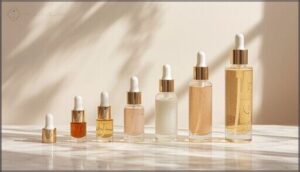
Your skincare routine works best when you layer products from thinnest to thickest. Apply serums with active ingredients like vitamin C or hyaluronic acid first, then follow with your face moisturizer to lock in those treatments and support your skin barrier.
Always finish with SPF in the morning—moisturizer blending with sunscreen reduces protection, so keep them separate for best results.
Recognizing Signs of Over or Under-moisturizing
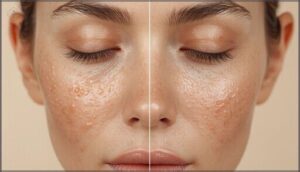
Your skin has a way of telling you when something’s off with your moisturizing routine. Too much product can trigger issues just as easily as using too little, and recognizing these signals helps you find the right balance.
Let’s break down what to watch for so you can adjust your routine based on what your skin actually needs.
Symptoms of Over-moisturizing
Your skin can actually tell you when you’ve crossed the line from hydrated to overloaded—and the signals aren’t always what you’d expect. Over-moisturizing can trigger oil imbalance, causing your sebocytes to slow down natural lipid production.
You might notice clogged pores, unexpected breakouts, or even skin irritation. When occlusives create moisture overload, your complexion may feel congested rather than nourished—a clear sign to dial back.
Effects of Skipping Moisturizer
On the flip side, neglecting moisturizer altogether strips your skin of the protective barrier it needs to fend off dryness, irritation, and accelerated aging. Without it, you’ll see dehydrated skin, dry patches, and compromised skin health across all skin types.
Moisture loss weakens your skin barrier, raising your irritation risk and making it harder for your complexion to protect itself from environmental stressors.
Adjusting Routine Based on Skin Feedback
Listening to what your skin tells you is how you fine‑tune moisture balance and support skin barrier repair. Here’s how to adjust:
- Excess shine or breakouts? Cut back to once daily or switch to a lighter formula.
- Flaking or tightness? Increase frequency and choose ceramide therapy options.
- Mix of oily and dry zones? Layer strategically—gel for oily areas, cream for dry.
- Irritation flare‑ups? Pause extra hydration layers temporarily.
Feedback loops guide how you moisturize your face across all skin types.
Moisturizing for Specific Concerns and Conditions

Certain skin conditions require a more customized approach to moisturizing than general guidance can provide. Your routine needs to adapt based on whether you’re managing chronic conditions like eczema, addressing signs of aging, or managing reactive skin that breaks out easily.
Let’s look at how to adjust your moisturizing frequency and formula selection for three common concerns.
Eczema and Sensitive Skin
If you have eczema or sensitive skin, think of moisturizing as your first line of defense against flare-ups and irritation. Dermatological advice consistently emphasizes twice-daily application—morning and immediately after bathing—to support barrier repair and lock in hydration.
Choose fragrance-free emollients with ceramides and proven moisturizer ingredients that strengthen your skin barrier without triggering eczema triggers or further compromising sensitive skin.
Anti-aging and Mature Skin
Twice-daily moisturizing becomes especially critical for mature skin care, as dermatologists confirm it improves skin barrier function by 40% compared to once-daily application. Morning and night routines support facial firming and wrinkle reduction while combating dryness.
Look for anti-aging skin care formulas with hyaluronic acid and ceramides to moisturize your face effectively, enhancing skin regeneration during your evening antiaging routine.
Acne-prone and Reactive Skin
Counterintuitively, acne-prone and reactive skin actually demands daily moisturizing—dermatologists confirm it improves treatment adherence by reducing irritation from retinoids and benzoyl peroxide. Choose lightweight, barrier repair formulas to avoid acne triggers while supporting your skin barrier.
Essential moisturizer ingredients for reactive skin types include:
- Ceramides for barrier repair without clogging pores
- Glycerin as a gentle humectant
- Noncomedogenic emollients that hydrate without heaviness
- Fragrance-free occlusives to prevent irritation
- Oil-free textures suitable for anti aging skin care routines
Tips to Enhance Your Moisturizing Routine
Getting the most from your moisturizer isn’t just about how often you apply it—it’s about what you pair it with and when. The right combinations can boost hydration, protect against environmental damage, and support your skin’s natural repair processes.
Here are three strategic ways to level up your routine and optimize the benefits you’re already working toward.
Pairing With SPF for Daily Protection
Pairing your moisturizer with SPF isn’t optional—it’s the most powerful duo for daily protection. Apply your moisturizing product first, let it sink in for a minute, then layer a dedicated sunscreen over it. This moisturizer layering strategy strengthens your skin barrier while delivering reliable UV defense. Even indoors, UV rays sneak through windows, making daily SPF application essential for complete sun protection in your daily skin care routine.
| Morning Routine Step | Product Purpose |
|---|---|
| Cleanse | Remove overnight oils |
| Moisturize | Hydrate and repair skin barrier |
| Apply SPF | Shield from UV damage |
| Reapply (every 2 hours outdoors) | Maintain sunscreen effectiveness |
Using Serums and Boosters
Serum layering before your face moisturizer unlocks powerful product synergy—lighter molecules absorb first, avoiding blockage by heavier creams. Apply water-based serums with active ingredients like hyaluronic acid or vitamin C on damp skin, then seal them with moisturizer to boost skin penetration and prevent moisture loss.
This skincare routine tips approach works across moisturizing for different skin types, maximizing booster benefits while supporting your skin type’s unique barrier needs.
Nighttime Rich Creams for Repair
Your skin shifts into repair mode after dark, making nighttime the prime window for rich cream benefits. Between midnight and 6 a.m., cellular renewal accelerates—collagen synthesis peaks, barrier function restoration ramps up, and increased blood flow delivers nutrients that support skin regeneration.
Apply a reparative face moisturizer with emollients, ceramides, and hyaluronic acid to damp skin each evening to:
- Trap moisture during nocturnal barrier permeability increases
- Deliver actives when fibroblast activity is highest
- Support antioxidant defenses against daytime UV damage
- Boost penetration of peptides and retinol for anti-aging
Night repair formulas align your moisturizing routine with your skin’s natural recovery cycle.
Frequently Asked Questions (FAQs)
Can I skip moisturizer if using serum?
You might think serums deliver enough hydration on their own, but dermatologists caution against skipping moisturizer entirely.
While hydrating serums provide active ingredients, they lack the occlusive barrier that prevents transepidermal water loss—meaning your skin can’t hold onto that moisture without emollients sealing it in.
Should I moisturize after using face masks?
Yes, you should moisturize after face masks. Post mask care helps with moisture retention by creating a facial barrier that locks hydration into your skin type, preventing the absorbed essence from evaporating quickly.
Does drinking water replace topical moisturizer benefits?
Hydration helps, but it doesn’t duplicate topical benefits. Water intake promotes overall skin health and wellness, yet only moisturizers deliver hyaluronic acid and lipids that fortify your moisture barrier and lock in hydration levels directly.
Can moisturizer expire or lose effectiveness over time?
Absolutely—most moisturizers carry expiration dates or Period After Opening symbols indicating shelf life, generally 6 to 24 months once opened. Beyond that, active degradation and microbial contamination can compromise product stability and irritate your moisture barrier.
Should I moisturize immediately after shaving or exfoliating?
People often skip this step, assuming their skin just needs to ‘breathe’—but shaving strips your moisture barrier instantly.
Apply moisturizer within two minutes while skin’s damp for best post-shave moisturizing and skin barrier repair.
Conclusion
Think of your skin like a house during a rainstorm—it’s not about how much water falls, but how well you’ve sealed the roof. Understanding how often you should apply face moisturizer isn’t about following rigid rules; it’s about listening to your skin’s language.
When you notice tightness after cleansing, increased sensitivity, or midday dullness, you’re getting real-time feedback. Adjust accordingly, stay consistent, and your skin barrier will thank you with resilience.