This site is supported by our readers. We may earn a commission, at no cost to you, if you purchase through links.

Most shaving problems trace back to one thing—angle. Not the razor brand, not the lather, not how many blades are stacked in the cartridge.
A blade hitting skin at the wrong tilt scrapes instead of slices, and your face pays for it by noon. The sweet spot sits around 30 degrees: enough edge contact to cut cleanly, not so much that you’re dragging steel across skin.
Nail that angle consistently, and nicks, razor burn, and patchy results mostly disappear.
Everything that follows shows you exactly how to find it and keep it.
Table Of Contents
- Key Takeaways
- What is The Correct Razor Angle?
- How to Angle a Straight Razor Properly
- Angling a Safety Razor for Best Results
- Preparing Skin and Beard for Shaving Angle
- Safety, Maintenance, and Troubleshooting Tips
- Frequently Asked Questions (FAQs)
- What is a razor blade angle?
- What angle should a safety razor be?
- What is the best angle to cut a razor?
- Do different types of razors require different angles?
- Can razor angle differ for head shaving?
- Does beard growth direction affect ideal angle?
- How does skin tightening improve razor angle control?
- Should razor angle change with shaving pass number?
- Can razor angle vary for upper lip shaving?
- Conclusion
Key Takeaways
- Holding your razor at 30 degrees is the single biggest factor in a clean, irritation-free shave — not your razor brand or blade count.
- Different facial zones demand different angles: cheeks sit at 30–35°, the chin needs 35–40°, and the upper lip tightens to 40–45°.
- Skin prep — cleansing, warm towel, pre-shave oil, and quality lather — is what lets the right angle actually do its job.
- A dull blade can’t hold its angle; strop 20–30 strokes daily and keep the edge dry to maintain sharpness between shaves.
What is The Correct Razor Angle?
The angle you hold your razor at isn’t a small detail — it’s the whole game. Get it wrong and you’re dealing with nicks, drag, and irritation before you’ve even finished the first pass.
Most people never question their technique, but brushing up on safe leg shaving practices can save your skin — literally.
Here’s what you need to know about razor angle and why it makes or breaks your shave.
Definition of Razor Angle
Razor angle is the degree of tilt between your blade plane and your skin’s surface — called the shave plane.
Think of it as geometry meeting grooming.
The bevel angle sits between 15 and 20 degrees at the edge itself, but your working blade angle targets around 30 degrees.
Nail that alignment, and the razor glides.
Miss it, and you’re dragging metal across your face.
Achieving the ideal blade angle setting is key for a smooth shave.
Why Angle Matters in Shaving
That geometry lesson from before? It has real consequences on your skin.
Blade exposure, cutting efficiency, shave closeness — all of it hinges on your blade angle. A 30-degree angle cuts hair cleanly, reduces razor burn, and drops your pass count dramatically. Good razor angling means less friction, less irritation, and a closer result every time.
A 30-degree blade angle cuts cleaner, burns less, and transforms a five-pass struggle into two effortless strokes
Here’s what proper shaving technique actually controls:
- Blade exposure — keeps contact between 0.01–0.05 mm, no digging
- Cutting efficiency — slices keratin cleanly without pulling
- Skin irritation — lowers friction by nearly 50% versus steep holds
- Pass reduction — two passes instead of five
- Shave closeness — cuts within 0.02 mm of the surface
A close shave can promote improved skin elasticity, supporting healthier skin.
Effects of Incorrect Razor Angles
Get the blade angle wrong and your skin pays for it.
Keeping the blade at exactly 30 degrees is the sweet spot — safe shaving techniques for beginners break down why even a slight tilt too steep or too shallow leads to nicks and irritation.
Too steep — past 35 degrees — and the blade scrapes instead of slices, triggering razor burn and nick formation fast.
Too shallow, and you’re pulling hair, not cutting it.
That means blade dulling, a patchy shave, and follicle irritation that builds with every pass.
How to Angle a Straight Razor Properly
Angling a straight razor correctly is where technique separates a clean shave from a painful one.
There are three fundamentals you need to get right every single time.
Master these, and you’ll feel the difference on your first pass.
Achieving The Ideal 30-Degree Angle
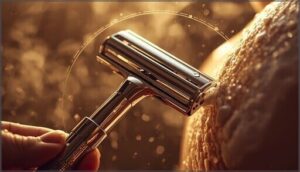
30-degree angle isn’t just a number — it’s a tactile angle feel you’ll recognize instantly.
Start with the blade almost flat, then slowly tilt until it bites clean. That’s blade edge geometry working for you.
Keep grip pressure light and consistent.
Short practice stroke rhythm builds muscle memory fast.
Nail this, and wet shaving transforms completely.
Adjusting Angle for Facial Contours

Your face isn’t flat — so your blade angle can’t be either. Cheekbones sit comfortably at 30–35 degrees. The jawline tilt shifts slightly steeper, tracking the bone ridge. Neck adjustment demands constant micro‑changes, especially around the Adam’s apple.
Chin contour needs 35–40 degrees. Upper lip angle tightens to 40–45 degrees for precision. Each zone rewards the right blade angle with zero irritation.
Hand Position and Grip Techniques
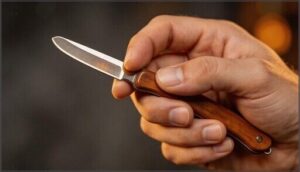
Controlling the blade starts with your hand — not your wrist, not your elbow.
Basic Grip puts two fingers in front of the scales, two behind, thumb underneath for balance.
Switch to a Pinch Grip for against-grain neck strokes. Use the Push Grip on longer runs. Freehand Grip controls your dominant-side passes.
Thumb Placement locks your Blade Angle. Wrong grip, wrong shave.
Angling a Safety Razor for Best Results
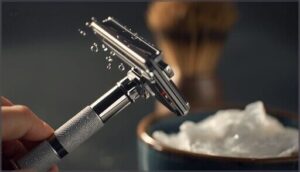
Safety razors are more forgiving than straight razors, but angle still makes or breaks the shave.
A few key things determine how you find and hold that sweet spot.
Here’s what what actually matters.
Optimal Angle Range (25–35 Degrees)
Safety razors live in a sweet spot — 25 to 35 degrees. That’s your whole operating range.
A 30-degree angle is the go-to for most shaving technique passes, but sensitive skin benefits from dropping to 25 degrees.
Coarse hair? Push toward 30-35.
Use blade angle feedback cues like sound and glide. Quiet scrape means you’re in.
No pressure-free technique breaks that zone.
How Razor Design Affects Angle
Not all razors are built equal — and that changes your blade angle before you even touch skin.
- Head Geometry shifts your handle position: closed comb heads hold steady around 30 degrees; open comb demands tighter control.
- Blade Exposure level determines aggressiveness — positive exposure favors steeper angles.
- Spine Thickness on straight razors sets the bevel, usually 16–18 degrees.
Shavette Setup and Handle Length also influence razor angling precision.
Step-by-Step Angle Adjustment Guide
Start perpendicular — handle straight up, blade flat. Then tilt slowly until both the top cap and safety bar rest flush against skin. That’s your 30-degree angle locked in.
Grip pressure light — three fingers, loose wrist.
Mirror feedback to monitor alignment on curves.
Air stroke drills before lathering up.
Lather balloon test to nail blade pivot without risking your face.
Preparing Skin and Beard for Shaving Angle

Even the perfect angle won’t save a bad shave if your skin isn’t ready. Prep is what separates a smooth result from a red, irritated mess.
Here’s what you need to do before the blade ever touches your face.
Cleansing and Hydrating Skin
Clean skin isn’t optional — it’s the foundation. Start with a pH‑balanced cleanser and lukewarm water.
Hot water strips your skin’s natural oils and invites irritation. Wash for about 30 seconds, rinse well, then press a warm, damp towel to your face for 2–3 minutes. That softens the beard.
Finish with a few drops of pre‑shave oil to lock in moisture and cut blade drag.
Creating and Applying Quality Lather
Good lather is half the shave. Once your skin is prepped, grab your shaving brush and load it properly — wet shaving lives or dies by what’s on your face.
- Brush loading — Work your badger brush into the shaving cream until it looks pasty
- Water balance — Add water slowly; too much kills density
- Ingredient selection — Pick creams with glycerin and stearic acid for real cushion
- Lather texture — Aim for glossy, yogurt-thick — no big bubbles
- Application technique — Use circular strokes first, then paint it flat
Pre-Shave Oil Benefits
Lather does the heavy lifting — but pre-shave oil sets the stage. A few drops before lathering up create real skin protection, forming a thin barrier that keeps your blade angle from dragging.
Hair softening happens fast — about a minute in. That means less pulling, better lubrication enhancement, and serious irritation reduction.
Oils like jojoba and argan also handle moisture retention, so your skin care doesn’t stop at the shave.
Safety, Maintenance, and Troubleshooting Tips

Even the best angle means nothing if your blade is dull or your technique keeps catching skin.
A few simple habits will keep your razor performing and your face intact.
Here’s what actually matters for safety, maintenance, and fixing the mistakes most guys make.
Preventing Nicks and Irritation
Nicking yourself isn’t bad luck — it’s usually a fixable technique. Nail these three habits and razor burn becomes rare:
- Shave with-the-grain using short strokes, 1–2 inches max
- Keep light pressure — let blade angle do the work
- Stretch skin taut before every stroke on cheeks and neck
post-shave cooling. Cold water, alcohol-free balm. Done.
Maintaining Blade Sharpness and Angle
sharp blade holds its angle — a dull one fights you.
Strop 20–30 strokes per side daily, edge trailing on leather.
That realigns microscopic teeth without eating into your blade bevel angle.
Hone with light, even pressure — consistency matters more than aggression.
After each shave, dry fully and apply edge preservation oils.
Moisture kills edges faster than bad technique ever will.
Common Angle Mistakes and How to Fix Them
Most angle mistakes fall into four buckets — and each one has a fast fix.
Steep Angle Errors cause tugging. Drop the handle until the blade glides clean.
Shallow Angle Problems scrape skin — tilt the spine up 1–2 degrees.
Inconsistent Angle Shifts wreck consistency; stabilize your wrist and let muscle memory build.
Grip Angle Confusion is common — focus on blade-to-skin, not handle position.
Contour Angle Adjustments matter most at the chin: go 5 degrees steeper.
Frequently Asked Questions (FAQs)
What is a razor blade angle?
Everything hinges on one invisible measurement. Blade angle is the tilt between your razor’s edge and your skin — 30 degrees hits the sweet spot for a clean, efficient cut every time.
What angle should a safety razor be?
Most safety razors hit their sweet spot at 30 degrees. That’s your blade angle baseline. Stay between 25–35 degrees — mild razors handle 35, aggressive ones need closer to 25 for safe blade exposure.
What is the best angle to cut a razor?
For the cleanest cut, 30-degree angle is your baseline.
Bevel angle standards land between 16–19 degrees per side — that’s pure blade geometry.
Your shaving technique bridges both: spine flat, edge engaged, smooth pass.
Do different types of razors require different angles?
Yes.
Blade geometry impact is real — straight razor shaving demands manual 30-degree control, safety razor angle sits 25–35 degrees, cartridge angle variance is built-in, and electric shaver tilt should stay flush to skin.
Can razor angle differ for head shaving?
Absolutely — scalp curvature changes everything. Crown angle drops to 15–20 degrees. Side panel gradient holds around Nape tilt stays 20– Head shaving demands constant blade angle adjustment, unlike the face.
Does beard growth direction affect ideal angle?
Growth grain mapping matters—a lot.
Your neck hair angle runs flatter, cheek direction influence shifts, and chin growth variance pops straight out.
Contour angle adjustment keeps your blade angle true, improving shaving techniques, beard preparation, and overall shaving safety.
How does skin tightening improve razor angle control?
Tight skin is your secret weapon. Skin tension flattens bumps, locks blade angle, and lifts hairs upright — cutting nicks by 50%. Better angle stability means cleaner cuts, less drag, zero guesswork.
Should razor angle change with shaving pass number?
small tweaks matter.
Most wet shavers keep a consistent blade angle across passes, adjusting only 5–10 degrees.
Your pass-by-pass angle strategy is less about big changes, more about precision.
Can razor angle vary for upper lip shaving?
Yes — upper lip angle shifts. The curve near the nose demands a flatter blade, closer to 25 degrees. Less angle, less scrape. Short strokes. Let the lip contour guide you.
Conclusion
Studies show that nearly 70% of shaving irritation comes from poor technique—not cheap razors. Learning how to angle the razor correctly solves most of that instantly. One small tilt adjustment—around 30 degrees—changes everything. No more burning, no more patchy spots, no more blaming the blade.
Your razor was never the problem. Once your angle locks in, every pass gets cleaner, faster, and more consistent. That’s not a minor upgrade. That’s the whole game.
- https://www.shaverater.com/learn/guides/30-degree-angle-safety-razor
- https://gravityrazors.com/blogs/gravity-razors-blog/how-to-select-the-right-blade-angle-for-your-straight-razor
- https://sharprazorpalace.com/beginners/103728-finding-right-blade-angle-proper-holding-technique-shave.html
- https://docs.google.com/forms/d/e/1FAIpQLSft2CcQT7O59GB6mBpFvAxcuYez30sIROpeaOIM3LqzTmbG5g/viewform?usp=pp_url&entry.1452073181=Website
- https://onlinelibrary.wiley.com/doi/full/10.1111/ics.12330