This site is supported by our readers. We may earn a commission, at no cost to you, if you purchase through links. This content is for general informational and educational purposes only and is not a substitute for professional medical, dermatological, or nutritional advice.

A braided beard doesn’t happen by accident. The guys pulling off clean Viking plaits or a sharp chin braid started exactly where you are—staring at a fistful of facial hair and wondering where to begin.
The good news is that braiding a beard follows a straightforward pattern once you know the basics, and the results hold longer than most people expect.
Length, texture, and prep work do most of the heavy lifting before your hands even start crossing strands. Get those three things right, and the rest clicks into place fast.
Table Of Contents
- Key Takeaways
- How Long Should Your Beard Be?
- What Tools Do You Need?
- How Do You Prep Your Beard?
- How Do You Braid Your Beard?
- Which Beard Braid Styles Work?
- How Do You Maintain a Braided Beard?
- Frequently Asked Questions (FAQs)
- How to braid a beard for beginners?
- Is braiding your beard good for it?
- What is it called when you braid your beard?
- What are the best products to use for beard braiding?
- How long does it take to braid a beard?
- What is the best way to maintain a beard braid?
- Are there any risks associated with beard braiding?
- How often should I wash my beard when braiding?
- How can I prevent my beard from tangling?
- What’s the best way to undo a braid?
- Conclusion
Key Takeaways
- You need at least 3–4 inches of beard length before braiding works, because shorter hair won’t hold tension between strands.
- Prep is half the battle—wash, condition, and apply beard oil or wax before you touch a single strand, or the braid won’t last the day.
- Even tension is what separates a clean braid from a lumpy mess, so keep your crossovers consistent and never pull sideways.
- Maintenance is simple but non‑negotiable: oil daily, wash two to three times a week, and loosen the braid before bed to avoid breakage.
How Long Should Your Beard Be?

Before you reach for a comb, you need to know if your beard is actually ready to braid. Length and texture both play a bigger role than most guys expect.
Once you’ve sized up your beard, picking the right tool makes all the difference—this guide on choosing the best beard comb for your hair type and length walks you through exactly what to look for.
Here’s what you need to know based on where your beard is right now.
3–4 Inches for a Basic Three-strand Braid
Three to four inches is your starting point. At this length, grip length importance kicks in — each strand has enough material to lock against the others and hold. Here’s what happens at this length:
- Tension management becomes easier since strands don’t slip apart constantly.
- Hold point stability improves once you secure the tip with an elastic band.
- Visibility impact is real — the simple three-strand braid pattern shows clearly.
4–8 Inches for Easier Styling and Control
Once you hit 4 to 8 inches, braiding gets noticeably easier. Your grip technique improves because each strand has real weight behind it.
Finger placement stays controlled, and edge incorporation — pulling in small bits of surrounding hair — actually holds. Your elastic choice matters here too: a snug, small band keeps the braid intact longer, boosting braid longevity through daily wear.
8+ Inches for Viking-style and Multi-braid Looks
Push past 8 inches and you’re in Viking territory. That’s where Viking Length Benefits really show — your braid hangs clearly below the chin, and Multi-Braid Volume actually fills out instead of tapering off.
Density Optimization matters here: thicker sections hold Texture Patterns beautifully.
Use Secure End Ties on each strand, and those Viking Double Braided Beard lines stay locked all day.
Straight, Wavy, and Curly Beard Differences
Your beard’s texture changes everything about braiding techniques and beard length requirements.
Straight hair lies flat and braids predictably, but curly hair suffers from serious curl shrinkage — what measures 6 inches stretched might be 4 inches naturally.
Growth direction varies too, affecting tangle tendency and moisture retention.
Curly beards need extra length and consistent hair texture management to build real visual volume in any braid.
Understanding genetics determines beard texture helps you select appropriate grooming tools.
Why Beard Density Matters for Clean Braids
Density is your secret weapon for Coverage Consistency and a braid that actually holds.
More hairs per section means better Tension Balance — you’re not fighting gaps or exposed skin as you cross strands.
It also improves Knot Resistance and Frizz Control, since fuller sections stay smooth longer.
Thin beards lose their Longevity Retention fast, so build density first, then braid.
What Tools Do You Need?
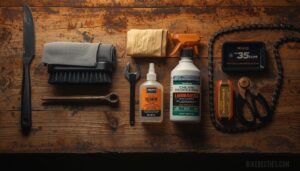
Before you start weaving strands, you’ll want the right gear in your corner. Nothing’s worse than getting halfway through a braid and realizing you’re missing something basic.
Here’s what you actually need to get the job done right.
Wide-tooth or Fine-tooth Beard Comb
You actually need two combs for beard braiding — not one. Start with a wide-tooth beard comb for breakage reduction and curl preservation; it glides through tangles without snagging.
Then switch to a comb with thin teeth for styling precision and clean sectioning. This density matching approach means you comb your beard in fewer passes, reducing damage while keeping every plait tight and controlled.
Beard Scissors or Trimmer for Cleanup
Both tools earn a spot in your beard care routine — just for different jobs. Use a trimmer with guard length settings for fast, even bulk removal along braid edges. Switch to beard trimming scissors for precision edge control and heat‑free cutting on flyaways a guard misses.
Here’s what to know about each:
- Scissors give you blade shape impact for softer, more feathered ends
- Trimmers keep both sides symmetrical through repeated guard passes
- Curved blades follow facial contours better than straight‑edged ones
- Scissors handle final detail work with no charging required
- Tool maintenance matters — dull blades on either tool create uneven braid sections
Beard Oil, Balm, or Wax for Hold
Think of styling products as a spectrum.
Beard oil conditions and adds slip — great for your daily beard care routine, but nearly zero hold. Beard balm sits in the middle with a weight flexibility balance that works for light shaping.
For a tight braid, beard wax wins: stronger hold, matte or low-shine finish, longer-lasting grip between strands.
Small Elastic Bands or Beard Ties
The right beard tie can make or break your braid’s finish. For Band Material Choices, fabric-covered small hair elastics are your safest bet — they won’t snag or snap strands. Width and Tension matter too: aim for 4–5 mm bands for everyday braids.
- Choose silicone or fabric-wrapped elastic bands for Safety and Comfort
- Match band width to braid size for proper tension control
- Swap out beard accessories every 4–6 weeks for Longevity and Replacement
Styling Accessories like colored beads or metal rings pair well with elastic hair ties for a polished look.
Mirror for Sectioning and Symmetry
A good mirror is non-negotiable when you section your beard. Eye-level positioning keeps you honest — you’ll catch drift and uneven splits before they become real problems. Vertical orientation helps confirm center line verification instantly.
| Mirror Use | What to Check | Why It Matters |
|---|---|---|
| Section Your Beard | Three equally sized sections | Balanced braid foundation |
| Lighting consistency | Section boundary clarity | Spot gaps and thin spots |
| Braiding rhythm | Strand alignment per cross | Prevents the braid walking sideways |
Beads, Rings, or Wraps for Styling
Once your mirror’s in place, it’s time to add some personality. Beads, beard rings, and wraps turn a clean braid into a signature look. Here’s what works:
- Bead Material Choices — Glass or stainless steel, sized 3–6mm for subtle Bead Placement Strategies
- Ring Wire Gauge — Use 20–24 gauge for wrap rings that hold without bulk
- Ring Comfort Tips — Smooth, bailless ends sit flat against skin
- Wrap Pattern Techniques — Micro-twist wraps add spiral texture
- Integrating Beads and Rings into Beard Braids — Pair beads with small chains for a layered, decorative finish
How Do You Prep Your Beard?

Good prep makes the difference between a braid that holds all day and one that falls apart by noon. Before you divide a single strand, your beard needs to be clean, soft, and ready to work with.
Here’s how to get it there.
Wash With a Gentle Beard Cleanser
Before anything else, wash your beard with a sulfate-free cleanser — your braid’s foundation depends on clean, pliable hair.
Surfactant choice matters here. Harsh detergents strip natural oils and leave strands brittle. Choose beard cleansers built with mild surfactants, moisturizing agents like glycerin, and a stable pH balance.
| Feature | Harsh Cleanser | Gentle Beard Wash |
|---|---|---|
| Surfactant type | Sulfate-based | Sulfate-free |
| pH Balance | Unregulated | Skin-friendly buffered |
| Moisturizing Agents | Absent | Glycerin, aloe, oils |
| Fragrance-Free Options | Rare | Commonly available |
| Rinse Temperature | Any | Lukewarm recommended |
Use lukewarm water, lather with one or two pumps, and rinse until suds clear. Fragrance-free options work best if your skin runs sensitive. Keep it simple — a clean beard is a braid-ready beard.
Condition to Soften and Improve Flexibility
After washing, don’t skip the conditioner — dry hair tangles, snaps, and fights you every step of the braid. A good beard conditioner delivers moisture retention and an elasticity boost that turns stiff, wiry strands into flexible fibers you can actually work with.
Massage it in, let it sit for a minute, then rinse. That heat-free softening makes all the difference when sectioning.
Pairing that softening step with a routine built around hair strengthening and thickening helps stop breakage before it steals your length.
Pat Dry Instead of Rubbing Harshly
Now that your conditioner is rinsed out, grab a clean towel and press — don’t scrub.
Rubbing creates friction reduction problems fast: frizz shoots up, tangles multiply, and skin irritation prevention goes out the window.
For smart moisture management, pat with a microfiber cloth — towel material choice matters here.
A few gentle presses and you’re done. Damp is perfect. Dripping isn’t.
Apply Oil or Balm for Slip and Control
Your beard is damp and ready — now’s the time to add your product.
For slip balance, a few drops of beard oil rubbed between your palms work well. Prefer more hold smoothing? A pea-sized amount of beard balm softens with body heat for even distribution.
Don’t overdo it. Light, even coverage keeps your beard conditioning routine clean and your braiding strands cooperative.
Detangle From Ends to Roots
Now comb your beard starting at the ends — not the roots. This is Knot Detection Techniques in action: catching older tangles before they tighten.
Use a wide-tooth comb with Comb Pressure Control, working in small sections through Progressive Sectioning. Moisture Slip from your beard oil benefits every stroke, letting the comb glide upward gradually until Root Tension Release happens naturally and each section lies smooth.
Part and Section The Beard Evenly
Now comes the step that makes or breaks your braid — parting and sectioning. Use Comb Direction Control to sweep hair cleanly from the center, establishing your Center Line Alignment straight down from your lower lip.
From there, apply Finger Pinch Measurement along both sides for Section Width Balance.
Root-to-End Separation keeps each strand clean, and this hair sectioning technique sets up every crossover that follows.
How Do You Braid Your Beard?
Now comes the part where it all comes together. Braiding a beard isn’t complicated once you know the order of moves. Here’s how to work through it step by step.
Divide The Beard Into Three Equal Strands
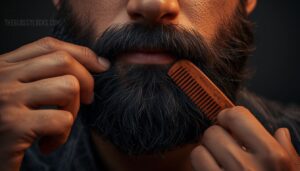
Start with the comb. Use the Comb Sectioning Technique to divide your beard straight down into three portions, working with its natural fall.
Strand Width Consistency is everything here — each section needs the same amount of hair at the base.
Do a quick Visual Symmetry Check in the mirror, then apply Hair Density Balancing by shifting a little from any thicker strand to the thinner one before your fingers take over with a firm Finger Grip Positioning.
Cross The Right Strand Over The Middle

Now the real braiding technique begins. Take the right strand and lay it flat across the middle — that’s your first cross.
Angle Consistency is key: keep the same crossing angle every time so your braid patterns stay uniform.
Use Finger Placement near the base and maintain Wrist Alignment so nothing snags.
Tension Control and Cross Visibility confirm you’ve nailed it.
Cross The Left Strand Over The New Middle
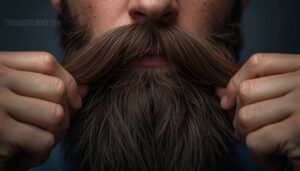
Once the right strand settles into the middle, the left strand takes its turn. Arc it smoothly across — that’s your Left Over Tension move, and it’s the heartbeat of any solid braid pattern.
- Lift the left strand and guide it in an Arc Motion toward center.
- Use Cross Path Control — keep it flat, not looped.
- Land it with Center Alignment directly over the midpoint.
- Follow a steady Hand Sequence so every pass mirrors the last.
- Match your tension to the right-side cross — even pressure, every time.
Add Small Amounts of Hair as You Braid

Now that both strands have found their rhythm, it’s time to build thickness through Incremental Hair Feeding. Before each crossover, pinch a small piece from the outer edge and fold it into the working strand — that’s Small Piece Integration in action. Strand Thickness Matching keeps everything even as you go.
| Step | Action | Why It Matters |
|---|---|---|
| Feed small pieces | Grab a thin section before each cross | Prevents bulk and gaps |
| Match strand size | Size each added piece to existing strands | Keeps braid even |
| Control direction | Feed hair along the braid’s path | Avoids bumps at seams |
| Stop when full | Continue normally once thickness is right | Locks shape cleanly |
Consistent Feed Direction means every piece enters from the same side. Crown Tension Control holds your base steady after each add. These Beard Braiding Techniques are the backbone of professional Hair Extension Techniques for Beard Braiding.
Keep Tension Even Without Pulling Too Tight
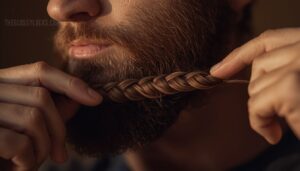
Tension is what separates a clean braid from a lumpy mess. Use Finger Width Guidance to keep each strand evenly spaced, and Cross Height Consistency, so no strand rides higher than the others.
Pull Direction Control means pulling straight down, never sideways. Apply Product Slip Balance, so hair glides without clumping. Run a quick Tension Check Routine every few crosses — braid tightening too fast risks traction alopecia.
Secure The End With a Small Band
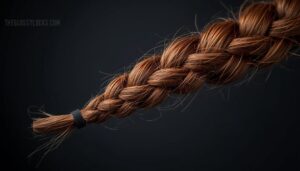
Once the braid is done, grab a thin elastic band and loop it right at the tail — that’s your Band Placement Precision in action.
Elastic Tension Balance matters here: tight enough to hold, loose enough not to snap hairs.
This is one of the simplest Fray Prevention Methods. Stick to a Band Replacement Schedule every week or two.
Which Beard Braid Styles Work?

Once you’ve got the technique down, the fun part starts — picking a style that actually suits you. Your beard length and density will narrow it down pretty quickly, so there’s no guessing game.
Here are the styles worth knowing about.
Single Chin Braid for Shorter Beards
Got a shorter beard? The single chin braid is your move.
Start at the chin, divide out three sections, and weave them down using your basic over-under pattern. Secure the end with a small elastic tie.
It’s a clean look that suits most beard shape compatibility types, and works well with a little beard wax to keep flyaways under control.
Double Viking Braids for Longer, Denser Beards
Double Viking braids demand commitment — you need 8+ inches of dense growth before attempting this style. Symmetry Techniques matter from the first split: divide your beard down the center and keep both sections equal in thickness throughout.
- Part cleanly and braid each side independently.
- Add small amounts of hair as you weave down.
- Secure each braid with quality Band Material Choices like metal rings or leather wraps.
Forked V Braid for a Split Look
The forked V braid splits your beard into two distinct sections, each braided separately for a bold, Viking-inspired look.
Symmetry Tips and Strand Thickness Balance are everything here — use a comb to center-part cleanly before weaving.
| Step | Detail |
|---|---|
| V-Shape Definition | Part evenly down the center |
| Product Slip Control | Apply beard wax before braiding |
| Forked Braid finish | Secure each end separately |
| Edge Beading Techniques | Add beard styling accessories to tips |
Fishtail Braid for a Textured Finish
The fishtail braid beard style is where things get interesting.
You’ll need at least 5 inches and a light Grip Spray to keep Section Width consistent as you alternate thin outer pieces across.
Use Tension Control so nothing bunches up, then Pancake Edge the sides gently for that full, textured look.
Finish with a Matte Finish beard wax and a small elastic to lock it in.
Beaded Goatee Braid for a Bold Style
Want a look that turns heads without saying a word? The beaded goatee braid delivers exactly that.
Start with your chin braid centered, then use the Wire Threading Technique to slide beard beads along the length — Bead Weighting helps them sit firmly and stay put.
Chrome or wood beads add Color Contrast Styling with real Cultural Symbolism behind every choice.
Swap beads every two weeks for Durability & Maintenance.
How Do You Maintain a Braided Beard?

Getting the braid right is only half the job. Keeping it looking sharp takes a little daily attention, but nothing complicated.
Here’s what you need to do to keep your braided beard in good shape.
Reapply Beard Oil to Keep Hair Soft
braided beard dries out faster than a loose one — oil has less surface to breathe through. Keep a few drops of beard oil handy and reapply daily, adjusting your drop quantity based on length and climate adjustments for dry or cold weather.
Work it in from roots to tips, then use a comb for even distribution. That’s your conditioning beard hair routine locked in.
Wash Gently a Few Times Per Week
Two to three times a week is your sweet spot for beard wash days. Use a sulfate-free shampoo with lukewarm water — avoid hot water, since it strips the oils keeping your beard healthy.
Apply a gentle rinse technique, massaging the roots without loosening the beard.
Finish with beard conditioner, rinse thoroughly, and pat dry.
That’s solid beard care routine discipline right there.
Loosen The Braid Before Sleeping
Before you hit the pillow, take a minute for nighttime braid loosening. Sleeping in a tight braid concentrates pressure on the roots and jawline — that’s a fast track to soreness and breakage. Loosen the braid gently, ease the end tie for gentle end release, and check for pressure points.
Sleeping in a tight braid is a fast track to soreness and breakage — loosen it before bed
Nighttime beard maintenance, this simple, goes a long way toward hair elasticity preservation.
Use a Silk Pillowcase to Reduce Friction
Once the braid’s loosened, what your head rests on actually matters. A silk pillowcase gives you real silk friction reduction overnight — hair glides instead of snagging on rough fabric. That means less frizz, better moisture retention, and genuine bedhead prevention by morning.
- Promotes skin hydration by absorbing less moisture than cotton
- Keeps nighttime protection for braided facial hair consistent
- Follow basic pillowcase cleaning tips: gentle wash, no harsh detergents
Trim Flyaways and Split Ends Regularly
Even on a well-kept braid, flyaways and split ends show up.
Flyaway Detection is simple — run your fingers along the braid after washing and feel for rough, snagging tips.
From there, Sharp Scissor Use matters: dull blades crush the ends and make things worse.
Use the Dusting Technique — trim just a quarter inch with a micro trim every six to eight weeks for solid Split-End Prevention.
Replace Tight Bands Before They Damage Hair
Bands stretch out and lose grip fast — and that’s when the real damage starts. Swap them every one to two weeks as part of your Band Replacement Schedule.
Watch for Damage Prevention Signs like thinning at the tie point, a signal of traction alopecia risk.
For Nighttime Band Care, loosen or switch to Safer Tie Alternatives — cloth ties or satin ribbons keep hair tension control gentle overnight.
Frequently Asked Questions (FAQs)
How to braid a beard for beginners?
Think of it like learning to tie knots — start simple. With a 3-inch beard, basic DIY beard braiding takes just three strands, steady hands, and patience.
Your StepbyStep Guide to Braiding a Beard begins here.
Is braiding your beard good for it?
It can be, yes — but only if you do it right.
Loose braids help with moisture retention and reduce daily friction. Go too tight, though, and you’re looking at real traction alopecia risk.
What is it called when you braid your beard?
Braiding your beard goes by a few names depending on the style. The general term is a beard braid or plaited beard.
Two braids side by side are called Viking beard braids.
What are the best products to use for beard braiding?
Your products make or break the braid.
Use Beard Oil for slip, Beard Balm or Beard Wax for hold, and a Beard Conditioner or Leave In Conditioner to keep strands flexible and frizz-free.
How long does it take to braid a beard?
Most guys spend 5–15 minutes once they’ve got the hang of it.
Your beginner learning curve adds time, and style timing variance is real — a single chin braid beats double Viking braids every time.
What is the best way to maintain a beard braid?
Keep it simple: oil daily, wash gently two or three times a week, and loosen the braid before bed.
A solid beard care routine is what separates a braid that lasts from one that falls apart.
Are there any risks associated with beard braiding?
Yes — tight braids carry real risks. Traction alopecia, skin irritation, breakage risk, and band pressure on hair ties are all worth knowing.
Loosen your braid nightly and skip synthetic hair hazards when possible.
How often should I wash my beard when braiding?
Wash your beard two to three times a week. Rinse-only days handle sweat and salt between washes.
Adjust based on your skin type, activity level, and how your braid smells or feels.
How can I prevent my beard from tangling?
Tangles are a beard’s worst enemy—and they’ll undo hours of work instantly.
Use beard oil daily, apply a leave-in conditioner, and practice even tension control while detangling from ends to roots.
What’s the best way to undo a braid?
Start from the bottom and work upward. Use your fingers first, then a wide-tooth comb. Add slip product to stubborn knots. Remove elastic ties carefully to avoid snapping hairs loose.
Conclusion
Most guys think learning how to braid my beard is some ancient Viking secret passed down in mead halls—reserved for the chosen few with mythic patience and magic fingers. The truth? It’s just three strands, steady tension, and a little wax.
You’ve got the steps, the tools, and the know-how now. So stop waiting for a sign carved in rune stone and start crossing those strands.
Your braid won’t plait itself.