
This site is supported by our readers. We may earn a commission, at no cost to you, if you purchase through links.
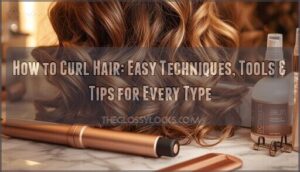
You’ve seen those perfect curls on Instagram, bouncy and natural, while yours fall flat within an hour. The frustration is real, but here’s the truth: the difference isn’t luck or magic products—it’s technique.
Most people skip key prep steps, use the wrong barrel size for their hair type, or crank up the heat thinking hotter equals better (spoiler: it doesn’t).
Learning how to curl hair properly means understanding your unique texture, choosing the right tools, and mastering a few key methods that actually work. Once you nail these fundamentals, you’ll create gorgeous, long-lasting curls that turn heads and boost your confidence.
Table Of Contents
- Key Takeaways
- Essential Tools for Curling Hair
- Preparing Hair for Curling
- Choosing The Right Curling Method
- How to Curl Hair With a Curling Iron
- How to Curl Hair With a Flat Iron
- Heatless Curling Methods Explained
- Tips for Long-Lasting Curls
- Curling Techniques for Different Hair Types
- Maintaining Healthy Curled Hair
- Safety Precautions When Curling Hair
- Frequently Asked Questions (FAQs)
- What are some common mistakes to avoid when curling hair?
- Can I curl my hair without using heat?
- How can I make my curls last longer?
- Are there any tips for preventing damage and breakage while curling hair?
- How do I refresh curls on day two?
- Can I curl wet or damp hair safely?
- Why do my curls fall flat so quickly?
- Whats the best way to sleep on curls?
- How do I fix curls that turned out uneven?
- Conclusion
Key Takeaways
- Prepping your hair with the right shampoo, conditioner, and heat protectant is essential for curls that last and stay healthy.
- Choosing the right curling tool and technique depends on your hair’s texture, length, and desired curl style.
- Letting curls cool completely before touching and using a lightweight holding spray helps lock in shape and volume all day.
- Avoid high heat, work in small sections, and use heat-resistant gloves to prevent damage, burns, and breakage while styling.
Essential Tools for Curling Hair

You can’t master the curl without the right gear in your hands. The tools you choose will make or break your results, so it’s worth knowing what actually works.
Here’s what you need to create curls that hold, shine, and turn heads.
Curling Irons and Wands
Curling irons and wands are the backbone of Curl Styling Tools. You’ll want to master both for every Hair Curl Type.
Curling Iron Tips: use the clamp for control, pick barrel size for curl shape, clean the barrel for Iron Maintenance, and always use heat protectant.
Wand Techniques give you looser waves—just wrap, hold, and release.
Flat Irons for Curling
If you’re ready to break the rules, grab your flat iron—this tool isn’t just for straightening. With the right Curling Techniques, a flat iron creates everything from tight ribbon curls to beachy waves.
Use 1-inch plates for medium curls, adjust Heat Settings for your hair type, and always pair with Styling Products for shine and Iron Maintenance.
Hair Rollers and Clips
If you’re craving soft volume or defined waves, hair rollers are your shortcut to easy texture. Pick roller materials like nylon-coated foam to avoid snagging, and pay attention to clip placement—no one wants crease marks. Adjust roller sizes for your curl tension and style.
These hairstyling tools let you control every curl, no heat required, just pure technique.
Heat Resistant Gloves
Once your rollers are set, grab a heat-resistant glove before picking up the curling iron. Glove materials like aramid fibers and silicone offer solid thermal insulation and burn prevention, especially with high heat. Safety features matter—look for non-slip grips and reinforced fingertips.
Pair with a heat protection spray, and you’ll master curling techniques with confidence, control, and zero singed fingers.
Preparing Hair for Curling

Getting your hair ready is the secret to curls that actually last. You’ll want to start with a few basics before you reach for any hot tools. Here’s what you need to know first.
Washing and Conditioning
Want curls that actually last? Start with clean, balanced hair—think Hair pH Balance and Scalp Care. Pick a Shampoo Selection that matches your hair texture, then follow with Conditioner Types that boost Moisture Levels. Your hair care routine sets the stage for every curl, no matter your hair types.
- Fresh scalp, fierce curls
- pH balance means less frizz
- Conditioner for shine
- Shampoo for strength
- Moisture for curl definition
Applying Heat Protectant
Every time you reach for a curling iron, grab your heat protectant first. A thermal spray or lightweight hair serum forms a shield, locking in moisture and defending against heat damage.
Heat protectant isn’t optional—it’s your shield against damage every single time you style
For bold, lasting curls, work the product through damp strands, focusing on mid-lengths and ends. Smart styling products mean less color fade, smoother finish, and real damage prevention.
Sectioning Hair Properly
Precision is your secret weapon for impeccable hair curling. Hair Sectioning sets the stage for uniform results and balanced volume, letting you control Curl Distribution from crown to nape.
Use Sectioning Tools like a tail comb and adjustable clips to divide your hair—don’t rush this step. Proper sectioning ensures every curl technique works, no matter your hair texture or styling goal.
Choosing The Right Curling Method

Finding the best curling method starts with understanding your hair and what you want from your style. The right approach depends on your texture, tools, and length.
Here’s how to choose the technique that fits you best.
Assessing Hair Texture and Type
Ever tried curling your hair only to watch it fall flat or frizz out? That’s why knowing your hair texture and type is your secret weapon. Start with:
- Hair Porosity and Scalp Analysis for true moisture control
- Texture Classification and Elasticity Measurement to predict curl hold
- Curl Pattern Identification for matching technique to hair care and maintenance needs
Master these, and you control the outcome.
Selecting Curling Tools
Think of curling tools as your arsenal—each one changes the game. Curling Iron Tips matter: choose ceramic or tourmaline for shine and less frizz. Barrel Sizes shape your style—smaller for tight curls, larger for loose waves. Heat Settings control damage; fine hair loves lower temps, thick hair needs more.
Curling wand, flat iron, hot rollers—pick what matches your vision.
Matching Curl Style to Hair Length
Your hair’s length calls the shots on which curl patterns work best. Ignoring Hair Length Considerations guarantees flat roots or floppy ends—here’s your roadmap for Styling Short Hair through Long Hair Curling:
- Short hair thrives with tight, defined curls that pack volume and shape
- Shoulder-length pairs with loose to medium waves for balanced body
- Medium to long benefits from soft, larger barrel curls preventing weighed-down looks
- Start curls near roots on shorter lengths, dodging crown flatness
- Very long hair needs root lifts combined with mid-length waves to fight excessive weight
Match your curl techniques to your length, and you’ll master Volume Enhancement Techniques that actually hold.
How to Curl Hair With a Curling Iron
The curling iron is your go-to tool for creating everything from loose, natural waves to tight, bouncy spirals that hold all day. Mastering a few core techniques gives you the freedom to switch up your look without heading to a salon or second-guessing your skills.
Here are four classic methods that’ll transform how you curl, no matter what vibe you’re going for.
Flat Wrap Curl Technique
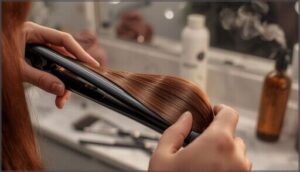
You’re about to discover a classic technique that delivers smooth, uniform curls with real staying power. Start by clamping your flat iron near the roots, then roll the hair around the closed plates while keeping tension consistent—this wrap angle controls your curl direction. Cool completely before touching, and you’ll see glossy, defined curls that resist humidity when sealed with flexible-hold spray.
| Hair Texture | Recommended Heat Settings |
|---|---|
| Fine or Thin | 300°F – 340°F |
| Medium Thickness | 340°F – 370°F |
| Thick or Coarse | 370°F – 392°F |
| Color-Treated | 300°F – 350°F |
| Damaged Hair | Below 320°F |
Lazy Curl Method
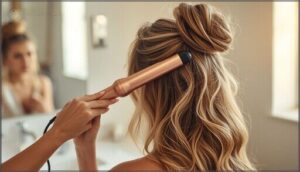
When speed trumps flawlessness, the lazy curl method sets you free. Grab a 1.25 to 1.5 inch curling iron, clamp larger sections loosely, and let gravity do the work—no twisting required. This technique boosts hair volume and creates relaxed curl patterns that look effortlessly cool.
- Wrap hair around the barrel with a loose grip for soft curl texture
- Hold for 5-8 seconds, then release without tugging
- Let curls cool completely before touching to extend curl longevity
- Skip the comb and finger-style for natural movement
- Try heatless styling overnight with foam rollers for zero-damage lazy curls
Spiral Curl Steps
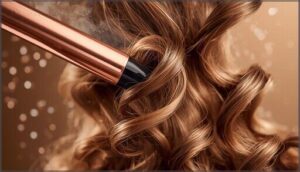
For tight, bouncy ringlets that won’t quit, master the spiral technique with your curling iron or curling wand. Wrap each section continuously around the barrel from ends to root, creating that signature S-shaped curl pattern.
Mist hair lightly before styling, apply heat protection, and hold for 8-10 seconds. Finish with light-hold spray for curl maintenance that defies gravity and humidity.
Red Carpet Waves
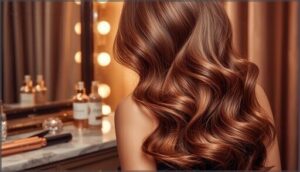
Once you’ve nailed spiral curls, it’s time to command Red Carpet Waves. Use your curling iron to sculpt medium sections into smooth, S-shaped hair waves. Alternate curl direction for balanced wave formation, then brush out gently for a flawless finish.
For that true red carpet look, remember:
- Prep with heat protectant
- Use flexible styling products
- Cool and set
- Boost with shine serum
How to Curl Hair With a Flat Iron
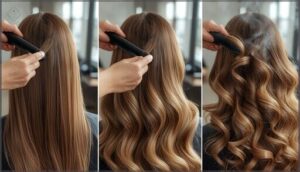
Flat irons aren’t just for straightening—they can create some of the most adaptable curls and waves you’ll ever wear. With the right technique, you can shape everything from tight ribbon curls to laid-back beachy waves.
Here’s how you can master each style step by step.
Creating Ribbon Curls
Ever wondered how to get those sleek, uniform spirals that make heads turn? The ribbon technique is your ticket. Use a flat iron or curling iron with a narrow barrel, wrap a thin strand vertically, and keep tension steady. Finish with a light-hold spray for curl longevity.
Here’s a quick breakdown:
| Curl Pattern | Hair Texture | Styling Products |
|---|---|---|
| Slender | Fine | Serum |
| Uniform | Thick | High-hold spray |
| Defined | Porous | Light mist |
Making Push Waves (S-Waves)
Fluidity sets the stage for push waves—think S Wave Technique with a flat iron or curling iron, held flat against your hair. For natural Wave Formation and Curl Enhancement, work section by section, keeping tension even.
Use heat protectant before curling hair, then finish with lightweight Styling Products. This method suits most Hair Texture, giving you smooth, touchable waves with rebellious polish.
Achieving Beachy Waves
Kick things off by misting your hair with heat protectant, then grab your flat iron or curling wand. For casual beachy waves, twist and glide each section away from your face, alternating directions for lived-in wave texture and natural volume.
Let curls cool before raking through with fingers. A dash of sea salt spray amps up hair movement and curl enhancement—classic Beachy Wave Tips.
Heatless Curling Methods Explained
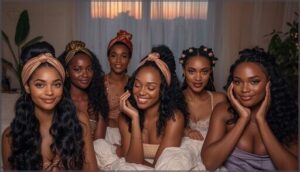
You don’t need hot tools to get beautiful curls. There are simple ways to shape your hair that are gentle and work with any texture.
Let’s look at a few heatless methods you can try tonight.
Braiding for Curls
Ready to rebel against heat damage? Braiding for curls puts you in charge—no hot tools, no fuss. Your braid patterns shape curl definition and enhancement, so experiment with tight box braids or loose plaits.
For best results:
- Section evenly for uniform curls
- Use silicone-free conditioners for grip
- Let hair dry completely before unraveling
Your hair texture drives the final look.
Using Hair Rollers
Want volume that lasts for days without frying your ends? Hair rollers are your secret weapon. Pick your Roller Selection—foam for gentleness, Velcro for speed.
Damp hair is best for Hair Setting and Curl Formation. Section evenly, roll away from your face for lift.
Roller Maintenance matters; clean them often to suit your Hair Texture and keep your hair curling techniques sharp.
Twisting and Pinning Techniques
Ever tried Twist Methods for curl enhancement and hold? Twist sections away from your face, secure with Pin Curling at varied heights, and let cool for serious Curl Longevity.
Use a light texturizing spray for Hair Texturing. Tighter Twist Patterns give bold, defined curls—looser ones, softer waves.
These hair curling techniques beat frizz, boost volume, and don’t need heat.
Tips for Long-Lasting Curls
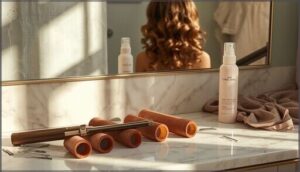
Getting curls to last all day can feel like a challenge, but a few smart tricks make a big difference. It’s all about what you do before, during, and after styling.
Here’s what you need to know for curls that hold their shape and bounce.
Cooling and Setting Curls
Curl Hold is all about patience and precision. For lasting hair setting, let each curl cool untouched for 5–10 minutes—this Cooling Time locks in shape and boosts Curl Preservation. Pin curls to your scalp, then spritz a lightweight spray for Frizz Control. Wait until heat’s gone before brushing; that’s how curls hold, protecting texture and enhancing heatless curls.
- Let curls cool fully
- Pin for shape retention
- Use lightweight holding spray
- Avoid brushing hot curls
- Prioritize gentle handling
Avoiding Common Mistakes
Letting curls cool is smart, but don’t sabotage your hard work with common styling errors. Using a curling iron on dirty hair or skipping heat protectant invites Curl Damage and dull results. Cranking up Heat Settings isn’t mastery—it’s a shortcut to hair damage.
Prioritize Hair Preparation, choose the right heat protection spray, and stay sharp about Curl Maintenance to keep your look bold.
Curling Techniques for Different Hair Types
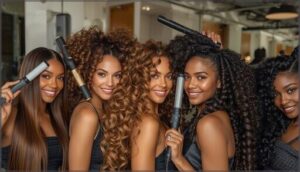
Every hair type has its own quirks regarding curling. Getting the right technique can make all the difference in how your curls turn out.
Here’s what you need to know for your specific hair type.
Fine and Straight Hair
Fine hair demands a lighter touch and smarter strategy. Start with a heat protectant, then choose a curling iron with a smaller barrel—around 0.75 to 1 inch—to create definition without weighing strands down.
Keep temperatures between 300°F and 350°F for damage prevention. Work in thin sections, hold for just five to eight seconds, and let curls cool completely before touching them for maximum curl enhancement.
Thick or Textured Hair
Thick hair is your secret weapon—it holds curls like a dream. Crank your curling iron up to 350°F to 380°F and work with wider sections since your dense strands need more heat to set.
Hair porosity affects how products sink in, so apply curl enhancement sprays while damp for better texture management.
A wide-tooth comb prevents breakage during detangling, and frizz control serums smooth the cuticle without weighing down your volume.
Color-Treated and Damaged Hair
Damage control starts before you even pick up your curling iron. Color-treated strands lose over 40% of their moisture, so you’ll need serious hair protection to keep breakage at bay and lock in curl preservation.
- Drop your heat to 350°F max—anything higher accelerates color fade and compounds hair damage exponentially.
- Layer a silicone-based heat protectant on dry hair to create a shield that distributes temperature evenly and aids frizz reduction.
- Work with smaller sections and skip repeat passes—one smooth glide preserves your color protection while delivering defined curls without extra stress.
Bond-building treatments between styling sessions restore strength, turning fragile hair into a canvas that holds waves beautifully. These hair care tips aren’t optional—they’re your lifeline to healthy, lasting curls and effective hair repair.
Maintaining Healthy Curled Hair
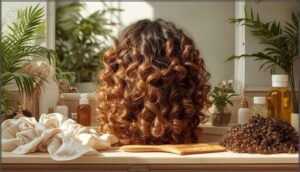
You’ve mastered the techniques, now it’s time to protect what you’ve created. Gorgeous curls aren’t just about the styling—they’re about keeping your hair strong, shiny, and ready for your next look.
Here’s how to maintain healthy hair that can handle all the curling you throw at it.
Post-Curl Hair Care
Your curls deserve royal treatment after styling. Lock in your look with a flexible-hold hairspray for curl preservation and frizz control, then resist the urge to touch them while they cool.
For hair refresh between washes, try a lightweight curl enhancer or texturizing spray. These hair care tips maintain style while protecting your work—keeping your curls bouncy, defined, and camera-ready all day.
Preventing Heat Damage
Your best defense against thermal damage starts before you even pick up a curling iron. Apply heat protection evenly from roots to tips, then dial your tool to the lowest effective temp—fine hair thrives at 300–340°F, while thick strands can handle up to 400°F. One pass per section beats multiple reheats every time.
Between styles, embrace heatless curling methods and heatless hair styling to give your strands a break and let damage control work its magic.
Recommended Hair Treatments
Think of hair treatments as your curl insurance policy—skip them, and you’re one hot-tool session away from brittle, lifeless strands. Integrate these into your routine every one to four weeks:
- Keratin Treatments smooth frizz for two to four months while locking in protein therapy benefits.
- Deep Conditioning Hair Masks restore moisture balance in just twenty minutes.
- Bond-Building Damage Repair products reinforce your cuticle after every heat styling session.
Safety Precautions When Curling Hair
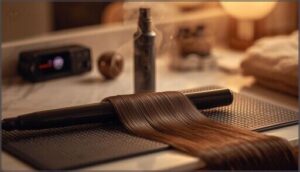
Curling your hair doesn’t have to come with the risk of burns, breakage, or heat damage—if you know how to protect yourself and your strands. A few smart precautions can make the difference between gorgeous, healthy curls and a styling disaster you’ll regret.
Here’s what you need to keep in mind before you turn up the heat.
Temperature Guidelines
You want curls that last, not hair that’s fried—so start with the lowest temperature that actually works. Fine or damaged hair thrives around 300–325°F, while thick or coarse textures usually need 350–375°F. Never push past 392°F, or you’ll dull your color and invite breakage.
Test a small section first, then adjust up if your curls won’t hold. Thermal control equals damage prevention.
Using Heat Resistant Gloves
Your hands deserve protection just as much as your hair does. Heat-resistant gloves made from silicone or neoprene shield you from burns while you work the curling iron close to your scalp or face.
Look for gloves rated to at least 400°F for solid thermal insulation. They give you control without sacrificing hand safety, so you can curl confidently and fearlessly.
Preventing Burns and Breakage
Keeping hot tools away from your scalp takes practice, but it’s worth it. Hold the curling iron barrel at least half an inch from your roots to dodge burns while you work.
Limit each section to 8–12 seconds of heat exposure—any longer invites breakage and thermal damage.
Heat protection spray isn’t optional; it’s your first line of defense against fried ends and weakened strands.
Frequently Asked Questions (FAQs)
What are some common mistakes to avoid when curling hair?
Overheating your curling iron above 350°C can fry your strands and trigger frizz—that’s not a myth.
Always use thermal protection, curl completely dry hair, and avoid gripping one section too long to prevent breakage.
Can I curl my hair without using heat?
Yes, you can absolutely create curls without heat. Heatless curling methods like braiding damp hair, using foam rollers, or twisting and pinning sections form natural waves and curls without causing heat damage.
How can I make my curls last longer?
Think of curls like a sandcastle—without the right mix, they crumble fast. Curl hold tips and smart product choices make all the difference.
For long lasting styles, use light-hold hairspray, cool curls before touching, and avoid heavy oils.
Are there any tips for preventing damage and breakage while curling hair?
For Damage Control and Breakage Prevention, always use Heat Protection before curling hair. Choose the lowest effective temperature on your curling iron, dry hair thoroughly, and section precisely.
For Hair Repair and Curl Preservation, schedule regular trims and deep treatments.
How do I refresh curls on day two?
For Day Two Styling, mist your hair with a lightweight curl refresher spray, then scrunch gently for Curl Revival.
Focus on the mid-lengths and ends, avoid heavy products at the roots, and let curls air-dry for natural enhancement.
Can I curl wet or damp hair safely?
Curling hair when it’s wet ramps up heat damage risk and breakage, especially for fine or color-treated hair.
For safer Damp Hair Styling, let hair air-dry, use heat protectant, and try Wet Curl Methods like braids or rollers.
Why do my curls fall flat so quickly?
Curls not holding? It’s a twist of fate—high hair porosity lets moisture mess with your curl pattern, humidity sabotages curl retention, and weak frizz control or wrong curling methods leave your texture limp, no matter the curling iron.
Whats the best way to sleep on curls?
To boost curl preservation overnight, swap out cotton for silk or satin sleep accessories.
Try a loose pineapple or braid, use a lightweight sealing product, and stick to a gentle nighttime routine for frizz prevention and curl maintenance.
How do I fix curls that turned out uneven?
Let’s iron out those curl regrets! For Curl Repair, section unruly strands, re-curl with your curling iron, and match tension and direction.
Hair Rebalancing means smoothing frizz, aligning texture, and finishing with flexible spray for impeccable Curl Redoing.
Conclusion
Think of your curling routine as the secret sauce—when you know how to curl hair with the right tools, prep, and method, you’re cooking up styles that actually last. Every strand responds differently, so experiment boldly and watch your confidence grow with each twist and wave.
Don’t let old habits flatten your vibe; take control and let your curls speak for you. With these techniques, you’re not just styling hair—you’re crafting your own signature look.