
This site is supported by our readers. We may earn a commission, at no cost to you, if you purchase through links.

You mixed the dye perfectly, followed the timing to the letter, and rinsed it out with anticipation—only to find your hair looks like a patchwork quilt. Some sections absorbed the color beautifully while others barely changed at all. It’s frustrating, embarrassing, and honestly a little baffling when you did everything by the book.
The good news? Patchy hair dye isn’t a disaster you have to live with or hide under a hat for weeks. Whether you’re dealing with a few stubborn light spots or a full-blown color catastrophe, you can fix it without frying your hair or breaking the bank. The right approach depends on how severe the patchiness is and what caused it in the first place.
Table Of Contents
- Key Takeaways
- What Causes Patchy Hair Dye?
- How to Assess Patchy Hair Color
- Step-by-Step Fix for Slightly Patchy Hair
- Solutions for Moderately Uneven Hair Dye
- How to Correct Severely Patchy Hair Dye
- At-Home Techniques to Fix Patchy Color
- Styling Tips to Conceal Patchy Dye
- How to Prevent Patchy Hair Dye Next Time
- Frequently Asked Questions (FAQs)
- What Causes Uneven Color?
- Should I Dye My Roots First or Last?
- How Do I Get Even Coverage With Hair Dye?
- What Does Banding Mean in Hair Color?
- What Can I Do About Patchy Bleached Hair?
- Why is My Hair Dying Unevenly?
- How Soon Can I Dye My Hair Again to Fix It?
- How Do You Fix Hair Color Mistakes?
- How Do You Fix Blotches in Your Hair?
- Can patchy hair dye damage my scalp?
- Conclusion
Key Takeaways
- Patchy hair dye stems from six fixable causes: incorrect dye-to-developer ratios, insufficient product volume for your hair length, poor sectioning during application, product buildup creating invisible barriers, and uneven porosity from previous damage or processing.
- Mild patchiness responds to color-depositing masks and toning glosses, moderate unevenness needs targeted semi-permanent reapplication or strategic highlights, while severe cases require full re-dyeing or professional color stripping to start fresh.
- Prevention beats correction every time—clarify buildup 1-2 days before dyeing, mix exact ratios, section hair into four quadrants with thin subsections, and apply systematically while respecting processing times to avoid repeating the same mistakes.
- You can temporarily hide patchy results with strategic braids that weave uneven sections together, root concealer sprays that wash out in 1-2 shampoos, or heat styling that creates dimension and shadows to blur harsh color transitions.
What Causes Patchy Hair Dye?
Patchy hair dye usually doesn’t happen by accident—there’s almost always a reason behind it. Understanding what went wrong is the first step to fixing it and preventing it from happening again.
Let’s break down the main culprits so you can see exactly where things went off track.
Incorrect Mixing of Dye and Developer
When dye and developer aren’t mixed properly, you’re asking for trouble. Think of it like baking—skip thorough blending, and you’ll get pockets where the color doesn’t take evenly.
Most systems need precise developer ratios (1:1, 1:1.5, or 1:2) to work right. Incomplete blending leaves streaks one tone lighter or darker. Even slight off-ratio mixing reduces pigment concentration by up to 50%, especially in resistant areas. That’s your recipe for patchy, uneven coverage.
Always follow manufacturer instructions to guarantee correct mixing.
Insufficient Dye or Developer
Here’s where most people stumble: they don’t use enough product. Whether you’re short on dye, developer, or both, your hair won’t get fully saturated.
Short hair needs about 60–75 ml of mixed color; medium hair, 75–90 ml; long or thick hair, 90–150 ml. Skimp on volume, and you’ll see lighter spots where coverage fell short. Stretching one kit across thick hair? That’s a setup for patchiness.
Buy extra if you’re unsure about hair density—it’s cheaper than corrective coloring. Failing to do so can lead to undesirable color outcomes.
Uneven Application Techniques
Even with enough product, incorrect application creates patches. Over 60% of professional colorists identify poor sectioning methods as the top cause of uneven results. When you skip systematic four-quadrant sectioning or apply in random patterns, entire areas get missed.
Poor sectioning causes over 60% of patchy dye jobs—skip systematic four-quadrant application and entire areas get missed
Saturation levels vary when you grab thick chunks instead of thin slices. Timing errors compound the problem—starting at roots on virgin hair creates hot spots, while delayed application between sections causes visible banding.
Tool usage matters: squeezing dye straight from the bottle instead of using a brush leaves streaky coverage. Application direction affects outcome, too.
Dirty or Uneven Base Hair
Your canvas matters as much as your technique. Product buildup and sebum levels create invisible barriers that block dye penetration in patches. Studies show unwashed hair for three days can have 30% surface coverage from oil, strongest at roots.
Previous color creates an uneven base—darker virgin roots versus lightened ends absorb differently. Scalp condition affects contact, too.
That’s why clarifying protocols recommend washing 12–24 hours before dyeing, removing buildup while protecting your scalp.
Hair Porosity and Damage
Porosity levels determine how well your strands grab and hold color—and damaged hair absorbs unevenly. Chemical processing and environmental impact create weak spots where dye floods in too fast, leaving darker patches.
Here’s how damage drives patchiness:
- Cuticle damage lifts protective scales, exposing the cortex
- Cortex weakening creates porous zones that over-absorb dye
- Bleached sections can nearly triple porosity within one minute
- UV exposure degrades melanin and alters fiber structure
- Repeated treatments compound porosity variations along each strand
Treating damaged hair before coloring evens your canvas.
How to Assess Patchy Hair Color

Before you can fix patchy hair dye, you need to understand exactly what you’re dealing with. Think of this step like a doctor diagnosing a problem—you can’t choose the right treatment until you know how serious it is.
Let’s walk through how to assess your situation so you can pick the best fix for your hair.
Identifying Severity (Mild, Moderate, Severe)
Before you jump into correcting uneven hair color, you need to know exactly what you’re dealing with. Evaluating your patchy hair dye situation upfront helps you choose the right fix and avoid wasting time or damaging your hair further.
Here’s how to gauge severity:
| Patch Level | What You’ll See |
|---|---|
| Mild | Slight color disparity between sections; subtle tonal shifts visible mainly in direct light |
| Moderate | Noticeable uneven hair color with distinct lighter or darker zones; multiple areas affected |
| Severe | Dramatic contrast across your head; sharply defined streaks or blotches; possible damage assessment needed |
Check your scalp condition too—redness or irritation signals future risk if you proceed with aggressive hair color correction immediately.
Recognizing Patch Patterns (Roots, Ends, Spots)
Where does your patchy hair dye show up most? Root banding appears as a 1–2 cm ring of off-color roots near the scalp, while end unevenness creates lighter or darker tips. Spotting patches form irregular blotches in dense areas like the crown.
Look for pattern cues—horizontal bands signal timing issues, vertical streaks point to sectioning problems. Check under bright viewing conditions; natural light reveals every uneven section you’ll need to correct.
Evaluating Hair Condition Before Correction
Before you apply another drop of color, your hair needs a thorough health check. Start by examining your scalp health for any irritation or flaking—those are red flags.
Next, assess shaft damage by running your fingers along strands; rough texture signals trouble. Test hair porosity by floating a strand in water, check elasticity risk with a gentle stretch, and review your chemical history honestly.
A strand test confirms what your hair cuticles can handle.
Step-by-Step Fix for Slightly Patchy Hair
If your hair color looks a little off but isn’t a total disaster, you’re in luck. Minor patchiness can often be fixed at home without starting from scratch.
Here are three simple methods to smooth out those slightly uneven areas and restore balance to your color.
Using Color Refreshing Masks
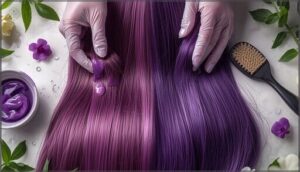
When your color looks slightly uneven, a color revitalizing mask acts like a toner meets a treatment—damage mitigation wrapped into one smart step. These masks deposit semi-permanent pigment onto your cuticle, creating visible tone adjustment in just 3 to 10 minutes.
Mask application is straightforward: work it through towel-dried hair, focusing on lighter patches. Market trends show over 60% of users rely on this patchy prevention method between salon visits.
Applying Toning Gloss or Glaze
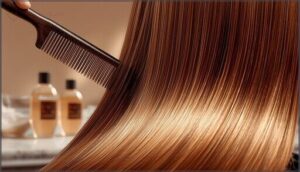
When your hair color needs subtle refinement, toning gloss or glaze becomes your go-to color correction tool. These acidic formulas (pH 4.0–6.0) gently deposit pigment without ammonia, making them perfect for fragile, over-processed strands.
- Section towel-dried hair and apply gloss evenly with a wide-tooth comb
- Leave on 5–20 minutes depending on desired intensity
- Rinse thoroughly until water runs clear
- Expect 4–6 weeks of gloss longevity with proper maintenance
- Professional application ensures consistent color blending across uneven areas
Color-Depositing Shampoos and Conditioners

Between salon visits, color-depositing shampoos and conditioners offer low-commitment tone correction. Purple formulas neutralize yellow brassiness in one wash, while red and copper masks revive faded ends in 10–30 minutes. These products deposit pigment at 0.5%–4% concentration—enough for managing unevenness without structural damage. Use weekly for 3–5 minutes, focusing on lighter sections. They’ll fade after 3–8 shampoos, but you’ll extend color longevity between full dye applications.
| Product Type | Best For |
|---|---|
| Purple shampoo | Blonde brassiness, yellow tones |
| Copper conditioner | Faded reds, warm highlights |
| Color reviving mask | Reviving mids and ends |
| Blue shampoo | Orange tones in brunettes |
Solutions for Moderately Uneven Hair Dye
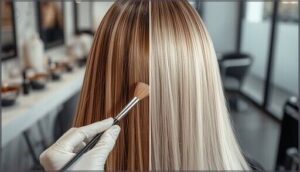
When your hair dye situation is past the quick-fix stage but not a total disaster, you’re dealing with moderate patchiness. This is where you need to roll up your sleeves and take more deliberate action to even things out.
Let’s walk through three solid techniques that’ll help you correct those uneven areas and get your color back on track.
Reapplying Semi-Permanent Dye
When patchy hair dye appears moderate, reapplying semi-permanent dye offers a straightforward fix. Allow one to two weeks between applications to minimize color build-up and cuticle stress, especially if porosity impact from previous processing makes your strands grab pigment unevenly.
Check fade patterns first—waiting until you’ve lost 30 to 50 percent intensity prevents banding and ensures smoother reapplication timing with better processing technique throughout.
Targeted Application to Missed Sections
Sometimes reapplication won’t cover every inch evenly—that’s when you target the lighter zones directly. Sectioning technique transforms fixing patchy hair dye from guesswork into control: divide hair into four quadrants, then create thin subsections within each patch.
Product preparation matters just as much:
- Remix dye and developer fresh for uniform pigment
- Match your original shade exactly
- Reserve extra mixture for stubborn spots
Load your brush and press color into both sides of each strand, ensuring full saturation where application missed before.
Adding Highlights or Lowlights
When targeted reapplication isn’t enough, dimension rescues flat, uneven results. Highlights placed 1–2 levels lighter than your base break up contrast lines around your crown and face—babylight weaves spaced 0.5–1 cm apart blur demarcation beautifully.
Overly light patches? Lowlights 1–3 levels deeper soften brightness, especially in mid-lengths where damage shows most.
Balayage-based correction blends patchy zones while preserving 30–50% of your existing color for natural-looking depth.
How to Correct Severely Patchy Hair Dye
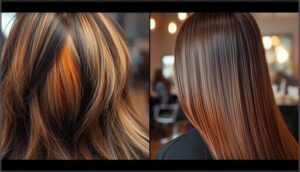
When your hair dye disaster is beyond a quick fix, you need more aggressive methods to get back on track. Severely patchy color won’t blend away with a gloss or mask—you’re looking at starting over or calling in backup.
Here are three powerful solutions that can salvage even the worst dye jobs.
Full-Head Re-Dyeing
When patchiness spans your entire head, full re-dyeing offers the most even solution. Start by evaluating porosity—high-porosity sections grab color faster, so you’ll need porosity equalization with a protein filler before application.
Choose developer strength carefully: 10-volume for same-level coverage minimizes damage on already-colored hair. Apply strategically to resistant areas first, then porous ends, managing risk through proper timing and post-color conditioning.
Color Stripping and Bleach Baths
When color stripping and bleach baths enter the picture, you’re dealing with heavy-duty hair dye correction methods. Oxidative dye mechanism breakdown happens through hydrogen peroxide, removing artificial color but causing structural hair damage. Professional color stripping agents generally work within 30–60 minutes, though bleach bath safety demands careful monitoring—fine hair needs only 15–45 minutes. Market usage context shows this segment is growing, yet at-home attempts carry serious risks.
- Strip before re-dyeing: Color stripping agents remove oxidative dye buildup, creating a clean canvas for correcting patchy hair dye without adding more pigment on top of uneven color.
- Dilute bleach properly: Bleach baths use lower peroxide concentrations than full bleaching, reducing structural hair damage while still lifting unwanted tones from your hair color correction.
- Watch processing times: Fine hair processes faster—check every 10 minutes to prevent overprocessing, gumminess, or breakage during your bleach bath safety protocol.
- Expect increased porosity: Both methods disrupt the cuticle and accelerate color fade in future washes, so you’ll need protein treatments and acidic rinses post-correction.
- Assess damage first: Previously chemically treated hair faces higher breakage risk—if your hair already shows dryness or elasticity loss, skip bleach baths entirely.
Seeking Professional Salon Correction
When at-home fixes won’t cut it, professional salon services step in with sophisticated hair color correction techniques that protect your hair health while delivering predictable results.
The correction process often spans multiple appointments. Stylists assess damage, plan phased lightening, and rebuild bonds between sessions.
Salon cost factors reflect this expertise: expect $100–200 per visit, though complex cases may run higher.
Finding qualified stylists through salon portfolios ensures you’re trusting someone skilled in professional hair stylist advice who understands your hair’s limits and delivers expected salon outcomes.
At-Home Techniques to Fix Patchy Color

If you’re fixing patchy hair dye at home, the good news is that a few key techniques can make all the difference. Getting it right comes down to how you prep, mix, apply, and rinse your color.
Here’s what you need to focus on to guarantee even, professional-looking results from your own bathroom.
Proper Sectioning and Application Methods
Think of sectioning like painting a wall—you wouldn’t slap color everywhere and hope for the best. Professional hair dye application methods rely on quadrant strategies to control color distribution and prevent patchy hair dye. Here’s how application technique transforms your results:
- Divide hair into four equal quadrants using center and ear-to-ear parts
- Create 1–2 cm subsections within each quadrant for thorough product saturation
- Apply systematically from back to front, adjusting application order for different hair types
- Monitor timing control across all sections to guarantee even processing
Mixing Dye Thoroughly
You can’t fix patchy hair if you’re working with a sabotaged mixture from the start. Developer ratios matter—professional systems use 1:1 for coverage, 1:1.5 for moderate lift, and 1:2 when lightening.
Weigh your color and developer with mixing tools (no eyeballing!) and stir for 60 seconds until streak-free. Mixture stability drops fast, so apply immediately.
Technique consistency prevents uneven color and eliminates causes of patchy hair before they happen.
Timing and Rinsing Best Practices
Processing duration isn’t negotiable—30 to 45 minutes for permanent hair dye application, adjusted for hair porosity timing differences. Start counting after your last section finishes.
When time’s up, emulsify color with wet hands at the scalp before rinsing with lukewarm water until clear. Agitation importance? Massage every quadrant thoroughly—incomplete rinsing leaves concentrated pigment in dense areas, creating exactly the uneven application you’re trying to fix.
Using Tools Like Dye Brushes and Bowls
Beyond timing and rinsing, your application technique hinges on what’s in your hand. A dye brush and mixing bowl aren’t optional upgrades—they’re precision tools that transform home hair dyeing from guesswork into controlled coverage.
Why bowl-and-brush methods prevent patchiness:
- Brush bristle density holds consistent product per stroke, saturating every strand root-to-end
- Bowl material safety (plastic, glass, ceramic) prevents metal reactions that alter dye chemistry
- Mixing bowl design with textured interiors ensures lump-free, even-strength color before you apply
Clean tools thoroughly after each use—residue from previous sessions compromises future results.
Styling Tips to Conceal Patchy Dye
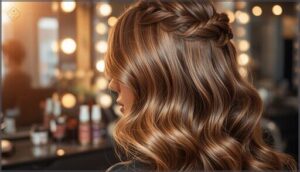
While you’re working on a more permanent fix, you don’t have to walk around with patchy hair on full display. There are plenty of quick styling tricks and temporary products that can help you hide uneven color until you’re ready to correct it properly.
Let’s look at some simple ways to disguise those patchy spots and feel more confident in the meantime.
Braids, Ponytails, and Updos
When you’re waiting for your next color correction, strategic hair styling can keep patchy hair dye out of sight. Braids work beautifully to break up harsh color lines—French or Dutch styles weave sections together, disguising uneven patches along your lengths. High ponytails soften root demarcation by gathering lighter and darker areas into one cohesive look. Messy buns and textured updos fold hair over itself, hiding color bands while adding simple dimension.
| Style Technique | Best For |
|---|---|
| French/Dutch Braids | Mid-length patchy sections and visible banding |
| High Ponytails | Overgrown roots and crown demarcation |
| Messy Buns | Uneven hairlines and nape patchiness |
| Half-Up Updos | Top-layer color inconsistencies |
Color Blending Sprays and Colored Dry Shampoo
When updos aren’t enough, color blending products offer instant coverage for patchy hair dye. Root concealer sprays coat the hair surface with temporary pigment that washes out in one to two shampoos—perfect for quick fixes between salon visits. Tinted dry shampoo does double duty, absorbing scalp oil while depositing color onto lighter patches for even blending.
Effective spray application techniques include:
- Hold the can six inches from dry hair to avoid oversaturation and uneven application.
- Match your shade carefully—brands now offer caramel, chestnut, and deep ebony tones for precise color correction.
- Apply in short bursts to targeted sections where uneven application is most visible, building coverage gradually.
- Let the spray dry completely before touching—most formulas become transfer-resistant within 30 seconds.
Color longevity factors matter: these products resist light humidity but require reapplication after shampooing. Ingredient safety concerns exist with some aerosol formulas containing irritants like diamine sulfate, so always spray in well-ventilated spaces and avoid contact with eyes.
Cost-effectiveness analysis shows temporary sprays at $8–15 per bottle deliver dozens of touch-ups, making them budget-friendly compared to salon color correction sessions.
Heat Styling for Volume and Dimension
While sprays provide surface coverage, strategic heat styling creates optical illusions that downplay patchiness. Blow-drying at your roots lifts hair away from the scalp, casting shadows that blur color transitions—but keep temperatures under 95℃ to prevent accelerated color fading and hair damage in high-porosity sections.
Curling irons add dimension through varied light reflection; loose waves disguise demarcation lines better than tight curls, which can exaggerate uneven tones if heat exposure oxidizes artificial pigments faster in previously over-processed areas.
How to Prevent Patchy Hair Dye Next Time

You’ve fixed the patchy mess, but let’s make sure it doesn’t happen again. A few simple habits can save you from another color disaster and keep your results looking salon-quality every time.
Here’s what you need to focus on before, during, and after your next dye job.
Prepping Hair Properly Before Dyeing
You need to start with a clean, balanced canvas. Use clarifying shampoos 1–2 days before dyeing to strip buildup without stripping scalp oil, which protects during coloring.
Test a strand to understand your hair porosity and how damaged sections grab color differently.
Deep conditioning earlier in the week boosts hair health, but skip heavy treatments right before—you want hair slightly damp, not dripping, for even moisture level and uptake.
Following Application Instructions Closely
Because at-home hair dyeing mistakes stem from skipping instructions, reading your brand directions prevents incorrect application. Mixing ratios, timing adherence, and sectioning methods directly impact saturation levels and even results.
Hair dye application techniques to follow:
- Mix color and developer at the exact ratio printed—often 1:1 or 1:2.
- Divide hair into four quadrants with 0.25-inch subsections for thorough saturation.
- Apply to mid-lengths first, then roots, respecting scalp heat.
- Leave dye on for the full recommended time—usually 30–45 minutes.
- Rinse with lukewarm water when processing completes.
Maintaining Hair Health and Color
When heat styling and UV exposure work together, they strip color faster and leave your hair brittle. Use a heat protectant before blow-drying or flat ironing to shield against damage.
Apply leave-in treatments with UV protection outdoors—sunlight breaks down pigments and dries cuticles. Gentle, sulfate-free shampoos preserve moisture retention and color longevity.
Professional treatments and deep conditioners restore hydration lost during dyeing, keeping your hair healthy between touch-ups.
Frequently Asked Questions (FAQs)
What Causes Uneven Color?
You might think “bad dye” is to blame, but uneven color usually starts with mixing ratios off, application saturation too thin, timing issues between sections, uneven base condition, or differences in hair porosity levels across your strands.
Should I Dye My Roots First or Last?
Apply hair dye to your roots first when covering gray or darkening regrowth, but work on midlengths and ends first when lightening uniformly.
Root processing speed near the scalp is faster because of body heat.
How Do I Get Even Coverage With Hair Dye?
Want truly even color coverage? Start by equalizing hair porosity levels with a bonding treatment, then divide your hair into clean sections.
Proper root application and thorough dye saturation prevent color inconsistencies before they start.
What Does Banding Mean in Hair Color?
Banding is a horizontal stripe or ring of different color between your roots and ends. This is usually caused by overlapping dye, long gaps between touch-ups, or scalp heat that processes regrowth faster than older hair.
What Can I Do About Patchy Bleached Hair?
Patchy bleached hair stems from uneven application or overlapping damage. DIY correction with toning solutions can help mild cases, while professional fixes are safer for severe unevenness.
Prevention tips include proper sectioning and monitoring processing time closely.
Why is My Hair Dying Unevenly?
Ironically, chasing perfect color often creates an uneven base, porosity issues, and product buildup.
Application errors—rushed mixing, thin saturation—combine with hair porosity levels to produce patchy hair from dye formulation problems or previous treatments.
How Soon Can I Dye My Hair Again to Fix It?
Most hair pros recommend waiting at least two weeks before reapplying permanent hair dye to fix patchy hair color. Semi-permanent hair treatment can often be used sooner, around one week.
How Do You Fix Hair Color Mistakes?
Even the pros mess up sometimes. To fix hair dye mistakes, choose corrective products like toners or color-depositing masks for DIY fixes, or book professional consultations for serious color correction methods.
How Do You Fix Blotches in Your Hair?
Blotches respond best to targeted application of semi-permanent dyes on lighter spots, color refresh masks for mild cases, or professional correction when contrast exceeds two levels—each styling solution matched to your uneven hair color’s severity.
Can patchy hair dye damage my scalp?
Yes, patchy hair dye can absolutely damage your scalp. When you mix dye incorrectly or apply it unevenly, concentrated chemicals can cause allergic reactions, chemical burns, barrier damage, and long-lasting symptom burden.
Conclusion
Fixing patchy hair dye is like solving a puzzle—you need the right pieces and patience to see the full picture. Whether you’re blending with a toning gloss, reapplying color to missed spots, or seeking professional help, the solution exists.
Don’t let one uneven result shake your confidence. With proper prep, thorough application, and these corrective techniques in your toolkit, you’ll master how to fix patchy hair dye and achieve the even, uniform color you’ve been chasing all along.
- https://pmc.ncbi.nlm.nih.gov/articles/PMC7678533/
- https://arolandsalonstudio.com/fixing-patchy-hair-color-professional-solutions/
- https://ijdvl.com/dermatological-adverse-effects-of-hair-dye-use-a-narrative-review/
- https://www.glamot.com/blog/32678/10-common-mistakes-you-re-making-when-dyeing-hair
- https://www.schwarzkopf.co.uk/article-overview/haircolor/unevenly_dyed_hair.html