This site is supported by our readers. We may earn a commission, at no cost to you, if you purchase through links. This content is for general informational and educational purposes only and is not a substitute for professional medical, dermatological, or nutritional advice.
Most guys who think they’re shaping a neck beard are actually making the same mistake: they’re shaving too high. The line creeping up toward the jawline might feel cleaner in the moment, but it strips away depth, shrinks your beard’s visual footprint, and leaves you looking like you’re wearing a chin strap instead of sporting real facial hair.
The proper neckline sits about one to two finger widths above your Adam’s apple, carving a subtle U-curve that follows where your neck meets your jaw. This placement anchors your beard, defines your jawline without choking it, and gives you the masculine edge that comes from understanding how to shape your neck beard the right way.
Get the anatomy right, and everything else—the trimming, the fading, the daily upkeep—falls into place.
Table Of Contents
- Key Takeaways
- Where Should Your Neck Beard Line Be?
- Does Face Shape Affect Neck Beard Shaping?
- Essential Tools for Shaping a Neck Beard
- Step-by-Step Guide to Shaping Your Neck Beard
- Shaping Techniques for Short and Long Beards
- Common Mistakes When Shaping a Neck Beard
- Maintaining a Clean and Healthy Neckline
- Frequently Asked Questions (FAQs)
- Is there a beard neckline template?
- How to shape your beard neckline below your ears?
- What neck exercises can build neck strength?
- How do you shape up a beard?
- What is a ‘neck beard’?
- How do you make a beard neckline?
- How do you cut a neck beard?
- How should I shape my neck beard?
- How to shape a beard under the chin?
- How do you tame a neck beard?
- Conclusion
Key Takeaways
- Your neckline should sit one to two finger widths above your Adam’s apple in a gentle U-curve—trimming higher creates a chin strap look that kills beard depth and makes your face appear weaker.
- Face shape dictates placement: round faces need the line lower for length, square faces can go slightly higher to soften angles, and long faces should drop it to add visual width.
- The fade technique prevents harsh edges by using progressively shorter guards (like 3mm to 2mm to 1mm) with overlapping strokes that blend naturally instead of creating visible lines.
- Over-shaving causes razor burn and ingrown hairs—limit yourself to two passes max, replace blades weekly, always shave with the grain, and give your skin recovery time between sessions.
Where Should Your Neck Beard Line Be?
Your neckline can make or break your entire beard, so getting the placement right is critical. Too high and you’ll look like you’re wearing a chin strap, too low and you’ll lose definition entirely.
If you’re just starting out, this guide to beard shaping for beginners walks you through finding your natural neckline and getting clean, balanced edges.
Your neckline can make or break your entire beard—too high looks like a chin strap, too low kills all definition
Here’s how to find that sweet spot and avoid the most common neckline mistakes.
Finding The Natural Neckline
Your natural neckline sits about one to two finger widths above your Adam’s apple, creating a gentle U-curve that follows where your neck meets your jaw. This sweet spot gives you proper beard symmetry without creeping down your neck like ivy.
Tilt your head back, place a finger at the top of your Adam’s apple, and you’ve found ground zero for smart neckline shaping.
For a refined look, consider the importance of a well-defined beard neckline in overall beard grooming.
Why The Jawline Isn’t Ideal
Placing your neckline right on the jawline robs you of beard depth and creates that dated chin strap look nobody wants. Here’s what you’re sacrificing:
- Beard fullness — you lose the neck hair that adds volume
- Smooth angles — movement exposes harsh edges under your chin
- Jaw definition — no shadow effect to sharpen your facial structure
- Style flexibility — less room for fades and tapers
- Beard balance — patchy appearance instead of solid coverage
Drop it lower for real impact.
Understanding the ideal neckline position techniques can make a significant difference in achieving a full, balanced beard.
Double Chin and Two-Fingers Method
Two simple techniques nail the placement every time. Stack your index and middle finger horizontally above your Adam’s apple—that top edge marks your trim zone. Or tilt your chin down to create a natural skin fold where jaw meets neck. Both methods land in the same sweet spot, roughly 1.5 inches up, giving you the beard symmetry and facial structure definition you’re after.
| Method | How It Works |
|---|---|
| Two Fingers | Stack fingers above Adam’s apple; top finger = neckline placement |
| Double Chin Fold | Tilt chin down; natural fold = trim boundary |
| Finger Width Adjustment | Wide fingers = use one; narrow = use two and a half |
| Curved U-Shape | Follow placement from jaw hinge to jaw hinge |
| Cross-Check Both | Match fold line with finger guide for beard trimming techniques consistency |
Does Face Shape Affect Neck Beard Shaping?
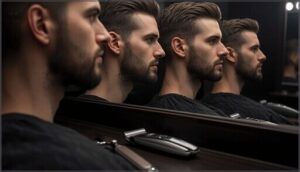
Your face shape isn’t just a detail—it’s the blueprint for where your neckline should land. A round face needs different treatment than a square or long one, and your natural growth patterns can throw their own curveballs into the mix.
Pairing the right neckline with proper beard grooming and hygiene practices ensures your facial hair always looks intentional and well-maintained.
Here’s how to adjust your neckline so it works with your features, not against them.
Round Face Neckline Placement
Round faces need strategic beard neckline placement to break up that soft, circular look. Set your line about 1 to 1.5 inches above your Adams Apple, forming a gentle U-Shape Curve that hugs where neck meets jawline. This keeps bulk under the jaw instead of pinching it high, which creates length and definition.
Master this grooming for different face shapes technique, and your beard trimming techniques will visually sharpen your entire face.
Square and Long Face Adjustments
Men with square faces usually set the neck beard line slightly higher at the back of the jaw, keeping that sharp jawline enhancement front and center without adding bulk. Long faces flip the script—drop your neckline a touch lower to add visual depth and counter vertical stretch.
This face shape analysis and neckline curvature tweak is pure facial hair balance, letting your beard styling tips and grooming for different face shapes work smarter, not harder.
Adapting to Growth Patterns
Growth rate and hair texture matter as much as facial structure when you’re dialing in your beard neckline. If neck density outpaces your cheeks, trim that zone more often to prevent a bottom-heavy look.
Uneven beard thickness calls for strategic guard adjustments—longer settings where growth lags, shorter where it sprints—keeping your beard shaping sharp and your facial hair grooming routine balanced during every beard trim and beard maintenance session.
Essential Tools for Shaping a Neck Beard
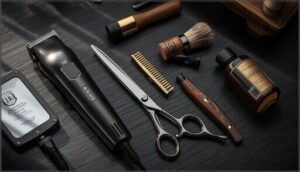
You can’t shape a neckline with your bare hands—you need the right gear to do the job without turning your neck into a warzone. The tools you choose determine whether you walk away with sharp, clean lines or a patchy mess that screams amateur hour.
Here’s what belongs in your grooming arsenal.
Choosing a Beard Trimmer
Your beard trimmer is the workhorse of neckline control, so invest in one that won’t let you down. Look for an electric trimmer with adjustable length settings—ideally 0.4 to 20 mm—so you can dial in the perfect fade from jawline to chest.
Blade types matter: titanium-coated or ceramic options glide through coarse hair with less tugging, while ergonomic design and cordless power sources keep your hand steady during detailed beard shaping work.
Using a Razor for Clean Edges
Once you’ve trimmed bulk hair with clippers, a razor becomes your finishing blade for shave techniques that carve crisp edges along the neckbeard line. Cartridge razors offer speed and forgiveness, while safety razors deliver less irritation through single-blade precision.
Prep skin with transparent gel for edge refining, then shave with the grain using light pressure—dull blades cause ingrown hairs, so swap them often for razor maintenance that keeps your neckline sharp.
Importance of Beard Comb and Mirror
You can’t judge neckline precision without a proper view. A handheld mirror shows the curve around your jaw and reveals patches you’d miss head-on, while a beard comb lifts tangled hairs so your beard trimmer cuts evenly.
Together, these grooming techniques turn guesswork into beard symmetry—combing downward shows exactly which hairs hang below the line, and mirror visibility lets you correct mistakes before they become crooked disasters.
Step-by-Step Guide to Shaping Your Neck Beard
Shaping your neck beard doesn’t have to feel like guesswork or a risky gamble with your clippers. With the right approach, you’ll carve out a clean, defined neckline that actually complements your beard instead of working against it.
Here’s how to get it done, step by step.
Pre-Trim Preparation and Washing

You wouldn’t trim a hedge without clearing debris first, right? Same logic applies here. Start with thorough beard cleansing—warm water therapy softens coarse hairs and opens pores for gentle shaving.
Wash your neck with beard-specific shampoo to strip away grime without drying out skin. Light skin exfoliation once weekly prevents ingrown hairs.
Pat dry completely before you pick up clippers, because wet hair lies flat and tricks you into over-trimming.
Defining and Marking The Neckline
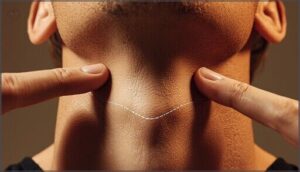
Once your beard’s dry, grab a white barber pencil for precise facial hair mapping. Place two fingers flat above your Adam’s apple, mark that spot, then dot under each jaw corner. Connect those points in a smooth U-curve—this neckline anatomy creates proper jawline contouring and beard symmetry.
Check both sides in dual mirrors to verify your neck curve styling matches perfectly before firing up that beard trimmer.
Trimming With Clippers or Trimmer
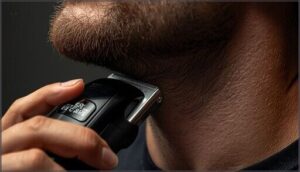
Snap on a 9 or 12 mm guard for your first pass—longer guards let you ease into beard trimming and shaping without accidentally scalping your neck. Work slow, even strokes downward, following the natural growth direction to prevent tugging. Use short, overlapping passes instead of sweeping your electric trimmer wildly. Keep light pressure; your beard texture shouldn’t fight the blade.
Once the bulk’s gone, drop to 3 or 6 mm for precise beard shaping and styling along that marked line.
Creating a Neckline Fade

A soft fade keeps your beard from ending in a harsh ledge. Start with a number 3 guard above your jaw, switch to a 2 on the mid neck, then a 1 near your Adam’s apple. Use light, flicking strokes—lift the trimmer away at each pass’s end to blend naturally.
- Overlap each stroke by a quarter inch to dodge visible bands
- Work against the grain first, then repeat downward with it
- Map your neck’s growth pattern before you begin fading methods
- Apply beard oil afterward to calm redness where guard changes happened
Shaping Techniques for Short and Long Beards
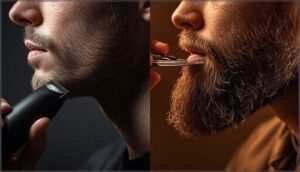
Your beard length changes everything regarding shaping that neckline. A stubble look demands different tactics than a full, flowing mane, and treating them the same is a rookie mistake.
Here’s how to adapt your technique based on whether you’re rocking a short crop or letting it grow wild.
Short Beard Neckline Guidelines
A clean neckline anatomy on a short beard makes all the difference between looking polished and unkempt. This beard symmetry respects your facial structure and keeps stubble from creeping down your neck. Place your beard neckline roughly one to one-and-a-half inches above your Adam’s apple, following a gentle U-shaped curve.
| Face Shape | Neckline Position | Effect on Beard Styling |
|---|---|---|
| Round | Slightly lower | Adds length, sharpens jawline |
| Square | Standard to higher | Softens boxy appearance |
| Long/Narrow | Higher with side bulk | Prevents face elongation |
Use your beard trimmer with a close guard—around 0.5 mm—and tilt your head back for visibility. The two-finger rule is a reliable grooming tip: stack two fingers horizontally above your Adam’s apple to find that natural sweet spot. This trimming technique prevents the dreaded “chin strap” look and ensures your short beard stays intentional and sharp, regardless of hair texture.
Long Beard Neckline Best Practices
Your long beard neckline sits one to two finger widths above the Adam’s apple, anchoring thick facial hair care and maintenance without dropping into scarf territory. That shallow U curve respects your facial structure and beard anatomy, keeping bulk hanging from the jaw instead of mid-neck.
Clean stray hairs below the line with your beard trimmer every few days so your neckline curves stay sharp and your beard shape looks solid, not scraggly.
Blending The Neckline With Beard Length
With a medium beard around 10 to 20 millimeters, your fade techniques need more room on the neck because there’s actual length to move down from. Start with your longest guard on the full beard shape, then drop one or two settings just below the neckline gradients.
Beard layering that uses three guard steps—say 6 millimeters, 4 millimeters, 2 millimeters—creates smooth blend methods your beard trimmer can nail without patchy stripes ruining your facial hair care and maintenance routine.
Common Mistakes When Shaping a Neck Beard
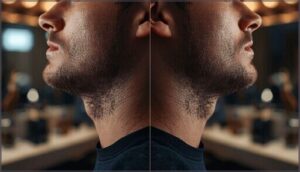
Even seasoned beard groomers make critical errors when shaping their necklines, and these mistakes can wreck an otherwise sharp look. The good news is that most slip-ups are entirely avoidable once you know what to watch for.
Here are the three most common neckline mistakes and how to steer clear of them.
Trimming The Neckline Too High
Shaving your beard neckline right at the jawbone might seem like a sharper choice, but it actually strips away the depth and fullness your beard needs. Trimming techniques that cut too high expose skin under the chin, making your facial structure look weaker and your beard thinner—often by 20 to 30 percent.
Instead, aim two fingers above your Adam’s apple with your beard trimmer for proper beard depth and natural hair thickness.
Uneven or Crooked Lines
A crooked beard neckline often sneaks up on you because mirrors hide what’s really happening under your jaw. Asymmetry issues arise when you rely on sight alone instead of using facial landmarks like jaw corners and the Adam’s apple as fixed reference points. Here’s how trimming errors create uneven lines:
- Cutting one side completely before touching the other copies angles incorrectly
- Stretching skin differently on each side causes the line to bounce back crooked
- Using your dominant hand for one side and switching mid-trim changes tool angle subtly
Symmetry techniques demand you alternate short, controlled strokes between sides, checking with straight-on photos under good lighting. If your beard neckline tilts noticeably, let neck hair grow one to two weeks, then redraw a smoother, lower line.
Neckline corrections work best when you soften hard edges into a short fade rather than chasing flawlessness and pushing the entire line higher. For ongoing beard styling and maintenance, mark dots at matching heights under each jaw using the two-finger method, then connect them with your beard trimmer in gradual passes—this grooming tip prevents the lopsided look that sabotages even the sharpest facial hair styling.
Over-Shaving and Skin Irritation
Attacking your neck daily with a razor turns it into a war zone—redness, stinging, and those angry little bumps all signal you’ve pushed too far. Razor burn flares when you scrape the same spot repeatedly, use a dull blade, or skip lubrication, while ingrown hairs pop up from shaving too close against the grain.
Smart shaving techniques—sharp razors, light strokes with the grain, fewer passes—cut irritation drastically. Aftercare tips matter just as much: rinse with cool water, pat dry gently, then lock in a soothing moisturizer to rebuild your skin barrier. These grooming tips and beard care basics keep your neck comfortable between trims, so shaving tips like spacing sessions every other day give your skin real recovery time instead of constant stress.
| Cause | Result | Prevention |
|---|---|---|
| Multi-pass shaving | Hot, rash-like burn | Limit to two passes max |
| Dull blade | Dragging, patchy streaks | Replace cartridge weekly |
| Alcohol aftershave | Burning, flaking | Use alcohol-free balm |
| Tight collars | Painful ingrown hairs | Wait before dressing |
| Dry shaving | Direct skin abrasion | Always use shaving cream |
Maintaining a Clean and Healthy Neckline
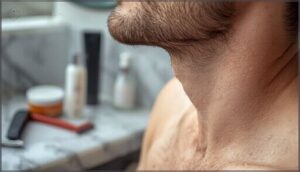
Getting your neckline right is just the beginning—keeping it sharp and irritation-free is where the real work happens. Your neck skin is sensitive, so you can’t just hack away and call it a day.
Here’s how to maintain a neckline that looks clean, feels comfortable, and doesn’t turn into a minefield of ingrown hairs.
Frequency of Neckline Upkeep
How often you maintain that beard neckline depends on your beard growth rate and skin sensitivity. Fast growers might need daily trimming to keep shirt collars clear, while most guys get away with touch-ups every two or three days for short beards.
Longer beards hide regrowth better, so weekly maintenance schedules work fine. Adjust your grooming tips and beard grooming techniques based on personal regrowth patterns and comfort.
Aftercare: Moisturizing and Beard Oil
Once you’ve trimmed, a few drops of beard oil worked into your neck area delivers real Beard Oil Benefits—Skin Hydration for the tight spots, plus softer stubble that won’t scratch your collar.
Warm the oil between your palms, massage upward to reach skin under the hairs, then comb through for even distribution. This Moisturizing Tips move keeps your Beard Care Routine simple, your neckline comfortable, and your overall Beard Health sharp.
Preventing Ingrown Hairs and Irritation
Sharp blades and soft skin don’t guarantee freedom from bumps—your Beard Care and Maintenance technique matters too. For Irritation prevention, gentle Exfoliation methods two to three times a week lift dead skin that traps hairs, and shaving with the grain reduces ingrown risk:
- Use a mild chemical exfoliant with low-strength salicylic or glycolic acid
- Shave downward, following natural hair direction
- Apply light pressure; one or two passes per spot
- Replace dull blades every five to seven shaves
- Leave existing ingrowns alone to avoid infection
These Shaving and Trimming Techniques respect Skin sensitivity while keeping your neckline clean.
Frequently Asked Questions (FAQs)
Is there a beard neckline template?
Yes, dedicated beard neckline templates exist—flexible plastic guides like the Aberlite FlexShaper that cradle your jaw and neck, giving you a curved edge to trim against for symmetrical, foolproof results every time.
How to shape your beard neckline below your ears?
Start right behind each earlobe and sketch a gentle upward curve down to about two finger widths above your Adam’s apple, keeping both sides symmetrical for balanced Facial Structure and proper Neckline Maintenance.
What neck exercises can build neck strength?
Isometric exercises like neck flexion holds, active movements such as controlled rotations, and resistance training with bands strengthen the muscles around your jawline and Adam’s apple.
These exercises support both posture and your beard neckline design.
How do you shape up a beard?
Comb your beard to detangle, then use clippers with a guard to trim evenly across the cheeks, jawline, and neckline.
Define sharp edges with a razor, and finish by applying beard oil for healthy facial hair.
What is a ‘neck beard’?
A neck beard isn’t just untrimmed hair—it’s the difference between looking sharp and sloppy. It’s facial hair growing below your jawline and Adam’s apple, creating a fuzzy throat that drowns out definition and structure.
How do you make a beard neckline?
Place two fingers horizontally above your Adam’s apple—the top finger marks your lowest point. Sketch a gentle U-shaped curve from that center mark upward toward each earlobe, following your natural jawline.
How do you cut a neck beard?
Most barbers start by placing two fingers above the Adam’s apple, marking where bare skin meets beard. Then they shave everything below that curved line, moving trimmer or razor downward to keep edges sharp and symmetrical.
How should I shape my neck beard?
Start by trimming everything below where your jaw meets your neck—about one to two finger widths above your Adam’s apple.
Follow a gentle U-shaped curve from ear to ear for balanced facial harmony and proper beard symmetry.
How to shape a beard under the chin?
Most barbers recommend keeping 1 to 5 inches of hair above your Adam’s apple, creating fullness when talking.
Use two fingers horizontally above your Adam’s apple; the top finger marks your ideal under-chin neckline reference.
How do you tame a neck beard?
Tame unruly facial hair grooming with daily grooming tools like trimmers and combs. Control growth by following hair direction, creating smooth transitions through strategic trimming.
Master styling principles that transform scraggly neck growth into clean, defined lines with proper beard neckline maintenance.
Conclusion
The devil’s in the details, and nowhere is that truer than with your neckline. Master how to shape neck beard placement—one to two fingers above the Adam’s apple, curved like a U—and you’ll transform scraggly growth into something sharp, deliberate, and undeniably masculine.
Skip the guesswork, ditch the high shave, and commit to precision. Your jawline deserves better than a crooked afterthought. Own the process, respect the anatomy, and let your beard do what it was meant to: make a statement.