This site is supported by our readers. We may earn a commission, at no cost to you, if you purchase through links. This content is for general informational and educational purposes only and is not a substitute for professional medical, dermatological, or nutritional advice.
Most beard problems don’t start at the cheeks—they start at the neck. A beard can be perfectly shaped on top and still look unkempt the moment someone glances at your jawline from across the room.
That two-inch strip of neck hair carries more visual weight than most guys realize. Get the neckline wrong and the whole beard reads as unfinished, regardless of how much time you put into the rest of it.
The good news? Trimming a neck beard cleanly is a repeatable skill, and once you know exactly where to draw the line, you won’t second-guess it again.
Table Of Contents
- Key Takeaways
- Why The Neckline Matters
- Find The Right Neckline
- Prep Your Beard Properly
- Trim a Neck Beard
- Blend and Finish Edges
- Top 2 Beard Washes
- Frequently Asked Questions (FAQs)
- How to make a neck beard look good?
- What are the best tools for trimming a neck beard?
- How often should I trim my neck beard?
- How do I know when I need to trim my neck beard?
- What can I do to prevent irritation when trimming a neck beard?
- How do I fix a mistake if I trim my neck beard too short?
- How to fix an uneven neckline?
- Should beard neckline match hairline?
- Whats the best trimmer for sensitive skin?
- How to trim neckline with longer beards?
- Conclusion
Key Takeaways
- Your neckline placement—two fingers above the Adam’s apple, curved in a gentle U‑shape—is the single most important factor in whether your beard looks sharp or sloppy.
- Trimming too high floats your beard off your jaw, while trimming too low invites ingrown hairs and irritation, so landing in that sweet spot is non‑negotiable.
- Always wash, fully dry, and comb your beard before trimming—skipping prep is why most guys end up with uneven lines they can’t explain.
- A trimmer handles the bulk, but a razor finishes the edges, and a soothing balm afterward keeps your skin from paying the price.
Why The Neckline Matters

The neckline is what separates a sharp beard from a messy one — it’s that simple. Get it right, and your whole face looks more defined; get it wrong, and even a full, healthy beard falls flat.
If you’re just starting out, this beginner’s guide to beard shaping walks you through the exact steps to nail your neckline without second-guessing yourself.
Your neckline is the line between a sharp beard and a messy one — get it right, and your whole face transforms
Here’s why that line does so much heavy lifting.
How a Clean Neckline Sharpens The Jawline
A clean neckline does more for your jawline definition than most guys realize. It creates visual contrast between beard and skin, instantly sharpening your angular appearance. That crisp edge removes the visual noise crowding your jaw, so facial proportion reads cleaner — even in photos.
Proper neck beard trimming techniques basically frame your face, giving you photographic definition and jawline emphasis that looks intentional, not accidental. The two‑finger method positioning helps position a natural neckline just above the Adam’s apple.
Why an Undefined Neck Beard Looks Messy
Skip defining your neckline, and suddenly whole beard looks accidental. An undefined neckbeard creates visual contrast in the worst way — stubble bleeding into your neck pulls attention away from your jaw. It’s one of the most common beard grooming mistakes guys make.
neckline matters more than you think:
- Uneven hair density makes your beard look patchy and asymmetrical from both sides
- face shape distortion hides your jawline behind a blur of fuzz
- Hygiene perception takes a hit — stray neck hairs collect lint and oils fast
- Undefined lines demand increased maintenance, ironically more than a clean neckline
- Proper neck beard trimming techniques require a clear baseline — without one, you’re just guessing
Problems Caused by Trimming Too High
Trim it too high and you’ll regret it fast. A high neckline creates a high contrast edge that makes your beard look like it’s floating above your jaw rather than anchored to it.
You’ll notice visible skin gaps, stunted beard density near the Adam’s apple, and uneven regrowth that lingers for weeks. It also causes jawline shortening — the exact opposite of what a neckbeard should do.
Problems Caused by Trimming Too Low
Going too low is just as bad. Trim it too low and you’re inviting a whole mess — Ingrown Hair Bumps, Skin Irritation, Redness, and Patchy Regrowth that takes weeks to fix.
A low neckline exposes Visible Neck Skin faster and creates Uneven Beard Bulk as the lower edge struggles to keep pace with the rest.
Ingrown hairs thrive when you shave that close to sensitive neck skin, so skin irritation prevention and solid post‑trim beard aftercare become non‑negotiable.
How The Right Neckline Improves Beard Shape
Get the neckline right, and everything above it clicks into place. It’s the foundation of solid Beard Contour — the thing that turns a rough shape into a frame your face actually works with.
A well-placed Neckline Proportion enhances your Facial Geometry by:
- Defining Chin Framing so the jawline reads sharp and intentional
- Enabling Symmetry Optimization across both sides without guesswork
- Letting proper neck beard trimming techniques control beard volume up and down
That’s beard grooming based on face shape done right.
Find The Right Neckline
Getting your neckline in the right spot is honestly the most important part of this whole process. Nail it, and everything else falls into place.
Here’s exactly how to find it.
Locate The Adam’s Apple
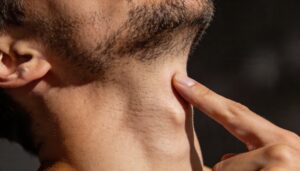
Your Adam’s apple is your anatomical reference point guide for proper neck beard trimming techniques — it’s literally built into your throat.
Use your Adam’s apple as a centering guide, then keep skin and beard healthy with the right products from this beard oil and mustache care routine to maintain a sharp, even look.
Place a finger on your midline throat mark and hum. Feel that cartilage bump buzzing under your fingertip? That’s it.
Some guys have a subtle bump, some pronounced — doesn’t matter. Neck skin tension changes when you tilt your head back, making it easier to spot.
Use The Two-finger Placement Method

Place two fingers horizontally just above your Adam’s apple — that gap marks your baseline measurement technique for determining the correct beard neckline. This two-finger method keeps guesswork out of the equation.
Keep these in mind for clean results:
- Use even pressure application — don’t compress the skin upward
- Maintain neutral jaw alignment throughout
- Make incremental height adjustments, not big swipes
- Mirror cross-check both sides before cutting
- Keep consistent head posture to avoid a beard neckline that’s too high
Map a Gentle U-shape

Think of your neckline as an arch, not a hard angle. From each ear, trace a gentle U-shaped line down toward the center — that’s your U-Shape Sketching process.
The highest point sits two fingers above the Adam’s apple, giving you proper Chin Clearance Measurement.
Focus on Curve Symmetry Check and Corner Height Consistency, so neither side drifts, keeping your neckline balanced and intentional.
Check The Line From Both Sides

One side never tells the whole story. Do a Mirror Angle Check by tilting your head left, then right — that Head Tilt Comparison reveals whether your Side-by-Side Symmetry is actually holding.
A Dual Mirror Setup or handheld mirror lets you catch dips you’d otherwise miss.
Run a Lighting Contrast Test under bright light, because shadows lie and uneven lines hide in them.
Adjust The Neckline for Face Shape
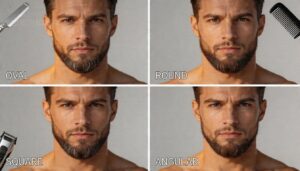
Not every face plays by the same rules.
Oval faces do well with a low, natural neckline for Face Shape Symmetry.
Round faces need a lower neckline and fuller chin coverage to counter the Neck Shortening Illusion.
Square faces benefit from a softer curve for Cheek Balance, while Jawline Emphasis through Growth Density Adaptation keeps angular faces sharp and intentional-looking.
Prep Your Beard Properly

Before you touch a trimmer to your neck, a little prep goes a long way. Rushing straight into trimming on a dirty, damp, or tangled beard is how you end up with uneven results and regret.
Here’s what to do first.
Wash The Beard Before Trimming
Before you touch a trimmer, wash the beard — it’s the step most guys skip and then wonder why their lines look off. A quick pre‑trim preparation with a quality beard shampoo does more than clean; it sets you up for precision.
- Warm water softening loosens stiff, unruly hairs
- Beard wash strips shampoo residue and built‑up oils
- Clean beard before trimming reveals true length and density
- Detangling before trim prevents snagging and uneven cuts
Dry The Beard Fully First
Now that you’ve rinsed, don’t rush straight to the trimmer. Towel pat drying beats rubbing every time — friction frizzes hairs and throws off your moisture level, check before you even start.
Air dry control matters too: wet beard trimming means hairs shrink as they dry, and suddenly your neckline’s higher than planned.
Aim for damp-to-dry, not dripping.
Comb Hairs Into Their Natural Direction
Your beard’s dry — now grab a fine comb and work through it. Hair flow mapping isn’t fancy; it just means following each growth pattern zone, so you’re not fighting the hair.
Use directional brushing from chin downward, then sweep a boar’s hair beard brush along the same path. That alignment tells you exactly where proper neck beard trimming techniques need to happen.
Gather a Trimmer, Razor, and Mirrors
Now that hair’s combed out, it’s time to line up your tools. Grab your electric trimmer — check the blade cleaning first, since hair buildup causes pulling. Have your beard trimmer guard sizes ready for guard adjustment later.
A manual razor takes care of the crisp edges a trimmer can’t.
For mirror positioning, set one at eye level and keep a handheld nearby. Mirror usage for grooming is everything here — you can’t fix what you can’t see.
Trim The Main Beard Length First
Before you touch the neckline, trim the rest of the beard first. Set your beard trimmer to its longest guard length and work all over — this is your Bulk Removal Pass, and it creates a Uniform Base Length that makes everything easier to blend later.
Use Comb Attachment Guidance to match your target length, then follow Progressive Trim Steps, dropping one guard size at a time until you’re satisfied.
Trim a Neck Beard
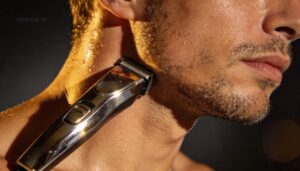
You’ve prepped your beard, found your line, and now it’s time to actually use that trimmer. This is where most guys either nail it or quietly make a mess of things — so take your time.
Follow these steps in order and you’ll have a clean neckline without second-guessing every stroke.
Mark The Lowest Point Under The Chin
Your neckline’s lowest point isn’t a guess — it’s a reference point. Place two fingers horizontally above your Adam’s apple, tilt your head downwards slightly, and mark that spot. That’s your anchor.
From there, following a step-by-step guide to shaping your beard at home keeps your lines consistent and your finish clean every time.
- Find the gnathion reference — the chin’s lowest midpoint
- Use the thyrohyoid space mark just below the hyoid dip alignment
- Apply two fingers above the Adam’s apple
- Run a midline consistency check at the center
- Complete a symmetry verification side-to-side
Start at The Center and Work Outward
Once you’ve marked your lowest point, start dead center — that’s your Central Reference, and everything else follows from it.
Work outward with short, Controlled Passes using Angle Consistency on every stroke.
This Progressive Trimming approach, paired with Balanced Strokes left and right, keeps things even as you find and trim your beard neckline.
Don’t rush the outer corners yet.
Remove All Hair Below The Line
Everything below that line has to go — no exceptions.
Start with guarded trimmer use to clear the bulk safely, keeping skin safety practices in mind as you work. This is where proper neck beard trimming techniques really matter.
Run a mirror visibility check from multiple angles to catch stray hairs hiding under the jaw. Miss one patch, and the whole thing looks unfinished.
Use Short, Controlled Trimmer Strokes
Think of it like painting a straight line — slow and steady wins. Keep your strokes to about 5–8 mm for stroke length precision, and don’t rush.
Wrist stability is everything here; a sudden jerk kills your angle consistency **.
Use light pressure control and lift the trimmer every few passes for a quick visual check.
That’s proper neck beard trimming techniques done right.
Recheck Symmetry as You Go
Symmetry doesn’t happen by accident — you have to check for it. That’s where Mirror Angle Checks earn their keep. Hold your mirror at arm’s length and tilt your head left, then right, catching both sides under steady light. Hair Direction Reset matters too — comb hairs flat before each look.
Keep these habits locked in:
- Check Centerline Alignment at three points every time: center, left, right
- Use Progress Timing — recheck after every few passes, not at the end
- Wipe stray hairs before each mirror check for clean Edge Consistency
- Step back occasionally — small differences compound fast up close
- After combing, verify both sides match before removing more hair
Blend and Finish Edges
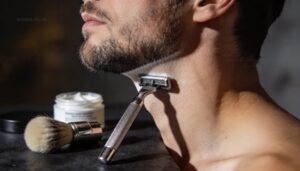
Trimming the line is only half the job — the finish is what separates a sharp beard from one that just looks "almost there." A few extra steps will smooth the change and clean up the edges so everything looks intentional.
Here’s how to blend and wrap it up properly.
Fade Above The Neckline Naturally
Once you’ve trimmed below the line, don’t just leave a hard edge hanging there — fade it. The Guard Shift Technique keeps things looking intentional.
Using Hair Grain Alignment, follow the natural growth direction as you work upward. Mirror Angle Checks from both sides catch any uneven spots.
For Fade Maintenance Frequency, touch it up every two to four days. Finish with Skin Soothing Aftercare to calm irritation.
Choose The Right Guard Size
Guard size makes or breaks the fade. A 2 guard works well for most guys — it removes enough bulk without stripping the neckline bare.
Use a Hair Thickness Guide mindset: coarser beards handle smaller guards; finer hair needs a larger Guard Size Increment to avoid patchiness.
Check your trimmer guard sizes chart, since sizing varies by brand. Blade Safety Tips matter too — guards keep blades off skin.
Use a Razor for Crisp Edges
Once the trimmer’s done its job, grab a manual razor — that’s where real precision happens.
Blade Sharpness Maintenance matters here: a dull blade drags, and dragging means razor burn.
Apply Pre-Shave Oil Glide so the razor glides cleanly and you can actually see the line.
Use the Vertical Stroke Technique with the Two-Pass Method, shaving downward.
Angle Control Tips: keep it flat against skin.
Round or Square The Corners
Now for the detail that trips most guys up — corners.
Round corners give you a softer, more forgiving line that blends naturally with your jaw’s curve. Square corners deliver that sharp, structured finish.
For round faces, softness wins. For square faces, lean into clean angles.
Either way, your corner shape impacts how often you’ll need touch-ups — rounded corners hide regrowth longer.
Apply Balm or Moisturizer After Trimming
Once the razor’s done its job, your skin needs a minute — and that’s exactly when your post-trim beard care routine earns its keep.
Apply a beard balm first for barrier recovery, then follow with a moisturizer packed with humectant benefits like glycerin.
Soothing ingredients — think aloe or chamomile — calm any redness fast.
Layer beard oil last.
Timing application right keeps your post-trim skin care tight.
Top 2 Beard Washes
Starting your trim with a clean beard isn’t just good hygiene — it actually helps you cut more accurately. The right beard wash removes buildup without stripping natural oils, so your hair behaves better under the trimmer.
Here are two solid options worth keeping on your shelf.
1. Every Man Jack Sandalwood Beard Wash

Every Man Jack Sandalwood Beard Wash pulls double duty — it cleans your beard and your face in one shot.
The sandalwood-citrus scent is subtle enough that it won’t fight your cologne, and the aloe vera and coconut oil formula actually softens your beard after a few washes.
No greasy residue, no drama.
It even works as a shaving cream on your neck.
A two-pack runs about $19, which makes it easy to keep one in the shower and one as backup.
- Cleans your beard and face at the same time — fewer bottles, less fuss
- Aloe vera and coconut oil actually soften your beard after regular use
- The sandalwood-citrus scent is subtle enough to layer with cologne or beard oil
- Doesn’t lather much, which can feel like it’s not doing enough
- The scent fades pretty fast if you want something that sticks around
- Some guys may need to use more product per wash compared to concentrated alternatives
2. Every Man Jack Unscented Beard Face Wash
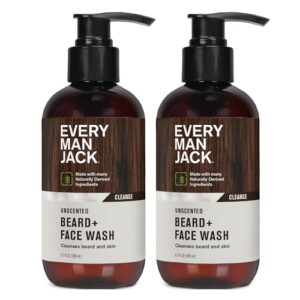
If fragrance isn’t your thing, this one’s for you. Every Man Jack’s Unscented Beard and Face Wash keeps it clean — literally.
The water-based, fragrance-free formula uses aloe and glycerin to soften beard hair and calm the skin underneath without leaving any greasy film behind. It even pulls double duty as a shaving cream on your neck.
At 6.7 fl oz per bottle in a two-pack, it’s a straightforward daily wash that stays out of the way of whatever cologne you’re wearing.
- Fragrance-free and gentle enough for sensitive skin, with aloe and glycerin to soften beard hair and soothe the skin underneath
- Pulls double duty as a face wash, beard wash, and shaving cream — fewer bottles cluttering your shelf
- Rinses clean with no greasy residue, so it won’t interfere with any beard oils or cologne you use after
- Some users catch a faint citrus scent despite the "unscented" label — not strong, but worth knowing
- Doesn’t lather much, which can feel underwhelming if you’re used to a traditional foamy wash
- A few customers ran into pump damage or leakage during shipping, so check the packaging when it arrives
Frequently Asked Questions (FAQs)
How to make a neck beard look good?
Forget the wild wizard look. A neck beard looks good when you define the neckline, keep it trimmed every few days, and blend it cleanly into your beard.
What are the best tools for trimming a neck beard?
You only need three things: a cordless electric trimmer with multiple guards, a razor for edging, and two mirrors.
That combo covers everything from bulk removal to a clean, crisp finish.
How often should I trim my neck beard?
Funny how neck hair never takes a day off.
Trim five to seven days for most beard lengths — or every two to three days if you’re rocking a short stubble look.
How do I know when I need to trim my neck beard?
Your neck beard needs a trim when dark stubble becomes visible under your chin, the neckline looks uneven after brushing, or loose hairs start blending poorly with your beard above.
What can I do to prevent irritation when trimming a neck beard?
Sharp blade, clean skin, light pressure — that’s your irritation‑free formula. Wash first, dry fully, and let the trimmer glide.
Skip alcohol aftershaves. A soothing balm after trimming keeps redness calm and skin happy.
How do I fix a mistake if I trim my neck beard too short?
It happens to everyone. Let it grow for a day or two, then adjust a slightly lower neckline and blend carefully with a longer guard to smooth the shift.
How to fix an uneven neckline?
Even out the higher side by trimming it down to match the lower one.
Work in small strokes, check both sides with a mirror, and always use your Adam’s apple as your anchor point.
Should beard neckline match hairline?
No, your beard neckline and hairline are completely different things. The neckline sits mid-neck, about two fingers above your Adam’s apple — nowhere near your forehead.
Mixing them up is one of the fastest ways to wreck your shape.
Whats the best trimmer for sensitive skin?
For sensitive skin, look for a trimmer with titanium or surgical-grade stainless steel blades, a built-in skin guard, and adjustable guards.
These features reduce friction, prevent nicks, and minimize irritation with every pass.
How to trim neckline with longer beards?
Longer beards hide a multitude of sins — until you hit the neckline.
Drop your trimmer one guard size below your beard length, then trim below your two-finger mark, working center outward.
Conclusion
With a clean neckline, your beard transforms from a messy afterthought to a sharp statement. Think of it as the frame that turns a great portrait into a masterpiece.
You’ve now got the skills to trim a neck beard like a pro. Practice makes perfect, so grab your trimmer and get refining.
A well-defined jawline is just a snip away, and with these steps, you’ll be sporting a chiseled look that’s uniquely yours, every day.