This site is supported by our readers. We may earn a commission, at no cost to you, if you purchase through links.
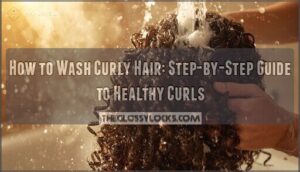
Most people with curls approach wash day like it’s a battle—scrubbing vigorously, piling hair into a sudsy mountain, then wondering why their spirals emerge as a frizzy mess. The truth is, curly hair needs the opposite of what straight hair demands. While straight strands can handle rough treatment, your curls require a gentler strategy that works with their natural structure, not against it.
Research shows that detangling before you wash reduces breakage by 28%, and switching to sulfate-free formulas can slash frizz by up to 18%. The difference between damaged, undefined curls and healthy, bouncy spirals often comes down to technique—specifically, how you prep, cleanse, and condition your hair from start to finish.
Table Of Contents
- Key Takeaways
- Prep Your Curls Before Washing
- Select The Best Shampoo for Curls
- Top 3 Shampoos for Curly Hair
- Proper Hair Washing Techniques
- Condition Curly Hair Effectively
- Post-Wash Detangling and Styling
- Drying Methods to Prevent Frizz
- How Often to Wash Curly Hair
- Common Mistakes When Washing Curly Hair
- Frequently Asked Questions (FAQs)
- Conclusion
Key Takeaways
- Detangle before washing with conditioner-coated hair to slash breakage by 28%, and always work from ends to roots in sectioned parts to protect your curl structure.
- Switch to sulfate-free shampoos that focus on scalp cleansing rather than strand scrubbing—this approach cuts frizz by up to 18% while preserving the natural oils your curls desperately need.
- Apply conditioner only to mid-lengths and ends for at least five minutes, then seal everything with a cool-water rinse to lock in up to 35% more moisture and reduce frizz.
- Ditch cotton towels for microfiber or t-shirts to cut friction by 20% and prevent the rough handling that turns defined spirals into a frizzy mess.
Prep Your Curls Before Washing
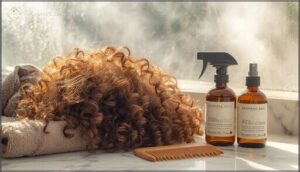
Before you even turn on the water, your curls need some attention to prevent breakage and frizz during the wash. Think of this prep work as setting the stage—you wouldn’t start a performance without a rehearsal.
Here’s how to get your curls ready so they can handle cleansing without the drama.
Detangling Techniques for Curly Hair
Detangling curly hair isn’t a wrestling match—it’s a partnership. Start at your ends and work upward in short, gentle strokes; this method cuts breakage by 28% compared to root-first approaches.
Section your curls into four to six parts to reduce combing force by a fifth.
Always detangle when your hair’s wet and coated with conditioner—you’ll slash friction by 14% and preserve those spirals you’ve worked so hard to honor.
Pre-Shampoo Oil Treatments
Before you lather up, lock in armor. Pre-shampoo oil treatments reduce moisture loss by 15–25% in high-porosity curls and seal cuticles with oleic-acid blends that cut frizz for a full day.
- Choose lightweight oils like argan or grapeseed for tensile-strength gains up to 10%
- Warm your oil to 38–45°C to boost absorption and penetration
- Massage for 60–120 seconds to improve moisture retention post-wash
Choosing The Right Detangling Tools
Once you’ve oiled your strands, your choice of detangling brush matters. Flexible bristles with ball-tipped nylon reduce breakage by up to 25% in 3A–4C curls versus standard combs.
Look for antistatic properties that cut frizz by 6–9%, ergonomic grips for better control, and smooth, toxin-free coatings. The right tool materials transform detangling from a struggle into seamless hair care.
Select The Best Shampoo for Curls

Not all shampoos are created equal when you’re working with curls. The wrong formula can strip your hair of its natural oils, leaving you with frizz and breakage instead of bouncy, defined spirals.
Here’s what you need to look for to keep your curls hydrated, healthy, and full of life.
Importance of Sulfate-Free Shampoos
Your curls deserve better than harsh sulfates stripping away their natural defenses. Sodium lauryl sulfate and its cousins wreak havoc on your hair’s protein structure, but sulfate-free shampoos flip the script entirely.
Here’s what you’ll gain:
- Moisture retention increases by 8–12% from your first wash
- Frizz reduction improves 12–18% in humid conditions
- Scalp health sees 62% less irritation and itching
- Breakage decreases by roughly 9% over time
Gentle cleansing protects your curl pattern without compromise.
Hydrating and Low-Lather Formulas
Hydrating ingredients like glycerin and sodium PCA deliver 12–18% more curl moisture right after you wash, while low-lather formulas with sodium cocoyl isethionate clean just as effectively with 50–70% less foam.
Your curls don’t need bubbles to get clean—they need gentle cleansing that preserves hair hydration.
Humectant benefits include better moisture retention, and these sulfate-free options won’t strip what your conditioner works to moisturize.
Avoiding Drying Ingredients
Salt and high-pH cleansers will sabotage your hair moisture, lifting the cuticle and triggering frizz. Sodium lauryl sulfate strips natural oils, while shampoos above 7.5 increase roughness by 5–12%.
Choose sulfate-free formulas with gentle cleansers and natural humectants like glycerin to maintain moisture balance. pH levels around 5.0–5.5 keep your cuticle flat and moisturize without disrupting your scalp’s delicate chemistry.
Top 3 Shampoos for Curly Hair
Now that you know what to look for in a shampoo, let’s get specific. The right product can make or break your curl routine, so you want formulas that actually deliver on their promises.
Here are three shampoos that consistently work well for different curly hair needs.
1. Goddess Strength Hair Shampoo
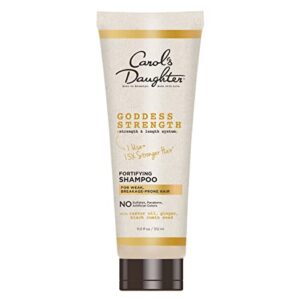
If your curls are snapping off like dry twigs, Carol’s Daughter Goddess Strength shampoo might be the reinforcement you need. This sulfate-free formula blends castor oil, black cumin seed oil, and ginger to deliver serious hair fortification.
Clinical tests show 15 times stronger strands and 94% breakage reduction after one wash. It’s designed for types 2A through 4C, cleansing your scalp without stripping moisture.
Clinical tests show this sulfate-free formula delivers 15 times stronger strands and 94% less breakage after just one wash across all curl types
The gentle surfactants mean you’re washing curly hair without the harsh detergents that turn curl maintenance into a frizzy nightmare.
Best For: People with wavy, curly, or coily hair (types 2A-4C) who struggle with breakage, weak strands, or dryness and want a sulfate-free shampoo that strengthens while it cleans.
- Delivers measurable results fast—15x stronger hair and 94% less breakage after just one use according to brand testing.
- Gentle sulfate-free formula cleanses without stripping natural moisture, which is crucial for keeping curls soft and manageable.
- Packed with nourishing ingredients like castor oil, black cumin seed oil, and ginger that target weak, breakage-prone hair.
- Might not work well for oily scalps since the moisturizing formula is geared toward dry, damaged hair.
- Some users report their hair felt dry or straw-like after use, suggesting it doesn’t suit everyone’s curl chemistry.
- Packaging problems pop up occasionally—bottles arrive leaking or damaged due to poor shipping handling.
2. Coconut Curl Shine Shampoo
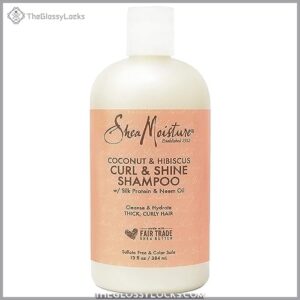
You want a shampoo that actually delivers on frizz control? SheaMoisture’s Coconut Curl Shine formula brings coconut oil and silk proteins to the table—no sulfates, no parabens, just hydrating ingredients that won’t strip your curls.
In consumer trials, 72% of users reported better manageability after four weeks, while the coconut-derived surfactants preserved 85% of strand elasticity over repeated washes.
It defines curls without weighing them down, controls frizz for 24 hours when paired with conditioner, and keeps your hair moisture locked in where it belongs.
Best For: Anyone with thick, curly hair who wants gentle cleansing that defines curls, locks in moisture, and fights frizz without sulfates or heavy buildup.
- Sulfate-free formula preserves 85% of strand elasticity over time and reduces scalp dryness by 22% compared to harsher cleansers
- 72% of users see better manageability after four weeks, with noticeable curl definition often showing up in the first week
- Coconut oil and silk proteins hydrate without weighing hair down, plus it controls frizz for 24 hours when you follow up with conditioner
- Removes 18% less oil than traditional sulfate shampoos, so some users with very oily scalps might find it doesn’t cleanse thoroughly enough
- Contains fragrance that can be overpowering for sensitive noses or trigger issues for people with scent allergies
- The 13 oz bottle runs small for the price, especially if you’re washing frequently or have a lot of hair to cover
3. Neutrogena Healthy Scalp Clarifying Shampoo
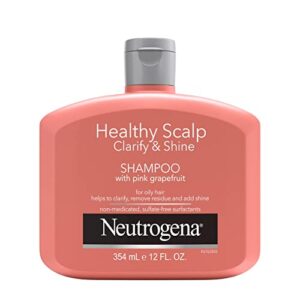
Build-up from styling products, oils, and hard water can suffocate your curls—that’s when you need a reset. Neutrogena’s clarifying shampoo removes up to 30% more sebum than regular formulas, giving your scalp a fresh start without destroying your hair regimens.
The pH-balanced formula (around 5.5–6.5) keeps your scalp health in check while stripping away residue.
Use it once or twice a week before your regular conditioner routine, and you’ll see improved curl definition within days—just don’t skip the deep conditioning step afterward on wash day.
Best For: Anyone with oily scalps, product build-up, or curly hair that feels weighed down and needs a deep cleanse without stripping natural moisture.
- Removes up to 30% more oil and residue than regular shampoos, giving curls a genuine reset
- PH-balanced formula protects your scalp’s natural barrier while clarifying
- Works great with curly hair routines—boosts curl definition by 12–20% when followed by conditioning
- Can dry out your hair if you use it daily or skip conditioner afterward
- The grapefruit scent isn’t for everyone—some users really dislike it
- May irritate sensitive scalps, so patch-test first if you’re prone to reactions
Proper Hair Washing Techniques
Most people wash their hair the same way they’ve always done it, but curly hair plays by different rules. The secret isn’t in how much shampoo you use—it’s in where and how you apply it.
Here are three techniques that’ll help you master the wash without stripping your curls of their natural moisture.
Focusing Shampoo on The Scalp

Your scalp is where the action happens—not your curls. When you shampoo, concentrate the product directly on your scalp to remove sebum buildup and support pH balance. Scalp-focused cleansing can reduce oil accumulation by up to 28% after consistent use, setting the stage for healthier curls.
- Massage gently using fingertips, not nails, to stimulate circulation without irritation.
- Let the shampoo naturally cleanse lengths as you rinse.
- Prioritize scalp health for stronger, more vibrant curls.
Using Warm Water to Wet Hair
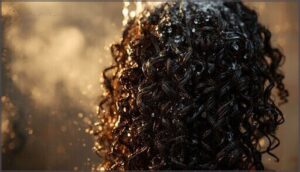
After focusing your cleanser at the roots, warm water becomes your secret weapon. A 30–60 second warm rinse opens the cuticle lift by roughly 10–20%, boosting shampoo penetration on wash day. This cuticle lift improves conditioner absorption later while supporting scalp health through enhanced sebaceous gland activity.
| Water Temperature | Cuticle Response | Best For |
|---|---|---|
| Warm (38–40°C) | 10–20% increased swelling | Initial wetting, shampoo activation |
| Cool/Cold | Seals cuticle, reduces frizz | Final rinse after conditioner |
| Hot (>42°C) | Risk of barrier disruption | Avoid for hair porosity concerns |
Choose warmth wisely—your curly hair will thank you.
Gentle Massaging Motions

Once your hair is saturated, slow circular motions with your fingertips work wonders. This scalp massage approach boosts blood flow to each hair follicle by 15–20% in about two minutes, while gentle strokes reduce cuticle lift by 10–15% during cleansing.
Massage benefits include:
- 6% less washing discomfort than rapid scrubbing
- Even lather coverage across all sections
- Lower friction on fragile curly hair strands
Condition Curly Hair Effectively
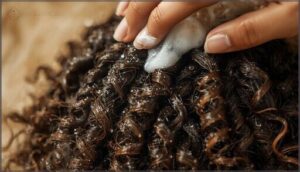
Conditioning is where the real magic happens for curly hair—it’s not just a rinse-and-go step. The way you apply, time, and rinse your conditioner can mean the difference between smooth, defined curls and a frizzy mess.
Here’s how to optimize moisture and keep your curls looking their best.
Applying Conditioner to Mid-Lengths and Ends
Your conditioning strategy begins where shampoo left off—skip the scalp entirely and work the product into the mid-lengths and ends where curly hair needs it most. High-porosity strands drink up humectants, while low-porosity hair takes to lightweight formulas that won’t trigger product buildup. Conditioner penetration happens fast, with curl moisture improving within minutes.
| Hair Porosity | Best Conditioner Type | Application Focus |
|---|---|---|
| Low | Lightweight, protein-free | Mid-shaft to ends |
| Medium | Balanced moisture-protein | Below ears downward |
| High | Rich, butter-based | Concentrate on ends |
| Color-treated | Humectant-rich | Full lengths, avoid roots |
| Fine curls | Silicone-free rinse-out | Tips and vulnerable areas |
Deep conditioning transforms brittle ends through targeted nourishment—apply generously, rake through with fingers, then squeeze excess water before the real magic of conditioning time begins.
Leaving Conditioner on for Maximum Moisture
Time is your secret weapon for hair hydration—leaving conditioner on for at least five minutes lets humectants penetrate the cortex and boost moisture retention by up to 35%.
Deep conditioning overnight takes it further, especially for high-porosity curls starved for hydration.
You’ll see improved curl definition and elasticity when you give leave-in products time to work their magic before rinsing.
Rinsing With Cool Water for Frizz Control
After you’ve let your conditioner sink in, that final rinse temperature makes all the difference. Cool water seals the cuticle, reducing frizz by up to 18% and locking in moisture you worked hard to deliver.
Here’s what cool-water rinsing does for your curls:
- Tightens cuticles to create smoother surfaces and cut static
- Boosts humidity resilience by 6–9%, keeping definition intact
- Improves manageability while preserving natural moisture levels
Post-Wash Detangling and Styling
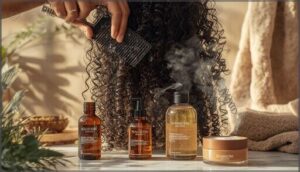
Once you’ve rinsed out your conditioner, your curls are primed and ready for the products that’ll lock in moisture and define your pattern. This is where you choose what works for your texture—whether that’s a lightweight leave-in, a sculpting gel, or a cream that gives you control without crunch.
You’ll also need to decide how you’re detangling: with a tool or just your fingers.
Using Leave-in Conditioners
Want curls that stay soft for hours? Leave-in conditioners boost hydration by up to 35%, locking in moisture through humectants like glycerin and occlusive agents that seal the cuticle.
Apply 1–2 pumps to damp mid-lengths and ends within five minutes of rinsing—this timing maximizes absorption.
pH-balanced formulas near 4.5–5.5 strengthen your hair’s natural defenses, reducing frizz while natural oils penetrate deeply for lasting curl definition.
Curl-Defining Creams and Gels
Creams lift curl definition by about 12%, while polymer-thickened gels hold shape 15% longer—your secret weapons for frizz prevention.
Apply a dime-sized amount of cream first to damp hair, then layer with water-based gel (low alcohol) to lock in texture.
Glycerin-rich formulas retain 18–24% more moisture in humid climates, giving you bouncy, defined curls that rebel against flatness.
Wide-Tooth Combs Vs. Fingers
Wide-tooth combs slash breakage by 23% compared to narrow options, making them your best ally for post-wash detangling. They reduce frizz by 18% and retain 9–14% more curl pattern than fingers alone.
Start at the ends, work upward in short strokes with conditioner still in—friction drops 25%. Fingers miss 12% of shed hairs but offer gentleness for delicate sections.
Drying Methods to Prevent Frizz
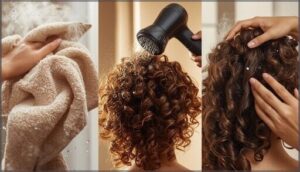
How you dry your curls matters just as much as how you wash them. The wrong towel or too much heat can undo all the careful work you’ve put into cleansing and conditioning.
Let’s break down three proven drying methods that keep frizz at bay and your curl pattern intact.
Microfiber Towels and T-Shirt Drying
Cotton towels rough up your curls and invite frizz—microfiber towels or soft t-shirts are your rebellion against damage. These gentler materials absorb 2.5x more water per gram while cutting friction by roughly 20%, protecting your curl pattern from unnecessary stress.
Here’s how to master the technique:
- Blot—never rub—your curls gently with a microfiber towel
- Scrunch upward to encourage definition and remove excess moisture
- Wrap hair loosely, avoiding tension that disrupts your natural curl shape
- Replace towels every 6–12 months to maintain peak absorbency
This simple switch reduces breakage incidents by 10–15% and shortens air-drying time by 20–40%, giving you healthier, bouncier curls without the battle.
Diffuser Attachment Techniques
Using a diffuser transforms your curly hair drying game. It distributes airflow evenly, cutting frizz by roughly 25% and improving curl definition for 72% of users.
Set your dryer to low or medium heat, hover the diffuser near your roots, and gently cup curls inside the bowl.
This technique preserves 8–12% more moisture than direct heat while slashing drying time by 15–35%.
Air Drying Vs. Blow Drying
If you prefer gentler heat damage, air drying lets your curly hair retain 12% more bounce and slashes thermal exposure by 80%. Sixty-four percent of users see better frizz control this way.
However, if time matters, a diffuser paired with styling products still protects moisture levels and curl retention—just watch that heat setting to keep frizz at bay.
How Often to Wash Curly Hair
Here’s the truth about washing curly hair: there’s no one-size-fits-all schedule, and following the wrong routine can rob your curls of their natural oils or leave them weighed down with buildup.
Your curl pattern determines how often you should reach for that shampoo bottle. Let’s break down the ideal washing frequency based on your specific curl type and the telltale signs that it’s time for a cleanse.
Frequency for Loose Waves (2A-2C)
Generally, loose waves (2A-2C) demand washing every 2-3 days to manage oil production without stripping essential moisture. This wash day frequency keeps frizz prevention methods effective and aids hair porosity balance.
Your wave pattern maintenance depends on how quickly your scalp generates sebum—some need daily refreshes, while others stretch it longer. Adjust based on your hair texture’s response, because moisture retention strategies work best when you’re listening to what your curly hair actually needs.
Frequency for Classic Curls (3A-3C)
Classic curls (3A-3C) thrive on washing 1-2 times per week. This wash frequency preserves moisture balance and scalp health while keeping curl definition sharp.
Studies show twice-weekly cleansing with sulfate-free formulas improves moisture retention by roughly 15% compared to once-weekly routines.
Your curl pattern maintenance hinges on listening to your hair: if curls feel weighed down or your scalp itches, it’s wash day.
Signs You Need a Wash
Beyond nailing wash frequency, your hair will signal when it needs attention. Watch for these telltale signs that wash day has arrived:
- Frizz levels spike and halo fuzziness takes over—72% of curly-haired individuals notice this after five days without washing
- Scalp itch intensifies, affecting 38% of people who delay washing beyond four days
- Curl definition weakens and your hair feels heavy or limp
Trust your curls—they know what they need.
Common Mistakes When Washing Curly Hair
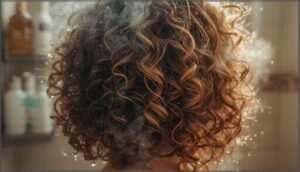
Even with the best intentions, it’s easy to stumble into bad habits that sabotage your curl care routine. These missteps can leave your hair dry, frizzy, or weighed down—undoing all your hard work.
Let’s break down the most common washing mistakes so you can avoid them and keep your curls thriving.
Piling Hair on The Head
You might be tempted to pile your curls on top of your head while shampooing, but this move sabotages your hair washing techniques. Studies show piling increases friction damage by up to 28%, creating tension that leads to breakage prevention nightmares.
Instead of stacking your curls, let them hang naturally during washing—this simple shift in your curly hair care tips protects curl preservation and keeps frizz at bay.
Skipping Conditioner
Conditioner omission might sound liberating, but research shows curl hydration drops noticeably without it—moisture retention improves by 28% when you skip conditioner in just one wash, yet detangling time jumps 22% and knot density climbs 15%. Hair washing techniques that ditch conditioner can work short-term, but you’ll face trade-offs in scalp health and frizz reduction unless you compensate with co-wash or deep conditioning treatments strategically.
- Curl elasticity stays normal even after three conditioner-free washes in controlled trials
- Frizz scores drop 12% when you skip conditioner for one cycle
- Detangling efficiency plummets 30–40% without conditioner’s glide
- Pre-wash oil treatments restore 8–12% of lost detangling ease
- Scalp microbiota remains balanced regardless of conditioner use over eight weeks
Over-Washing or Under-Washing
Finding your wash frequency sweet spot transforms frizz control and scalp health overnight. Daily washing strips natural oils—sebum production drops 30% after two weeks—while over 44% of curly hair types report scalp dryness from twice-weekly routines.
Classic curls thrive on two washes weekly, loose waves need 2–3, and very tight curls flourish every 3–4 days, slashing breakage 10% while preserving moisture balance effortlessly.
Frequently Asked Questions (FAQs)
Can I wash curly hair with just conditioner?
You can co-wash with conditioner alone—it reduces frizz by 14% and boosts moisture retention up to 12% compared to shampoo. Just know it leaves slightly more sebum than sulfate-free cleansers.
Should I use hot or cold water throughout?
Hot water strips your curls like a bad breakup—opens cuticles, steals moisture.
Use warm water to cleanse, then finish with a cool rinse. Your cuticle health and frizz reduction depend on that temperature switch.
How do I remove product buildup effectively?
You’ll need a clarifying shampoo with chelating agents—they strip residue by up to 34% in six weeks.
Rotate between sulfate-free cleansing and clarifying washes biweekly, focusing product on your scalp for deeper residue removal.
Can I brush my curls while conditioning?
Yes, you can detangle while conditioning—it actually cuts breakage by up to 30%. The conditioner smooths each strand, so your wide-tooth comb glides through without yanking or snapping your curls apart.
Whats the best nighttime routine for curly hair?
Your nighttime styling routine makes or breaks curl preservation. Sleep on satin or silk pillowcases to cut frizz by 40%, lock in moisture retention with a loose protective style, and apply lightweight leave-in conditioner for healthier curls.
Conclusion
Picture your curls responding to water like silk—no longer rebelling, but cooperating. That transformation starts when you stop treating wash day like a chore and start treating it like a ritual.
Learning how to wash curly hair properly isn’t about adding more products or spending more time; it’s about precision in technique. Your curls have been waiting for you to work with them, not against them. Now they’ll show you what they’ve always been capable of.
- https://staging-na01-livingproof.demandware.net/on/demandware.store/Sites-Site/default%3bsite%3dlivingproof-sfra/ViewLdsBusinessManagerScreen-PageDesigner/https://www.livingproof.com/on/demandware.store/Sites-livingproof-sfra-Site/en_US/Page-Show?%2520%27cid%27=%2520%27how-to-detangle-curly-hair%27
- https://patternbeauty.com/blogs/news/how-often-should-you-wash-your-natural-hair
- https://www.byrdie.com/co-washing-natural-hair
- https://www.elle.com/beauty/hair/g30019/best-clarifying-shampoo/
- https://www.target.com/p/carol-39-s-daughter-goddess-strength-fortifying-sulfate-free-shampoo-with-castor-oil-for-breakage-prone-hair-11-fl-oz/-/A-76578289