This site is supported by our readers. We may earn a commission, at no cost to you, if you purchase through links.

You’ve probably heard the kitchen-to-grooming advice before: olive oil works wonders for beards. But unlike most pantry remedies that promise more than they deliver, this one has some genuine science behind it.
Olive oil’s emollient properties smooth rough hair shafts, while its oleic acid and vitamin E create a protective barrier that locks moisture into both your beard and the skin underneath. The antioxidants shield against daily environmental damage, and there’s even evidence that oleic acid blocks DHT formation, potentially encouraging growth.
That said, olive oil isn’t a one-size-fits-all solution—its moderate comedogenic rating means it can clog pores for some guys, and proper application makes all the difference between a well-conditioned beard and a greasy mess.
Table Of Contents
- Key Takeaways
- Is Olive Oil Good for Beards?
- Key Benefits of Olive Oil for Beards
- How Olive Oil Supports Beard Growth
- Applying Olive Oil to Your Beard
- DIY Olive Oil Beard Oil Recipes
- Potential Drawbacks and Precautions
- Frequently Asked Questions (FAQs)
- Can Olive Oil Alone Be Applied to a Beard?
- What is Extra Virgin Olive Oil?
- Do You Have to Wash the Olive Oil Out of Your Beard or Leave It?
- How Effective is Olive Oil in Treating a Curly Beard?
- How Do You Make Beard Oil With Olive Oil?
- Can I Apply Olive Oil to the Beard Overnight?
- Does Olive Oil Prevent Hair Loss?
- Does Extra Virgin Olive Oil Grow Beard?
- What Kind of Olive Oil Works Best in Beards?
- Can olive oil help with beard dandruff?
- Conclusion
Key Takeaways
- Olive oil moisturizes beard hair and skin through oleic acid and vitamin E, but its comedogenic rating of 2 means it can clog pores if you have oily or acne-prone skin.
- The compound oleuropein in olive oil activates hair follicles directly, while dietary olive oil consumption can boost testosterone by 17.4% in three weeks, supporting natural beard growth.
- Apply 2-3 drops for short beards on damp hair after cleansing, warming it between your palms first, and limit use to once daily or every other day to avoid greasy buildup.
- Mix olive oil with jojoba at a 1:1 ratio for lighter absorption, and always dilute essential oils to 1% concentration (one drop per 5ml) to prevent skin irritation.
Is Olive Oil Good for Beards?
Why’s olive oil so popular in the grooming world? Simple—it works, but not always how you’d expect. Olive oil brings legitimate benefits to your beard through emollient properties that coat and smooth the hair shaft. It’s rich in oleic acid and vitamin E, which form a protective barrier that locks in moisture and reduces transepidermal water loss beneath your beard. Many users find it’s a solid beard oil alternative on a budget.
However, here’s the catch: olive oil absorbs slowly compared to lighter oils, creating a perceptible film that can feel heavy or greasy depending on your beard density. Different olive oil grades affect absorption—extra virgin is thicker, while refined versions feel slightly lighter. Long-term effects on beard health depend entirely on your skin type and how consistently you cleanse to prevent buildup. To keep your beard healthy, consider adjusting application frequency based on your skin type.
Key Benefits of Olive Oil for Beards
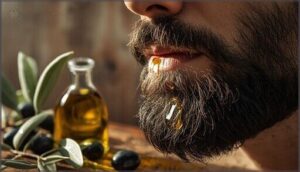
Olive oil brings more to the table than just cooking benefits. As for beard care, it offers a handful of practical advantages that can improve how your beard looks and feels.
Let’s break down what makes it worth considering for your grooming routine.
Deep Moisturization and Skin Health
For moisturizing beard skin, olive oil delivers solid hydration that targets dry, flaky areas underneath your whiskers. Studies show applications over 2 to 4 weeks increase skin moisture meaningfully.
Here’s what it does:
- Locks moisture into your stratum corneum through a hydrophobic coating
- Improves epidermal renewal and surface texture over several weeks
- Reduces inflammation, erythema, and scaling in irritated skin
- Provides antioxidant protection against environmental damage
Keep in mind that its comedogenic rating is 2, which indicates a moderate likelihood of clogging pores. Keep in mind comedogenic risks if you’re acne-prone.
Promoting Beard Growth and Strength
Beyond keeping skin healthy, you want your beard to actually grow thicker and stronger. That’s where olive oil’s vitamin E and oleic acid shine. Oleic acid blocks 5-alpha reductase, which lowers DHT formation—a hormone linked to hair thinning.
Studies on antioxidant oil blends show measurable gains:
| Timeline | Growth Rate Increase | Density Improvement |
|---|---|---|
| Week 2 | 12.9% | 21.93% |
| Week 4 | 24.30% | 48.43% |
Your hair follicle health improves, breakage drops, and the growth environment strengthens. That means fuller facial hair over time.
Softening and Conditioning Beard Hair
Coarse hair doesn’t have to feel like steel wool. Olive oil’s emollient properties coat each hair fiber, reducing roughness and improving manageability right away.
You’ll notice beard softness after just one application—the oleic acid smooths the shaft while locking in hydration. That means less frizz, easier combing, and a natural shine that makes your beard look well-groomed without feeling greasy.
Antioxidant and Anti-Fungal Properties
When environmental stressors hit your beard, antioxidants step in. Olive oil delivers vitamin E and polyphenols that neutralize free radicals, protecting both hair and skin from daily damage.
However, there’s a catch with antifungal properties:
- Olive oil’s lipid content can feed Malassezia yeast
- This may worsen dandruff concerns in prone individuals
- Heavy application risks skin inflammation
- Oil balance matters—less is more
- Antioxidant benefits shine with sparing use
How Olive Oil Supports Beard Growth
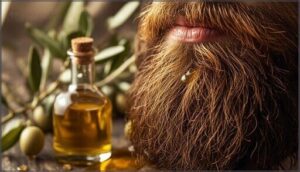
You’ve probably heard that olive oil can help your beard grow thicker and fuller, but what’s actually going on beneath the surface?
The answer comes down to a few specific mechanisms that work together to support healthy facial hair. Let’s break down how olive oil influences beard growth from the inside out.
Vitamin E and Nutrient Content
Olive oil packs more than just fat—a single tablespoon delivers roughly 2 mg of vitamin E, covering about 13% of your daily needs. That’s real nourishment for beard and skin.
You’re also getting a powerful antioxidant profile, including polyphenols and squalene, which can reach up to 7,500 mg per kilogram in quality oils. These nutrients work together to strengthen hair follicles and protect against environmental wear.
Impact on Testosterone Levels
What you eat can actually shift your testosterone levels—and that matters for beard growth and diet. Research shows men who swapped butter for olive oil saw a 17.4% testosterone increase after just three weeks, thanks to its healthy fats and antioxidants working on hormone regulation.
Swapping butter for olive oil boosted men’s testosterone by 17.4% in three weeks, directly supporting beard growth
Here’s what clinical evidence tells us:
- Testosterone production jumps – Luteinizing hormone rose 42.6%, signaling your body to make more testosterone
- Exercise effects improve – Athletes using olive oil maintained higher testosterone and beard growth during training
- Stress hormones drop – Lower cortisol means better hormonal health and testosterone balance
- Direct consumption aids – Eating olive oil the testosterone and beard growth connection naturally
Stimulation of Hair Follicles
Your follicles need more than surface moisture—they need direct activation. Oleuropein, a compound in olive oil, triggers the Wnt/β-catenin pathway in hair follicles, kicking cells into growth mode.
Polyphenol Benefits include boosting IGF-1 and VEGF, which feed follicular cells. Fatty Acids improve microcirculation around roots, while antioxidant action shields against oxidative damage.
This Oleuropein Effects combination fosters genuine hair growth stimulation at the follicle level.
Applying Olive Oil to Your Beard
Getting olive oil into your beard the right way makes all the difference between a well-groomed look and a greasy mess. The technique matters just as much as the product itself.
Here’s how to apply it properly, distribute it evenly, and figure out the right amount for your beard.
Step-by-Step Application Guide
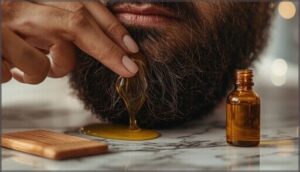
Applying olive oil to your beard doesn’t have to be complicated once you nail the basics. Here’s how to properly apply olive oil for best results:
- Pre-Application Cleansing: Wash your beard with a mild cleanser and warm water, then towel-dry until damp—not dripping—to boost absorption by 30–40%.
- Measuring Oil: Start with 2–3 drops for short beards, scaling up to 4–8 drops as length increases.
- Application Technique: Rub oil between palms for 5–10 seconds, then work from cheeks down to chin and moustache, massaging from roots outward.
- Massage Tools: After applying, comb through from skin to tips using a wooden or antistatic comb to carry oil along each hair fiber.
- Routine Integration: Apply once daily—preferably at night—to let the conditioning work while you sleep.
Tips for Even Distribution
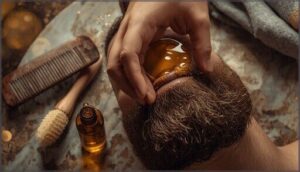
Even topical application of olive oil won’t help if it sits in clumps on the surface. Warming the oil between your palms first thins its consistency, making it easier to massage into both hair and skin. Comb in multiple directions—with and against the growth—to push the product through all beard layers, not just the surface. A quality brush breaks up any greasy buildup and redistributes excess from saturated zones to drier patches.
| Coverage Strategies | Technique Sequencing |
|---|---|
| Short Beards | Warm oil → roots → outward strokes |
| Medium to Long Beards | Section beard → apply by zones → comb through |
| Dense or Curly Beards | Circular massage → detangle → multi-pass combing |
| Application Tools | Fingertips for massage, comb for distribution |
| Clump Management | Brush away buildup, redistribute to dry areas |
How Much and How Often to Use

Once you know how to properly apply olive oil, the next question is frequency and volume. Short beards under one inch need just two to three drops daily; longer growth might take eight to ten.
Daily application ranges from once after a morning shower to twice in dry climates, but olive oil’s thickness means most guys stick to every other day or a few times per week—adjust for your hair type to avoid buildup.
DIY Olive Oil Beard Oil Recipes

You don’t need to spend money on expensive beard oils when you can make your own at home. Mixing olive oil with a few simple ingredients gives you a product that’s just as effective and costs a fraction of the price.
Here’s how to create your own custom blends and what you need to know about choosing the right additions.
Mixing Olive Oil With Essential Oils
When you blend olive oil with essential oils for beards, you’re crafting a custom DIY beard oil that suits your specific needs. For safe, effective DIY beard care, start with proper dilution safety—aim for 1% essential oil concentration, which translates to about one drop per 5 milliliters of olive oil to minimize sensitization risks and irritation.
Consider these proven combinations for your beard:
- Rosemary and lavender: Clinical trials show this blend increases hair growth rate by roughly 58% with favorable hair effects on thickness and density
- Tea tree oil: Offers antimicrobial uses against bacteria and fungi beneath your beard, helping prevent folliculitis
- Peppermint oil: Stimulates follicles and provides an invigorating sensation when properly diluted
- Cedarwood oil: Adds a masculine scent while supporting overall beard health
Always follow formulation parameters carefully—for a 30-milliliter olive oil base, you’ll use approximately 6 drops of essential oils for beards at the recommended 1% strength. Perform a patch test before full application, and use fresh, properly stored essential oils to avoid oxidation that increases skin sensitivity.
Recipe Instructions and Variations
Once you’ve nailed proper dilution, it’s time to build your go-to DIY beard oil recipes. For a warm oil mask, gently heat 1 to 2 tablespoons of extra-virgin olive oil to about 37 to 40 degrees Celsius, massage it in for 3 to 5 minutes, then leave it on for 20 to 30 minutes before rinsing. Use this weekly for deep conditioning.
For daily leave-in blends, try these jojoba blend ratios:
| Carrier Oil | Proportion | Purpose |
|---|---|---|
| Jojoba Oil | 50% | Lightweight absorption |
| Olive Oil | 25% | Deep moisturization |
| Avocado/Almond Oil | 25% | Balanced viscosity |
Mix 1 tablespoon olive oil with 1 tablespoon jojoba oil in a 30-milliliter dropper bottle for several weeks of use. Apply 3 to 6 drops once or twice daily, rubbing between your palms before working it through from roots to tips.
Scented variations add personality—for a 1-ounce batch, add 7 drops cedarwood, 3 drops pink pepper, and 2 drops clary sage to stay within safe facial-use limits.
Store your DIY olive oil beard oil recipe in opaque glass at room temperature for up to 6 to 12 months. Label each batch with the production date, and discard if you notice rancid odors or cloudiness during batch preparation.
Choosing The Right Ingredients
Your ingredients matter as much as your ratios. Start by selecting extra-virgin olive oil with high oleic acid—around 70 to 85 percent—for oxidative stability and longer shelf life.
Check carrier oils for oil comedogenicity ratings under 2 if you have oily skin; jojoba and avocado both sit at 2, matching olive oil.
Screen for allergenicity concerns by patch-testing any new natural ingredients or essential oils before full application.
Potential Drawbacks and Precautions

Olive oil works well for most guys, but it’s not a perfect fit for everyone. Like any grooming product, it comes with a few potential downsides you should know about before slathering it on your beard.
Let’s walk through what to watch out for and how to use it safely.
Skin Sensitivity and Allergic Reactions
While olive oil works for many, your skin mightn’t agree with it. Studies show about 5% of patch-tested patients react to topical olive oil, and it’s been linked to irritant contact dermatitis—especially for guys with atopic skin risks or existing dermatitis.
Before committing, run a patch test:
- Apply a small amount to your inner forearm
- Wait 24 hours and check for redness or itching
- Watch for signs of skin irritation or fungal overgrowth
- Skip olive oil if you have sensitive skin or eczema
- Consider lighter alternatives if irritation develops
Your skin health comes first.
Pore Clogging and Greasiness
Even though it moisturizes well, olive oil rates a 2 out of 5 on the comedogenic scale—meaning it can clog facial pores, especially if you’ve got oily or acne-prone skin. That thickness leaves a greasy residue on beard hair and the skin underneath, trapping sebum and raising your acne risk through follicle blockage.
| Skin Type | Comedogenic Rating Impact | Greasy Residue Risk |
|---|---|---|
| Oily | High clogging potential | Heavy, visible shine |
| Acne-prone | Increases acne risk | Traps bacteria easily |
| Sensitive | May worsen dermatitis | Irritation from buildup |
| Normal/Dry | Lower concern | Manageable with moderation |
Your skin health matters more than any oil’s reputation.
Best Practices for Safe Use
Before you reach for that bottle, protect your skin with smart habits. Patch testing on your inner forearm for 24–48 hours screens for delayed reactions, while proper oil dilution—around 1% essential oil to carrier—keeps irritation at bay.
- Limit application frequency to once or twice daily; more invites clogged pores and compensatory oil production
- Match your skin type to comedogenic ratings—oily complexions need lighter alternatives
- Check expiration dates regularly, since oxidation risks increase irritation over time
How to properly apply olive oil matters as much as what you apply.
Frequently Asked Questions (FAQs)
Can Olive Oil Alone Be Applied to a Beard?
You can apply pure olive oil straight to your beard, but its thick consistency may leave a greasy residue. Test your absorption rate first—patch testing helps avoid dermatitis risks before full application.
What is Extra Virgin Olive Oil?
Extra virgin olive oil comes from pure mechanical pressing without chemical refining, keeping acidity below 8%. Production methods preserve its fatty acids and antioxidants, though adulteration risks make quality verification important.
Do You Have to Wash the Olive Oil Out of Your Beard or Leave It?
It’s the definitive beard care question: leave it in or wash it out? You can do both—leave a few drops in daily for conditioning, or rinse after an overnight treatment to avoid greasiness and clogged pores.
How Effective is Olive Oil in Treating a Curly Beard?
Olive oil works well for softening curly beard hair and reducing breakage, but its heavy texture can weigh down curls if you use too much. Stick to a few drops on damp hair for best results.
How Do You Make Beard Oil With Olive Oil?
Most guys overthink it. Start with a 30 milliliter dark glass bottle—essential oil dilution matters. Add 3–5 drops of essential oils first, then fill with extra virgin olive oil. Shake well.
Storage best practices and shelf life considerations keep your DIY beard oil fresh for months. The carrier oil ratios stay simple: stick to 1% essential oils for safe beard care. Bottle type matters because amber or cobalt glass protects against light degradation better than clear containers.
Can I Apply Olive Oil to the Beard Overnight?
Yes, you can leave olive oil in your beard overnight to increase moisturization and softness. Just use a few drops, rinse thoroughly the next morning, and limit treatments to 1–3 times weekly.
Does Olive Oil Prevent Hair Loss?
Clinical evidence doesn’t support olive oil alone preventing androgenetic alopecia or common hair loss. However, it may improve scalp health and reduce breakage, creating better conditions for hair follicles while supporting overall hair growth as an alternative treatment approach.
Does Extra Virgin Olive Oil Grow Beard?
No trial proves extra virgin olive oil topically accelerates beard growth or triggers new facial hair follicles.
Dietary intake may modestly raise testosterone, but direct evidence linking olive oil to follicle stimulation remains absent.
What Kind of Olive Oil Works Best in Beards?
Extra virgin olive oil works best because it’s cold-pressed and loaded with polyphenols, squalene, and fatty acids that refined oils lose during processing.
Its antioxidant levels beat regular olive oil hands down for beard care.
Can olive oil help with beard dandruff?
Olive oil isn’t recommended for beard dandruff. It can feed Malassezia yeast, cause barrier damage, and worsen flaking.
Antifungal shampoos and lighter oils like jojoba offer safer, more effective alternative treatments for beard itchiness and skin care.
Conclusion
Don’t let the thought of greasy residue scare you off—applied correctly, olive oil becomes one of your beard’s most reliable allies. The question “is olive oil good for beards“ comes down to technique and consistency.
Start with small amounts, warm it between your palms, and work it through methodically. Your beard will respond with improved texture, healthier skin, and noticeable resilience.
Sometimes the simplest tools deliver the most lasting results.
- https://www.ncbi.nlm.nih.gov/pubmed/23472458
- https://www.healthline.com/health/beauty-skin-care/hydration-moisture
- https://www.medicalnewstoday.com/articles/321014
- https://pubmed.ncbi.nlm.nih.gov/23472458/
- https://cymbiotika.com/blogs/skin-health/does-olive-oil-moisturize-skin-exploring-the-benefits-risks-and-best-practices