
This site is supported by our readers. We may earn a commission, at no cost to you, if you purchase through links.

The neck is the most punishing place to shave on your whole face—and most guys treat it like an afterthought. Here’s the problem: neck skin is roughly half as thick as the skin on your cheeks, with fewer oil glands to cushion each blade pass. One wrong angle or a dull blade, and you’re dealing with razor burn, bumps, and two days of regret.
The neck also grows hair in multiple directions, sometimes swirling three different ways under the jaw alone. That’s not bad luck. That’s anatomy. Getting a clean, comfortable shave there means working with your skin’s structure, not against it.
Table Of Contents
- Key Takeaways
- Check Neck Skin Sensitivity
- Map Hair Growth Directions
- Trim Length Before Wet Shaving
- Cleanse Away Oil and Debris
- Exfoliate to Prevent Ingrowns
- Soften Hair With Warm Water
- Apply Pre-Shave Oil or Moisturizer
- Choose The Best Neck Razor
- Build a Cushioning Lather
- Position Your Neck and Neckline
- Frequently Asked Questions (FAQs)
- Conclusion
Key Takeaways
- Neck skin is roughly half as thin as your cheeks, so bad technique — wrong angle, dull blade, harsh soap — punishes you quickly with burns and bumps.
- Map your hair grain before every shave, because neck hair swirls in multiple directions and dragging a blade the wrong way is the main cause of ingrown hairs.
- Spend at least two minutes softening hair with warm water before shaving, since wet hair requires about 65% less cutting force, meaning fewer passes and less irritation.
- Sharp blades, a cushioning lather, and a pre‑shave oil aren’t optional extras — they’re the core trio that protects thin neck skin every single time.
Check Neck Skin Sensitivity
Your neck isn’t like the rest of your face — it’s thinner, more reactive, and way less forgiving. Before you pick up a razor, you need to know what you’re working with.
That’s why finding your neckline before you shave is the step most guys skip — and the one that makes or breaks the whole look.
Here’s what to check first.
Why Neck Skin Irritates Faster Than Cheeks
Your neck isn’t built like your cheeks.
The dermis is barely half as thick — 1.2 mm versus 2.56 mm on your face.
That thin dermis layer offers less cushion against every blade pass.
Reduced sebaceous glands mean less natural oil, so friction hits harder.
Add higher skin extensibility, and you’ve got skin that punishes bad technique fast.
Replacing replace dull blades before each shave helps minimize tug‑and‑pull on the delicate neck skin.
Signs of a Compromised Skin Barrier
Thin neck skin breaks down fast — and it tells you when it’s struggling. Persistent tightness after cleansing signals loss of surface lipids, a sign of compromised skin barrier.
Watch for these warning signs:
- Stinging Sensations when applying products means exposed nerve endings and surface cracks.
- Tight Skin Feeling after cleansing signals rapid moisture loss and missing barrier lipids.
- Rough Texture Patches and Increased Breakouts point to weakened protection and clogged pores.
Heightened Sensitivity to heat or everyday products confirms barrier damage. Skin irritation prevention starts with recognizing these signs early. Use a noncomedogenic moisturizer, a cool compress, or aloe vera gel to support skin barrier protection before picking up any razor.
When to Delay Shaving Irritated Skin
Redness Recovery starts with one rule: if it still stings, step back. Shaving over inflamed skin is like sanding a fresh bruise — you’re only making it worse.
Mild razor burn clears in 2–3 days. Severe irritation? Give it a week.
| Signal | What It Means | What to Do |
|---|---|---|
| Redness present | Barrier still healing | Apply cold compress, wait |
| Open Wound Healing | Razor Bump Pause needed | Skip shaving entirely |
| Infection Indicators (pus, swelling) | Barrier Repair required | Seek medical advice |
Watch for Infection Indicators — pus isn’t a shaving side effect. Use cool rinse and postshave soothing balms during downtime. Skin irritation prevention beats fixing damage later.
Choosing Fragrance-free, Alcohol-free Products
While your skin heals, what you put on it matters just as much as what you avoid. Front-label claims like "alcohol-free" can mislead — ingredient label decoding is your real protection.
moisturizing humectants like glycerin and panthenol. patch test protocol on a small area first.
Simple formula focus wins every time. Fewer ingredients mean fewer surprises.
Map Hair Growth Directions
Most guys skip this step and wonder why they keep getting bumps. Your neck hair doesn’t grow in one neat direction — it shifts zones, swirls, and doubles back on itself.
Here’s how to read it before you ever pick up a razor.
Why Neck Hair Grows in Swirls and Zones

Your neck hair doesn’t grow in neat rows — it grows in swirls and zones, and that’s not random. Embryonic follicle orientation locks in each hair’s angle before you’re born, shaped by cellular polarity pathways and genetic whorl determinants.
Skin tension effects from all that head movement shift those zones further.
The result? Multiple hair grain directions sitting inches apart. That’s your starting puzzle.
Finger-rub and Mirror Methods to Find The Grain

You’ve got two reliable tools here — your fingers and a mirror. Together, they’ll map your hair grain direction quickly.
- Finger Rub Technique: Rub stubble in multiple directions. The smoothest path is with the grain; scratchy means against it.
- Mirror Grain Check + Light Angle Observation: Use bright natural light and a hand mirror for Visual Grain Assessment. Hair tips point with the grain.
- Tactile Grain Reading: Slow down near the jawline — the grain shifts there.
Map your hair grain before every shave.
Marking Separate Shaving Zones Under The Jaw
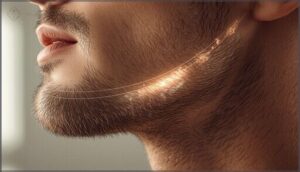
Once you’ve read the grain, it’s time for Jawline Zone Segmentation — splitting the under-jaw into separate blade paths.
Hair grain mapping for neck area reveals Sharp Grain Transitions quickly. Your left and right sides often grow differently. Treat each as its own zone.
| Zone | Hair Growth Direction | Blade Path Planning |
|---|---|---|
| Left jaw | Downward or angled left | Stroke down or diagonal |
| Right jaw | Downward or angled right | Mirror left-side approach |
| Center/throat | Often fans outward | Short inward strokes |
Use Visual Zone Lines and Skin Tension Markers — small landmarks like your Adam’s apple — to stop one stroke before crossing into a new grain. Proper neck shaving technique means never dragging past a grain shift.
Using Your Grain Map to Avoid Razor Bumps

Your grain map isn’t decoration — it’s your shave sequence. Follow it zone by zone, adjusting blade selection and angle optimization as the grain shifts.
Light zone pressure keeps hairs from curling back under. That’s how hair grain mapping for neck area turns into real bump prevention. Proper neck shaving technique means working the map every single time, not just once.
Trim Length Before Wet Shaving
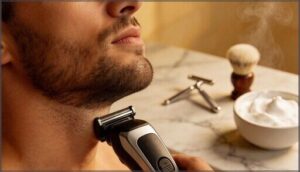
If your neck hair is longer than a few days of growth, throwing a razor at it right away is a mistake. A quick pass with a trimmer first changes everything.
Here’s what you need to know before that first wet shave stroke.
When Long Neck Hair Should Be Reduced First
Long neck hair is a razor’s worst enemy. If your hair bends or curls, it catches the blade instead of cutting cleanly. That’s when bulk hair reduction saves you. A quick pre-trim before shaving makes every stroke more controlled.
Watch for these trim timing signals:
- Hair feels dense, coarse, or uneven
- You spot existing razor bumps or redness
- Mixed lengths are making your neckline look patchy
Using a Trimmer to Prevent Razor Clogging
Think of your razor like a drain — pack it with too much hair and everything backs up. That’s blade gap management in short.
Running a trimmer first takes care of hair bulk reduction before the razor even touches your neck beard.
Less bulk means better trimmer blade clearance, smoother water flow optimization during rinses, fewer razor passes, and a cleaner neckline shaping result.
Ideal Stubble Length Before Razor Shaving
So now your trimmer’s done the heavy lifting. What’s the sweet spot before a razor takes over?
Barber standards land at 1–3 mm. That’s your stubble range guideline.
Growth timing usually gets you there in about three days.
At that length, stubble visual cues are obvious — close, even, manageable.
Use short gentle strokes with a guard comb to hit that target cleanly.
How Trimming Lowers Tugging and Pressure
Once you’re at that 1–3 mm sweet spot, your razor’s job gets a lot easier.
Shorter hair means less resistance — that’s Reduced Blade Drag in action. The blade glides instead of pulling.
Hair Tension Relief is real: there’s no long strand bending and tugging before it cuts.
Keep a light grip, use short strokes, and let the blade do the work.
Cleanse Away Oil and Debris

Before anything touches your skin, it needs to be clean. Sweat, oil, and dead cells sitting on the surface will drag your blade and invite irritation.
Here’s what you need to know about cleansing your neck the right way.
Washing Off Sweat, Oil, and Dead Skin
Skipping a Post-Workout Rinse before shaving is like painting over a dirty wall — nothing sticks right. Sweat mixes with your skin’s natural oil fast, and that combo clogs hair follicles before the razor even touches you.
Rinse with lukewarm water right after sweating. It takes care of solid Sweat Removal Timing without stripping your barrier.
Follow up with an Oil-Balancing Cleanser for a proper Dead Skin Lift.
Best Gentle Cleansers for The Neck
Not every cleanser earns a spot in your pre-shave lineup. Your neck needs a Fragrance-Free Formula that won’t trigger redness before the razor even touches skin.
A Ceramide-Rich Cleanser like CeraVe rebuilds your barrier while cleaning. A Glycerin-Infused Cleanser pulls moisture in. A pH-Balanced Cleanser keeps skin at 5.5. Even a Micellar Water Cleanser works — light, effective, no stripping.
Why Harsh Soaps Can Increase Irritation
Harsh soaps are quietly wrecking your neck before the razor even shows up. Most bar soaps sit above pH 9 — your skin prefers 4.5 to 5.5. That alkaline pH damage breaks down your barrier fast.
Here’s what you’re actually dealing with:
- Lipid Stripping pulls out ceramides, leaving skin rough and unprotected
- Sulfate Aggression from SLS inflames follicles before the first stroke
- Fragrance Irritants cause micro‑irritation on freshly cleaned skin
- Barrier Disruption lets bacteria and razor friction hit deeper layers
Switch to a gentle cleanser. Your neck will thank you.
Patting Skin Damp Before The Next Step
After rinsing, grab a soft towel and pat — don’t rub. Light pressure removes the excess water while keeping your neck slightly damp. That leftover moisture is working for you.
| Step | Why It Matters |
|---|---|
| Soft Towel Choice | Reduces friction on thin neck skin |
| Patting Technique | Preserves natural oils, limits irritation |
| Light Pressure | Avoids stressing already‑cleansed skin |
| Moisture Lock | Prepares skin for product absorption |
| Damp, Not Wet | Prevents diluting aftershave and moisturizer |
Exfoliate to Prevent Ingrowns

Exfoliating your neck before shaving is one of the easiest ways to stop ingrown hairs before they start. Dead skin cells trap hairs beneath the surface, and your razor can’t fix what’s already buried.
Here’s what you need to know to do it right.
How Exfoliation Helps Trapped Neck Hairs
Dead skin is like a lid over your follicles — and trapped hairs can’t push through a sealed door. That’s where exfoliation does the heavy lifting.
- Follicle unclogging clears oil and debris blocking the hair’s exit
- Trapped hair extraction becomes easier when softened skin releases the tip
- Skin surface smoothing lowers the chance hairs curl back under
- Micro-exfoliation timing matters — exfoliation before shaving preps the path cleanly
Physical Vs. Chemical Exfoliation Options
Two tools, two different jobs. A physical scrub — think jojoba beads or fine particles — manually lifts dead cells off the surface. Great for most guys. But on sensitive neck skin, too much friction causes redness fast.
That’s where chemical exfoliation earns its keep. Salicylic acid (a BHA) clears pore-level buildup. Fruit enzymes dissolve surface debris gently, with zero scrubbing. Lower irritation risk overall.
How Often Sensitive Skin Should Exfoliate
Sensitive skin doesn’t need more exfoliation — it needs smarter scheduling. Once a week is your starting point. Some guys with reactive neck skin do better with once every two weeks, which aligns with dermatologist guidance for thinner skin.
Follow this for exfoliation frequency:
- Normal weeks — once weekly max
- Dry or cold seasons — seasonal frequency adjustments mean dropping to biweekly
- After a new product — allow full barrier recovery time before resuming
- First use — always patch test; timing matters; wait 24 hours
Why Over-exfoliating Makes Shaving Worse
More exfoliation isn’t always better — past a certain point, it becomes the problem. Strip away too much of the skin barrier and you’ve got increased blade drag, real razor burn risk, and an inflammatory response that lingers.
Over-exfoliated skin delays healing and raises ingrown hair risk on the neck. Smart exfoliation frequency protects your skin prep — scrubbing twice a week isn’t dedication, it’s damage.
Soften Hair With Warm Water

Dry, stiff neck hair is harder to cut cleanly — and that’s where warm water does the real work. Hydrating your hair before the blade touches skin can be the difference between a smooth pass and a rough, irritating one.
Here’s what you need to know about doing it right.
Warm Shower Vs. Hot Towel Preparation
Both options work — it just depends on your setup. A warm shower is the easiest route: steam opens pores, warm water hydrates your whole neck evenly, and skin hydration level stays balanced without extra equipment needed.
A hot towel delivers direct heat exposure to a focused area in 2–3 minutes.
Either way, skip scalding temps. Finish with a cold water rinse to calm the skin.
How Long to Hydrate Neck Hair Properly
Time is the part most guys skip. Your hydration duration standard is two to three minutes of steady warm water contact — not a quick splash.
Here’s what that water soak time actually looks like in practice:
- Shower steam counts toward your steam exposure clock.
- A damp towel holds moisture retention better than open air.
- Lather extends your absorption standard by trapping moisture.
- Warm water for pores works faster than cool water.
- Shaving before two minutes means fighting stiffer hair.
Why Softened Hair Cuts With Less Resistance
Once you hit that two-minute mark, something real happens inside each hair shaft. Water triggers keratin swelling — the fiber absorbs moisture and literally loosens up.
That cutting force reduction is dramatic: wet hair requires about 65% less force to slice than dry hair. Less resistance means better glide efficiency, less blade drag decrease, and fewer repeated passes tearing up your neck.
Wet hair takes 65% less force to cut, meaning fewer passes and far less damage to your neck
Water Temperature Mistakes to Avoid
Scalding water feels productive — it doesn’t help. Excessive Heat Exposure strips your skin’s natural oils and amps up redness before the razor even touches you. Avoid hot showers as prep.
Prolonged Warm Soak weakens the barrier too. Cold Water Shock tightens everything back up, undoing your softening work.
Lukewarm water wins every time. No Temperature Fluctuation Mistake, no Inconsistent Rinse Temperature drama. Just steady warmth.
Apply Pre-Shave Oil or Moisturizer

Pre-shave oil or moisturizer is the step most guys skip — and their skin pays for it. Think of it as a shield between the blade and your skin.
Here’s what you need to know to get it right.
How Pre-shave Products Reduce Blade Drag
Think of pre-shave oil as a slip layer between your blade and skin. That’s lubricant chemistry doing real work. It locks in moisture, softens stubble, and creates glide enhancers that reduce blade edge interaction with sensitive neck tissue.
- Apply presave oil before lather — not after
- Presave lotion works well for very dry skin
- Lubricating gels add cushion around the Adam’s apple
- Presave skin softening cuts friction by hydrating each hair shaft
- Presave preparation steps like this mean fewer repeat passes
Best Lightweight Oils for Sensitive Neck Skin
Not all oils play nice with sensitive neck skin. For barrier sealing and slip factor, squalane is your best bet — it absorbs fast, won’t clog pores, and feels like nothing on the skin.
Jojoba and grapeseed are solid hydrating pre-shave oil options too. Always patch test a new pre-shave oil first.
Check ingredient compatibility and shelf life before committing to anything new.
When to Use Moisturizer Instead of Oil
Sometimes oil isn’t the right call. If you’ve got oily skin, active breakouts, or you’re shaving in a humid climate, swap to a water-based moisturizer instead.
Four situations where moisturizer wins:
- Oily Skin Preference — it hydrates without clogging pores
- Humid Climate Benefits — won’t trap sweat or cause blade slippage
- Quick Morning Routine — one product covers pre‑ and post‑shave skincare routine
- Fragrance‑Free Moisturizers — safer for sensitivity, with better razor blade compatibility
How Long to Let The Product Sit
Thirty to sixty seconds. That’s your Oil Set Time sweet spot.
Massage it in, then let it sit — don’t rinse it off. That brief Moisture Retention Window is where the presave oil benefits actually happen: the Product Slip Interval lets absorption work before your lather goes on.
Rush it, and you’ve skipped the most important step in preparing neck skin for shaving.
Choose The Best Neck Razor

The razor you pick makes or breaks your neck shave. Neck skin is thin, curved, and unforgiving — the wrong tool turns a quick shave into a week of irritation.
Here’s what to know before you grab anything off the shelf.
Safety Razor Vs. Cartridge for Neck Curves
Both razors have their place on curved neck contours — it just depends on your skill level.
Cartridge razors win on Head Design Flexibility; that pivoting head follows your jawline automatically.
Safety razors demand more from you: lock in that 30-degree angle, stretch the skin taut, and navigate each zone deliberately.
Better closeness on contours, but multi-blade irritation on curves is real. Choose honestly.
When an Electric Razor is The Better Choice
Sometimes a manual razor just isn’t worth the battle. If your neck flares red after every shave, an electric razor changes everything.
Foil vs rotary matters here — foil shavers feel gentler on sensitive skin.
The dry shave convenience means no setup, no mess.
Travel-friendly design and decent battery life make it practical anywhere.
For easily irritated necks, electric often wins.
Why Sharp Blades Matter on Thin Skin
Blade sharpness isn’t optional on the neck — it’s the whole game. Neck skin is thinner than your cheek, so a dull blade drags instead of cuts.
That friction destroys your skin barrier fast.
Blade Edge Control means letting a sharp edge do the work, so Pressure Reduction happens naturally.
Less friction, fewer passes, cleaner cuts. Friction Minimization protecting you from razor burn before it starts.
How Often to Replace or Clean Blades
Sharp today doesn’t mean sharp tomorrow. Stick to a Blade Replacement Schedule — most blades last 5 to 10 shaves. Daily shavers should swap weekly.
Your Blade Dullness Indicators are simple: extra pressure, multiple passes, tugging. That’s your sign.
After each shave, rinse thoroughly. Shake dry — never leave it wet. Storage Hygiene Practices matter too. Keep your razor outside the shower. Rust kills a good edge fast.
Build a Cushioning Lather

The lather you build is your blade’s best ally on the neck. Get it wrong, and even the sharpest razor will drag.
Here’s what actually matters when you’re choosing and building yours.
Cream, Gel, or Soap for Neck Shaving
Each one brings something different to the table. In a quick Texture Comparison:
Shaving cream cushions well and rinses fast — solid Rinse Simplicity.
Shaving gel gives you Clear Visibility of your neckline, which helps with precise lathering the neck.
Shaving soap builds dense lather with strong Slip Efficiency, but needs practice.
For sensitive skin, cream or fragrance‑free gel usually wins on comfort and Lather Longevity through tricky curves.
Ingredients That Improve Glide and Comfort
The label matters more than the brand.
Look for Humectant Boosters like glycerin or hyaluronic acid — they pull moisture into your skin during the shave. Emollient Oils like jojoba add real slip. Soothing Additives like allantoin calm irritation fast. Glide Enhancers like stearic acid build that slick cushion your blade needs. Barrier Supporting Agents like ceramides protect thin neck skin.
Stick to fragrancefree products and alcoholfree soothing aftershave — simple ingredients, better results.
Using a Brush to Lift Flat Neck Hairs
Your fingers can’t do what a shaving brush does. Bristle stiffness matters here — a boar brush has the backbone to push under flat neck hairs and lift them up.
Work in circular motion across the swirls and mixed-grain zones. Keep your brush angle slight so bristles fan out.
Lift timing counts too — shave while those hairs are still standing.
How Much Lather The Neck Really Needs
Think of it like frosting a cupcake — you don’t need the whole bag. A nickel-sized amount of shaving cream is enough for the neck.
Full opaque coverage is the goal, not thickness. Your lather consistency should look like whipped cream, not soap bubbles.
If it dries mid-shave, add a few drops of water. No need to reapply a full load. Minimize product waste, increase control.
Position Your Neck and Neckline

Most shaving mistakes happen before the first stroke even lands. How you position your neck controls everything — blade angle, skin tension, and whether you catch that tricky Adam’s apple cleanly.
what to get right before you begin.
Tilting The Head to Flatten Curved Areas
Your neck isn’t flat — so stop shaving it like it is. Proper neck shaving techniques start with position.
Use a Forward Lean of about 10–15 degrees, then add a Backward Tilt to flatten the skin along the jawline. Downward Tilt addresses stubborn under‑chin curves.
Chin Turtling flips concave hollows convex. Pair every head tilt with Short Stroke Adjustment — 1–2 cm max — for real neck contour adaptation and fewer passes overall.
Managing The Adam’s Apple and Jawline
The Adam’s apple is the trickiest bump you’ll shave. Don’t go straight over it. Instead, use skin tension pulling — drag the skin to one side, shave that half, then switch. That’s your bump avoidance strategy.
Use a blade angle range of 30–45 degrees with a diagonal stroke technique along the sides. Follow up with a cold water rinse to calm everything down.
Defining a Clean Neckline Before Shaving
Before the razor touches skin, set your border. Place your reference finger placement at the top of the Adam’s apple, then trace a curved edge sketch toward each ear — never a flat line.
Use mirror angle adjustment to confirm symmetry on both sides. A symmetrical line check prevents uneven results.
Use trimmers to define neckline cleanly before any wet shaving begins.
Final Pre-shave Checklist Before The First Stroke
Everything’s in place — now run a quick final check. Confirm your blade sharpness by feeling for smooth glide, not drag. Do a lather consistency test — it should cling, not drip.
Use skin tension technique to flatten curves. Do a mirror angle verification for symmetry.
Your product absorption time is done. Warm water, preshave oil, sharp clean blades — you’re ready.
Frequently Asked Questions (FAQs)
Can diet affect neck skin shaving sensitivity?
Yes, absolutely.
Sugar intake, dairy impact, and gut health all affect skin sensitivity. Omega-3 benefits, zinc’s role, and probiotics support barrier strength. Skin hydration, adequate sleep, and lifestyle habits shape how your neck deals with a blade.
Does shaving frequency change neck hair texture?
No. Your follicle diameter controls texture — shaving can’t touch that.
What changes is the blunt edge perception of stubble. Short, freshly cut hair just feels coarser. That’s the Hair Growth Cycle fooling you, not frequency.
How does humidity impact neck shaving results?
Humidity changes everything. High humidity softens hair and stickiness increases, while lather dilution weakens protection.
Low humidity strips moisture fast. Both extremes demand adjusted skin preparation and exfoliation before shaving for clean, irritation-free results.
Should neck shaving routines differ by season?
Your skin doesn’t read a calendar, but it absolutely feels the seasons. Winter demands a Moisture Boost; summer needs Sweat Management. Adjust your prep and products — same technique, different texture.
Can stress trigger more neck skin breakouts after shaving?
Stress absolutely can. Cortisol oil surges drive a hormonal sebum surge that clogs freshly shaved pores. Stress-induced inflammation slows delayed healing. Sweat-induced blockage worsens bumps fast.
Conclusion
Think of your neck as a high-performance engine—it needs the right tune-up before hitting the road. By mapping hair patterns, softening stubborn growth, and cushioning thin skin, you’re not just shaving; you’re engineering a smooth, irritation‑free glide.
This prep transforms a daily chore into a ritual of control. No more flinching at nicks or bumps. Instead, you step away with clean lines and quiet confidence.
Master this prepare neck area for shaving process, and every mirror check becomes a victory lap. Your neck deserves this respect.
- https://docs.google.com/forms/d/e/1FAIpQLSft2CcQT7O59GB6mBpFvAxcuYez30sIROpeaOIM3LqzTmbG5g/viewform?usp=pp_url&entry.1452073181=Website
- https://geni.us/leaf_razor
- https://pubmed.ncbi.nlm.nih.gov/23441628/
- https://genovaskincare.com.au/blogs/skincare/neck-skin-barrier-breakdown-why-it-stings-itches-and-flushes-inflammation-vs-sensitivity
- https://southernmarinderm.com/how-to-care-for-your-neck/