This site is supported by our readers. We may earn a commission, at no cost to you, if you purchase through links.

Hair follicles cycle through growth, rest, and shedding phases every two to seven years—and when that rhythm gets disrupted, you don’t just lose strands, you lose confidence. The culprits behind thinning hair range from iron deficiency and hormonal imbalances to chronic stress and harsh styling habits, but the good news is that most of these factors respond to targeted intervention.
Nutrition plays a foundational role in follicle health, with specific proteins, vitamins, and minerals directly influencing keratin synthesis and scalp circulation. Beyond what you eat, how you handle your hair matters just as much: excessive heat, tight hairstyles, and chemical treatments can weaken the hair shaft and trigger premature shedding.
Understanding the science behind hair growth equips you to make informed choices that protect your follicles, enhance your growth phase, and restore thickness from the inside out.
Table Of Contents
Key Takeaways
- Your hair’s growth and strength depend on a balanced diet rich in protein, omega-3 fatty acids, iron, vitamin D, and antioxidants.
- Harsh styling habits—like excessive heat, tight hairstyles, and chemical treatments—directly weaken hair and trigger premature shedding.
- Chronic stress, poor sleep, dehydration, and smoking can disrupt the hair growth cycle and accelerate hair loss.
- Evidence-based treatments such as minoxidil, finasteride, low-level laser therapy, and scalp massage can boost regrowth when nutrition and lifestyle changes alone aren’t enough.
Best Foods to Promote Healthy Hair Growth
Your hair follicles need specific nutrients to produce strong, resilient strands. Without adequate protein, essential fatty acids, and key vitamins, your growth cycle slows and existing hair becomes brittle.
The foods you choose directly influence scalp health and follicular function, so let’s look at the most effective options for promoting growth.
Lean Proteins for Hair Structure

Your hair follicles demand protein—hair shafts are roughly 80–95% keratin, built from amino acids you consume daily. Without sufficient protein intake (aim for 0.8 g per kilogram of body weight), follicles shift prematurely into shedding mode.
Lean proteins like chicken, fish, and Greek yogurt deliver complete amino acids that fuel keratin production, reinforce hair strength, and maintain nutrient balance essential for sustained hair growth. Understanding protein deficiency risks is vital for promoting healthy hair.
Omega-3 Rich Foods and Scalp Health

Fatty fish like salmon, mackerel, and sardines pack EPA and DHA—omega-3 fatty acids that calm scalp inflammation and boost blood flow to your follicles. Six-month trials show omega-3 supplements markedly increase hair density and reduce shedding.
You’ll see these fatty acid benefits when you:
- Eat two servings of fatty fish weekly to support hair follicle health
- Consider fish oil supplements if you don’t consume nutrient-rich foods regularly
- Choose algae oils as plant-based omega-3 sources for scalp health
Regular consumption of foods rich in omega 3 benefits can lead to improved hair growth and overall scalp health.
Eggs and Essential Hair Nutrients

You’re building a strong foundation with omega-3 fatty acids—now add eggs to multiply those benefits.
One large egg delivers 6 to 7 grams of complete protein for keratin synthesis, plus 10 micrograms of biotin to strengthen hair follicles. Egg yolks supply vitamin D, B vitamins, iron, and selenium—nutrients that reverse telogen effluvium when deficiencies are corrected.
Cook them thoroughly to preserve biotin availability and optimize vitamin enrichment.
Antioxidant-Packed Fruits and Vegetables

Colorful produce arms your follicles against oxidative stress that accelerates miniaturization. Bell peppers deliver 169% of your daily vitamin C to synthesize collagen, while berries supply polyphenols that measurably improve one-third of oxidative biomarkers after seven days of consistent intake.
Dark leafy greens like spinach and broccoli provide carotenoids your body converts to vitamin A, fueling sebum production that prevents brittle, dry strands.
Nuts, Seeds, and Healthy Fats
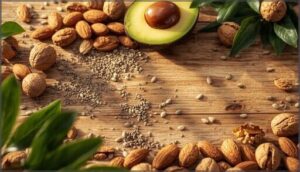
A handful of nutrient-dense nuts and seeds can transform your scalp’s landscape. You support follicle integrity and fatty acid balance with:
- Omega-3 fatty acids from walnuts and chia,
- Vitamin E-rich almonds that shield against oxidative stress,
- Healthy oils in avocados, which boost microcirculation.
Prioritize antioxidantrich foods and moderate fat intake for resilient, thriving hair.
Key Vitamins and Minerals for Hair Health

Your hair follicles don’t run on hope—they run on nutrients. When specific vitamins and minerals drop below ideal levels, your hair growth cycle can stall, thin, or shift into excessive shedding.
Your hair follicles run on nutrients, not hope—when vitamins and minerals drop below ideal levels, growth stalls and shedding accelerates
Let’s break down the key nutrients that directly influence follicle function and how deficiencies show up in your strands.
Iron and Ferritin Levels
Iron deficiency stands among the most documented hair loss causes, with research showing that women experiencing diffuse shedding face a 21-fold increased risk when ferritin drops to 30 ng/mL or below.
Ferritin testing reveals your iron stores, and correcting nutrient imbalance through targeted iron intake can support hair follicle health and hair growth promotion, particularly when combined with anemia prevention strategies that address depleted reserves.
Vitamin D and Hair Growth Cycle
Vitamin D deficiency disrupts hormone regulation and growth phase optimization throughout the hair follicle cycle, with research showing that 86% of men with premature hair loss had vitamin D levels below 30 ng/mL.
You can support your hair follicle health by:
- Prioritizing sun exposure benefits for natural vitamin D synthesis
- Testing serum levels if unexplained shedding occurs
- Recognizing that lower vitamin D correlates with greater severity
- Combining nutrient-rich foods with strategic supplementation
- Understanding that duration alone doesn’t guarantee adequate levels
B Vitamins and Follicle Health
Your hair follicles depend on B vitamin deficiency screening only when you show systemic symptoms or risk factors. A retrospective analysis found B12 deficiency in just 2.6% of telogen effluvium cases and zero folate deficiency among 115 patients.
| B Vitamin | Deficiency Prevalence | Clinical Recommendation |
|---|---|---|
| Vitamin B12 | 2.6% in hair loss patients | Test if neurologic symptoms present |
| Folate | 0% in studied cohort | Reserve for high-risk cases |
| B Complex | Less consistent association | Prioritize when dietary gaps exist |
You won’t need routine B12 supplements unless a documented deficiency exists. However, correction becomes essential for hematologic implications when nutrient intake falls short.
Zinc and Hair Loss Prevention
Your scalp’s enzymatic processes rely on zinc to regulate normal anagen–telogen transitions, yet 9.6% of telogen effluvium patients show deficiency. When dietary zinc falls short, your hair follicles lose a critical cofactor for cycling and structural integrity.
- Zinc deficiency disrupts follicle function more often than B12 deficiency but less than ferritin depletion
- Mineral balance matters—gastrointestinal absorption issues warrant serum zinc testing in unexplained shedding
- Zinc supplements require controlled trials to quantify density improvements, as current evidence remains limited
The Role of Biotin and Collagen
Despite biotin’s reputation for strengthening hair follicles, a 2020 study found no serum difference between telogen effluvium patients and controls—all exceeded deficiency thresholds. Your diet and intestinal flora usually provide adequate biotin without supplements.
Collagen supplements for hair growth lack rigorous placebo-controlled trials, though both nutrients support skin health.
Focus on nutrient-rich foods rather than chasing deficiencies that rarely exist in your scalp.
Healthy Hair Care Habits to Support Growth

You can’t out-supplement a bad hair care routine. Even the best diet won’t protect your strands if daily habits actively work against growth. The way you handle, style, and maintain your hair determines whether those follicles can do their job—so let’s break down what actually helps and what quietly sabotages your progress.
Reducing Heat and Chemical Damage
Flat irons that soar past 200°C will strip your hair’s structural integrity, triggering breakage you can’t undo. You’ve got the power to dial down heat styling and space out chemical treatments—bleach, relaxers, and permanent dyes all weaken keratin bonds.
Apply heat protectants before every blow-dry, keep your dryer moving, and let hair air-dry to 80% first. Your strands deserve thermal care, not thermal warfare.
Brushing, Combing, and Handling Hair
Beyond heat, your hands hold real power over breakage prevention. Gentle brushing—once or twice daily—cuts shedding compared to aggressive, repeated strokes that stress fibers under cyclic load.
When detangling wet hair, reach for a wide-tooth comb and work from ends to roots; damp strands stretch easily and fracture under tension.
If your scalp aches or hairs snap at the hairline, you’re pulling too hard—loosen your grip and let hair care tips guide smarter handling for long-term hair health.
Regular Trims to Prevent Breakage
Gentle handling sets the stage, but regular trims seal the deal on hair length retention. Removing damaged ends every six to eight weeks stops split end repair from becoming a marathon—you’re cutting breakage at the source.
- Trim frequency matters: Schedule trims every 6–8 weeks to prevent splits from traveling upward and triggering hair breakage along healthy sections.
- Target damaged tips first: Focus on visibly frayed or heat-damaged areas to preserve overall length while controlling hair damage repair needs.
- Trimming techniques vary: Ask for micro-trims or point cutting to remove only compromised fibers without sacrificing growth progress.
- Split ends sabotage growth: Untrimmed splits fracture mid-shaft, offsetting your monthly half-inch gain and stalling visible hair care results.
- Consistency wins: Routine cuts maintain fiber strength, so hair growth translates into real length instead of disappearing through spontaneous snaps.
Professional trimming techniques—like slide cutting for thick strands—distribute mechanical load evenly, keeping your ends strong and your hair care tips actionable.
Choosing Protective Hairstyles
Protective styles shield your strands, but tension tells a different story. Tight braids, weaves, and slicked-back buns tug follicles relentlessly—clinical data link chronic pull to traction alopecia, especially when combined with chemical relaxers or heavy extensions.
Rotate your styling techniques every few weeks, choose looser braids over cornrows, and skip adhesive glues that cement hair breakage and scalp health problems into place.
Lifestyle Factors That Influence Hair Growth

Your daily habits shape your hair’s potential far beyond what you eat or how you style it. Stress levels, hydration, sleep patterns, and lifestyle choices like smoking or drinking all send signals to your follicles—and they respond accordingly.
Let’s examine the key lifestyle factors that either support or sabotage your hair growth goals.
Stress Management and Relaxation Techniques
Chronic stress can push up to 30% of your hair follicles into premature shedding—but you hold the power to reverse that damage. Mindful meditation and yoga therapy trigger the relaxation response, lowering stress hormones that disrupt your hair growth cycle.
Pair these calming techniques with stress reduction practices like deep breathing, and support your efforts with nutrition and hair health essentials: omega-3 fatty acids, vitamin D, and antioxidants to fortify follicles from within.
Hydration and Scalp Moisture
Without enough water, your scalp’s moisture balance collapses—and dry scalp disrupts sebum production, choking hair follicles before they can thrive. Adults with suboptimal hydration show measurably reduced skin turgor, directly impacting scalp care and hair health and nutrition.
- Drink at least 2 liters daily to maintain euhydration and support hair growth
- Low water intake raises transepidermal water loss by 10–20%, starving follicles
- Topical hair hydrators like coconut oil lower TEWL and restore barrier function
- Moderate wash frequency clears oxidized sebum without stripping essential moisture
Sleep Quality and Hair Regeneration
Restful nights repair more than fatigue—they drive hair regrowth through melatonin therapy and circadian rhythms that govern follicle cycling. Genetically predicted insomnia multiplies alopecia areata risk nearly fourfold, while inadequate sleep shortens anagen phases and elevates cortisol, undermining collagen production and nutrient-rich foods you consume.
| Sleep Patterns | Impact on Hair Regeneration | Clinical Evidence |
|---|---|---|
| 7–9 hours nightly | Ideal follicle cycling | Shorter duration raises alopecia risk |
| Chronic insomnia | Autoimmune hair loss trigger | OR 3.88 in alopecia areata cases |
| OSA/fragmented sleep | Hypoxia damages follicle supply | Higher balding prevalence in men |
| Shift work | Elevated cortisol, inflammation | 4.46× odds of sleep disorders |
| Circadian alignment | Enhanced hair health | Melatonin activates stem cells |
Topical melatonin solutions increase hair density without shedding—your scalp’s clock matters as much as your plate.
Smoking, Alcohol, and Hair Loss Risks
Nicotine and alcohol abuse accelerate hair follicle damage through vasoconstriction, DNA adducts, and nutrient depletion. Current smokers face a 1.48-fold higher risk of androgenetic alopecia, while the combined toxic exposure from these habits can double the risk of early-onset hair loss.
Hair loss prevention demands decisive action:
- Smoking cessation improves scalp blood flow and reduces oxidative stress markers
- Alcohol moderation restores zinc, biotin, and B-vitamin levels
- Environmental control limits secondhand smoke deposition on follicles
- Lifestyle interventions combining both strategies maximize hair loss management and hair health outcomes
Your nutrition and hair investments falter without addressing these modifiable risks.
Evidence-Based Treatments and Growth Strategies

When diet and lifestyle changes aren’t enough, you have proven medical and clinical options that can accelerate regrowth and protect what you already have.
These treatments range from FDA-approved topical solutions to emerging light-based therapies backed by clinical trials.
Here’s what the research shows actually works.
Topical and Prescription Medications
Prescription 5α-reductase inhibitors like finasteride treatment and dutasteride efficacy deliver measurable hair growth promotion in androgenetic alopecia, with trials showing men on finasteride gaining roughly 15–20 hairs per cm² annually while dutasteride often outperforms it.
Minoxidil therapy—especially the 5% solution—increases follicle density in 40–60% of users, and topical finasteride combined with minoxidil shows enhanced results over minoxidil alone, minimizing medication interactions and systemic retinoid effects.
Low-Level Laser Therapy Benefits
Laser hair growth devices employ red light treatment and photobiomodulation to stimulate hair follicles, with helmet-type systems increasing density by roughly 17–67 hairs per cm² over 16–26 weeks.
Low-level therapy boosts ATP production, prolongs anagen, and combats miniaturization—clinical trials confirm that combining it with 5% minoxidil delivers excellent hair care outcomes, all with minimal side effects and substantial safety data.
Scalp Massage and Microneedling
Beyond lasers, you’ll find powerful allies in manual scalp stimulation and controlled micro-injury. Massage techniques improve blood flow and reduce stress hormones—studies show 10% thickness gains after consistent sessions—while microneedling devices trigger growth factors and wake dormant hair follicles. Combining these methods with topical treatments amplifies results:
- Increases hair density by 60–90 hairs/cm² over minoxidil alone
- Prolongs anagen phase through mechanical stretch
- Enhances nutrient delivery to follicles
- Activates stem cells in the bulge region
- Strengthens dermal anchoring around roots
Both support vigorous hair health when performed correctly.
When to Consider Dietary Supplements
When whole foods fall short, dietary supplements become your safety net. Target nutrient deficits—ferritin below 30–40 ng/dL, Vitamin D under 20 ng/mL, or zinc imbalances—before reaching for bottles. Supplement timing matters: align dietary additions with hair growth phases for maximum effect, usually three months minimum.
| Nutrient | Deficiency Threshold | Daily Dose |
|---|---|---|
| Iron (Ferritin) |
- https://jddonline.com/articles/vitamin-and-mineral-deficiencies-in-patients-with-telogen-effluvium-a-retrospective-cross-sectional-S1545961616P1235X/
- https://rsdjournal.org/rsd/article/view/36206
- https://pmc.ncbi.nlm.nih.gov/articles/PMC5315033/
- https://onlinelibrary.wiley.com/doi/10.1002/mnfr.202400652
- https://hairgp.co.uk/alcohol-smoking-the-hair-loss-science-in-2025/