This site is supported by our readers. We may earn a commission, at no cost to you, if you purchase through links.
Post-shave redness isn’t random. Every razor pass creates microscopic cuts in your skin’s outer layer—and your body responds the same way it would to any wound: inflammation.
The tighter, drier, or more irritated your face feels after shaving, the more your skin barrier has taken a hit. Most people reach for whatever’s nearby and hope for the best.
There’s a smarter way. The right sequence of moves—starting before you ever pick up a blade—can reduce inflammation after a shave dramatically, and some of the most effective fixes cost almost nothing.
Table Of Contents
- Key Takeaways
- Why Your Skin Turns Red After Shaving
- Prep Your Skin Before Every Shave
- Shaving Techniques That Prevent Inflammation
- Immediate Steps to Calm Irritated Skin
- Choosing The Right Products for Post-Shave Care
- When Post-Shave Inflammation Needs a Doctor
- Frequently Asked Questions (FAQs)
- How to prevent razor burn & other shaving irritations?
- Can shaving cause folliculitis?
- How to prevent skin irritation when shaving pubic hair?
- How do you get rid of itchiness after shaving?
- How to reduce swelling after shave?
- Can diet affect post-shave skin inflammation?
- Are electric razors better for sensitive skin?
- How does weather affect post-shave skin recovery?
- Can stress make razor irritation harder to heal?
- Conclusion
Key Takeaways
- Dull blades and poor prep cause most post-shave redness — sharp razors, warm water, and a fragrance-free shaving cream cut inflammation before it starts.
- Shaving with the grain using light pressure protects your skin barrier far better than aggressive multi-pass technique ever will.
- Right after shaving, a cool compress followed by aloe vera or witch hazel (alcohol-free) is your fastest path to calm, redness-free skin.
- If redness lasts beyond a week, spreads, or turns into pustules, stop troubleshooting at home — that’s your skin asking for a dermatologist.
Why Your Skin Turns Red After Shaving

That post-shave redness isn’t random — your skin is reacting to real, specific damage. A few common mistakes are almost always behind it. Here’s what’s actually triggering the inflammation.
Understanding what calms redness after shaving starts with knowing exactly which habits are setting your skin off in the first place.
Micro-Cuts and Skin Barrier Disruption
Every shave leaves behind microcuts — tiny nicks in your stratum corneum, the skin’s outermost shield. These breaks trigger transepidermal water loss, barrier protein alteration, and inflammatory signaling pathways that flood the area with blood flow and redness. Worse, microchannel irritant penetration means product chemicals reach deeper layers quickly. The result? Skin barrier disruption that stings, tightens, and stays angry.
Supporting skin microbiome balance helps maintain a healthy barrier after shaving.
Signs your barrier took a hit:
- Persistent redness minutes after finishing
- Tight, dry feeling despite moisturizing
- Heightened sensitivity to aftershave products
- Visible streaks or blotchy patches
- Stinging when water touches the area
Dull or Dirty Blades Pulling at Hair
A compromised barrier makes every subsequent pass worse — especially when your blade isn’t sharp. Blade Edge Dullness turns each stroke into a tug-of-war. Instead of cutting hair cleanly, a dull razor drags and pulls, amplifying inflammation fast.
| Problem | What It Causes |
|---|---|
| Blade Rust Buildup | Increases friction, catches hairs |
| Blade Clogging Issues | Reduces cutting efficiency |
| Blade Edge Sharpness loss | Pulls instead of cuts |
| Ignoring Blade Replacement Timing | Compounds irritation with each shave |
A solid Blade Maintenance Routine — drying blades after use, replacing every 5–10 shaves — keeps things clean and sharp. Use clean sharp razors. Always.
Shaving Against The Grain
Even with a sharp blade, shaving against the grain stresses skin more than most people expect. Hair Growth Mapping reveals that grain direction shifts across your face — neck skin especially rebels against ATG passes.
Pass Order Planning helps: go with-the-grain first, then across. Selective ATG Application — only where your Skin Tolerance Testing shows it works — keeps postshave inflammation manageable without sacrificing closeness.
Razor Burn Vs. Razor Bumps Vs. Folliculitis
Not all postshave irritation is the same — and skin type influence matters more than most people realize.
- Razor burn hits fast: red, stinging, gone within a day.
- Razor bumps arrive 24–48 hours later — trapped hairs, raised bumps, longer treatment timeline.
- Folliculitis means infection: pustules, tenderness, sometimes requiring medical interventions.
Incidence rates spike with coarse or curly hair.
How to Tell Which Reaction You Have
Timing clues do most of the diagnostic work here. Razor burn stings within minutes and clears by the next day — localized, flat, no spread beyond the shave lines. Razor bumps show up 24–48 hours later as raised, follicle-centered lumps.
If you’re unsure which you’re dealing with, common causes of razor bumps on skin break down exactly why those delayed, follicle-centered lumps form where they do.
Folliculitis brings pustules and tenderness. Contact dermatitis or a postshave rash? Watch for itch vs pain — itching usually signals a product reaction, not a blade problem.
Prep Your Skin Before Every Shave

Most shaving irritation starts before the razor even touches your skin. How you prep makes the difference between a clean, comfortable shave and a red, angry mess afterward.
Here’s what to do before you pick up that blade.
Warm Water to Soften Hair and Open Pores
Warm water is your first line of defense — not just comfort. The ideal temperature sits around 38–40°C, warm enough to soften hair shafts and improve pore flexibility without triggering extra redness.
That’s why shaving after showering works so well: your skin hydration is high, hair softening is real, and pre-shave warmth has already done the heavy lifting.
Skin preparation before shaving starts here.
Gentle Cleansing and Light Exfoliation
Clean skin cuts inflammation risk before your blade even touches you. A syndet cleanser — soap-free, low-pH cleansing formula — won’t strip your barrier or sting freshly prepped skin.
Follow with light enzymatic exfoliation using papain or a PHA gentle exfoliant; short contact exfoliation of one to two minutes is plenty.
Fragrance-free, always. This is pre-shave cleansing done right.
Applying a Lubricating Shaving Cream or Oil
Think of lubricating shaving cream as your razor’s first line of defense. Apply it right after cleansing — that’s your application timing sweet spot.
Film formation matters: cream builds a cushioning lather; oil delivers pure glide with lower viscosity.
Fragrance-free moisturizers and formulas with Aloe vera or anti-inflammatory agents protect barrier skin best.
Layering strategy? Oil first, cream on top for sensitive skin.
Shaving Techniques That Prevent Inflammation

Good prep gets you halfway there — technique carries you the rest of the way. How you actually shave matters just as much as what you put on your skin beforehand.
These three habits make the biggest difference.
Shaving With The Grain Using Light Pressure
Your razor isn’t a scraper — treat it like a paintbrush. Shave in the direction of hair growth, keeping a shallow angle against the skin.
Blade angle optimization matters more than pressure; let the razor’s weight do the work. Light pressure benefits your skin barrier by cutting hair cleanly without grinding the surface.
One or two minimal passes beat five aggressive ones every time.
Rinsing Your Blade Between Strokes
A clogged blade drags — and dragging means inflammation. Use the running water method: rinse your razor under warm water after every stroke, not just at the end. Blade residue management is that simple.
Hair and lather build fast, turning a sharp blade dull within passes. Rinse consistency keeps cutting smooth and skin trauma low.
Cold water rinse? Save that for after.
Adjusting Technique for Sensitive Areas
Sensitive spots — neck, underarms, bikini line — need a different approach. Hold your razor at roughly 30 degrees and use short strokes with light pressure.
Stretch skin gently, but don’t overdo it. One clean pass with the grain beats three aggressive ones.
If a patch keeps flaring, adjust your grip and shave in the direction of hair growth only.
Immediate Steps to Calm Irritated Skin
The damage is already done — now your only job is damage control. Luckily, your skin responds fast when you give it the right signals.
Here’s what to reach for the moment you put the razor down.
Cool Water Rinse and Cold Compress

Right after shaving, reach for cool—not ice-cold—water first. A quick rinse drops your skin’s surface temperature and triggers vasoconstriction, narrowing those irritated vessels almost immediately.
For cool compress duration, 10 to 15 minutes with a cool washcloth works well. Always keep a cloth between ice and skin.
Repeat sessions if redness returns—short intervals beat one long freeze.
Applying Aloe Vera Gel After Shaving
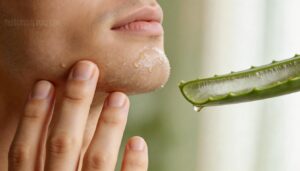
Once the cool compress has done its job, reach for Aloe vera gel — your next line of defense.
Here’s what makes it work:
- Immediate Application calms heat and stinging fast
- Glycoproteins act as natural anti-inflammatory agents
- Lightweight postshave moisturization without clogging pores
- Ideal for sensitive skin suitability — patch-test first
- Reapplication timing: reapply if tightness returns within hours
Using Witch Hazel or Colloidal Oatmeal

Aloe handled the heat — now address the lingering redness.
Witch hazel tightens irritated vessels fast, but always choose an alcohol-free formula. Rubbing makes things worse; use gentle press application only. Colloidal oatmeal works differently — it lays down an oatmeal barrier film that physically shields raw skin and locks in moisture.
| Ingredient | Best For |
|---|---|
| Witch hazel | Inflammation reduction, redness |
| Colloidal oatmeal | Barrier repair, dryness |
| Both combined | Skin barrier disruption recovery |
Post-shave timing matters — apply within five minutes. A Daily patch test is recommended.
Short-Term Use of Hydrocortisone Cream
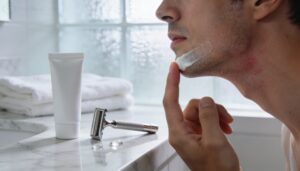
When nothing else quiets the inflammation, hydrocortisone cream (1%) earns its place in your post-shave skin care routine — but only short-term. Apply a thin layer technique to targeted areas only, never covering the skin tightly (avoid occlusion).
Side effect awareness matters here: daily use thins the skin over time. Think of it as a fire extinguisher, not a daily moisturizer.
Hydrocortisone cream is a fire extinguisher, not a daily moisturizer
Choosing The Right Products for Post-Shave Care
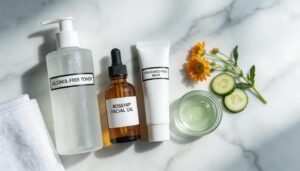
What you put on your skin after shaving matters just as much as how you shave. The wrong product can undo everything — the right one speeds up recovery fast.
Here’s what to look for, what to skip, and how to lock your skin barrier back in place.
Soothing Ingredients to Look For
Think of your post-shave product as a repair crew — and the right ingredients are your best workers.
Look for aloe vera, colloidal oatmeal, and Centella Asiatica to calm visible redness fast. Panthenol B5 locks in moisture; a ceramide complex rebuilds your barrier.
Chamomile extract and niacinamide boost overall skin comfort, while allantoin quietly smooths irritation without drama.
Harsh Chemicals and Fragrances to Avoid
Some products are basically a minefield for freshly shaved skin. Synthetic fragrance allergens hide under the single word "fragrance" — and they can trigger redness almost instantly. Alcohol-based aftershave stings and dries your barrier when it’s already compromised. Watch for these five offenders:
- Alcohol (denatured) — dries and stings irritated skin
- Synthetic fragrance allergens — hidden allergens, zero benefit
- Strong surfactants (SLS) — strips protective skin oils
- Irritating preservatives (methylisothiazolinone) — known inflammation triggers
- Phthalate fixatives — linger on skin, worsen post-shave sensitivity
Reach for fragrance-free moisturizers instead.
Barrier-Restoring Moisturizers With Ceramides
Your skin barrier just took a hit — ceramides help patch it back up. These lipid molecules fill the gaps between skin cells, cutting water loss and calming reactivity. A multi-ceramide blend (NP, AP, EOP) works better than one type alone.
| Ceramide | Ceramide NP Benefits | Role in Lipid Barrier Repair |
|---|---|---|
| Ceramide NP | Hydration support | Locks in moisture |
| Ceramide AP | Barrier resilience | Strengthens lipid layers |
| Ceramide EOP | Lipid organization | Reduces transepidermal water loss |
| Cholesterol | Structural support | Stabilizes lipid matrix |
| Fatty Acids | Barrier cohesion | Fills intercellular gaps |
Apply a lightweight gel-cream ceramide complex twice daily — morning and night — as your post-shave skincare routine anchor. Fragrance-free moisturizers with glycerin or hyaluronic acid layer well on top for added skin barrier protection.
When Post-Shave Inflammation Needs a Doctor
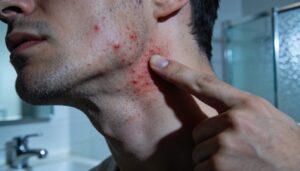
Most post-shave redness clears up on its own — but not always. Sometimes your skin is signaling something more serious than friction.
Here’s how to tell when it’s time to stop troubleshooting at home and call a dermatologist.
Signs of Infection Vs. Normal Irritation
Razor burn stays put — redness limited to where the blade went, a sting that fades within hours.
Infection moves. Watch for pain escalation, spreading warmth, pus formation, or odor detection from the area.
Systemic symptoms like fever, presence, or chills mean bacterial or viral infection, not irritation.
At that point, no cool compress or anti‑inflammatory agents will cut it — you need a doctor.
Persistent Redness, Pustules, or Scarring
Redness that won’t quit after a week isn’t normal irritation — it’s a signal worth taking seriously. Persistent pustules can leave behind post-inflammatory hyperpigmentation, and repeated damage without healing raises your scarring risk fast.
Watch for:
- Red marks darkening over days — Hyperpigmentation Management starts early
- Pus-filled bumps that won’t resolve — anti-inflammatory ingredients and skin barrier restoration help, but may not be enough
- Lasting texture changes needing Professional Laser Therapy
Long-Term Alternatives if Shaving Keeps Causing Problems
If shaving keeps fighting back, it might be time to break up with your razor for good.
| Alternative | How It Works |
|---|---|
| Laser Hair Reduction | Damages follicles to reduce future growth |
| Electrolysis Treatment | Permanently destroys individual follicles |
| Waxing and Sugaring | Pulls hair from the root |
| Threading Method | Mechanically removes hair without chemicals |
Depilatory creams offer another option — though follow label directions carefully to avoid burns.
Electric shaver benefits include less skin contact overall.
Pair any method with fragrance-free moisturizers and a cold water rinse to keep irritation manageable.
Frequently Asked Questions (FAQs)
How to prevent razor burn & other shaving irritations?
Think of your razor as a scalpel — precision matters. Sharp blades, proper pre-shave hydration, and a smart shave angle optimization routine stop razor burn prevention before it starts.
Can shaving cause folliculitis?
Yes — and more often than you’d think.
Dull blades, poor blade sterilization practices, and shaving against hair curl direction push bacteria into follicles, triggering folliculitis: red, acne-like bumps that aren’t just irritation.
How to prevent skin irritation when shaving pubic hair?
Trim first, soak in warm water, apply fragrance-free lubricating shaving cream, use clean, sharp razors, shave with the grain using light pressure, and finish with a non-comedogenic moisturizer.
Skip tight underwear afterward.
How do you get rid of itchiness after shaving?
Cool water down, then press a cold compress on the area. Aloe vera or non-alcoholic aftershave stops itchiness after shaving fast. Fragrance-free moisturizers seal the deal.
How to reduce swelling after shave?
A cold compress pressed against irritated skin for 10 minutes works fast. Follow it with aloe vera or witch hazel, then a fragrance-free moisturizer. Swelling usually fades within the hour.
Can diet affect post-shave skin inflammation?
Absolutely.
High sugar intake raises your body’s baseline inflammation, making post-shave redness worse. Omega-3 fats and anti-inflammatory foods calm that response.
Hydration levels and gut microbiome balance matter more than most people realize.
Are electric razors better for sensitive skin?
For sensitive skin, electric razors are generally the smarter pick.
Foil shaver benefits include a protective mesh that keeps blades off skin directly—cutting the main trigger for razor burn before it starts.
How does weather affect post-shave skin recovery?
Weather matters more than most people think. Humidity impact, dry air effects, temperature variations, wind exposure, and sunlight sensitivity all shape how quickly your skin bounces back after shaving.
Can stress make razor irritation harder to heal?
Cortisol Elevation weakens your barrier, slows Barrier Healing Delay recovery, and fuels Immune Dysregulation — turning minor postshave skin irritation into a lingering problem.
Stress-Exacerbated Itch makes you scratch, which only extends the damage.
Conclusion
You’ve finally ‘cut’ through the noise on post-shave inflammation. By now, it’s clear that reducing inflammation after a shave isn’t rocket science—it’s about understanding your skin and making informed choices.
To reduce inflammation after shave, focus on gentle techniques, soothing products, and a little patience. Your skin barrier will thank you.
Make these habits a part of your daily routine, and say goodbye to razor burn and hello to calm, healthy-looking skin that lasts.
- https://www.ncbi.nlm.nih.gov/books/NBK547754/
- https://www.aad.org/media/news-releases/tips-for-men-how-to-shave
- https://www.frontiersin.org/journals/medicine/articles/10.3389/fmed.2024.1481645/full
- https://pubmed.ncbi.nlm.nih.gov/37717558/
- https://dralkaskincare.com/the-hidden-enemy-of-flawless-skin-micro-tears-and-the-skins-silent-cry/