This site is supported by our readers. We may earn a commission, at no cost to you, if you purchase through links.
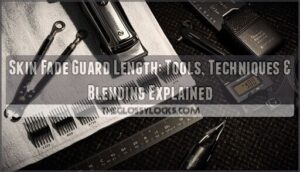
Guard zero sits flush against skin—no buffer, no safety net. You’re one slip away from a bald stripe that’ll take weeks to fix.
Most guys panic at guard selection because they don’t know that each number adds exactly 1/8 inch until you hit guard eight at one full inch. Skin fade guard length isn’t guesswork—it’s math mixed with muscle memory.
Guard one leaves 3 mm, guard two stretches to 6 mm, and guard three hits 9.5 mm. Those millimeters determine whether your fade screams precision or looks like you attacked your head with kitchen scissors.
Face shape dictates your starting point. Hair texture changes how fast each guard step blends into the next zone. Get the progression wrong and you’ll spend the next two weeks wearing hats.
Table Of Contents
- Key Takeaways
- What is Skin Fade Guard Length?
- Choosing The Right Guard Length for Skin Fades
- Skin Fade Guard Progressions and Blending Zones
- Maintenance Tips for Skin Fade Guard Lengths
- Top 10 Tools for Perfect Skin Fade Guard Length
- 1. Aomgd Hair Trimming Guide Template
- 2. Self Haircut Kit for Men
- 3. Fade Comb Set for Hair Cutting
- 4. Blend Friend Fade Comb Set
- 5. Fadeking Hair Clipper Guards Set
- 6. Fade Combs Haircut Kit For Men
- 7. Fade Comb Haircut Kit for Men
- 8. Fade Comb For Men Haircut Tool
- 9. Dliojhl Gradient Hair Fade Comb
- 10. Blend Friend Hair Fade Comb Tool
- Frequently Asked Questions (FAQs)
- Conclusion
Key Takeaways
- Guard numbers follow exact math—each step adds 1/8 inch until guard eight hits one full inch, so knowing your millimeters (guard 1 = 3mm, guard 2 = 6mm, guard 3 = 9.5mm) eliminates guesswork and prevents bald stripes.
- Skin fades demand tighter blending zones (1/4 to 3/4 inch between guards) and weekly touch-ups because you’re working from zero—one slip destroys the sharp contrast that separates skin fades from low, mid, or high fades.
- Your face shape and hair texture control where the fade starts and how fast guards blend—round faces need higher fade lines, coarse hair resists blending faster than fine strands, and ignoring either creates patchy disasters.
- Most fade failures happen in the first three guard transitions (not at the skin line), so mastering lever manipulation and guard progression from zero to three through deliberate vertical passes separates clean fades from choppy messes.
What is Skin Fade Guard Length?
Guard length controls the millimeters between your scalp and where the skin fade begins—mess this up and your skin fade looks like a beginner’s experiment.
Start with a fade haircut length guide to pick the right guard sizes for each stage of your fade.
Guard length controls the millimeters between your scalp and where the skin fade begins—mess this up and your fade looks like a beginner’s experiment
You need to know which guard does what, how the numbers translate to actual hair length, and why a skin fade demands precision other fades don’t.
Here’s what separates a clean skin fade from a patchy disaster.
Definition and Purpose of Guard Lengths
Guard length basics start with distance—from skin to the first clipper guard you lock in place. That’s your foundation.
- Guard numbers map to hair clipper guard lengths in millimeters or fractions of an inch.
- Clipper guards protect your scalp and control how much hair you strip away.
- Fade techniques rely on guard progression to build contrast between skin and longer sections.
- Hair texture affects how fast each guard step blends into the next zone.
- Scalp preparation reduces irritation when you’re working close to skin level with guard 1 or guard 3.
For more on the precision and protection that guards provide, explore this guide to beard guard length types.
Master this, or you’ll butcher the fade.
How Guard Numbers Relate to Hair Length
Each guard number locks in a fixed hair length—zero sits at skin level, one leaves 1/8 inch, two gives 1/4 inch. Guard numbers climb in 1/8-inch steps until you hit eight at one full inch.
Hair texture can trick your eye—coarse strands look thicker at guard two than fine hair at the same setting. Know your clipper guards, or you’ll guess wrong every time.
To better understand the differences, you can check this guide on haircut numbers and guard lengths.
Skin Fade Vs. Other Fade Types
Now that you know guard numbers, here’s how a skin fade breaks from the pack:
- Skin fades shave the baseline to zero—sharp contrast that screams precision.
- Low fades start near your ears but skip the skin-level edge.
- Mid fades blend around temples for balanced fade gradient.
- High fades climb above your temples, maximizing top-to-side drama.
Skin fades demand weekly touch-ups. Face shapes and scalp health matter more here than in any other fade haircuts.
Choosing The Right Guard Length for Skin Fades

You can’t pick the right guard length without understanding what each number actually does to your hair.
Your face shape, hair texture, and personal style all fight for attention in this decision—ignore one and your fade falls apart.
Here’s what you need to know before you touch those clippers.
Guard Zero to Guard Four Explained
You need precision—your clipper guards control hair length in tiny increments. Guard zero sits flush with the blade, shaving nearly to skin. Guard 1 leaves 3 mm, guard 2 adds 6 mm, guard 3 stretches to 9.5 mm.
Guard selection dictates your fade haircut’s drama. Blending zones between guard numbers create smooth transitions. Master these fade techniques and your clipper maintenance pays off.
Face Shape and Fade Starting Point
Your face shape decides where the skin fade starts—round faces demand a slightly higher fade line to stretch vertical proportion.
Square jaws shine with temple blending at or above the ear, framing the jawline.
Heart-shaped faces need mid-level guard numbers for scalp contouring that balances width. Align the fade with your hairline and facial proportions—blending zones must match your bone structure.
Hair Texture and Density Considerations
Texture analysis reveals fine strands (0.04–0.07 mm) blend faster through guard lengths than coarse hair exceeding 0.10 mm.
Frequent touch-ups help fine-textured hair maintain crisp fade lines, especially when using proper clipper techniques for fades around problem areas.
High density demands thinning between clipper guards to prevent bulk—low density needs strategic guard progression to avoid sparse zones.
Scalp conditions and hair follicle health dictate how blending techniques interact with your texture. Hair porosity affects product absorption during density mapping. Match guard lengths to your strand diameter.
Personal Style and Desired Contrast
Contrast levels define your aesthetic preferences—high contrast styling demands bold guard length jumps for visual balance. Minimalist style expression requires tighter blending between guard numbers.
Your skin fade haircut speaks before you do. Match fade starting points to your color harmony and hair texture.
Bold streetwear thrives on pronounced edges. Elegant looks need smooth guard progression for refined visual impact.
Skin Fade Guard Progressions and Blending Zones
You can’t just slap random guards on a head and call it a fade.
Guard progression follows a precise sequence—zero to one to three to four—with blending zones that span 1/4 to 3/4 inch between each step.
Master these three elements and you’ll execute clean fades instead of choppy disasters.
Step-by-Step Guard Progression for Skin Fades
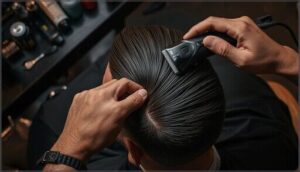
Start at the nape with guard zero—that’s your baseline. Work upward with guard 1, stopping an inch above where skin shows.
Switch to guard 3 and overlap the previous line by half. This guard progression creates your blending zones.
Each clipper guard length adds about 3mm, so you’re building a fade haircut in controlled steps. Keep your passes vertical and consistent—sloppy fade techniques ruin the whole cut.
Blending Techniques Between Guard Steps

Your blending zone sits between 1/4 and 3/4 inch—keep it tight. Use light feathering strokes with your clipper guards to avoid harsh demarcation between guard steps.
Clipper angle mastery demands steady pressure and vertical passes for flawless fade methods. Check both sides constantly—symmetry breaks when you rush. Guard step techniques rely on deliberate motions, not speed.
Master blending techniques or your fade haircut shows every mistake.
Lever Manipulation for Seamless Fades
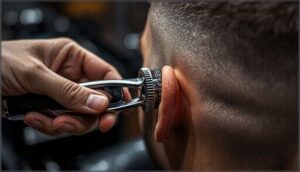
Your lever control separates amateurs from pros—closed to open settings shift blade exposure in 0.5 to 1.0 millimeter increments. Move the lever gradually between Guard 1 and Guard 3 to eliminate fade lines without widening your blending techniques.
Half-open settings deliver mid-range cuts ideal for hair texture transitions. Clean clipper guards between passes—blade sharpening and clipper maintenance prevent resistance that destroys fade techniques.
Maintenance Tips for Skin Fade Guard Lengths

Your fade doesn’t maintain itself—and ignoring the timeline will cost you that sharp contrast you worked so hard to create.
Guard length dictates how often you’ll need to trim, which tools you’ll actually use at home, and what your scalp needs before each cut.
Here’s how to keep your skin fade looking fresh without wasting time or money.
Trimming Frequency by Guard Length
Your guard length dictates your trimming schedule—period. Guard 1 and lower clipper settings demand touch-ups every one to two weeks to keep skin-line blends sharp.
Guard 3 to 4 clipper guards extend fade maintenance to three to four weeks. Hair regrowth speed varies with texture, but ignore this and your lines blur fast.
Clipper guard lengths control how often you’re locked into maintenance.
At-Home Vs. Barber Maintenance
You choose between two maintenance paths—each with tradeoffs in time management and cost comparison.
At-home use of guard length tools delivers:
- Quick adjustments around your schedule without travel time
- Lower long-term costs after initial clipper investment
- Control over your skin fade execution and barbering techniques
Barbers guarantee professional-grade blends through high-level skill and clipper maintenance. Your convenience factor weighs against their consistency.
Scalp Preparation and Tool Hygiene
Your scalp demands inspection before any clipper guard touches it. Look for cuts, rashes, or irritation—postpone if present.
Clean your hands, wipe blades with 70 percent alcohol, and apply a light antiseptic around the hairline. Sanitation methods and cleaning protocols aren’t optional.
Tool maintenance keeps your clipper guard sharp. Scalp health depends on hygiene practices and proper scalp care between sessions.
Top 10 Tools for Perfect Skin Fade Guard Length
You need the right tools—not just clippers, but guards, combs, and guides that give you control over every millimeter. Cheap kits waste your time with uneven blends and guards that slip mid-fade.
Here are ten tools that actually deliver clean skin fades without the guesswork.
1. Aomgd Hair Trimming Guide Template
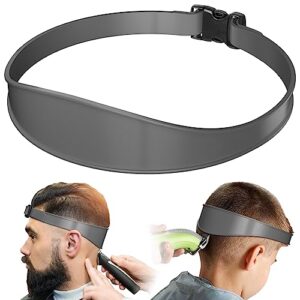
Nailing the neckline guide without guessing where to cut—that’s what the Aomgd Hair Trimming Guide Template delivers. This silicone and elastic band wraps around your head, providing adjustable length markers for customizable haircuts.
It weighs 1.76 ounces and measures 3.58 x 2.95 x 2.13 inches, making it portable enough to toss in your kit. The non-slip design works with razors, trimmers, and clippers.
Be warned—larger heads may find the grip slips, and overtightening causes discomfort. Practice with it before expecting perfect lines.
| Best For | People who want to save money on haircuts by doing clean necklines and fades at home, especially if you’ve got a smaller to average-sized head. |
|---|---|
| Material | Silicone/Elastic |
| Primary Use | DIY haircuts at home |
| Skill Level | Beginners to Advanced |
| Portability | Portable |
| Cleaning | Easy to clean |
| Design Feature | Non-slip adjustable |
| Additional Features |
|
- Adjustable markers help you cut straight lines without eyeballing it
- Works with whatever tools you already own—razors, trimmers, clippers
- Lightweight and easy to clean, so you can use it anywhere
- Tends to slip on larger heads or loosen up during use
- Takes some trial runs before you get the hang of it
- Gets uncomfortable if you crank it too tight trying to keep it in place
2. Self Haircut Kit for Men
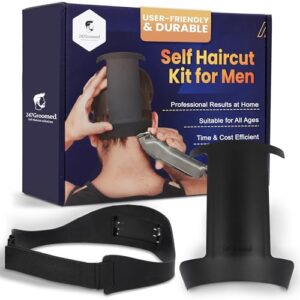
Precision starts with the right hardware—and the 247 Groomed kit packs everything you need for a skin fade into one compact setup. You get clippers, guards zero through four, a fade guide, and a neck shaping template that fits head sizes XS to XXL. It weighs 82 grams and measures 7.91 x 5.94 x 2.95 inches.
Don’t expect premium materials—it’s plastic and silicone. The ratchet adjustment feels clunky, and cutting the back solo takes practice. Budget-conscious home cutters will save money; impatient beginners won’t.
| Best For | Budget-conscious home cutters willing to practice for clean fades and lineups without paying for regular barbershop visits. |
|---|---|
| Material | Plastic/Silicone |
| Primary Use | Self-haircuts at home |
| Skill Level | Kids to Seniors |
| Portability | Portable |
| Cleaning | Washable |
| Design Feature | Adjustable size XS-XXL |
| Additional Features |
|
- Includes everything needed for skin fades—clippers, guards 0-4, fade guide, and neck template
- Adjustable fit works for head sizes XS to XXL, making it versatile for different users
- Saves money over time by eliminating regular trips to the barber
- Plastic and silicone construction feels cheap and the ratchet adjustment is clunky
- Cutting the back of your own head is difficult and requires practice to get right
- Overpriced for the material quality you’re getting
3. Fade Comb Set for Hair Cutting
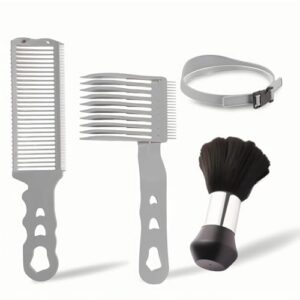
Gradient transitions don’t happen by accident—they demand professional tools built for the job. This fade comb kit gives you two professional-grade combs with different tooth gaps, plus an adjustable silicone neck band that stretches to fit any head size.
The curved profile hugs your skull’s natural shape, and the anti-slip matte coating won’t slide mid-cut. At 10.6 x 4 x 1.6 inches and 7.05 ounces, it’s lightweight ABS plastic. You’ll nail fade angles without wrestling with unstable guides—just snap, position, and cut.
| Best For | Home users and DIY enthusiasts who want to create professional-looking fades without paying for regular barber visits. |
|---|---|
| Material | ABS Plastic |
| Primary Use | DIY neckline trimming |
| Skill Level | Beginners to Professionals |
| Portability | Portable |
| Cleaning | Washable |
| Design Feature | Ergonomic handle |
| Additional Features |
|
- Curved design follows your head’s natural shape for consistent fade angles
- Anti-slip matte coating keeps the comb stable during cuts
- Adjustable neck band fits all head sizes and makes DIY neckline trimming easier
- Takes practice to get good results—not instantly foolproof
- Won’t work well if you keep your hair very short
- Quality may feel cheaper compared to premium barber tools
4. Blend Friend Fade Comb Set
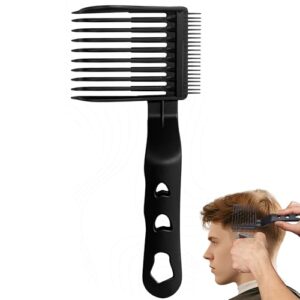
Two heat-resistant ABS combs with triangular-arched teeth follow your scalp’s curve without snagging. Each tooth is precision-spaced to maintain uniform guard length across every pass—you get sharp fade lines and smooth transitions from guard zero to four.
The ergonomic non-slip handle locks your grip around ears and tight curves. At 7.4 x 3.15 x 1.06 inches and 2.08 ounces, they’re portable enough for travel kits. Clean with a damp cloth after each cut, dry thoroughly, and store in a protective case to keep teeth aligned.
| Best For | Home barbers and DIY enthusiasts who want to master fade cuts without paying for salon visits every few weeks. |
|---|---|
| Material | ABS Plastic |
| Primary Use | Barber-quality fade haircuts |
| Skill Level | Home and Professional |
| Portability | Portable |
| Cleaning | Easy to clean |
| Design Feature | Ergonomic non-slip handle |
| Additional Features |
|
- Triangular-arched teeth glide along your scalp’s natural curve without pulling or catching hair
- Precision spacing keeps guard lengths consistent so you get clean fade lines every time
- Lightweight and compact enough to toss in a gym bag or suitcase for cuts on the go
- Plastic construction can crack or break with regular use according to some buyers
- Takes practice to get comfortable holding and maneuvering the comb around ears
- May not hold up well if you have very fine or fragile hair that needs gentler tools
5. Fadeking Hair Clipper Guards Set
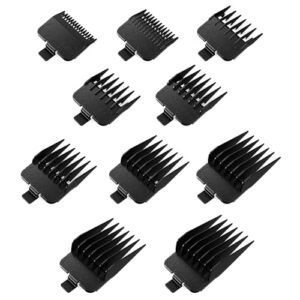
You need guards that lock onto your clipper without slipping mid-fade. Fadeking’s set delivers 0.5 mm to 13 mm coverage—enough range to build any skin fade from baseline to crown.
Each guard snaps securely onto standard clipper bars, with color-coding so you grab the right size without squinting. Rounded edges prevent scalp irritation when you’re working tight around the hairline.
Clean with a brush after every cut, wipe down with a damp cloth, and store them in the included case to avoid cracks.
| Best For | Barbers and home users who need reliable guards that stay locked during fades and tight hairline work. |
|---|---|
| Material | Plastic |
| Primary Use | Precise cutting lengths |
| Skill Level | Home and Professional |
| Portability | Compact |
| Cleaning | Water and soap |
| Design Feature | Universal compatibility |
| Additional Features |
|
- Secure snap-on attachment prevents guards from slipping during cuts
- Color-coded sizing (0.5mm to 13mm) makes it easy to grab the right guard quickly
- Rounded edges protect the scalp from irritation around sensitive areas
- May not fit all clipper models despite claiming universal compatibility
- Some users reported the sizing isn’t always accurate
- Quality and cutting performance can be inconsistent according to reviews
6. Fade Combs Haircut Kit For Men
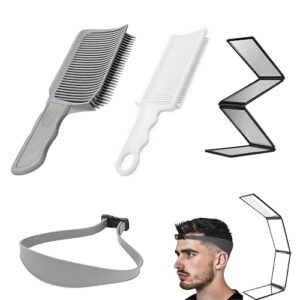
Blending a skin fade without visible lines demands combs that adapt to your guard progression. This four-piece kit gives you flat and curved fade combs to shift smoothly from skin to length—one for straight passes, one for contoured work around the ears.
The 360-degree mirror setup lets you check every angle without twisting your neck. Compact enough to stash in a gym bag. Clean the teeth with the brush after each session, wipe down with alcohol, and store dry.
| Best For | Guys who cut their own fades at home and want cleaner blends without spending money at the barber every two weeks. |
|---|---|
| Material | Plastic |
| Primary Use | Self-grooming and fades |
| Skill Level | Beginners to Advanced |
| Portability | Compact |
| Cleaning | Easy to clean |
| Design Feature | 360-degree mirror included |
| Additional Features |
|
- Flat and curved combs handle different head contours so you’re not fighting the shape when you blend
- 360-degree mirror lets you see the back and sides without holding your phone awkwardly
- Compact enough to throw in a bag if you travel or hit the gym regularly
- Takes practice to get smooth fades—beginners will likely mess up the first few times
- No instructions or tutorials included, so you’re learning by trial and error
- Won’t handle complex styles or highly textured hair well
7. Fade Comb Haircut Kit for Men
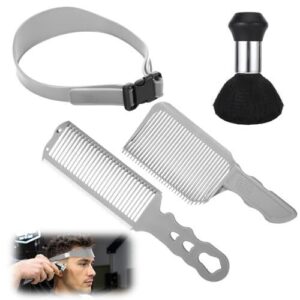
You need precision and protection in one motion—this kit combines a friend fade comb with an adjustable silicone band that won’t slip mid-cut. The angled tip shields your scalp while the polished teeth glide through thick hair without snagging.
Four pieces cover guard zero through four progressions. Reusable and simple to sanitize after each session.
Don’t expect miracles if your technique isn’t dialed in—the comb guides your clipper, but you still control the angle and pressure.
| Best For | Home barbers and DIY enthusiasts who want to achieve professional-looking fades on thick or coarse hair without the cost of regular salon visits. |
|---|---|
| Material | Silicone |
| Primary Use | DIY fades and haircuts |
| Skill Level | Novices to Professionals |
| Portability | Reusable |
| Cleaning | Easy to clean |
| Design Feature | Adjustable silicone band |
| Additional Features |
|
- Angled tip protects your scalp while the polished teeth glide smoothly through thick hair
- Adjustable silicone band stays put during cuts for better control and comfort
- Reusable design saves money over time and cleans up easily between sessions
- The band may slip off for some users depending on head shape
- Combs can feel bulky and may not let hair flow through as smoothly as expected
- Won’t compensate for poor technique—you still need steady hands and practice to get clean fades
8. Fade Comb For Men Haircut Tool
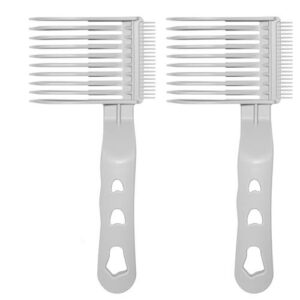
Your foundation needs a tool that removes guesswork from blade alignment and guard transitions. This fade comb uses high-quality ABS plastic—anti-static and built to resist heat from extended clipper sessions. The triangle ruler design gives you clear reference points at guard zero through four.
An ergonomic hollow handle prevents slipping when your grip gets sweaty. Works across home cuts and professional booths.
Practice matters—user error still creates uneven lines if you rush the angles or skip consistent pressure.
| Best For | DIY hairdressers and barbers who want clean fade lines without constant measuring—whether you’re cutting at home or working in a salon. |
|---|---|
| Material | ABS Plastic |
| Primary Use | Professional styling boundaries |
| Skill Level | Novices to Professionals |
| Portability | Portable |
| Cleaning | Easy to clean |
| Design Feature | Ergonomic hollow handle |
| Additional Features |
|
- Triangle ruler markings take the guesswork out of guard transitions and blade angles
- Anti-static ABS plastic handles heat well during long clipper sessions
- Hollow ergonomic handle keeps your grip secure even when your hands get sweaty
- You’ll need practice runs to nail consistent angles and pressure
- Rushing through cuts still creates uneven lines despite the guide markers
- Some users report quality inconsistencies between different units
9. Dliojhl Gradient Hair Fade Comb
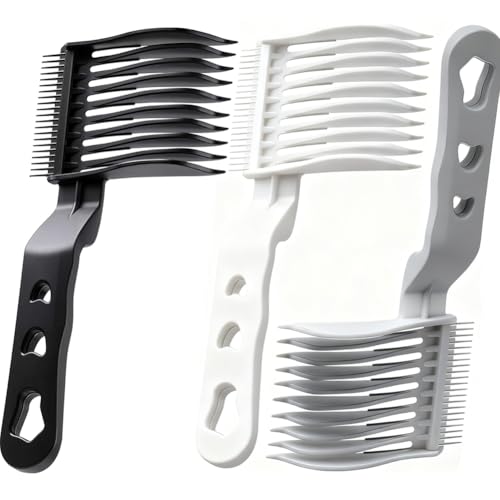
Gradient teeth guide your clipper through progressive length reductions without memorizing guard math. The Dliojhl comb uses a three-piece pack—black, white, grey—so you can see reference lines against any hair color. Each tooth is arranged to create shorter lengths from bottom to top for smooth transitions.
The 3.3-inch body fits tight spaces behind ears and along necklines. Works with any clipper system you already own.
Fragile plastic cracks under heavy pressure—treat it like a precision instrument, not a battering ram.
| Best For | Home barbers who want to create fade haircuts without guessing guard numbers, especially if you’re working on different hair colors and need visual reference lines. |
|---|---|
| Material | Plastic |
| Primary Use | Gradient hairstyles |
| Skill Level | Home and Barbershop |
| Portability | Compact |
| Cleaning | Easy to clean |
| Design Feature | Gradient comb structure |
| Additional Features |
|
- Graduated teeth eliminate the need to swap clipper guards mid-fade—one pass creates multiple length transitions
- Three color options (black, white, grey) make it easier to see your guideline against light or dark hair
- Compact 3.3-inch design reaches tight spots around ears and necklines that larger combs miss
- Plastic construction cracks easily if you press too hard or drop it
- Thick, coarse hair can overwhelm the tooth spacing and create uneven results
- Requires practice to angle correctly—beginners may struggle with their first few attempts
10. Blend Friend Hair Fade Comb Tool
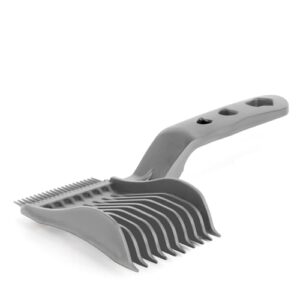
Heat-resistant ABS plastic survives extended sessions without warping—critical when you’re running clippers for forty minutes straight. Blend Friend’s curved arch mimics scalp contour so you don’t fight gaps between comb and skin. Evenly spaced teeth control blade proximity across guard transitions—zero to three without guesswork.
Compatible with Wahl, Andis, and Oster systems. No adapters required. The anti-static surface reduces flyaways during trimming. Lightweight enough to carry in your kit without adding bulk. Works across all hair textures when you maintain consistent pressure.
| Best For | Barbers and home users who want salon-quality fades without free-hand cutting skills, especially those working with textured or wavy hair. |
|---|---|
| Material | ABS Plastic |
| Primary Use | Salon-quality hairstyles |
| Skill Level | Beginners to Professionals |
| Portability | Lightweight |
| Cleaning | Easy to clean |
| Design Feature | Curved and flat sides |
| Additional Features |
|
- Heat-resistant ABS plastic won’t warp during long sessions, and the curved design follows your scalp naturally so you get smooth, gap-free blends
- Works with all major clipper brands (Wahl, Andis, Oster) right out of the box—no adapters or compatibility issues
- Anti-static surface keeps flyaways under control while the tooth design gives you precise guard transitions from zero to three
- Takes practice to get comfortable using it, especially when cutting your own hair or working with curly textures
- Not great for very short styles like crew cuts where you need ultra-close precision
- People with stick-straight hair might not get enough texture or volume control compared to other hair types
Frequently Asked Questions (FAQs)
Is a 3 or 4 guard shorter?
A 3 guard is shorter—cutting to 10 millimeters instead of the 4 guard’s 13 millimeters. That 3-millimeter gap matters when you’re building contrast and deciding your fade’s starting depth.
What is shorter, a 7 or 8 guard?
A seven guard leaves seven eighths of an inch. An eight guard leaves exactly one inch.
The seven is shorter by one eighth of an inch—use it for tighter fades.
Can you fade curly hair with regular guards?
Yes—regular guards work on curls if you blend carefully between steps.
Account for shrinkage by choosing slightly longer guards. Use clipper-over-comb and lever adjustments to avoid harsh lines in textured hair.
How often should clippers be oiled for fades?
Oil your clippers after every single cut—yes, every time.
Skip it and you’ll feel blades run hot, pull hair, or grind.
One to two drops per session keeps friction low and blade life high.
What causes uneven fading on one side only?
Uneven fading happens when your barber uses inconsistent guard placement, applies unequal pressure, or encounters natural hair density differences.
Your growth patterns—whorls, cowlicks—also disrupt smooth gradients on one side.
Should you fade wet or dry hair always?
Dry cuts reveal true length and deliver sharper lineups. Wet hair stretches—reducing lift—so you lose precision.
Many barbers toggle between both, adjusting for texture and desired fade accuracy mid-session.
Conclusion
Most barbers report that 80% of fade mistakes happen in the first three guard transitions—not at the skin line. Your skin fade guard length mastery lives in those millimeter jumps between guards one through three.
Lock down your progression sequence. Practice your lever angles until your wrist moves without thinking. The difference between a clean fade and a patchy mess isn’t talent—it’s repetition paired with ruthless attention to guard math.