This site is supported by our readers. We may earn a commission, at no cost to you, if you purchase through links. This content is for general informational and educational purposes only and is not a substitute for professional medical, dermatological, or nutritional advice.

Somewhere around 60% of people report having sensitive or reactive skin — yet most of them are still reaching for products packed with fragrances, alcohol, and synthetic dyes that quietly fuel the fire. Irritated skin isn’t always about what you’re not doing. Often, it’s about what’s in the products you’re already using.
The right ingredients don’t just mask redness or tightness — they work at the barrier level, signaling your skin to stand down.
From time-tested botanicals like aloe vera and chamomile to clinically backed compounds like niacinamide and centella asiatica, the best soothing ingredients for irritated skin do something impressive: they calm without compromising.
Table Of Contents
- Key Takeaways
- Soothing Skin Ingredients
- Reducing Inflammation Naturally
- Calming Irritated Skin
- Anti-Inflammatory Compounds
- Gentle Skin Care Routine
- Frequently Asked Questions (FAQs)
- What ingredients calm irritated skin?
- How often should I apply soothing skincare ingredients?
- Can diet impact skin inflammation and irritation?
- Are natural ingredients better than synthetic skincare solutions?
- What causes sudden skin sensitivity and redness?
- How quickly do soothing ingredients show results?
- Can diet affect skin inflammation and irritation?
- How does stress trigger sensitive skin flare-ups?
- Which fabrics are safest for irritated skin contact?
- Does water quality impact skin sensitivity over time?
- Conclusion
Key Takeaways
- Ingredients like niacinamide, centella asiatica and colloidal oatmeal don’t just mask redness — they repair your skin barrier at the source, cutting moisture loss and blocking the inflammatory signals that keep skin reactive.
- Most skin irritation traces back to what’s already in your products: fragrances, alcohol, and synthetic dyes quietly break down your barrier every day, so switching to fragrance-free, pH-balanced formulas is often the fastest fix.
- Natural and synthetic soothing ingredients each have real trade-offs — your skin doesn’t care about the label, it cares whether the formula actually works and stays stable in the bottle.
- Results aren’t instant: aloe and oatmeal can calm redness within hours, but meaningful barrier repair from niacinamide or centella typically takes four to eight weeks of consistent use.
Soothing Skin Ingredients
When your skin is red, itchy, or just plain angry, the right ingredients can make a real difference.
A soothing serum for irritated and red skin can calm inflammation while quietly strengthening your barrier from the inside out.
Some work by calming inflammation, others by repairing your skin’s barrier — and a few do both at once.
Here are the key soothing ingredients worth knowing about.
Aloe Vera Benefits
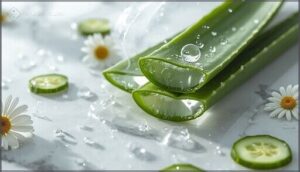
Aloe vera is one of the most well-researched ingredients in sensitive skin care — and for good reason. That near-instant cooling sensation isn’t just invigorating; it’s biology at work.
- Anti-inflammatory polysaccharides calm redness by suppressing pro-inflammatory cytokines
- Deep hydration comes from acemannan, which locks moisture into the epidermis
- Barrier repair and wound healing improve through fibroblast stimulation and collagen support
For irritated skin relief, few ingredients deliver this much, and this gently. Scientific studies highlight its [antioxidant and anti-inflammatory](https://www.curaloe.de/blogs/aloe-vera-benefits/the-science-behind-aloe-veras-soothing-properties-for-sensitive-skin) effects.
Chamomile Anti-Inflammatory Properties

Chamomile is one of nature’s most reliable skin-soothers — and the science backs it up.
Its apigenin pathway blocks inflammatory signals like NF‑κB inhibition, while the α‑bisabolol mechanism directly calms reactive tissue.
Chamazulene benefits go further, targeting both COX‑2 and allergic responses.
For redness reduction and real skin soothing, chamomile’s anti-inflammatory action makes it a standout among natural skin remedies.
Its antimicrobial skin protection helps guard against bacteria and fungi.
Green Tea Antioxidants

Green tea extract is where antioxidant science gets genuinely impressive. The EGCG mechanism works by blocking NF‑kB pathways — the same inflammatory triggers chamomile targets, just through a different route. That catechin synergy neutralizes up to 90 % of UV‑generated free radicals before they damage your skin cells.
Green tea’s EGCG neutralizes up to 90% of UV-generated free radicals by blocking the same inflammatory pathways that drive skin damage
For irritated skin, this matters:
- UV Protection shields skin DNA from oxidative stress
- Skin Hydration improves measurably within 30 days of topical use
- Anti‑Aging benefits come from collagen‑stimulating, soothing polyphenols
Niacinamide Skin Repair
Niacinamide is perhaps the most well-rounded ingredient in sensitive skin care. This vitamin B3 derivative works on several fronts at once — Barrier Strengthening, Pigment Lightening, Sebum Regulation, and more.
Here’s what consistent use delivers:
- Skin Barrier Repair — boosts ceramide production and cuts moisture loss by up to 20%
- Moisture Retention — keeps irritated skin smooth without heaviness
- Pore Minimization — visibly tightens enlarged pores
- Anti-Inflammatory Skin Care — blocks cytokines that trigger redness
- Soothing — calms post‑acne erythema fast
Start at 2–5% if your skin runs sensitive.
Reducing Inflammation Naturally
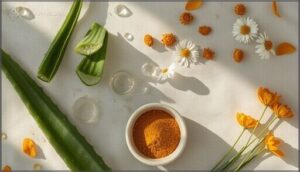
Nature has packed serious anti-inflammatory power into a handful of everyday ingredients. Your skin doesn’t always need a prescription to calm down — sometimes the right plant-based compound does the job just as well.
Tea tree oil and willow bark, for instance, can work surprisingly fast — some plant-based overnight acne spot treatments visibly shrink pimples and cut redness within just a few hours.
Here are four natural ingredients worth knowing about.
Turmeric Anti-Inflammatory Effects
Turmeric’s active compound, curcumin, is one of the most studied natural anti-inflammatory ingredients in dermatology. It works by blocking NF-κB inhibition pathways and cytokine suppression — basically cutting off the signals that trigger skin inflammation at the source.
That means real barrier restoration, faster wound healing, and calmer, less reactive skin. Nano delivery formulations now make topical curcumin even more effective, pushing this soothing, skin-protective powerhouse deeper where it matters.
Licorice Root Skin Benefits
Licorice root is quietly one of the most effective natural remedies for irritated skin. Its key compounds work on multiple levels — calming redness, fading dark spots, and strengthening your barrier.
- Glycyrrhizin Hydration locks in moisture and soothes eczema flare-ups
- Glabridin Pigment Control inhibits tyrosinase, reducing hyperpigmentation effectively
- Licochalcone Redness blocks NF-κB inflammation pathways over 8 weeks
- Liquiritin Radiance disperses melanin for visibly even, brighter skin
- Barrier Strengthening protects against UV stress and environmental damage
Honey Moisturizing Properties
Honey is one of those natural remedies that genuinely earns its place in sensitive skin care. Its humectant action pulls moisture into the outer skin layers and keeps it there — real water‑loss reduction, not just surface gloss.
The emollient softening effect smooths rough patches, while antioxidant hydration shields barrier lipids from oxidative damage.
Solid barrier reinforcement and anti‑inflammatory relief, all in one ingredient.
Tea Tree Oil Anti-Inflammatory Properties
Tea tree oil’s main active compound, terpinen-4-ol, works by dialing down NF-κB signaling — the same inflammatory pathway behind angry redness and swelling.
It delivers rapid redness reduction, sometimes within minutes of application.
But oxidation stability matters: old or undiluted oil can cause skin irritation instead of fixing it.
Keep it as a spot treatment, around 5%, and your skin stays happy.
Calming Irritated Skin

When your skin is irritated, the right ingredients can make a real difference — fast. Some of nature’s best-kept secrets go beyond basic moisturizing to actually calm the skin down at the source.
Here are four worth knowing about.
Colloidal Oatmeal Soothing Effects
Colloidal oatmeal isn’t just a bath-time remedy — it’s backed by serious science. Its avenanthramide pathway blocks inflammatory signals at the cellular level, delivering real itch mediator reduction for sensitive skin.
It boosts barrier proteins, rebuilds moisture through hydration film formation, and protects against free radicals via antioxidant polyphenols. For anti-inflammatory skin care that’s also deeply moisturizing, this ingredient genuinely delivers.
Witch Hazel Balancing Properties
Witch hazel punches well above its weight for sensitive skin. Its tannins deliver real astringent tightening, temporarily refining enlarged pores and reducing shine through effective oil control. It also nudges your skin back toward its natural pH — that’s pH regulation doing quiet, important work after alkaline cleansers disrupt your barrier.
Key benefits for anti‑inflammatory skin care:
- Calms redness and irritation relief with gallic acid and flavonoids
- Strengthens barrier reinforcement when paired with glycerin or aloe
- Provides antioxidant protection against UV and pollution‑triggered free radicals
- Controls surface oiliness without stripping your skin’s lipid layer
One of the most underrated soothing ingredients in a calm‑skin routine.
Centella Asiatica Skin Regeneration
Centella Asiatica is a skin‑repair plant. Its key compounds — asiaticoside and madecassoside — trigger fibroblast activation and boost collagen synthesis, literally rebuilding your skin matrix from within.
It also helps wound contraction and barrier restoration, making it ideal for irritated or post‑acne skin.
| Compound | Benefit |
|---|---|
| Asiaticoside | Accelerates healing, anti-inflammatory |
| Madecassoside | Collagen repair, skin barrier support |
| Asiatic Acid | Soothes redness, reduces scarring |
One of the most science‑backed healing herbs in skin care.
Sea Buckthorn Oil Nourishing Benefits
Sea buckthorn oil might be the most underrated soothing skincare ingredient in your natural skincare routine. Packed with omega-7 hydration, it reinforces your lipid barrier boost while calming skin inflammation quickly. Its vitamin C brightening power rivals oranges tenfold. Here’s what makes it work:
- Restores moisture with omega fatty acids
- Strengthens barrier against irritants
- Delivers antioxidant radiance daily
- Aids healing wound repair
- Reduces visible redness gently
Anti-Inflammatory Compounds

Some anti-inflammatory compounds go beyond the basics — they’re engineered to work at a cellular level, not just on the surface.
Science has given us a few standout actives worth knowing about. Here are the ones that consistently deliver results.
BioGenic Asiaticoside-200 Benefits
If your skin is constantly red, reactive, or just plain angry, BioGenic Asiaticoside-200 is worth knowing about.
Derived from Centella Asiatica, this ingredient uses encapsulation technology to solve a real formulation problem — asiaticoside is poorly water‑soluble, so without it, you’d lose most of the benefit.
The result? Better skin barrier support, meaningful collagen boost, genuine anti‑inflammatory and anti‑redness effects, and faster skin repair — especially for sensitive skin.
BioGenic Bergenin-200 Antioxidant Properties
BioGenic Bergenin-200 takes antioxidant protection seriously. Its water-soluble stabilization makes bergenin — a polyphenol with antioxidant activity comparable to vitamin C — actually usable in serums and creams.
- Bergenin radical scavenging against free radicals
- Lipid peroxidation inhibition to reduce cellular damage
- Collagen protection for firmer-looking skin
- UV damage mitigation from oxidative stress
- Anti-inflammatory, soothing support for sensitive skin
BioGenic EGCG-200 Anti-Inflammatory Effects
Green tea’s most potent catechin — EGCG — has long impressed researchers, but it breaks down fast without the right delivery system.
BioGenic EGCG-200 solves that with Microemulsion Delivery technology, keeping Encapsulated EGCG Stability intact so the active actually reaches your skin.
For sensitive skin dealing with flushing or post-sun redness, the UV Redness Reduction benefit matters — it works through Cytokine Suppression of inflammatory messengers like TNF-alpha.
Pair it with niacinamide or aloe for smart Antioxidant Pairing.
This Soothing, AntiInflammatory Green Tea Extract delivers real Skin Protection without heaviness.
Resveratrol Anti-Aging Benefits
Resveratrol might be the quietest overachiever in Anti-Aging Skincare — and it deserves more attention. This polyphenol delivers serious Antioxidant Defense by neutralizing free radicals from UV exposure and pollution before they break down your collagen and elastin.
Here’s what it brings to your Skin Barrier:
- Collagen Boost that keeps skin firmer, longer
- Wrinkle Reduction backed by clinical trans-resveratrol trials
- Skin Repair by activating tissue-regenerating pathways
- Environmental Protection against photoaging triggers
It’s Soothing, Anti-Inflammatory, and genuinely effective.
Gentle Skin Care Routine
gentle routine isn’t about using a dozen products — it’s about picking the right ones.
skin reacts to what you put on it every single day, so those choices matter more than you’d think. Here’s what to focus on when putting together a routine that actually calms things down.
Choosing Gentle Cleansers
Your cleanser is where the routine either starts right — or starts breaking things down. For sensitive skin, the goal is simple: clean without stripping. Look for barrier-friendly cleansers built on mild surfactants, not harsh sulfates.
A pH balance close to 4.5–5.5 keeps your acid mantle intact. Fragrance-free formulas cut the biggest irritation risk right away. Creamy texture cleansers work especially well, since they deposit soothing ingredients while washing.
| Feature | What to Look For |
|---|---|
| Surfactant Type | Amino acid-based, non-ionic |
| pH Level | 4.5–5.5 (skin-matched) |
| Key Ingredients | Aloe vera, chamomile, allantoin |
| Additives to Avoid | Fragrance, dyes, alcohol |
| Best Texture | Cream or milk formula |
Applying Soothing Moisturizers
Timing after cleansing matters more than most people realize. Apply your moisturizer within three minutes — that’s when your skin barrier is most receptive.
For an extra boost, try following up with a non-irritating face mask made with colloidal oatmeal or honey to lock in that post-cleanse moisture even longer.
Use the patting technique: press gently, do not rub. For sensitive skin, a pea-sized amount covers the whole face.
soothing ingredients like ceramides and niacinamide go on before sunscreen. Always follow a patch test procedure with anything new.
Using Calming Toners
A calming toner is your skin barrier’s quiet reset button. Application timing matters — use it right after cleansing, before serums. For sensitive skin, pat it in with clean fingertips to cut friction.
- Pick pH-balanced formulas (5–7) with soothing ingredients like aloe, glycerin, or panthenol
- Follow frequency guidelines: start three times weekly, then adjust
- Mist application works beautifully midday for anti‑inflammatory skin care on the go
Always check ingredient safety — fragrance‑free means fewer flare‑ups.
Selecting Non-Irritating Exfoliants
Exfoliation doesn’t have to feel like a gamble. PHA gentle options like gluconolactone and enzyme buffers from papaya work on the surface without stripping your barrier. Low‑pH acids are effective, but keep concentrations under 10%.
| Exfoliant Type | Best For |
|---|---|
| PHA (Gluconolactone) | Barrier‑friendly exfoliants, daily use |
| Enzyme (Papaya/Pineapple) | Reactive, fragile skin |
| Lactic Acid | Dry, sensitive skin |
| Oatmeal Powder | Redness-prone skin |
Pair actives with Aloe Vera, Oats, Panthenol, Allantoin, or Niacinamide. Follow frequency guidelines — once or twice weekly max.
Frequently Asked Questions (FAQs)
What ingredients calm irritated skin?
Think of your skin barrier as a brick wall — when it cracks, irritants flood in. Niacinamide, ceramides, panthenol hydration, allantoin calm, and beta‑glucan relief are your best repair crew.
How often should I apply soothing skincare ingredients?
Most soothing skincare ingredients work best applied once or twice daily. During flares, bump to three times.
For sensitive skin, start slow — a few times weekly — then build up as your skin adjusts.
Can diet impact skin inflammation and irritation?
Yes, absolutely. What you eat shows up on your skin. high Glycemic Load diet spikes insulin, fuels inflammation, and worsens breakouts. Dairy Influence is real too — milk proteins drive sebum and irritation.
Omega‑3 Benefits are well-documented: fatty fish, flaxseed, and chia help your body produce fewer pro-inflammatory signals, easing redness and skin swelling. Think of them as your internal Anti‑Inflammatory Skin Care.
Gut Microbiota matters more than most people realize. diet diversity disrupts gut balance, which sends inflammatory signals straight to your skin. Ultraprocessed foods make this worse. Fermented foods and fiber help reverse it.
The fix isn’t complicated. Load your plate with Anti‑Inflammatory Foods — colorful vegetables, berries, nuts, and omega-3-rich fish. Cut back on refined sugar and cow’s milk. These small swaps support real Skin Inflammation Treatment from the inside out, complementing any Natural Anti‑Inflammatory Ingredients you use topically.
Are natural ingredients better than synthetic skincare solutions?
Neither wins by default. Natural ingredients carry real allergy risk and batch inconsistency, while synthetics offer tighter ingredient consistency and predictable results.
Your skin doesn’t care about the label — it cares about the formula.
What causes sudden skin sensitivity and redness?
Your skin’s barrier disruption works like a broken fortress wall — once compromised, almost anything gets through.
Climate shifts, stress hormones, allergic contact reactions, and medication photosensitivity can all trigger sudden redness and skin sensitivity.
How quickly do soothing ingredients show results?
Results depend on the ingredient.
Aloe vera and colloidal oatmeal can ease redness within hours.
Niacinamide takes 1–2 weeks.
Full improvements in tone and barrier function often need 4–8 weeks of consistent use.
Can diet affect skin inflammation and irritation?
Absolutely.
What you eat shows up on your face. Omega‑3s calm inflammation, while high Glycemic Load foods spike acne.
Probiotic Foods, Antioxidant Berries, and cutting dairy impact can quietly transform your skin.
How does stress trigger sensitive skin flare-ups?
Stress triggers a hormone cascade that spikes cortisol, weakening your skin barrier.
That opens the door to immune overdrive, nerve itch loops, and healing slowdown — turning minor triggers into full flare-ups.
Which fabrics are safest for irritated skin contact?
Think of your fabric like a second skin. For irritated skin, choose OEKO TEX certified organic cotton, bamboo viscose, Tencel lyocell, or a silk pillowcase — all breathable, low-friction, and gentle.
Does water quality impact skin sensitivity over time?
Yes, absolutely.
Hard water effects, chlorine irritation, and alkaline pH impact quietly wear down your skin barrier over time — making sensitive skin more reactive, inflamed, and harder to manage with even the gentlest routine.
Conclusion
Here’s a theory worth testing: your skin isn’t the problem — product shelf might be. The right soothing ingredients for irritated skin don’t just quiet the redness temporarily; they rebuild the barrier that keeps trouble out long-term.
Aloe, niacinamide, centella, oatmeal — these aren’t trends. They’re tools.
Start simple, stay consistent, and pay attention to how your skin responds. It’ll tell you exactly what it needs.