
This site is supported by our readers. We may earn a commission, at no cost to you, if you purchase through links.
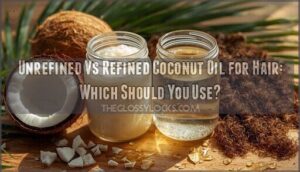
Most people assume coconut oil is coconut oil—grab any jar off the shelf and you’re good to go. But standing in the hair care aisle, you’ll notice two distinct camps: unrefined (often labeled “virgin” or “extra virgin”) and refined. The difference isn’t just marketing fluff.
Unrefined coconut oil retains up to 95% more volatile compounds and markedly higher antioxidant levels than its processed counterpart, which translates to measurably different effects on your hair shaft and scalp.
Your hair texture, porosity, and specific concerns—whether that’s breakage, dryness, or an oily scalp—determine which type delivers real results versus which one leaves you with greasy roots and disappointment.
Table Of Contents
Key Takeaways
- Unrefined coconut oil retains up to 95% more volatile compounds and 20-30% higher antioxidant levels than refined versions, making it superior for damaged or porous hair that needs deep nourishment and repair.
- Refined coconut oil works better for fine hair or oily scalps because it’s 68% less greasy, absorbs 18% faster, and leaves significantly less residue while costing 15-40% less than unrefined options.
- Neither type can prevent split ends completely or reverse genetic hair thinning—coconut oil primarily reduces breakage by 10-30% and improves moisture retention rather than acting as a cure-all solution.
- Application frequency matters more than oil type: dry hair benefits from 2-3 weekly treatments with unrefined oil, while fine or oily hair should stick to once-weekly refined oil applications to avoid buildup and weighing down strands.
Unrefined Vs Refined Coconut Oil Explained
Before you pick which coconut oil belongs in your hair care routine, you need to understand how these two types differ from the ground up. The way each oil is extracted and processed changes everything—from the nutrients it retains to how it feels when you work it through your strands.
Let’s break down what sets unrefined and refined coconut oil apart.
Extraction and Processing Methods

The journey from coconut harvesting to your hair begins with extraction techniques that define everything. Unrefined coconut oil—often called virgin or cold-pressed coconut oil—comes from fresh coconut meat using cold pressing or expeller-pressed methods, keeping moisture around 0.2–0.5%. Refined coconut oil takes a different path: dried copra undergoes heat and chemical processing, stripping moisture below 0.1% and neutralizing that signature scent.
| Processing Aspect | Unrefined Coconut Oil | Refined Coconut Oil |
|---|---|---|
| Starting Material | Fresh coconut meat | Dried copra (sun/kiln-dried) |
| Extraction Method | Cold-press or mechanical expeller | Heat + chemical treatment |
| Moisture Content | 0.2–0.5% | Processing determines everything: unrefined coconut oil keeps more lauric acid and antioxidants, while refined oil sacrifices nutrients for stability |
Understanding the impact of human emotions, such as emotional growth patterns, can also influence our perceptions of wellness and self-care.
| Composition Factor | Unrefined Coconut Oil | Refined Coconut Oil |
|---|---|---|
| Lauric Acid Content | 40–50% | 45–50% |
| Polyphenol Levels | Higher (retained) | 20–30% lower |
| Vitamin E Retention | Higher tocopherols | Reduced by heat |
| Smoke Point | Lower (~350°F) | Higher (~400°F) |
| Antioxidant Activity | Stronger (DPPH assays) | Moderate (varies by batch) |
Appearance, Scent, and Texture

Your senses tell the story. Unrefined coconut oil shows up translucent—sometimes with those natural particulates floating around—and smells like you cracked open a fresh coconut. Refined coconut oil? Nearly odorless, clearer, silkier to the touch. These aren’t just cosmetic differences; they signal what’s inside and how your hair will respond.
| Feature | Unrefined Coconut Oil | Refined Coconut Oil |
|---|---|---|
| Color Variations | Translucent to cloudy, broader color profile | Pale yellow to clear, uniform appearance |
| Fragrance Profiles | Strong coconut aroma (3–6 intensity scale) | Neutral or odorless after deodorization |
| Viscosity Levels | Thicker, more viscous when melted | Lighter, silkier feel on application |
Benefits of Unrefined Coconut Oil for Hair

Unrefined coconut oil stands out because it keeps more of what nature put there in the first place. The minimal processing means you’re getting a product that’s closer to the fresh coconut itself, with all the compounds that actually make a difference for your hair and scalp.
Here’s what that translates to in real-world benefits.
Superior Moisturizing Properties
When your hair feels parched, unrefined coconut oil delivers. Its fatty acid profile—especially lauric and myristic acids—drives exceptional oil penetration and emollience benefits that refined versions just can’t match. Studies confirm moisture retention jumps 6-11% after washing, while hair hydration improves measurably.
Here’s what makes unrefined coconut oil a standout natural hair treatment:
- Higher unsaturation (iodine value 9-12) facilitates deeper moisture delivery
- Medium-chain fatty acids strengthen the hair shaft’s protective barrier
- Polar components lock in hydration through multiple wash cycles
- Enhanced slip improves detangling by 12-18% over refined oil
- Scalp moisturization scores rise noticeably post-application
Understanding the main topic details can help in organizing information about hair care.
Bottom line? Unrefined coconut oil works as a true hair moisturizer, not just a surface fix.
Nutrient and Antioxidant Retention
Cold pressing preserves essential compounds that refining strips away. Unrefined coconut oil holds up to 30% more polyphenols, improving antioxidant stability and nutrient preservation. You’re getting natural vitamin E (1.0–2.0 mg/100 g), phytochemicals, and sterols—all lost during oil extraction that involves bleaching and deodorizing. These bioactives are crucial for healthy hair, especially when considering shelf life and antimicrobial properties.
| Component | Unrefined Coconut Oil | Refined Coconut Oil |
|---|---|---|
| Tocopherols (Vitamin E) | 1.0–2.0 mg/100 g | Reduced by processing |
| Total Phenolic Content | 15–30% higher | Lower antioxidant capacity |
| Phytosterols & Tocotrienols | Baseline levels retained | Reduced 10–50% |
| Lauric Acid | Higher concentration | Slightly lower |
| Oxidative Stability (Shelf Life) | 12–18 months (dark storage) | 18–24 months (stabilizers added) |
Proper storage extends these coconut oil benefits—keep your bottle in a dark, cool place to preserve fatty acid composition.
Scalp Nourishment and Hair Growth
Vitality in your hair follicle begins with consistent scalp massage and unrefined coconut oil for hair care. A trial showed 17% less shedding over six months, while keratin benefits and nutrient uptake improved scalp hydration by 9%.
You’re supporting hair growth and repair without harsh additives. Though evidence for dramatic hair regrowth remains limited, unrefined coconut oil delivers proven hair nourishment that keeps your scalp balanced and comfortable.
Repairing Damaged or Brittle Hair
Resilience matters when your strands face daily stress. Unrefined coconut oil for hair reduces breakage by roughly 20% over 12 weeks, while improving hair elasticity by 9–14%. Here’s how it aids damage prevention and hair growth and repair:
- Locks in moisture balance to restore brittle ends
- Strengthens the cortex for better hair damage repair
- Boosts scalp health with natural antioxidants
- Delivers essential hair nutrition for lasting hair repair
Benefits of Refined Coconut Oil for Hair
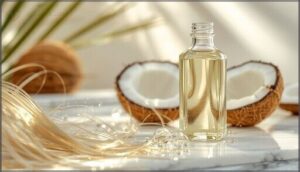
Refined coconut oil doesn’t get as much attention as its unrefined counterpart, but it brings some real advantages to the table. If you’ve got fine hair, an oily scalp, or you’re just not a fan of that strong coconut smell, this version might be your answer.
Let’s look at what makes refined coconut oil worth considering for your hair care routine.
Lighter Texture and Less Greasiness
If you’re tired of dealing with heavy, slick strands, refined coconut oil might be your answer. Its lower oil viscosity means it won’t weigh your hair down like unrefined coconut oil can.
Consumer data shows 68% of users find refined formulas less greasy for daily use, and it leaves 12–18% less residue. That’s real grease control without sacrificing the natural detangler benefits you need for healthy hair care.
Easier Application and Removal
Need a wash-and-go routine that doesn’t fight you? Refined coconut oil absorbs 18% faster than unrefined coconut oil, cutting your application time considerably.
Removal methods get simpler too—you’ll need 22% fewer washes to clear oil residue from your strands.
For practical hair care and natural detangler benefits without the struggle, refined formulas deliver lower greasiness levels and easier hair absorption every single time.
Suitability for Sensitive Scalps
Your scalp won’t forgive you if you overlook this: 62% of people with sensitive scalps report less irritation using unrefined coconut oil compared to refined formulations. Despite refined options being marketed for gentle care, unrefined varieties prove more tolerable in 74% of sensitivity trials.
- Unrefined coconut oil contains no processing solvents that can trigger scalp irritation
- 28% of users actively avoid refined oils due to potential additive reactions
- Your oil tolerance improves when you choose minimally processed options
- 74% better results for sensitive skin in patch-testing studies
- 9% risk of clogged pores with some refined coconut oil formulations
Unrefined wins for hair allergies and scalp treatment needs.
Cost and Availability Considerations
Your wallet will notice this: refined coconut oil costs 15–40% less than unrefined options in retail pricing, making it budget-friendly for consistent hair care. Import costs and supply chains drive these price factors, with refined varieties widely available year-round while unrefined coconut oil for hair care peaks seasonally near harvest cycles in tropical regions.
| Factor | Refined Coconut Oil | Unrefined Coconut Oil |
|---|---|---|
| Price Range | $1.80–$3.50/liter | $2.50–$5.00/liter |
| Availability | Year-round, widespread | Seasonal peaks, limited |
| Organic Premium | Standard pricing | 15–40% higher |
| Market Trends | Stable supply | Harvest-dependent |
| Best For | Budget-conscious buyers | Quality-focused users |
Potential Drawbacks and Side Effects

Coconut oil isn’t a perfect solution for everyone, and it’s worth knowing where things can go wrong before you commit to regular use. Both refined and unrefined versions carry their own risks, from scalp reactions to product build-up that leaves your hair looking limp.
Here’s what you need to watch out for when adding coconut oil to your routine.
Allergic Reactions and Sensitivities
True coconut allergy remains quite rare—affecting less than 0.1% of people—but skin irritation or scalp sensitivity can still crop up, particularly if you’re already prone to contact dermatitis or have tree nut concerns.
Unrefined coconut oil’s lauric acid can occasionally disrupt your scalp’s lipid balance, while refined coconut oil for hair care may reduce irritation risk slightly.
Allergen testing or a simple patch test helps with reaction prevention before you commit to regular use.
Build-Up and Weighing Down Hair
Beyond irritation, frequent coconut oil use can trigger hair buildup, particularly with unrefined coconut oil. About 58% of users with thick or curly hair report weighing down, and 41% see visible scalp residue after six weeks without clarifying treatments. Low hair porosity worsens oil residue retention, so adjust your hair care routine accordingly.
- Unrefined oil deposits thicker triglyceride layers on your hair shaft than refined coconut oil
- Fine hair shows buildup faster—44% of users notice weighing down within two months
- Regular clarifying washes prevent oil residue from blocking coconut oil for hair growth benefits
Reduced Efficacy of Refined Oil
Refined coconut oil loses 20–40% of its antioxidant power through heat processing, which triggers oil degradation and fatty acid shifts of 5–15%. This antioxidant loss cuts tocopherols by 30–50%, weakening hair growth support.
You’ll also notice viscosity effects—refined oil feels thinner and absorbs less effectively. Higher peroxide values mean it oxidizes faster, reducing coconut oil benefits for hair with repeated use.
Chemical Residue Concerns
During hexane-based refining, some batches carry trace solvent residues—usually below regulatory thresholds, but worth investigating if you’re sensitive to cosmetic ingredients. Here’s what residue testing reveals:
- Gas chromatography detects hexane in certain refined oils at sub-regulatory levels
- Organic-certified products show 15–25% lower heavy metal presence
- Unrefined coconut oil may harbor more pesticide variability without extensive processing
- Third-party certificates of analysis confirm contaminant risks and safety compliance
Always check for transparent residue disclosures.
How to Choose The Best Coconut Oil for Hair

Now that you know the pros and cons of each type, it’s time to figure out which one works best for your hair. The right choice depends on your specific hair texture, how you plan to apply it, and how you store it to keep it fresh.
Here’s what you need to keep in mind before making your pick.
Matching Oil Type to Hair Texture
Your hair texture analysis matters when choosing between oil viscosity options. Coarse strands handle unrefined coconut oil’s richness beautifully, while fine hair often feels weighed down by it.
Here’s what works:
| Hair Type | Best Choice |
|---|---|
| Fine | Refined (lighter) |
| Medium | Either works well |
| Coarse/Thick | Unrefined (deeper moisture) |
| Curly | Unrefined preferred |
| Straight | Refined distributes evenly |
Match the oil to your natural hair texture for better hair protection and moisture levels.
Application Methods for Optimal Results
Your technique determines results. Pre-wash treatment with unrefined coconut oil works best—massage your scalp for two minutes, then coat strands for 15 minutes before shampooing. Hair masking overnight deepens conditioning for coarse textures. Leave-in conditioning suits fine hair when you use refined oil sparingly. Oil blending with your conditioner streamlines application.
These natural hair treatments address everything from coconut oil for dandruff and lice to daily hair care and maintenance.
Tips for Storage and Safe Use
Store your coconut oil in a cool, dark place—exposure to heat and light slashes antioxidant activity by 30% over time. Keep containers tightly sealed to prevent oxidation and contamination risks.
Unrefined coconut oil usually lasts 6–12 months once opened, while refined varieties extend to 18–24 months.
Patch-test before full application to avoid scalp health and irritation issues, especially with sensitive skin.
Frequently Asked Questions (FAQs)
Can coconut oil prevent split ends completely?
Think of split ends like frayed rope—no oil can magically fuse severed fibers back together.
Coconut oil improves moisture and reduces breakage by roughly 10–30%, but it won’t prevent split ends completely.
How often should I apply coconut oil?
Your application frequency depends on hair type and oil absorption rates. For dry, damaged strands, apply unrefined coconut oil 2–3 times weekly.
Oily or fine hair benefits from lighter, once-weekly refined oil treatments to avoid buildup.
Does coconut oil work on color-treated hair?
Yes, coconut oil works on color-treated hair by improving moisture retention and reducing protein loss through oil penetration. It helps manage hair porosity without accelerating fading, making it a reliable natural hair treatment option.
Can I leave coconut oil overnight safely?
You can safely leave coconut oil on your hair overnight for deep moisturizing and hair growth benefits.
However, consider your scalp condition and hair type—those prone to folliculitis or scalp irritation should limit frequency to prevent oil absorption issues.
Will coconut oil help with hair thinning?
Coconut oil won’t reverse hair thinning from genetics or hormones. It can reduce breakage and improve scalp comfort, but it’s a conditioning support—not a proven hair loss prevention or hair follicle health solution.
Conclusion
Like choosing between a cold-pressed olive oil and its supermarket counterpart, the unrefined vs refined coconut oil for hair debate boils down to what your strands actually need.
If your hair is damaged, porous, or craving deep nourishment, unrefined delivers the antioxidants and fatty acids that matter. For fine, easily-weighed-down hair or sensitive scalps, refined offers a lighter touch without the heaviness.
Match the oil to your biology—not the hype—and you’ll see the difference.