This site is supported by our readers. We may earn a commission, at no cost to you, if you purchase through links.

You squeeze a dollop of shampoo into your palm every day, but that thick, fragrant liquid is far more complex than it appears. Most shampoos contain 20 to 40 carefully selected ingredients, each serving a specific purpose in the cleaning and conditioning process. The formula isn’t random—it’s a precise blend of surfactants that lift dirt, conditioning agents that smooth your hair cuticle, preservatives that keep the product safe, and pH adjusters that protect your scalp’s delicate balance.
Understanding what’s actually in your shampoo helps you make better choices for your hair type and avoid ingredients that might cause irritation or damage. The ingredient list holds the answers to why some shampoos leave your hair soft while others strip it dry.
Table Of Contents
- Key Takeaways
- What Are The Main Ingredients of Shampoo?
- Key Cleansing Agents in Shampoo
- Conditioning and Moisturizing Ingredients
- Functional Additives and Specialty Ingredients
- How to Interpret Shampoo Ingredient Lists
- Frequently Asked Questions (FAQs)
- What are the ingredients in a shampoo?
- What is a natural shampoo?
- What makes a good shampoo formulation?
- What are the best shampoo ingredients for curly hair?
- What is a primary surfactant in a shampoo?
- What Emollients are used in shampoo?
- How long does shampoo typically last once opened?
- Can shampoo ingredients cause allergic reactions or sensitivities?
- Whats the difference between clarifying and regular shampoo?
- Do expensive shampoos have better quality ingredients?
- Conclusion
Key Takeaways
- Shampoos contain 20 to 40 ingredients organized into four essential categories: surfactants that lift dirt through micelle formation, water as the primary solvent (70-90% of the formula), pH adjusters that maintain your scalp’s natural 4.5-5.5 acid mantle, and preservatives that prevent microbial growth in water-based formulas.
- Surfactants like SLS and SLES dominate most shampoos because they remove up to 90% of oil effectively, but sulfate-free alternatives such as sodium cocoyl isethionate and decyl glucoside now offer gentler cleansing with lower irritation rates while maintaining solid performance.
- Conditioning ingredients work through distinct mechanisms—silicones coat your hair shaft for instant shine but can build up over time, fatty alcohols penetrate hair fibers to improve mechanical strength by up to 2.5%, humectants like glycerin bind 25% of their weight in water, and cationic polymers stick to negatively charged hair at pH 5.5 to reduce combing force and frizz.
- Reading ingredient lists reveals concentration through position since water and primary surfactants appear first (80-90% of formulation), ingredients above 1% threshold appear before fragrances, and your hair type determines which ingredients work best—oily hair needs lightweight surfactants, dry hair requires emollients like shea butter, curly hair benefits from sulfate-free formulas with coconut oil, and sensitive scalps demand fragrance-free options.
What Are The Main Ingredients of Shampoo?
When you flip over a shampoo bottle, you’ll see a long list of ingredients that might look like a chemistry test. Most of these components fall into a few key categories, each serving a specific purpose in cleaning and caring for your hair.
Let’s break down the four essential ingredient types that form the foundation of every shampoo formula.
Surfactants and Their Role
At the heart of every shampoo, surfactants work like tiny molecular magnets—their water-loving heads and oil-loving tails grab onto sebum and dirt, lifting them away from your hair. Common ones include sodium lauryl sulfate (SLS) and sodium laureth sulfate (SLES), which create rich lather and effective cleansing through micelle formation.
However, their irritation potential has sparked the sulfate-free movement, prioritizing surfactant mildness. Many shampoos also include secondary surfactants like Cocamidopropyl betaine to boost foam production.
Water as The Primary Solvent
While surfactants grab the spotlight, water—listed as “Aqua” in shampoo formulation—makes up 70% to 90% of the bottle. This universal solvent dissolves and disperses every other ingredient, from surfactants to preservatives. Water quality matters too:
- Deionized water prevents mineral interference with cleaning agents
- Hard water reduces lather and leaves mineral buildup on your hair
- High water content requires effective preservatives for microbial stability
- Purified water ensures consistent formulation impact and product shelf life
Shampoos combine surfactants, and adjust viscosity with salt.
PH Adjusters for Scalp Compatibility
Your scalp’s natural pH sits around 4.5 to 5.5—its protective acid mantle. Shampoos rely on pH balancers like citric acid to match this scalp balance, preventing irritation and cuticle damage. Alkaline neutralizers, such as sodium hydroxide, fine-tune formulas during manufacturing, while buffering systems keep the pH level stable over time. pH measurement ensures each batch delivers compatibility, not harshness.
| pH Adjuster Type | Common Ingredient | Primary Function |
|---|---|---|
| Acidic Adjusters | Citric Acid | Lower pH, preserve acid mantle |
| Acidic Adjusters | Lactic Acid | pH balance for hair, mild exfoliation |
| Alkaline Neutralizers | Sodium Hydroxide | Raise pH during processing |
| Alkaline Neutralizers | Potassium Hydroxide | Initial pH adjustment in formulation |
| Buffering Systems | Acid + Salt Blends | Maintain stable pH level over time |
Preservatives for Product Safety
Without preservation strategies, that pH-balanced shampoo becomes a breeding ground. Shampoos need preservatives like parabens, phenoxyethanol, or benzyl alcohol to block microbial risks—bacteria and mold thrive in water-based formulas.
Regulatory limits cap concentrations (EU restricts parabens to 0.4–0.8%), while sensitization concerns around formaldehyde releasers push emerging trends toward multifunctional ingredients that preserve without traditional preservative labels.
Key Cleansing Agents in Shampoo
Surfactants are the workhorses of any shampoo formula, responsible for lifting dirt, oil, and product buildup from your hair and scalp. Not all surfactants are created equal, though—some are aggressive cleansers, while others offer a gentler touch.
Let’s break down the main types you’ll find on ingredient labels and how they actually get your hair clean.
Anionic Surfactants (e.g., SLS, SLES)
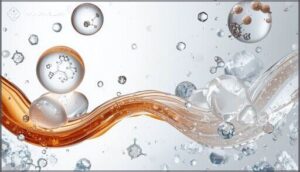
You’ll recognize SLS and SLES as the workhorses in most shampoos—they generate that satisfying lather and power through sebum effectively, with SLES removing around 90% of oil in testing.
These anionic surfactants dominate because they’re cost-effective and reliable, though their cleansing performance comes with irritation potential on sensitive scalps, particularly at concentrations above 20%.
This is why many formulas blend them with gentler co-surfactants.
Milder and Sulfate-Free Surfactants
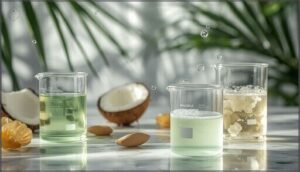
If you’re looking to sidestep the irritation of Sodium Lauryl Sulfate (SLS) or Sodium Laureth Sulfate (SLES), sulfate-free shampoo formulations now deliver solid cleansing power without the harshness.
Green surfactants like sodium cocoyl isethionate showcase considerable isethionate mildness, while decyl glucoside—a plant-derived option—offers glucoside benefits such as biodegradability and stable foam.
Taurate cleansing with sodium methyl cocoyl taurate rounds out these sulfate alternatives, giving you gentler shampoo cleansing agents that respect your scalp’s barrier.
Amphoteric and Non-Ionic Surfactants

Beyond primary sulfate-free surfactants, amphoteric and non-ionic shampoo cleansing agents improve your formulation with proven benefits. Cocamidopropyl betaine, an amphoteric workhorse, delivers mildness comparison studies showing lower irritation than anionics alone. Non-ionic decyl glucoside adds regulatory status as safe and gentle. Together, they boost micellar interactions, reduce barrier damage, and drive market growth in natural shampoo formulation ingredients—giving you effective surfactants that respect your hair and scalp.
- Cocamidopropyl betaine boosts foam and reduces harshness at 2–10% concentration.
- Non-ionic decyl glucoside cleanses gently at 1–5%, stable across pH ranges.
- Amphoteric surfactants act as conditioning agents in typical shampoo pH (4.5–5.5).
- Mixed surfactant systems lower TEWL increases, preserving your scalp barrier.
- Renewable-derived surfactants meet green formulation and regulatory expectations globally.
How Surfactants Clean Hair
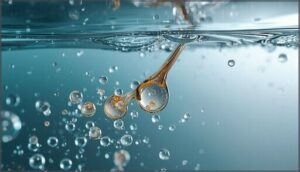
Surfactants clean your hair through a precise molecular dance. Their amphiphilic structure—hydrophilic heads bonding with water, hydrophobic tails grabbing oils—reduces interfacial tension, allowing dirt to lift easily. At the critical micelle concentration (around 0.049% for SLES), micelles form 7.5–11.7 nm spheres that trap sebum and grime. During rinsing, water flushes away these oil-loaded parcels, leaving your strands fresh and residue-free.
Surfactants clean hair by forming microscopic spheres that trap oil and dirt, then rinse away with water
| Cleaning Stage | What Surfactants Do |
|---|---|
| Oil Emulsification | Tails penetrate sebum; heads stay in water, breaking oil cohesion |
| Micelle Formation | Spheres encapsulate dirt at CMC (0.049% w/w for SLES) |
| Cuticle Interaction | Increase negative charge, reduce water repellency, lift scales slightly |
| Rinsing Efficacy | Remove up to 93% of hydrocarbons; micelles prevent redeposition |
| Water Influence | Hard water (>120 mg/L Ca²⁺) cuts performance 40–60%; pH 4.5–5.5 best |
Conditioning and Moisturizing Ingredients
Cleaning your hair is only half the job—conditioning and moisturizing ingredients work behind the scenes to keep it soft, manageable, and healthy-looking. These components smooth the hair cuticle, lock in moisture, and prevent the dryness that surfactants can sometimes cause.
Let’s break down the key players that give your shampoo its conditioning power.
Silicones and Their Effects
Silicones like dimethicone coat your hair shaft with a thin, protective film that reduces friction and enhances shine instantly. However, you should know that these ingredients can accumulate over time, especially non-water-soluble types:
- Silicone buildup may weigh down your curls and dull your hair’s natural texture
- Environmental impact is significant—cyclic silicones persist in waterways for over 1,200 days
- Regulatory actions in the EU now restrict certain silicone types due to toxicity concerns
Water-insoluble silicones provide lasting smoothness but require clarifying shampoos for removal.
Fatty Alcohols and Emollients
Fatty alcohols like cetyl alcohol aren’t drying—they’re emollients that smooth your hair cuticle and build viscosity through gel networks with surfactants.
At 0.5–2.5% concentration, they penetrate hair fibers, improving mechanical strength and reducing breakage under fatigue testing.
These conditioners also improve sensory attributes like softness and gloss while stabilizing suspended silicones, preventing phase separation over time.
Humectants for Hair Hydration
While emollients coat your hair, humectants pull moisture in—and they’re backed by data. Glycerin binds roughly 25% of its weight in water, while propylene glycol holds about 20%. Here’s what works:
- Glycerin reduces evaporation rates substantially at 60–70% concentration in tests
- Propylene glycol performs optimally at 2–5% in formulations
- Panthenol boosts hydration by 15% within two hours
- Humidity matters—your humectants draw water from air when it’s available
Cationic Polymers for Manageability
Humectants help, but cationic polymers—like Polyquaternium-10—actually stick to your hair. At pH 5.5, your hair carries a negative charge, so these positively charged conditioning agents deposit directly onto each strand.
You’ll notice lower combing force, measurably reduced frizz, and smoother cuticles.
Shampoo formulation chemistry shows that hair conditioning depends on polymer deposition driven by electrostatic attraction—not just surface coating, but actual fiber protection through targeted adsorption.
Functional Additives and Specialty Ingredients
Beyond cleansing and conditioning, shampoos contain functional additives that improve texture, scent, and user experience. These ingredients don’t directly clean or moisturize your hair, but they make the product more pleasant to use and shelf-stable.
Specialty ingredients target specific concerns like dandruff or damage, giving your shampoo its unique character and performance benefits.
Thickeners and Texture Enhancers
Behind every pumpable shampoo lies careful polymer interactions and salt effects. Thickeners like xanthan gum, guar gum, and acrylates copolymers transform watery surfactant blends into luxurious clear gels.
These stabilizers, usually dosed at 0.1–2% of the formula, control sensory perception and formulation stability by building viscosity that flows when you squeeze but clings perfectly to your hair, ensuring both convenience and performance.
Fragrances and Sensory Agents
Fragrance compounds like linalool and limonene appear in roughly 60–95% of perfumed shampoos, delivering the signature scent you expect. But here’s the catch: oxidized terpenes from these same molecules cause fragrance allergens to affect 0.7–2.6% of the population. Cooling agents such as L-menthol add sensory impact at concentrations below 0.0001%, while labeling regulations now require disclosure of 26 specific sensitizers, helping you navigate sensory enhancers with confidence.
- Linalool and limonene dominate fragrance blends in 60–95% of shampoos
- Oxidized terpenes become potent allergens during shelf storage
- L-menthol cooling agents work at ultra-low sub-0.0001% concentrations
- Fragrance allergens affect up to 2.6% of the general population
- EU labeling regulations mandate disclosure of 26 fragrance sensitizers
Active Ingredients (e.g., Anti-Dandruff Agents)
When dandruff and scalp health issues arise, antidandruff shampoo ingredients intervene with targeted actives that address the root cause. Azole antifungals, such as ketoconazole and piroctone olamine, effectively reduce Malassezia yeast, while metal-based antifungals like selenium sulfide complement their action. Keratolytic actives, including salicylic acid, break down stubborn flakes, and clinical outcomes demonstrate that combining these agents provides a broader spectrum of effectiveness against scalp concerns.
| Active Category | Common Examples | Primary Mechanism |
|---|---|---|
| Azole Antifungals | Ketoconazole (2%), Piroctone Olamine (0.5%), Climbazole (0.45%) | Target Malassezia fungal overgrowth on scalp |
| Metal-Based Antifungals | Zinc Pyrithione (1%)*, Selenium Sulfide (1–2.5%) | Inhibit fungal growth, reduce inflammation |
| Keratolytic Actives | Salicylic Acid (1–3%), Sulfur (2–5%) | Break down scale adhesion, facilitate penetration |
| Combination Formulas | Sulfur + Salicylic Acid, Azole + Keratolytic | Multi-mechanism approach for persistent dandruff |
| Regulatory Status | EU banned Zinc Pyrithione (March 2022) | Carcinogen classification shifted formulations |
*Banned in EU cosmetics since March 2022
Botanical Extracts and Natural Oils
Beyond synthetic actives, botanical ingredients introduce plant-derived benefits that appeal to clean-beauty consumers. Argan oil and coconut oil deliver nourishing lipids, while essential oils add sensory impact alongside potential antimicrobial properties.
Extract efficacy varies—saw palmetto shows measurable hair-density gains in clinical trials, yet sourcing impacts quality and safety profiles depend on concentration.
Formulation trends increasingly favor these natural extracts, though “botanical” doesn’t guarantee hypoallergenicity.
How to Interpret Shampoo Ingredient Lists
Reading a shampoo label can feel like decoding a chemistry textbook, but once you know what you’re looking at, you’ll make better choices for your hair. The ingredient list isn’t random—it follows specific rules that reveal what’s actually in the bottle and how much of it matters.
Let’s break down how to read these labels like a cosmetic chemist, so you can spot the good stuff, avoid what doesn’t work for you, and match ingredients to your specific hair needs.
Understanding Ingredient Order and Concentration
Reading shampoo ingredient lists reveals concentration through ingredient predominance. Regulatory listing rules place water and primary surfactants first, showing they commonly account for 80–90% of formulation. Ingredients above the 1% threshold appear before fragrances, while trace ingredients follow in any order.
Understanding shampoo ingredients means recognizing that position indicates approximate concentration, helping you apply practical reading strategies when evaluating main shampoo ingredients and shampoo ingredient functions.
Identifying Ingredients to Avoid
Protecting your scalp starts with recognizing shampoo ingredients to avoid. Sulfate irritation, formaldehyde risks, and paraben concerns pose real threats. Human patch testing confirms that SLS and SLES trigger irritation and dryness, while formaldehyde-releasing preservatives increase allergic reactions over time.
Watch for these harmful chemicals in shampoo:
- Sulfates (SLS/SLES): Cause scalp irritation and barrier disruption
- Formaldehyde releasers (DMDM hydantoin): Linked to sensitivity and hair loss
- Isothiazolinones (MCI/MI): Allergy preservatives accounting for 22.8% of shampoo reactions
Fragrance dangers include undisclosed synthetic chemicals and phthalates with endocrine-disrupting activity.
Choosing Ingredients for Your Hair Type
Your hair type determines which shampoo ingredients work best. Oily hair thrives with salicylic acid and lightweight surfactants that clean without weighing strands down.
Dry hair needs emollients like shea butter and argan oil paired with glycerin.
Curly hair benefits from sulfate-free formulas rich in coconut oil.
Color-treated hair requires gentle, pH-balanced systems.
Sensitive scalps demand fragrance-free, hypoallergenic options with soothing aloe vera.
Frequently Asked Questions (FAQs)
What are the ingredients in a shampoo?
Ever wondered what makes your shampoo foam, cleanse, and condition? Common shampoo ingredients include surfactants for cleansing, water as the solvent, conditioning agents, preservatives, thickeners, and fragrances—each serving distinct formulation science roles.
What is a natural shampoo?
Natural shampoos use plant-derived surfactants, botanical extracts like aloe vera and tea tree oil, and coconut oil instead of synthetic chemicals.
They carry natural certifications, emphasize ingredient sourcing, and address health considerations while reducing environmental impact.
What makes a good shampoo formulation?
A good shampoo formulation balances ingredient synergy, scalp microbiome health, and sensory experience.
You’ll find functional additives, active ingredients, and surfactants working together, ensuring formulation stability while prioritizing sustainable sourcing and effective cleansing without irritation.
What are the best shampoo ingredients for curly hair?
Picture someone with tight ringlets staring at a shelf of bottles, overwhelmed. You need curl-safe surfactants like cocamidopropyl betaine, humectant pairings with glycerin, emollient benefits from shea butter, coconut oil, or argan oil, conditioning agents, silicone alternatives, botanical support, and focused hair hydration and moisture.
What is a primary surfactant in a shampoo?
A primary surfactant is the main cleansing agent in shampoo, usually sodium lauryl sulfate (SLS) or sodium laureth sulfate (SLES), constituting 10–20% of the formula and delivering over 80% of detergency through micelle formation.
What Emollients are used in shampoo?
You’d think emollients just soften, yet they quietly shape your shampoo’s texture. Silicone emollients like dimethicone smooth cuticles, while plant oils—argan, coconut—and fatty alcohols (cetyl, stearyl) deliver slip and frizz control in conditioning formulations.
How long does shampoo typically last once opened?
Once opened, most shampoos remain effective for 6 to 24 months, indicated by the PAO symbol on packaging.
Storage conditions, preservatives, and bacterial growth potential influence this timeframe, with visual indicators signaling when replacement becomes necessary.
Can shampoo ingredients cause allergic reactions or sensitivities?
Yes, shampoo ingredients commonly trigger allergic reactions and skin sensitivity. Preservatives, irritant surfactants, and fragrance sensitivities dominate allergen prevalence, with patch testing revealing reactions in up to 9% of dermatitis patients exposed to harmful chemicals.
Whats the difference between clarifying and regular shampoo?
Clarifying shampoos contain higher concentrations of strong anionic surfactants like sodium lauryl sulfate (SLS) and sodium laureth sulfate (SLES) for deep buildup removal.
Regular shampoos feature milder cleansing agents with more conditioning components for routine use.
Do expensive shampoos have better quality ingredients?
Higher-priced shampoos often contain richer conditioning agents and specialty actives at greater concentrations, but formulation design matters more than cost.
Well-made drugstore options can match premium performance for healthy, untreated hair.
Conclusion
Knowledge is half the battle when you’re standing in the shampoo aisle. Now that you understand what the main ingredients of shampoo are and how each component functions, you can scan labels with confidence, spotting the surfactants that match your cleaning needs and the conditioning agents your hair craves.
Your scalp’s health depends on making informed choices, not marketing claims. Read those ingredient lists carefully—they reveal exactly what you’re applying to your hair every single day.
- https://www.sciencedirect.com/topics/chemistry/shampoo
- https://www.healthline.com/health/shampoo-ingredients-for-different-hair-needs
- https://www.mordorintelligence.com/industry-reports/surfactants-market
- https://www.verifiedmarketresearch.com/product/north-america-europe-and-china-sulfate-free-shampoo-market/
- https://pmc.ncbi.nlm.nih.gov/articles/PMC4387693/