This site is supported by our readers. We may earn a commission, at no cost to you, if you purchase through links.
The question isn’t really why women have long hair—it’s why we decided they should. Your follicles don’t know your gender. Estrogen extends the growth phase of hair by a few years compared to testosterone, sure, but that biological quirk explains maybe an inch or two of difference, not the flowing locks that got tangled up with femininity somewhere between ancient Greece and your grandmother’s beauty parlor.
What started as a minor hormonal variation became a cultural obsession, weaponized into rules about who you are and how much space you’re allowed to take up. Long hair signals health, fertility, status—or at least it did before we had antibiotics and could afford shampoo. Now it’s mostly theater, a performance of gender we’ve been rehearsing so long we forgot we’re acting.
Table Of Contents
- Key Takeaways
- Why Do Women Have Long Hair?
- Historical Significance of Long Hair
- Health and Status Indicators
- Cultural and Gender Implications
- Practical Aspects of Hair Care
- Personal Choices and Aesthetics
- Frequently Asked Questions (FAQs)
- What is the biological purpose of long hair?
- Why do men prefer long hair on women?
- Why do women have longer hair?
- Why do people have long hair?
- Do women wear long hair?
- Are long haired women more feminine?
- Why is it standard for women to have long hair?
- Why do females grow longer hair than males?
- Why did long hair become feminine?
- What is the psychology behind long hair women?
- Conclusion
Key Takeaways
- Estrogen extends women’s hair growth phase by a few years compared to testosterone, but this biological difference explains only an inch or two—not the cultural obsession with long hair as a marker of femininity.
- Long hair became a loaded symbol of health, fertility, and social status across ancient civilizations and religious traditions, transforming a minor hormonal variation into rigid gender expectations that persist today.
- Maintaining long hair reveals economic privilege through the costs of salon services, premium products, and time flexibility, creating a beauty gap that mirrors income inequality.
- Hair length operates as both personal choice and cultural performance, with workplaces, legal systems, and social norms still policing what’s considered “appropriate” based on outdated scripts about gender and professionalism.
Why Do Women Have Long Hair?
Why does long hair remain such a stubborn fixture of feminine beauty? Your locks tell a story that weaves together biology, culture, and rebellion.
Throughout history, myths about hair growth and care have reinforced the idea that longer hair signals health, youth, and desirability in women.
Estrogen extends your hair’s growth cycle—usually two to seven years—letting you cultivate length that men’s testosterone-shortened phases can’t match. But here’s where it gets interesting: cultural norms have hijacked this biological quirk, transforming hair length into a loaded symbol of femininity, social identity, and even economic access.
Biology gives women longer hair, but culture turned that difference into a weapon of femininity and class
Long hair signals health (adequate nutrition, minimal stress), yet it’s also become shorthand for conforming to beauty standards that many women now question. You can learn more about the historical association of long hair with femininity and social status.
Whether you’re growing it out or chopping it off, your choice challenges or confirms centuries of cultural symbolism around what makes someone “properly” feminine.
Historical Significance of Long Hair
Long hair wasn’t always just about aesthetics—it carried coded messages about who you were and where you belonged.
Ancient civilizations attached specific meanings to flowing locks, while religious texts turned hair length into a moral question. Let’s look at how two powerful forces shaped the narrative around women and long hair.
Ancient Greek and Roman Influences

Hair symbol and status converged in striking ways across ancient Greece and Rome. Roman women kept their tresses long and often parted down the center—a cultural signature that archaeologist Elizabeth Bartman confirmed through her research.
The ancient Greeks linked flowing locks to beauty and fertility, while Roman beauty standards elevated hair into art. Wealthy women spent hours with enslaved hairdressers crafting elaborate styles that screamed privilege. Greek hair customs celebrated goddesses with cascading waves, embedding cultural symbolism that still echoes in modern hair history.
Religious Perspectives on Hair Length

Beyond secular beauty standards, faith-based styles have long shaped how you see long hair. St Paul’s letters to early Christians declared women’s hair her glory—a divine appearance marking spiritual order. Sacred locks in Sikhism remain uncut as gifts from God, while Hindu devotees grow theirs long to honor deities.
The cultural significance of hair runs deep across traditions:
Different ethnic groups have distinct hair characteristics that shape grooming practices, with variations in hair density and texture across ethnicities influencing cultural beauty standards worldwide.
- Islamic modesty codes often require covering long hair in public settings
- Nazirite vows in ancient Judaism forbade cutting hair during consecration periods
- Christian denominations still debate gender and hair based on Biblical passages
- Hindu ascetics maintain dreadlocks as visible spiritual discipline
- Sikh turbans protect uncut hair, a religious adornment with profound meaning
Hair symbol and history intertwine with the spiritual significance communities attach to every strand. Across Indian traditions, hair holds deep spiritual and cultural importance that shapes social identity and religious practice.
Health and Status Indicators
Your hair tells a story about your body—and your bank account. Long, glossy locks have historically signaled everything from fertility and youth to the kind of economic privilege that affords salon visits and premium conditioners.
Let’s look at how health and wealth get tangled up in those cascading strands.
Long Hair as a Sign of Well-being
You might think your hair is just decoration, but those flowing strands tell a deeper story about your overall wellness. Long hair acts as a biological billboard—it demands adequate protein, stable hormones, and clean follicles to thrive. When your thyroid hums along properly and you’re eating well, your hair shows it through shiny, resilient growth that defies beauty standards built on artifice.
Hair vitality connects directly to mental health too. Women who maintain long locks often report higher confidence and creative satisfaction from styling rituals that provide structure and mood boosts. The daily discipline—gentle brushing, protective wraps, regular trims—becomes a wellness practice in itself.
Your hair doesn’t lie about late nights, poor nutrition, or chronic stress. It’s a remarkably honest wellness signal, broadcasting your self-care habits and biological resilience to anyone paying attention.
Hair Maintenance and Socio-economic Status
Beneath the shine and gloss lives a truth about Economic Inequality—your hair reveals who can afford the upkeep. Long hair maintenance demands resources that track neatly with social status, from Product Affordability to Salon Services access. Women in affluent neighborhoods enjoy gifted stylists within minutes, premium keratin treatments, and flexible schedules for regular trims. Meanwhile, budget constraints push others toward drugstore bottles and skipped appointments, creating a beauty gap that mirrors income divides.
Here’s how Maintenance Costs expose class divisions:
- Premium products: Professional-grade formulas cost more but deliver salon-worthy results
- Service frequency: Regular cuts and treatments require both money and time flexibility
- Geographic access: Quality Hair Access concentrates in higher-income areas
- Knowledge gaps: Education about proper hair care follows socioeconomic lines
Your strands broadcast privilege—or its absence—whether you intend them to or not.
Cultural and Gender Implications

Hair length isn’t just about biology or beauty—it’s wrapped up in laws, morals, and expectations about who you’re supposed to be.
Throughout history, your hair has been policed, praised, and parsed for meaning, especially in relation to gender. Let’s look at how societies have used hair to draw lines between acceptable and rebellious, feminine and masculine.
Hair in Legal and Moral Contexts
Your hair isn’t just yours—courts, employers, and moral gatekeepers have claimed a stake in it for centuries. Laws in many jurisdictions now prohibit forcing you to shave or cut hair for work, recognizing hair length as a protected attribute under anti-discrimination statutes.
Schools must accommodate religious and cultural practices, while workplace policies face scrutiny for disproportionately affecting protected classes—especially when “professional” codes stigmatize natural Black hairstyles or religious coverings. This is where Hair Discrimination meets Legal Rights and Social Justice head-on.
The moral dimension runs deeper: hair signals virtue, rebellion, femininity, or deviance depending on who’s judging. Courts have examined juror biases related to hair, acknowledging that societal expectations shape perceptions of Human Dignity. Cultural significance of hair transcends aesthetics—it’s woven into gender roles, social norms, and Moral Obligations, making every strand a quiet battleground for identity and freedom.
Long Hair and Gender Roles
Your hair declares who you’re—or who you’re expected to be. Long hair remains a potent symbol of Feminine Beauty across cultures, while short cuts can signal rebellion against Gender Expression norms. Societal expectations still link flowing locks to traditional femininity, yet women in media and politics now wield long hair as power, not submission. Men with long hair? They’re read as artists, outcasts, or nonconformists challenging Masculine Standards. Hair length doesn’t just reflect gender roles—it rewrites them.
- Cultural Identity shapes judgment: Natural Black hair and religious coverings face workplace scrutiny under “professional” codes that privilege European beauty standards.
- Trans communities reclaim hair: Length becomes a visible tool for affirming gender, challenging the binary that long equals woman, short equals man.
- Status signals persist: Maintaining glossy, long hair requires time and money, making it a class marker wrapped in feminine ideals.
Practical Aspects of Hair Care

You can romanticize long hair all you want—attribute it to ancient goddesses, evolutionary biology, or feminist rebellion—but at some point, you’re standing in front of a mirror with a detangling brush and a bottle of conditioner.
The reality is less poetic than the symbolism suggests. Let’s talk about what actually happens when you commit to keeping your hair long, and why some women eventually decide it’s just not worth the effort.
Challenges in Long Hair Upkeep
Let’s be honest—your long hair demands more than casual attention. Daily tangle management eats up 5 to 15 minutes, and wet strands are 40 percent more vulnerable to hair breakage when you rush through brushing.
That extra length creates scalp tension in nearly 40 percent of wearers, sometimes triggering headaches from ponytail pull. Moisture loss dries out ends faster than roots, demanding weekly deep conditioning sessions.
Split ends multiply without quarterly trims, while heat styling chips away at your cuticle integrity. Hair maintenance isn’t just hair care—it’s strategic investment in hair growth and hair length.
Short Hair and Practicality
Short hair cuts through your morning routine like a hot knife through butter—you’re looking at 5 to 15 minutes less Daily Styling versus long hair.
Weather Resistance? Your scalp breathes easier in heat, dries faster after rain, and responds to climate shifts without the weight.
Low Maintenance trims every month keep you sharp, while improved Scalp Health and simplified Hair Texture management free you from the cultural significance of hair length.
Personal Choices and Aesthetics
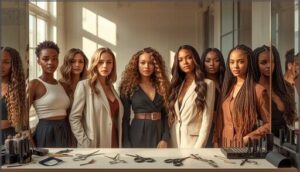
At the end of the day, your hair length is yours to decide—no matter what history, biology, or your great-aunt thinks about it.
The choice becomes even more complex when workplace dress codes and age-based expectations enter the picture. Let’s look at how professionalism and aging shape the politics of long hair.
Professionalism and Long Hair
Walk into most corporate offices and you’ll notice long hair isn’t just accepted—it’s practically a power move. Your workplace grooming choices matter more than you’d think, tangling up professionalism with outdated beauty standards and gender roles. The truth is, well-maintained long hair conveys discipline and femininity in many client-facing roles, though the cultural significance varies wildly by industry.
Some workplaces still police hair under the guise of professional image, skirting dangerously close to hair discrimination.
- Sleek styles signal competence without sacrificing your aesthetic freedom
- Office etiquette often judges maintenance quality over actual length
- Client perception shifts based on how confidently you wear your hair
- Safety-driven industries require practical solutions, not arbitrary rules
- Your hair choices challenge rigid definitions of what “professional” even means
Age and Perception of Hair Length
Your hair length sends age cues whether you mean it to or not. Longer strands often signal youthful appearance—think shiny, well-maintained hair that advertisers love—but cultural norms complicate the picture. Some societies read long hair on older women as defiance, while others see it as wisdom wrapped in beauty standards. What matters most isn’t length but hair quality: healthy locks override perception bias every time, reshaping how others judge your personal identity and the cultural significance of hair itself.
- Thick, glossy hair reads younger regardless of your birth certificate—maintenance trumps length
- Strategic styling lets you control age impressions in professional settings and social spaces
- Owning your choice matters more than conforming to outdated scripts about what’s “appropriate
Frequently Asked Questions (FAQs)
What is the biological purpose of long hair?
Your scalp needs cooling and protection—that’s where biology steps in.
Long hair boosts evaporative cooling, shields against UV radiation, and signals strong health through estrogen-driven growth phases and adequate nutrition.
Why do men prefer long hair on women?
Is it evolutionary attraction or social conditioning that drives this preference?
In many cultures, men associate longer hair with femininity, youth, and health—signals reinforced through beauty standards, gender roles, and deeply embedded cultural significance of hair.
Why do women have longer hair?
Your hair grows longer largely because estrogen extends the growth phase, keeping strands active for years.
Cultural identity and beauty standards tied to femininity reinforce this biological edge, shaping expectations around hair length.
Why do people have long hair?
You scroll past another influencer’s hair tutorial—yet another signpost that long hair signals health, wealth, and cultural expression.
It’s personal freedom meets social status, woven through beauty standards spanning centuries.
Do women wear long hair?
Yes, women often wear long hair—it remains a widespread feminine identity expression shaped by cultural hair practices, female beauty standards, and personal aesthetics.
Long hair symbolism persists across fashion, though individual choice ultimately drives hair length trends.
Are long haired women more feminine?
Think of a boardroom full of women with sleek ponytails—you might unconsciously read them as polished women.
Cultural norms link long hair to femininity, but biology and personal choice blur those stereotypes daily.
Why is it standard for women to have long hair?
Cultural norms, shaped by centuries of gender roles and beauty standards, made long hair the feminine ideal.
It signals health, wealth, and social identity—reinforcing traditional gender expression through hair symbolism that persists today.
Why do females grow longer hair than males?
Biology writes the script before culture takes the stage.
Estrogen extends your hair’s growth phase, while testosterone shortens it in males—a hormonal difference that hair length, femininity, and genetic factors have long reinforced across societies.
Why did long hair become feminine?
Long hair became feminine because ancient civilizations tied it to fertility and beauty standards, while hormones naturally supported growth.
Religious texts, gender roles, and cultural norms cemented this association across centuries.
What is the psychology behind long hair women?
Psychologically, your flowing hair broadcasts health, vitality, and femininity—a beauty standard reinforcing feminine identity.
It shapes personal identity through self expression, creating emotional connection while coping with social expectations about hair length and what it symbolizes.
Conclusion
Your scalp doesn’t care about Rapunzel or Samson—it just grows keratin. The reason why women have long hair has less to do with biology than with centuries of people deciding what femininity should look like, then passing that script down until it felt inevitable.
Hormones give you maybe two extra inches; culture does the rest. You can keep the performance going or cut it short. Either way, now you know whose rules you’re following.
- http://mailto:openthread
- https://twitter.com/VVFriedman
- https://www.jstor.org/stable/507324?seq=1
- http://www.britannica.com/topic/The-Letter-of-Paul-to-the-Corinthians
- https://theologyintheraw.com/the-cultural-context-for-the-hair-length-style-vs-head-coverings-debate-in-1-cor-11-the-meaning-of-kephale-part-12/