
This site is supported by our readers. We may earn a commission, at no cost to you, if you purchase through links. This content is for general informational and educational purposes only and is not a substitute for professional medical, dermatological, or nutritional advice.
Most people trim their brows too short the first time. It happens fast—one snip, then another—and suddenly you’re filling in sparse patches for the next three weeks.
The difference between a clean, shaped brow and that regrettable outcome usually comes down to technique, not talent.
Eyebrow hair grows in layers, hides its true length when brushed flat, and responds poorly to the wrong tools.
Once you understand how the hair actually behaves, trimming becomes precise and predictable.
The steps ahead will walk you through everything—from prep to finishing touches—so your brows look intentional, not accidental.
Table Of Contents
- Key Takeaways
- Preparing Eyebrows
- How to Trim Eyebrows
- Essential Trimming Tools
- Shaping and Maintaining Brows
- Common Trimming Mistakes
- Frequently Asked Questions (FAQs)
- How do I trim my eyebrows?
- Should you trim your eyebrows outside your natural brow shape?
- How do you cut a brow?
- How long does it take to trim eyebrow hair?
- How to trim your eyebrows right?
- Do you brush eyebrows up or down to trim them?
- How do I trim my eyebrows right?
- How to trim eyebrows after threading?
- Should you wait for a professional to trim your eyebrows?
- How do you trim brow hair?
- Conclusion
Key Takeaways
- Brushing brows upward with a spoolie before every trim reveals true hair length and shows exactly which strands need cutting.
- Snip at a 45-degree angle, one hair at a time, starting from the inner corner and working outward — this keeps edges soft and natural.
- The biggest mistake people make is over-trimming, so cut only the longest 10–15% of hairs and step back often to check symmetry.
- Your tools matter: short-bladed rounded scissors, slant-tip tweezers, and a dual-ended brow comb give you control that flat or improvised tools simply can’t.
Preparing Eyebrows
Getting your eyebrows ready is the first step toward a clean, polished look.
Once your brows are shaped, matching them to your hair dye results ties the whole look together effortlessly.
You’ll want to set the stage before you start trimming.
Here’s how to prep your brows for the best results.
Brushing Eyebrow Hairs Upward
Brushing your brow hairs upward is the foundation of any solid brow grooming routine. Grab your spoolie brush and sweep from the inner corner outward, following the natural growth angle. This simple spoolie technique does more than tidy things up — it reveals true hair length, exposes uneven hair density, and makes arch visualization actually possible before you touch any scissors or tweezers.
Here’s what upward brushing shows you instantly:
- Which hairs exceed the brow line and need trimming
- Where hair density is uneven or patchy
- The natural arch you’re working with
For daily maintenance, a quick upward brush — even without product integration like brow gel — keeps everything aligned and controlled. Consider using the brow lamination technique for a longer‑lasting lifted look.
Combining Hairs for Trimming
Once your brows are brushed up, combining hairs before you cut makes all the difference.
Use your spoolie brush to group strands by visible length — length grouping in action.
Target only the longest 10–15% first.
Then follow directional alignment, combing each section the way it naturally grows: upward at the head, outward through the arch.
Apply a light sweep of brow gel to hold coarser hairs in place during tool‑integrated combining.
Work in small bundles across dense zones — density segmentation keeps you from overthinning.
Keep shape referencing in mind, and let your scissors follow the comb’s edge, never ahead of it.
Filling in Brows to Define Shape
After you’ve grouped and tamed each section, pick up your brow pencil and map your shape with soft, hair-like Pencil Strokes. Start at the inner edge, using your spoolie brush to blend color and fill sparse spots. For extra fullness, layer gentle Powder Shading underneath the arch, then sweep on Tinted Gel for hold and texture. Focus on Arch Definition by building a subtle Gradient Fill from base to tail. Step back often—symmetry is your compass. Brow grooming is personal, so let your tools shape confidence.
- See your face framed with intention
- Feel control in every gentle snip
- Watch your features sharpen with each pass
Accurate brow mapping ensures symmetry and lasting shape. accurate brow mapping
How to Trim Eyebrows
Once your brows are prepped, it’s time to trim with intention. Think of it like editing — you’re refining what’s already there, not starting over.
For precise trimming, reach for a stainless steel brow tool with a textured, non-slip grip to keep your edits controlled and comfortable.
- Work from inner brow outward, snipping only the longest hairs
- Hold scissors at a 45-degree angle for feathery, natural-looking cuts
- Step back after each pass to check symmetry before trimming more
Your growth cycle timing matters here — trim every three to four weeks, not daily. Seasonal adjustments apply too; brows grow faster in warmer months. Less is always more.
Essential Trimming Tools

The right tools make all the difference between brows that look polished and ones that go sideways — literally.
Before you pick up anything sharp, it helps to know what each tool actually does. Here’s what you’ll want to have on hand.
Using Scissors for Eyebrow Trimming
right pair of eyebrow scissors changes everything. Look for short blades — around 2 to 3 centimeters — with rounded tips that protect the delicate eye area. That blade design gives you real control without the risk.
Start by brushing hairs upward with a spoolie brush, then practice sectional trimming, moving from the inner brow toward the tail in small passes. Work at a 45-degree angle, making tiny snips along the hair tips rather than closing the blades in one heavy cut.
Good hygiene practices matter too — clean your scissors after every use.
For travel convenience, a compact pair facilitates eyebrow trimming anywhere you go.
Tweezers for Shaping and Maintenance
Step into eyebrow maintenance with tweezers—the unsung heroes of facial grooming.
Choose slant-tip tweezers made of stainless steel; they offer material durability and a grip that won’t slip, even after months of tension adjustment.
When you target stray hairs, pull the skin taut and work from the underside of the arch outward. That approach lets you shape without risking gaps or uneven lines.
Hygiene practices matter: clean tweezers with 70% isopropyl alcohol after every session. Store them in a dry spot and use the protective cap to avoid tip damage.
Each tweezer tip shape fulfills a purpose, so match your tool to your grooming techniques.
Small refinements add up—think subtle, not drastic. For eyebrow trimming, patience and precision are your strongest allies.
- Slant-tip tweezers shape brows naturally
- Stainless steel resists rust and keeps tips sharp
- Clean and store tweezers for lasting performance
Brow Combs for Aligning Hairs
A good brow comb does more work than most people realize. The tooth material choice matters — metal teeth stay straight over time, while fine plastic teeth suit everyday use.
Look for a dual-ended design that pairs a comb with a spoolie brush so you can align and blend without switching tools.
Use a comb guard length setting to trim hairs evenly, and keep your cleaning routine consistent: rinse, scrub with a soft brush, and dry completely.
Spoolie Brushes for Styling
spoolie brush is the one tool that earns its spot in every brow kit. Unlike a comb, which aligns and separates, a spoolie’s spiral bristles lift and blend — that’s the spoolie vs comb difference that matters most. Bristle material choice affects performance: soft synthetic fibers groom without scraping skin, while firmer bristles shape more precisely.
- Brush hairs upward using short strokes before eyebrow trimming
- Apply your angle technique — work from inner corner outward
- Use portable spoolie designs for on-the-go eyebrow maintenance
- Follow spoolie cleaning tips: rinse weekly to remove buildup
- Blend brow gel through hairs for smooth eyebrow grooming tips
Shaping and Maintaining Brows

Trimming is only half the story — shaping is where your brows really come to life.
Knowing your face, your tools, and how to keep things looking fresh between sessions. Here’s what you need to focus on.
Determining Face Shape for Eyebrow Shaping
Your face shape is the blueprint behind every great brow. Before any trimming or grooming decision, take a moment to identify what you’re working with — it changes everything.
Pull your hair back and measure your forehead, cheekbones, jawline, and face length. Those four numbers reveal your shape and guide your brow arch angles from there.
| Face Shape | Brow Style | Key Focus |
|---|---|---|
| Round | High, angled arch | Forehead proportion |
| Square | Soft curve, gentle angle | Jawline guidance |
| Heart | Low, rounded arch | Cheekbone influence |
| Oval | Most shapes work | Balanced facial features |
Face mapping basics help you place the arch exactly where it lifts and flatters. That’s why eyebrow trimming guided by your face shape always looks intentional — never accidental.
Trimming Long Hairs Above The Brow
Brush those brow hairs straight up with your spoolie brush — whatever pokes above the natural brow line is your target. This is where Micro‑Trim Precision pays off.
Using angled scissors, work one hair at a time and apply the Angle Cutting Technique, snipping at a slight diagonal to keep things soft. Staggered Lengths are your best friend here — uneven snips mimic the Hair Growth Cycle naturally. Small cuts only. Tweezers catch any strays after trimming.
- Brush upward with a spoolie brush to expose true length
- Snip above the brow line using angled eyebrow scissors
- Cut one hair at a time for gap‑free results
- Use the Angle Cutting Technique for a feathered, natural finish
- Apply Post‑Trim Care with a light moisturizer to soothe skin
Using Brow Gel for Maintenance
Once your hairs are trimmed and sitting clean above the brow line, brow gel locks everything in place — think of it as the finishing coat that makes your work last.
- Clear Gel Benefits — works on any shade, holds all day without flaking, and keeps natural brows groomed upward for an easy no-makeup look.
- Tinted Gel Advantages — fills sparse patches while shaping, adds depth to thin areas, and delivers up to 24 hours of color hold.
- Gentle Removal Steps — press a micellar-soaked cotton pad on brows for 15 seconds, then swipe softly to avoid breakage.
Apply with short upward strokes from inner brow outward — that’s your core Application Technique for even coverage every time.
Preventing Over-Trimming and Flyaways
Brow gel sets the stage — but even after everything’s locked in, a few stray hairs can still pop up.
That’s where the Micro‑Trim Technique saves you. Use a spoolie brush to expose flyaways, then apply Gentle Pressure with precision scissors, cutting one hair at a time using Sequential Cutting and Angle Control.
| Hair Length Assessment | Action |
|---|---|
| Slightly above brow line | Trim with care |
| Well past brow outline | Remove gradually |
Less is always more with eyebrow maintenance.
Common Trimming Mistakes
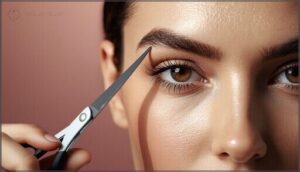
Even the most careful hands slip up sometimes, and eyebrow trimming has a few traps that are easy to fall into. Knowing what to watch for makes all the difference between clean, natural-looking brows and a fix-it appointment.
Here are the most common mistakes to avoid.
Avoiding Over-Tweezing and Under-Trimming
Over-tweezing is one of the most common — and most regrettable — mistakes in brow grooming. Unlike a bad haircut, damaged follicles from repeated aggressive tweezing may never fully recover, which makes frequency guidelines genuinely worth following. Aim to tweeze only four to six weeks, focusing on hairs clearly outside your natural brow line.
Over-tweezing can permanently damage follicles, so tweeze sparingly and only outside your natural brow line
Protect your follicle health by avoiding these habits:
- Tweezing without mapping your start, arch, and tail points first
- Pulling multiple hairs at once instead of removing them one by one
- Setting no time limit, which invites impulse plucking
- Skipping symmetry checks mid-session
- Neglecting post‑trim care like light moisturizing to soothe skin
Less truly is more. Honor your natural growth cycle — your future brows will thank you.
Preventing Uneven Eyebrow Shapes
Even seasoned hands slip into the ideal trap — and that’s usually when brows end up uneven.
Symmetry Mapping before you trim saves you from guessing: mark where each brow starts, arches, and ends using diagonal lines from your nostril. Then sketch light Brow Outlines as your guardrails before picking up precision eyebrow scissors or tweezers.
Use Consistent Snipping — small, alternating cuts between both eyebrows rather than finishing one side completely. This keeps Balanced Arch height from drifting.
Do Visual Checks by stepping back regularly; close‑up brow grooming distorts perspective fast. Your brows are sisters, not twins — chase harmony, not a mirror image.
Trimming in Natural Light for Accuracy
Catching every detail starts with the right light. Set up your eyebrow trimming station near a window, using Window Positioning to soak in mid-morning daylight.
This Daylight Color Temperature keeps your brow hair true to color—no surprise reds or grays. Shadow-Free Lighting lets you spot stray hairs and follow natural growth patterns, so you maintain your Natural Brow Shape.
For those cloudy days, use High CRI LED bulbs to mimic daylight. Golden Hour Timing, just after sunrise or before sunset, offers soft, flattering light if needed. Here’s what natural light delivers:
- Realistic brow and skin tones
- Clear view of stray and vellus hairs
- Balanced illumination for both brows
- Accurate comparison for Eyebrow Maintenance and Grooming Techniques
Using Regular Mirrors for Realistic Views
Your mirror choice can make or break a trim. Skip the magnifying mirror — it distorts every tiny hair and pulls your focus away from the full picture. A regular mirror gives you a Full-Face View that matches what others actually see.
- Maintain Mirror Distance of 12–18 inches for Side-by-Side Check accuracy
- Use Angle Consistency to catch uneven arches before they become a problem
- Pair with Natural Lighting Balance for true-to-life Eyebrow Maintenance results
Step back between snips. Your bathroom mirror is your best Grooming Techniques partner.
Frequently Asked Questions (FAQs)
How do I trim my eyebrows?
client prepping for a big event—she brushes brows up, snips stray tips with brow scissors, and uses tweezers for shape.
Pairing brow products and post‑trim skincare, she adapts trimming frequency to her hair growth cycle.
Should you trim your eyebrows outside your natural brow shape?
No — keep your trimming within the natural brow shape. Cutting outside it disrupts growth patterns, throws off facial balance, and risks over-trimming that can take months to recover.
How do you cut a brow?
Brush hairs up with a brow brush, rest a finger guard below the line,
then use precision eyebrow scissors on a steady surface — dry hair cutting only — and snip the tips.
How long does it take to trim eyebrow hair?
Beginner timing runs 15 to 30 minutes in your first session. With practice and the right precision eyebrow scissors, you’ll finish in under 10 minutes.
comfortable groove after just a few tries.
How to trim your eyebrows right?
Start at the front, snip one hair at a time with your spoolie guiding each strand upward.
Work toward the tail, stepping back often to check symmetry before your next cut.
Do you brush eyebrows up or down to trim them?
Always go upward first. Sweeping your spoolie up reveals which hairs break past your brow line, making growth direction analysis easy.
A quick downward pass afterward catches any strays you missed.
How do I trim my eyebrows right?
A spoolie does more than style—it reveals exactly which hairs need trimming.
Comb brows upward, snip strays at a scissor angle, check brow symmetry, then finish with a light aftercare moisturizer.
How to trim eyebrows after threading?
After threading, give your skin 24 to 48 hours before any brow trimming. That window lets redness ease and sensitivity settle — making your grooming session safer, cleaner, and far more precise.
Should you wait for a professional to trim your eyebrows?
Not always. If your brows are already shaped, a quick home trim works fine.
But sparse brows, uneven arches, or an upcoming event? That’s when a brow stylist definer is worth every penny.
How do you trim brow hair?
Brush your eyebrows upward with a spoolie, then snip protruding hairs using small scissors at a scissor angle.
Follow the hair growth direction, trim conservatively, and do a symmetry check before finishing.
Conclusion
Think of your brows as a frame—when it’s right, everything inside it looks better. Now that you know how to trim eyebrows with the right tools, proper prep, and a steady hand, sparse patches and lopsided arches don’t have to be your story anymore.
Work in natural light, brush before every snip, and resist the urge to over-correct. small, careful steps will always outlast the rushed results of a careless minute.



Jared James
March 22, 2020 at 02:28 PM
I think the scissors is the best option… gives you the control… ????
Raymond Miles
March 22, 2020 at 04:05 PM
I think so too ????